Kazakh–Dzungar Wars
| Kazakh–Dzungar Wars | |||||||
|---|---|---|---|---|---|---|---|
 Kazakhstan and Dzungaria in 1750 | |||||||
| |||||||
| Belligerents | |||||||
|
Supported by:  Khanate of Bukhara Khanate of Bukhara |
 Dzungar Khanate Dzungar KhanateSupported by:  Kalmyk Khanate Kalmyk Khanate | ||||||
| Commanders and leaders | |||||||
 Salqam Jangir Khan † Tauke Khan Abul Khair Khan Nauryzbai Batyr Qabanbai Batyr Ablai Khan (POW) Raiymbek Batyr Bogenbay Batyr Salqam Jangir Khan † Tauke Khan Abul Khair Khan Nauryzbai Batyr Qabanbai Batyr Ablai Khan (POW) Raiymbek Batyr Bogenbay BatyrSupported by: Yalangtoʻsh Bakhodir |
Erdeni Batur Galdan Boshugtu Khan Tsewang Rabtan Galdan Tseren Septen Lama Dorji Supported by: Ayuka Khan Galdamba Batur Galdamba Batur | ||||||
The Kazakh–Dzungar Wars were a series of military conflicts between the Kazakh jüzes (three tribal confederations of the Kazakh Khanate) and the Dzungar Khanate lasting from the 17th to the mid-18th century.
Background
In the 15th century, the Oirats—a Western Mongolian people who had recently established their own state—began expanding into the territory of present-day Kazakhstan. Seeking to control key trade routes and fertile agricultural oases in Jetisu, they launched repeated raids into Central Asia, particularly against the Uzbek Khanate, ruled by Abu'l-Khayr Khan. In 1457, Oirat forces under Uch-Temur Taishi decisively defeated Abu'l-Khayr Khan's army near the Uzbek capital of Sighnaq after a prolonged battle. Following the defeat, Abulkhair temporarily abandoned Turkistan and returned to the steppes of Desht-i-Kipchak, later reappearing in the Syr Darya region in 1460.[1]
During this period of political instability, two Chinggisid sultans of the Töre dynasty—Janibek Khan and Kerei Khan—disillusioned with Abulkhair's rule, led their followers eastward to Semirechye and settled in Moghulistan. There, they founded the Kazakh Khanate in 1465. Their followers, who broke away from the Uzbek Khanate, were initially referred to as "Uzbek Cossacks" (from the Turkic qazaq, meaning "free"),[2] later simply known as Kazakhs (qazaqtar).
In the 16th century, the first clashes occurred between the Oirats and Kazakhs in the 1530s.[3] The Oirats and Kazakhs fought with a Kazakh loss, failing to subjugate the Oirats.[3] Over time, Kazakh nomadic camps of the Middle and Little jüzes were routed. In pursuit, some Oirat troops crossed the Ishim, Irghiz, and Emba rivers and, skirting the Aral Sea from the north, ravaged the areas around the cities of Urgench and Khiva.[3]
According to the historical chronicle Badai al-Waqai (Persian: بدايعالوقايع, lit. 'Amazing Events'), written by the late-medieval Tajik historian Wasifi during the reign of Tayir Khan in the early 16th century, a fortress named Jatan (or Jashan—its exact location remains unverified by modern scholarship) was constructed to defend against Oirat incursions.
The Rise of Dzungars
In the mid-1630s, important changes began to take place. The Oirat tribes, who had been migrating across the vast expanses of Southern and Western Siberia, started to unite under the leadership of Khara-Khula-taishi from the Choros clan. This group among the Oirat tribes was called "Zün hār" (left wing, or more accurately, the left arm) — the Dzungars. In 1634, Khara-Khula-taishi died, and his energetic son Erdene-Batur (Khoto-Khotsin) took over the leadership of the union. In 1635, the Dalai Lama granted him the title Erdene-Batur-khuntaiji, but he became historically known simply as "Batur-khuntaiji." The year 1635 is considered the first year the new and powerful state of Mongol-speaking nomads, the Dzungar Khanate, appeared on the ethno-political map of Central Asia. "The last great nomadic empire in Central Asia," wrote Vasily Bartold.[4]
The internal fragmentation of the Kazakh Khanate in the late 16th and early 17th centuries weakened its position and contributed to the rise of a new regional power—the Dzungar Khanate, established in the early 17th century. The first phase of clashes between the Kazakhs and the Dzungars began in 1635, shortly after the formation of the Dzungar state.[5]
1635–1658
The ruler of the Dzungar Khanate, Erdeni Batur, launched major military campaigns into Kazakh territory. In 1635, during the war with the Kazakhs, he captured Sultan Jangir.[5][6] He soon launched a second Dzungar campaign into Kazakh lands in 1640. This time it was also successful for the Dzungar feudal lords,[7] capturing 16,000 Kazakh-Kyrgyz Tokmaks between the Issyk-Kul Lake and the Chu River.[8]
According to Tursun Sultanov, Jangir's humiliating captivity made him an irreconcilable enemy of the Dzungars, and he devoted the rest of his life to fighting them. In this struggle, Jangir demonstrated personal bravery and military talent, and his name became famous. For his bravery and military successes, people nicknamed him “Salqam Jangir Khan”.
In 1643, an army led by Erdeni Batur invaded Jetisu. The Battle of Orbulaq took place in the Orbulaq River gorge on the Ili River. A detachment of 600 Kazakh warriors led by Jangir Khan held back a 25,000 to 50,000 Dzungar army in a narrow mountain pass for some time. After the Dzungars reached the plain,[9] they engaged a 20,000-strong relief army brought by the Emir of Samarkand, Yalangto'sh Bakhodir. The Dzungar army was stopped, and Erdeni Batur turned back to Dzungaria.[9] This failure led Erdeni to punish those who had not joined the campaign, causing internal unrest in the Dzungar Khanate. He also attempted to organize a joint campaign with the Volga Kalmyks against the Kazakhs, but failed.[10]
In 1645–1646, Erdeni Batur launched a new campaign against the Kazakhs, inflicting heavy casualties and devastation on the Kazakh Khanate. Russian ambassador D. Arshinsky reported that before his arrival at the Dzungar headquarters in May 1646:
“Kontaysha waged war on the Cossack horde of Yangir Tsarevich and killed many people, and took Yangir's brother, his wife, children, and many people captive.”
Jangir Khan fought the Dzungars with varying success and fought three major battles with Dzungar troops in 1635, 1643, and 1652, but he was killed in the last battle. According to the Oirat chronicle “Moonlight: The History of Rabjam Zaya-Pandita”, he was killed by the 17-year-old Khoshut tayiji Galdamba, which is also supported by Altangerel's biography of Galdamba.[11] He later defeated a Bukharan relief force on the Chu and Talas River, killing Abushukher Noyan in 1658.[12] The border was consolidated from the Ayagöz River to the Talas River.[13]
1670–1686
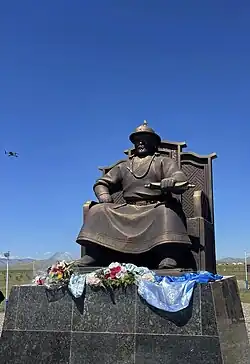
After the death of Erdeni Batur, a succession war began in the Dzungar Khanate, which Sengge won. Sengge made friendly relations with the Kazakhs.[14] However, after Sengge was killed in a coup by Zotov Batur and Chechen tayiji, Tauke Khan led an 80,000-strong army against the Dzungar Khanate. He gained fame as a military expert and a brave man in battle, and for this he was awarded the honorary title of “batyr” (“hero; brave man”) by his subjects.[15] He took Jetisu while taking advantage of the succession war.[16]
Meanwhile, Galdan won the war and succeeded Sengge. He defeated the Khoshut Khan, Ochirtu.[17] He also invaded the Yarkent Khanate.[18] Galdan later invaded Jetisu and Southern Kazakhstan. He attempted to besiege Sayram in 1681 and 1683 but failed.[19] In 1684, Sayram was captured and this contributed to its economic decline.[20] Galdan's troops soon captured a number of cities, including Menkent, Kharasman, Tashkent, and others. The main exception was Turkistan, which remained under Tauke's control. Tashkent voluntarily recognized Galdan's authority and was captured in 1684.[21] The Dzungars also captured one of Tauke's sons and took him to Lhasa, confirming Galdan's serious intentions to impose Lamaism on the Kazakhs.[22]
The Dzungars later abandoned most of the cities they had captured, except for Jetisu, which they recaptured.[23] Galdan then invaded Outer Mongolia in 1687.[24] This contributed to the First Dzungar–Qing War. Galdan was defeated and died in 1697. His death marked a new stage in relations between the Dzungars and the Kazakhs.[24]
1698–1703
At the beginning of the 18th century, a struggle broke out between Kazakh associations and the troops of the Dzungar khan, Tsewang Rabtan, for control over the oases and trade and craft centers of southern Kazakhstan.[25] In 1698, a 40,000-strong Dzungar army defeated the Kazakh uluses of the Senior jüz, who roamed the Chu and Talas rivers. Several thousand people were killed and 10,000 prisoners were taken.[26][27]
In a letter to the Kangxi Emperor, Tsewang Rabtan justified his wars against the Kazakhs. He claimed that (1) Tauke demanded the return of his son, captured earlier by Galdan's troops; Tsewang Rabtan agreed and sent him home with a guard of 500 soldiers, but Tauke killed the guards and seized Uerhude Batur-Tayiji and more than 100 Uriankhai people with their families; (2) the Kazakhs attacked the caravan of the daughter of Ayuka Khan, who had been married to the Dzungar khan; and (3) returning merchants of Tsewang Rabtan were raided and sacked by Kazakh bandits.[26]
In 1702, the Kazakhs retaliated for the attack of 1698 and also attacked the Kalmyks and Dzungars, but the campaign failed. In 1703, Tauke Khan and Kaip Khan sent an ambassador to negotiate a ceasefire. It is unknown whether an agreement was reached, but in the following years there were no major clashes.[28][29]
1708–1718
In 1708, a small Dzungar force invaded the territory of the Senior jüz, and the Kazakhs withdrew toward Tashkent. The advance units of the Dzungar troops reached the Sarysu River in Central Kazakhstan. This led to the first kurultai[b] in the summer of 1710 in the Karakum. The kurultai decided to appoint Bogenbay Batyr to lead a Kazakh militia.[30][31] Bogenbay defeated the Dzungars in a series of battles in 1711–1712.[31][32]
During 1713–1714, the Dzungars suffered major defeats at the hands of the Kazakhs.[31] The Qing diplomat Bao Zhu, who was in the Dzungar Khanate in 1716, reported to the Kangxi Emperor:[31][25]
"... In the third year, the Khazaks [Kazakhs], making raids, completely ruined many border settlements, killed many people, and took women and children captive... Last year, Duler, the prince of Zaysan, who was opposed to them with three thousand men, suffered defeat and returned with great losses."
In 1714, the Kazakhs under Abul Khair invaded the border of the Dzungar Khanate. In response, Tsewang Rabtan launched operations through the territories of the Kyrgyz on the Tian Shan,[25] and sent Galdan Tseren to Lake Zaysan and Lobsangsür[c] to Shara-Us, repelling invasions and recapturing lost territories.[33]
In 1715, the Qing emperor appealed to Kyrgyz and Kazakh leaders with a proposal to "punish" the Dzungar khan. The Kyrgyz and Kazakhs became active in Eastern Turkestan, but the Dzungars withstood these clashes.[34] After capturing Hami by 1715,[35] Tsewang Rabtan sent troops to the Kazakh steppes in 1716. The Dzungar army under Tseren-Dondook defeated the Kazakh militia and captured many prisoners.[36] In the same year, Kazakh militias attacked the Choros on the Ili River and captured Lieutenant Markel Trubnikov.[37]
The Kazakh militia then launched another campaign against the Dzungars, but it failed. Because of disagreements between Kaip Khan and Abul Khair Khan, the Kazakhs suffered losses and retreated. At this time, Kazakh leaders began negotiations with the Siberian governor M. P. Gagarin on joint action against the Dzungars. However, while the Siberian administration encouraged resistance, it avoided a full Kazakh–Russian military alliance.[31][38]

In 1717, Kaip and Abul Khair attempted to conclude an anti-Dzungar alliance with Peter I, partly influenced by letters from Gagarin warning about Dzungar expansion. The Russian government did not support a joint campaign against the Dzungar Khanate, viewing it as a counterweight to the growing power of the Qing dynasty and preferring the possibility of peaceful annexation. As a result, St. Petersburg limited itself to general encouragement and made no concrete promises of military aid.[39]
In the same year, Dzungar troops defeated a Kazakh militia of 30,000 men[38] at the Battle of the Ayagoz River. The Dzungars built wooden trenches and fortifications to hold their position until reinforcements arrived.[40] A reinforcement of about 1,500 men then arrived and defeated the Kazakh army.[38] In the spring of 1718, the Dzungars made a swift march from Jetisu to the Arys and Chayan rivers, seeking to capture Turkistan, the headquarters of the Kazakh khans. Several battles took place, with the Dzungars reportedly "cutting down the Kazakh horde".[15]
After the Second Dzungar–Qing War began, the Dzungar offensive ended. This allowed the Kazakhs to recover territory and capture about 3,000 Dzungar prisoners. The Russian ambassador to the Dzungar Khanate, I. D. Cheredov, reported that in 1720, "the Cossack horde approached and captured about three thousand people, whom they took with them."[41]
1723–1730
In 1723, the Dzungar Khanate invaded the Kazakh Khanate after the Kazakhs suffered a harsh winter. Many Kazakhs were preparing to migrate to summer pastures and were busy with seasonal economic work, including the castration of young animals. The Dzungar troops attacked suddenly, and the rulers of the Junior and Middle jüzes did not expect the threat. Tsewang Rabtan sent more than 30,000 troops under the command of his son Lobsangsür, defeating the Kazakhs at Sayram, Tashkent, and Khara-Murut.[42] Other forces campaigned in the Talas and Arys valleys. Many people were killed or captured, and nomadic settlements and towns were attacked. In the same year, the Dzungars captured Turkistan and took the family of Abul Khair prisoner.[43] They also captured Khujand, Samarkand, and Andijan, occupying the Fergana Valley.[41] These years became known in Kazakh history as the "Barefooted Flight" (Ақтабан Шұбырынды, Алқакөл сұлама).[44] It is often compared to the Mongol invasion of the 13th century: many Kazakh clans fled southern Kazakhstan, with the Senior Jüz and part of the Middle Jüz retreating toward Tashkent, Khujand, the Kara-tegin and Fergana regions, and as far as the Pamirs; most of the Middle Jüz went to Samarkand; and the Junior Jüz fled toward Khiva and Bukhara.[45]
In late winter 1724, the Dzungars launched a second attack along the Chu River, striking the wintering quarters of the Senior Jüz. The Argyns and Jalairs were driven out of the Chu Valley, and trading centers on the northern Karatau were captured, plundered, and destroyed, including the city of Sozak. Some Kazakhs fled to the Betpak-Dala desert and the Balkhash steppe, while others retreated to the Karatau Mountains and used mountain gorges as fortresses. The first two attacks did not affect the Junior Jüz.[46]
In 1724, Abul Khair Khan returned from the Northern Campaigns and captured Turkistan. However, in 1725, Dzungar forces led by Lobsangsür recaptured the city after a series of battles.[47]
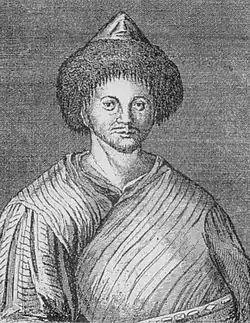
In 1726, representatives of the Kazakh jüzes met in Ordabasy near Turkistan and decided to organize another militia, agreeing to appoint Abul Khair, khan of the Junior Jüz, as commander.[48] After the meeting, forces led by Abul Khair Khan and Bogenbay Batyr fought the Dzungars at the Battle of Bulanty near Ulytau in the Karasyir area. This was the first major Kazakh victory in many years and had strong moral and strategic impact. The terrain was later called "Kalma қırılғan" – "a place where the Kalmaks were exterminated".[49]
In 1727, Tsewang Rabtan died, causing a succession struggle between Galdan Tseren and Lobsangsür. Galdan Tseren won and killed Lobsangsür.[50] This gave the Kazakhs an opportunity to consolidate their forces. On 6 November 1728, the khan of the Middle Jüz, Semeke, sent an embassy to the Volga Kalmyks for peace talks to secure his western rear and allow the Kazakhs to focus against the Dzungar Khanate.[51]
Another kurultai took place in 1728, again agreeing to appoint Abul Khair as commander of a united Kazakh militia.[52] The last major battle between the Kazakh militia and the Dzungar army took place about 120 km from Lake Balkhash in the Anrakai area.[d][54][52][55] Moiseev dates the Battle of Anrakai to 1729,[54] while Kadyrbaev suggests 1729 or spring 1730.[52] Kazakh cavalry repeatedly charged at enemy forces led by Abilmambet, Barak, Abylai, and others.[53]
In 1729, Galdan Tseren requested the Russian Empire to form a coalition against the Kazakhs. He asked the Russian envoy M. Etigerov:[56]
"Are they not attacking the Cossacks [Kazakhs] on your side?"
The Siberian administration rejected this proposed alliance.[56] Soon after the Battle of Anrakai, a civil conflict began among Abulmambet, Sameke, and Abul Khair over the question of a supreme khan. This led the forces of the Junior and Middle jüzes to leave the theater of military operations.[57][58]
1731–1735
In the summer of 1730, Kazakh forces captured about a thousand Dörbet yurts with their livestock. In autumn 1731, a deep Kazakh raid into Dzungaria captured "many people, women and children, and yurts with a thousand or more head of cattle and belongings".[59] Kazakh forces also raided the Altai Mountains, and 10,000 Dzungar troops were sent to guard nearby border areas.[60]
In winter 1731, Kazakh raiders attacked a Dzungar trade caravan and captured a Russian convoy and Uyghur merchants. Because the raiders were aware of Russo–Dzungar relations, they released the Russian convoy but kept the Uyghur merchants. Prisoner issues were later resolved in a relatively humane manner.[59]
In 1731, some rulers of the Junior and Middle jüzes accepted Russian protectorate. Russian authorities sought to use the Kazakhs to help protect Siberia from possible Dzungar invasions and to gain an ally.[61] In response to planned Kazakh offensives, a 7,000-strong Dzungar force attacked the Middle Jüz in summer 1732 but was repelled.[62] In the same year, 700 Dzungar families were captured.[60] The invasion was significant enough to prevent a traditional meeting of Middle Jüz nobility that year.[63] However, the campaign against the Senior Jüz succeeded and Dzungar forces captured Tashkent, Sayram, and Turkistan.[64]
In May 1733, a Dzungar tayiji named Tsagan arrived in Semipalatinsk with a formal request for Russian troops to jointly "destroy the Cossack (Kazakh) horde." Russian commanders refused, stating they could not provide assistance without higher orders, especially without open conflict with the Kazakhs.[65]
Because of the war with the Qing dynasty, the Dzungars withdrew forces from southern Kazakhstan. In 1734, I. K. Kirilov and A. I. Tevkelev reported to the Collegium of Foreign Affairs that the khan of the Senior Jüz:
"had taken possession of the former cities of Tashkent and others, which had previously been conquered by the former Dzungar ruler, the khongtaiji, but which his son Galdan Tseren had abandoned because of the war with China… and now they hold them peacefully, and the Dzungar Kalmyks have sent envoys to them seeking to live in peace."
Other sources indicate that the Senior Jüz remained independent. In one conversation with A. I. Tevkelev, the elder of the Junior Jüz, Bukenbay, stated that:
"they, the Kirghiz-Kaisaks [Kazakhs], formerly possessed cities, namely Tashkent, Turkestan, and Sairam, together with their dependent towns and villages, and these were held by the Kirghiz-Kaisak khans and elders. In those cities lived the Sarts, that is, townspeople, from whom they collected tribute. The Khong Tayiji expelled them from those cities fifteen years ago [apparently five years ago], and now no one controls them and no tribute is collected; they live without administration…"
Nevertheless, around 1735 the Dzungars again invaded the Senior Jüz. Kazakh leaders were compelled to recognize Dzungar rule. Moiseev notes that Levshin linked Galdan Tseren's capture of the Senior Jüz and the cities of Prisyrind to blocking incorporation into Russia,[68] while Moiseev emphasizes border security and revenue as motives.[60] Bogenbay Batyr also sent information to Russian authorities, stating (based on prisoner reports) that Galdan Tseren planned to send up to 20,000 troops against the Middle Jüz.[69]
1739–1741
During the reign of Tsewang Rabtan in Dzungaria in 1710–1719, and 1723–1732, several major invasions were launched into Central Asia and modern-day Kazakhstan. Despite initial successes, Tsewang Rabtan was unable to subjugate any of the Kazakh tribes. In 1727–1730, the Kazakhs defeated the Oirat armies of Galdan Tseren. However, internal political strife prevented the Kazakhs from using these victories to regain their lost nomadic lands in Semirechye and modern-day Eastern Kazakhstan.[61]
After concluding peace with the Qing Empire, Galdan Tseren established his rule over the Senior Horde in 1735. The feudal lords of the Senior Jüz were forced to send hostages to Urga every year, and the population had to pay a tax of one steppe fox skin per family per year. Simultaneously with the invasion of the territory of the Senior Jüz and Central Asia, the Oirat feudal lords invaded the border nomadic lands of the Middle Jüz. This is evidenced, in particular, by the testimony of soldier Ivan Khoroshkov. The Oirats told him that they had gone on a campaign against the Middle Jüz, "and defeated several Cossack uluses and took a hundred men captive from the Cossack horde, and drove away ten thousand horses and a hundred camels... There were no Cossack Hordes fortresses near the Irtysh, and those that were there were all destroyed, while the rest scattered."[68]
After the annexation of Khalkha, Tibet, and Kukunor, it became clear to the Dzungarian feudal lords that they lacked the strength not only to unite the Mongol world but also to successfully resist the Qing Empire in Central Asia. For this reason, in the late 1730s, their military-political activity turned westward.[70] In the second half of the 1730s, the Oirat leadership was preparing a large-scale campaign into Kazakhstan with the aim of subjugating the Middle Juz. The Middle Juz of the Kazakhs was the most numerous and powerful. Preparation for the large-scale invasion of its territory had been underway for several years. However, as long as peace had not been concluded with the Qing Empire, Galdan Tseren did not risk starting military actions. According to reports to the Orenburg authorities, the invasion of Kazakhstan was scheduled for the spring of 1738. However, due to the winter and unfinished negotiations, these plans were disrupted.[71][60] Some of the rulers of the Junior and Middle Jüz during the struggle with the Dzungar Khanate accepted Russian protectorate. According to historian Moiseev, this was done to secure their possessions from Russia. The Russian government, in turn, sought to use the Kazakhs to protect Siberia from possible invasions by the Oirats and to gain an ally in the Kazakh militias.[61]
Seeking to conceal the expansionist nature of his policy in Kazakhstan, Galdan Tseren instructed the envoys sent in 1740 to present military actions against the Kazakhs as a form of “just retribution” for their raids. The envoys Lama-Dorji and Nauruz-bai met with the Siberian governor Pyotr Ivanovich Buturlin on 8 January 1741 and explained that “one third of the Kazakh Horde” was under the authority of Galdan Tseren and loyal to him. However, the remaining “two thirds” were independent and, “by their natural custom, engaged in theft.” According to the envoys, the cause of the conflict was blood revenge, since the Kazakhs had killed a relative of Galdan Tseren and had also repeatedly attacked his subjects, killing them and driving off livestock.[70]
In the second half of the 1730s, Galdan Tseren was preparing a major campaign aimed at subjugating the Middle Juz, which at that time was coming under increasing Russian influence.[72][69] Accordingly, in 1737–1738, the College of Foreign Affairs and the Military Collegium received reports that the Oirat command was withdrawing troops from Khalkha and Eastern Turkestan and concentrating them near the borders of the Middle Juz along the Irtysh defensive line. In 1738, the Siberian governor Pyotr Ivanovich Buturlin reported that an eight-thousand-strong Dzungar detachment had appeared in the Altai Mountains in the area of the Kan River. Earlier, in the spring of 1735, Bogenbay Batyr conveyed to the Russian authorities information obtained from prisoners stating that, after concluding peace with the Qing Empire, Galdan Tseren intended to send a force of up to 20,000 troops against the Middle Juz.[69]
Despite the fact that Galdan Tseren's plans to attack the Middle Juz were known to the Kazakhs, the batyrs of the Middle Juz,[e] with a force of two thousand men, joined in 1738 the campaign of the Younger Juz against the Volga Kalmyks.[69]
In the spring of 1739, 24,000 Oirat cavalrymen attacked the lands of the Middle Juz in two strike columns[f]
The Kazakhs were unable to repel the Dzungar invasion, as they were engaged in preparations for raids against the Kalmyk Khanate and the Bashkirs.[72] Mobilization measures in the Middle Juz began only after the Dzungar attack. The Senior Juz, which was in political dependence on Dzungaria, remained neutral. The Younger Juz also maintained neutrality. According to Moiseev, the khan of the Younger Juz, Abulkhair, was absorbed by the Khivan question, attempting to seize the throne of the Khiva Khanate.[73]
The disunity of the Kazakh juzes gave Galdan Tseren reason to believe that they would be unable to offer serious resistance to his armies[73][g]
Fearing a new invasion, in September 1740 the Russian government instructed the Orenburg Commission to strengthen precautionary measures, and Sultan Barak and other rulers to supply the troops with gunpowder and other necessary provisions (with the exception of artillery and firearms). However, already in the autumn of the same year, Dzungar detachments resumed attacks on Kazakh auls.[74]
At the end of 1739 and in the first half of 1740, the Dzungars undertook another offensive against the Kazakhs.[74] The leaders of the Kazakh militia carried out preparations in advance and offered determined resistance, with Kazakh forces delivering a number of pre-emptive strikes against the Dzungars.[75] Despite some initial setbacks, the Dzungar troops encountered organized resistance from Kazakh warriors and militiamen. According to the testimony of Abyz Baibulatov, “two thousand Kazakhs under the leadership of Abdulmamet advanced against the Kalmyks of Galdan Tseren.” Fighting with varying success continued until the winter of 1741. Oirat commanders attempted to cut off the Kazakhs’ routes to Russian fortresses and to the Baraba Steppe. In a conversation with Lieutenant Proskuryakov, the Dzungar commander-in-chief openly stated his intention “to send two thousand Kalmyks to Baraba to search for the enemies of the Kazakh Horde.” A representative of Septeni who arrived at the Yamyshevsk Fortress confirmed that a movement was planned “down the Irtysh toward the Yamyshev side and on to the Om in order to eradicate the Kazakh Horde”.[76]
In 1740, an Oirat embassy arrived in Russia, formally sent to congratulate Empress Anna Ioannovna. However, scholars note that its primary purpose was to ascertain St Petersburg's position regarding the impending war against the Kazakhs. The envoys inquired about the size and locations of the nomadic camps of Kazakh clans and sought to secure a ban on their crossing beyond the line of Russian fortresses. During the negotiations, Pyotr Buturlin assured the Dzungar representatives that Russian garrisons had received orders to strengthen security and to prevent Kazakhs from crossing the fortified line. Encouraged by these assurances, the Oirat envoys openly declared to the Siberian governor their intention to begin attacks on Kazakh uluses from 15 February 1741. In response to Russian concerns over the presence of Dzungar troops near the border and their crossing to the left bank of the Irtysh, the envoys stated that this had been forced by the actions of the Dzungar command, since the Kazakhs had burned the grass in areas designated for the deployment of troops.[77]
The regional situation in the early 1740s developed in favor of the Dzungar Khanate. The Russian administration in Siberia, in effect, did not obstruct Galdan Tseren's actions against the Middle Juz, while the Qing court at that time took no steps against Dzungaria. Contradictions among Kazakh rulers persisted, and the elite of the Younger Juz as well as some sultans of the Middle Juz continued clashes with the Volga Kalmyks. In a report of the Orenburg Commission dated 26 August 1741 to the College of Foreign Affairs, it was stated that these skirmishes occurred “apparently not only in order to avenge their grievances, but also to compensate for the devastation inflicted upon them by the Dzungars.” Large Kazakh forces under the leadership of Abilmambet Khan, Kuchuk, Sultan Barak, and the batyrs Imet, Zhanibek, and others took part in these engagements.[78]
The pretext for a new Oirat campaign was provided by attacks on Dzungaria carried out by Sultan Barak and Karasakal. The latter, having fled from Bashkiria and having passed himself off as Shono-Louzan, the son of Tsewang Rabdan who had died in Kalmykia, sought to secure the support of Kazakh rulers in order to restore his claims to the throne. One source noted: “The Kirghiz, being the age-old enemies of the Dzungars, readily gathered around the renowned leader, who, in the event of success, could become a good neighbor and a friend to the Kirghiz [Kazakh]”.[78]
In late February 1741, a thirty-thousand-strong Oirat army under the command of Septeni and Galdan Tseren's eldest son, Lama-Dorji, invaded the nomadic lands of the Middle Juz. The offensive was conducted along three axes: along the Ishim River, from Tashkent, and from Turkestan. Khan Abilmambet retreated toward Orenburg; however, his ulus was attacked, and he was left with only about thirty kibitkas. In March, Khan Abulkhair reported to V. A. Urusov that “the Dzungars have surrounded us on all sides” and requested the construction of a fortress in his nomadic lands. His envoys, Kutyr-batyr and Baibek, also petitioned for the establishment of a fortification on the Syr Darya. Many Kazakh encampments were completely destroyed, and livestock and people were driven off to Dzungaria.[79] According to a report by the Oirat envoy Galzat, Septeni's army returned with three thousand captives, among whom was Sultan Ablai with two hundred warriors. Other sultans and batyrs were also taken captive[80][h]
Despite these successes, the Dzungars failed to achieve their main goal—to defeat the main forces of the Middle Jüz and destroy its population. The bulk of the Kazakh uluses migrated beyond the Tobol River, after which their enemies sent a guide from among the prisoners to follow them. He deliberately led them through frost and snow, causing many to freeze to death. The enraged Dzungars burned him and, abandoning their further advance, returned. And to indicate the other such Cossack hordes, the captive comrade led them, the Kalmyks of the Cossack horde, and he deliberately led them astray and caused great snow and frost, because he was a heretic, and because of that, the Kalmyks barely escaped, and several died from the cold, and so they, the Kalmyks burned that heretic thief and went back to attack the Cossack dwellings, which were apparently very crowded, but because of the above-mentioned loss of their people from the frost, they did not dare to attack them and so they returned.".[82] About 15,000 soldiers returned with Septem, while the other detachments continued to operate separately, "behind rocks and close to Kirghiz (Kazakh) dwellings.".[83]
Attempts by the Dzungar command to strike from the south also ended in failure. According to a Yenisei Kyrgyz who escaped from captivity, "the Cossack horde fought against the Kalmyk forces last winter... and the Cossack horde defeated the Kalmyk forces and killed many of them on the right wing." The batyr Olzhabay distinguished himself in these battles, and folk legends and songs refer to him as the victor over Galdan Tseren.[84][85] Kazakh troops also made several incursions into the territory of the Dzungar Khanate, defeating the right wing of the Dzungar army and crushing the ulus of Septenya.[82]
Aftermath
After the death of Galdan Tseren in 1745, a civil war began. Amursana sought Qing support, contributing to the collapse of the Dzungar Khanate. Ablai did not intervene and sheltered Amursana and Dawachi from attacks led by Lama Dorji. However, after Amursana and Dawachi broke their alliance, Ablai took the opportunity to seize herds and territory from the Dzungars, in coordination with the Qing in the east, hoping to benefits from something in relations with the Qing Chinese. However, relationship between the Kazakh Khanate and the Chinese deteriorated rapidly after the Chinese Emperor, Qianlong, sought to vassalise (or incorporate) the Kazakh Khanate into the Manchu-Chinese realm, and demanded the extradition of Amursana back to Beijing, which Ablai Khan opposed out of sympathy for the Dzungar Khong Tayiji, which ultimately resulted in war; because of the Kazakh–Qing War, it had managed to unite both the Kazakhs and Dzungars under one banner for the first, and only time, against a common enemy.[86]
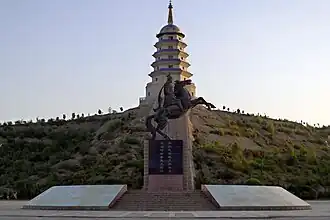
In 1771, the Volga Kalmyks under Ubashi Khan led a mass migration toward former Dzungar lands, aiming to revive their state. Estimates in the literature commonly give roughly 140,000–170,000 people, or about three-quarters of the Volga Kalmyk population.[87] A large part of those who remained behind were Dörbets who opposed the migration.[88] By mid-1771, the migrants had reached the Lake Balkhash region, suffering heavy losses from harsh conditions, hunger, disease, and attacks.[87] They later entered Qing territory and were accepted as Qing subjects.[89]
Popular culture
- Nomad, a 2005 Kazakh historical epic film that fictionalizes Abylai Khan's youth.
- Myn Bala, a 2011 Kazakh historical drama film set in 1729 during war between the Kazakhs and the Dzungars.
See also
- Dzungar Khanate
- Kazakh Khanate
- Kalmyk Khanate
- Dzungar–Qing Wars
- First Kazakh-Qing War
- Second Kazakh-Qing War
- Battle of Shiderty
- Xinjiang under Qing rule
- Qing dynasty in Inner Asia
Notes
- ^ After the death of Tauke Khan (1715/1718), the Kazakh Khanate lost its former unity, and the hordes (juzes) became independent khanates. The last khan of the Kazakhs whose authority was recognized throughout the Kazakh steppe was Abylai Khan, proclaimed khan of all Kazakhs in 1771.
- ^ A kurultai was an assembly of nomadic leaders.
- ^ Also known as Lobsangshono.
- ^ According to a comparative analysis of Kazakh folk toponymy and historical legends by Mukhamedzhan Tynyshpaev, the main directions of Kazakh attacks were: Senior Jüz forces crossing the Keles–Badam range west of Mount Kazykurt; Middle Jüz forces advancing north of that area; and Junior Jüz forces advancing along the western slope of the Karatau Mountains.[53]
- ^ Bogenbay, Eset, Altai
- ^ As reported by Bashkirs who had escaped from Kazakh captivity, Khan Galdan Tseren “assembled a great army … numbering 24,000 men and, dividing it into two parts, cut down five volosts of the Kirghiz-Kaisaks: Kanzhygaly, Karagul, Yatamanlimai, Uvatsk, and Kerensk, and drove off 50,000 sheep.” The Dzungar forces were commanded by the khan’s uncle Tseren-Dondob, while separate detachments under the leadership of the noyon Septeni, stationed near the southern section of the Irtysh defensive line, carried out predatory raids on the nomadic camps of the Middle Juz.([73])
- ^ According to N. Ya. Bichurin, “after concluding peace with the Central State, Galdan Tseren decided to punish the Kirghiz-Kazakhs, who, taking advantage of his previously difficult situation in the east, had carried out raids on the western frontiers of Dzungaria”.([73])
- ^ Barak and Durgun, as well as the batyrs Atykmash and Kobutygan.([81])
References
- ^ Bregel 2003, p. 44.
- ^ Dughlat 1969, p. fols. 37a, 386.
- ^ a b c Remileva 2005, p. 74.
- ^ Atygaev 2025, p. 347.
- ^ a b Chimitdorzhiev 1979, p. 32.
- ^ Moiseev 1991, p. 43.
- ^ Moiseev 1991, p. 44.
- ^ Burton 1997, pp. 219–220.
- ^ a b Burton 1997, p. 220.
- ^ Moiseev 1991, p. 45.
- ^ Altangerel n.d., p. 107.
- ^ Pozdneev 1880, p. 148.
- ^ Atygaev 2023, p. 138.
- ^ Atygaev 2023, pp. 138–139.
- ^ a b Kadyrbaev 2023, p. 9.
- ^ Atygaev 2023, pp. 139–140.
- ^ Adle 2003, p. 148.
- ^ Adle 2003, pp. 149, 193.
- ^ Burton 1997, p. 337.
- ^ Moiseev 1991, p. 51.
- ^ Adle 2003, p. 147.
- ^ Moiseev 1991, pp. 51–52.
- ^ Moiseev 1991, p. 24.
- ^ a b Moiseev 1991, p. 53.
- ^ a b c Erofeeva 2007, p. 149.
- ^ a b Kushkumbaev 2001, p. 124.
- ^ Moiseev 1991, p. 62.
- ^ Moiseev 1991, pp. 64–65.
- ^ Kushkumbaev 2001, p. 125.
- ^ Moiseev 1991, p. 66.
- ^ a b c d e Suleimenov & Moiseev 1988, p. 20.
- ^ Kushkumbaev 2001, pp. 135–136.
- ^ Altangerel n.d., p. 641.
- ^ Kuznetsov 1983, pp. 18, 128.
- ^ Barthold 1962, p. 162.
- ^ Kushkumbaev 2001, p. 126.
- ^ Moiseev 1991, p. 70.
- ^ a b c Kushkumbaev 2001, p. 127.
- ^ Erofeeva 2007, p. 155.
- ^ Haines 2017.
- ^ a b Suleimenov & Moiseev 1988, p. 21.
- ^ Moiseev 1991, p. 72.
- ^ Jambyl 2019, p. 18.
- ^ Moiseev 1991, p. 74.
- ^ Erofeeva 2007, p. 164.
- ^ Tompiev & Uali 2015, p. 210.
- ^ Erofeeva 2007, p. 176.
- ^ Unknown 2006, pp. 221–222.
- ^ Adle 2003, p. 100; Jambyl 2019, p. 50.
- ^ Adle 2003, pp. 150–151.
- ^ Kadyrbaev 2023, pp. 11–12.
- ^ a b c Kadyrbaev 2023, p. 12.
- ^ a b Erofeeva 2007, p. 190.
- ^ a b Moiseev 1991, p. 80.
- ^ Erofeeva 2007, p. 197.
- ^ a b Moiseev 1991, p. 145.
- ^ Kushkumbaev 2001, p. 132.
- ^ Kadyrbaev 2023, pp. 12–13.
- ^ a b Moiseev 1991, pp. 103–104.
- ^ a b c d Kushkumbaev 2001, p. 133.
- ^ a b c Moiseev 1991, p. 111.
- ^ Kadyrbaev 2023, p. 134.
- ^ Apollova 1960, p. 89.
- ^ Vostlit n.d.
- ^ Moiseev 1991, p. 105.
- ^ Moiseev 1991, p. 107.
- ^ Moiseev 1991, p. 106.
- ^ a b Moiseev 1991, pp. 107–108.
- ^ a b c d Moiseev 1991, p. 113.
- ^ a b Moiseev 1991, p. 112.
- ^ Moiseev 1991, p. 110.
- ^ a b Kadyrbaev 2023, p. 13.
- ^ a b c d Moiseev 1991, p. 114.
- ^ a b Moiseev 1991, p. 115.
- ^ Suleimenov & Moiseev 1988, p. 34.
- ^ Moiseev 1991, p. 116.
- ^ Moiseev 1991, p. 117.
- ^ a b Moiseev 1991, p. 118.
- ^ Kushkumbaev 2001, p. 135.
- ^ Moiseev 1991, p. 119.
- ^ Moiseev 1991, p. 199.
- ^ a b Suleimenov & Moiseev 1988, p. 35.
- ^ Moiseev 1991, pp. 119–120.
- ^ Moiseev 1991, pp. 120–121.
- ^ Kushkumbaev 2001, p. 136.
- ^ "Казахско-китайские войны 18-го века: причины и последствия". Central Asia Monitor. Retrieved 2026-02-13.
- ^ a b Polessu n.d.
- ^ Halmgynn 2021.
- ^ Besprozvannykh 2003.
Sources
- Adle, Chahryar (2003). History of Civilizations of Central Asia (5th ed.). UNESCO. ISBN 978-8120820463.
{{cite book}}: CS1 maint: ref duplicates default (link) - Altangerel, Chulunbatyn. Дэлхийн талыг эзгэн үе эрхшээсэн түүхт Монголын зэвсэг, дайн, хил хамгаалалтын толь [A look at the weapons, warfare, and border defenses of the historical Mongols, who conquered half the world] (in Mongolian). Chulunbatyn Altangerel. pp. 107, 641.
- Apollova, N. G. (1960). The Economic and Political Relations of Kazakhstan with Russia. Academy of Sciences. p. 89.
{{cite book}}: CS1 maint: ref duplicates default (link) - Atygaev, Nurlan (2023). КАЗАХСКОЕ ХАНСТВО: ОЧЕРКИ ВНЕШНЕПОЛИТИЧЕСКОЙ ИСТОРИИ XV-XVII BEKOВ [Essays on the Foreign Policy History of the 15th–17th Centuries] (in Russian). Almaty: Eurasian Research Institute. ISBN 978-601-7805-24-1.
{{cite book}}: CS1 maint: ref duplicates default (link) - Barthold, V. V. (1962). Four Studies on the History of Central Asia. Vol. 1. Brill. p. 162. ISBN 978-90-04-00149-7.
{{cite book}}: ISBN / Date incompatibility (help)CS1 maint: ref duplicates default (link) - Besprozvannykh, E. L. (2003). "Китайские документы о принятии волжских калмыков в цинское подданство" [Chinese documents on the acceptance of the Volga Kalmyks into Qing subjecthood]. Вестник Калмыцкого университета (in Russian).
{{cite journal}}: CS1 maint: ref duplicates default (link) - Bregel, Yuri (2003). Historical Atlas of Central Asia. Leiden; Boston: Brill. p. 44. ISBN 978-90-04-12321-2.
{{cite book}}: CS1 maint: ref duplicates default (link) - Burton, Audrey (1997). The Bukharans: A Dynastic, Diplomatic and Commercial History 1550–1702. London: Curzon Press. pp. 219–220, 337. ISBN 978-0-7007-0417-0.
{{cite book}}: CS1 maint: ref duplicates default (link) - Chimitdorzhiev, Shirap (1979). Relations between Mongolia and Central Asia in the 17th and 18th centuries (in Russian). Science. Editorial office of Eastern Literature (publishing house). p. 32.
{{cite book}}: CS1 maint: ref duplicates default (link) - Dughlat, Muhammad Haidar Mirza (1969). Tarikh-i Rashidi (Manuscript) (in Russian). Tashkent: Institute of Oriental Studies, Academy of Sciences of the Uzbek SSR. pp. fols. 37a, 386.
{{cite book}}: CS1 maint: ref duplicates default (link) - Erofeeva, Irina (2007). Khan Abulkhair: Commander, Ruler, Politician (in Russian). Almaty: Daik-Press.
{{cite book}}: CS1 maint: ref duplicates default (link) - Haines, Spencer (2017). "The 'Military Revolution' Arrives on the Central Eurasian Steppe: The Unique Case of the Zunghar (1676–1745)". Mongolica: An International Journal of Mongolian Studies. 51: 170–185. doi:10.1353/mng.2017.0008.
{{cite journal}}: CS1 maint: ref duplicates default (link) - "Убаши-хан: судить нельзя простить". halmgynn.ru (in Russian). 30 March 2021.
- Hummel, Arthur W. (2017). Eminent Chinese of the Qing Period. Berkshire Publishing Group. p. 601. ISBN 9781614728498.
{{cite book}}: CS1 maint: ref duplicates default (link) - Jambyl, Artykbaev (2019). АБЫЛАЙ ХАН (in Russian). Nur-Sultan: ИЗДАТЕЛЬСТВО ФОЛИАНТ. ISBN 978-601-338-293-7.
{{cite book}}: CS1 maint: ref duplicates default (link) - Kadyrbaev, Alexander (2023). "On the History of Relations between the Volga Kalmyks and the Oirats of Dzungaria with the Nogais, Turkmens, and Kazakhs in the 17th–18th Centuries". Bulletin of Kalmyk University (in Russian). 3 (59): 6–16. doi:10.53315/1995-0713-2023-59-3-6-16.
{{cite journal}}: CS1 maint: ref duplicates default (link) - Kushkumbaev, Aibolat (2001). The Military Affairs of the Kazakhs in the 17th–18th Centuries (in Russian). Almaty: Daik-Press.
{{cite book}}: CS1 maint: ref duplicates default (link) - Kuznetsov, V. S. (1983). The Qing Empire on the Borders of Central Asia (second half of the 18th – first half of the 19th centuries) (in Russian). Novosibirsk: Nauka. pp. 18, 128.
{{cite book}}: CS1 maint: ref duplicates default (link) - Moiseev, Vladimir (1991). The Dzungar Khanate and the Kazakhs (17th–18th Centuries) (in Russian). Alma-Ata: Gylym; Institute of Uighur Studies, Academy of Sciences of the Kazakh SSR.
{{cite book}}: CS1 maint: ref duplicates default (link) - "Судьба калмыцкого ханства после «пыльного похода» в XVIII веке" (PDF) (in Russian). Archived from the original (PDF) on 2023-07-19. Retrieved 2023-07-19.
- Pozdneev, A. M. (1880). Образцы народной литературы монгольских племён. Вып. I [Examples of Folk Literature of the Mongolian Tribes. Issue 1] (in Russian). A. M. Pozdneev. p. 148.
{{cite book}}: CS1 maint: ref duplicates default (link) - Remileva, E. (2005). Ойрат-монголы: Обзор истории европейских калмыков (in Russian). Munich: E. Remileva. ISBN 978-3-939165-18-7.
{{cite book}}: CS1 maint: ref duplicates default (link) - Suleimenov, Ramazan; Moiseev, Vladimir (1988). From the History of Kazakhstan in the 18th Century (on the External and Internal Policy of Ablai) (in Russian). Alma-Ata: Nauka; Institute of History, Archaeology and Ethnography named after Ch. Ch. Valikhanov, Academy of Sciences of the Kazakh SSR.
{{cite book}}: CS1 maint: ref duplicates default (link) - Tompiev, Maral; Uali, Murat (2015). Эпоха обретения границ [The era of gaining borders] (in Russian). Almaty. p. 210.
{{cite book}}: CS1 maint: location missing publisher (link) CS1 maint: ref duplicates default (link) - Unknown, Unknown (2006). Ordabasy Kurultai. Almaty: Kazakh encyclopedias. pp. 221–222.
{{cite book}}: CS1 maint: ref duplicates default (link) - "From the history of Kazakhstan in the 18th century". vostlit.info (in Russian).