Kazakh–Dzungar War (1635–1658)
| Kazakh–Dzungar War (1635–1658) | |||||||||
|---|---|---|---|---|---|---|---|---|---|
| Part of the Kazakh–Dzungar Wars | |||||||||
| |||||||||
| Belligerents | |||||||||
 Kazakh Khanate Kazakh KhanateSupported by:  Khanate of Bukhara Khanate of Bukhara |
 Dzungar Khanate Dzungar KhanateSupported by:  Khoshut Khanate Khoshut Khanate | ||||||||
| Commanders and leaders | |||||||||
|
Salqam Khan (POW)[2][3] Supported by: Yalangtoʻsh Bakhodir Abushuker Noyan †[1] Abd al-Aziz Khan Abd al-Raḥman Beg |
Erdeni Batur Galdamba Batur | ||||||||
The Kazakh–Dzungar War of 1635–1658[a] was a military conflict fought between the Kazakh and Dzungar Khanates, which consisted of a series of military campaigns by the Dzungar Khong Tayiji, Erdeni Batur, against the Kazakh Khan, (Salqam) Jangir Khan supported by the Khanate of Bukhara lasting from 1635 to 1658.
The conflict determined the border of Dzungar Khanate and the Kazakh Khanate from Ayagöz river to the Talas river. This was the first part of and start the of Kazakh–Dzungar Wars, which lasted from 1635 to 1741.[1] Leading to the Dzungar annexation of eastern Kazakhstan, most of Kyrgyzstan, Badakhshan and incursions to Uzbekistan.
Background
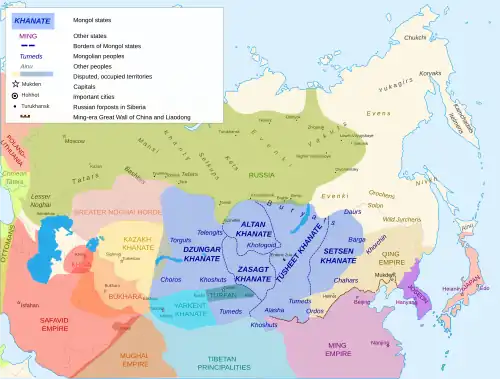
In the 1530s, the relations between the Oirats and the Kazakhs plummeted, resulting in the Kazakh–Oirat Wars, with the Oirats attempting to capture Kazakh pastures and the Kazakhs attempting to subjugate the Oirats from 1552 to 1590's.[4] The Khalkha Mongols led by Ubashi Khong Tayiji later led a coalition with the Kazakhs against the Oirats, however they were defeated and the Oirats declared independence from the Kazakhs and Khalkhas in 1623.[5][4]
This later led to the formation of the Dzungar Khanate by Erdeni Batur—son of Kharkhul—on the upper Emil river and the Tarbaghatai mountains in 1634.[6] He started a wave of major invasions in 1635, aiming to secure the Kazakh pastures.
Course of the war
In 1635, Erdeni Batur launched his first campaign against the Kazakh Khanate, which the Dzungars captured Jangir Khan[2] and repulsed the Naimans from the Bulanty and Buliety Rivers of the Ulytau Mounains to the northwest.[7][8] In 1637, he returned to Dzungaria and set out a campaign with Torobaikhu (Güshi Khan), battling the Khalkhas in the Battle of the Bloody Hills—marrying the Torobaikhi's daughter—Amin Dara.
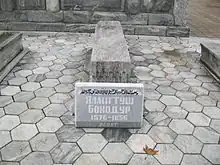
In 1640, the Dzungars launched another campaign against the Kazakh Khanate,[9] as they captured about 16,000 Kazakh–Kyrgyz Tokmaks between the Chu River and the Issyk-Kul Lake in 1643.[10] The Dzungars also captured Turkistan, Tashkent and various towns on the Syr Darya.[11] Meanwhile, the Khanate of Bukhara had intervened on the side of the Kazakh Khanate, with Jangir and the emir of Samarkand, Yalangtoʻsh Bakhodir having established friendly relations before.[12] The Bukharan forces led by Abd al-Aziz was sent to relieve them—as the Dzungars had perpetrated widespread killings, plundered and took many prisoners—however the Bukharans were defeated and soon retreated to Samarkand.[11] Later, Jangir Khan battled the invading Dzungar army on the Ili river, Jetisu, known as the Battle of Orbulaq. Yalangtoʻsh Bakhodir arrived at the battle and defeated the Dzungars with their use of muskets and advantage of the hilly terrain to defeat the Dzungars.[12]
This caused an unrest on the Dzungar Khanate, as Erdeni Batur had purged others who had not joined his campaigns against the Kazakhs and attempted to form an alliance with the Kalmyks in the Volga River, however it failed.[13] Meanwhile, Jangir earned the nickname "Salqam" for his military success in the Orbulaq battle. In 1646, Erdeni resumed his campaigns and captured the city of Sayram and Turkistan, however the Bukharan army led by Abd al-Aziz defeated the Dzungar army.[14]

Soon, this led to Erdeni Batur to seek assistance from their ally, the Khoshut Khanate. As the son of Ochirtu Khan, Galdamba was chosen to lead an army against the Kazakh Khanate.[3] The Khoshut forces battled Jangir khan and resulted the death of Jangir in the Battle of Turkistan, and in from towards that he campaigned around the Dzungarian Alatau.[3] Later a Bukharan relief force under the leadership of Abushuker noyan was sent at Chu River and Talas river. Which Galdamba with 3,000 Olot and Khoshut troops, engaged in a battle against the Bukharans, Galdamba personally killed Abushuker in battle and whilst the Bukharan forces of 38,000 men were defeated.[1] This formed the border of the Dzungar Khanate and the Kazakh Khanate from the Ayagöz to the Talas, resulting in a Dzungar victory.[1]
Aftermath
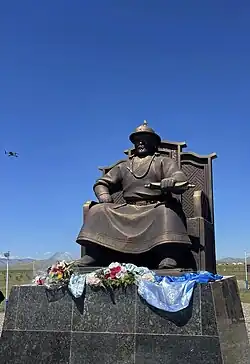
Although the Dzungars have won the war, Erdeni batur died in 1653. Leaving to his son, Sengge as the Khong Tayiji of the Dzungars. He later fought against his half brothers: Chechen Tayiji and Zotov Batur, who were able to secure his position with the support of Ochirtu Khan of the Khoshut Khanate and his brother Galdan in 1661.[15] Fromwards, the Dzungars and Kazakhs had established peaceful relations with Jangir's succesor, Tauke Khan, which Sengge had focused more against the Russians. Who he invaded the Yenisei River against the Tsardom of Russia and the Altan Khanate in 1665. The peace between Dzungars and Kazakhs lasted until Sengge's death, which Tauke recaptured Jetisu. Meanwhile, Galdan took the Dzungar Throne, conquered the Yarkend Khanate and started his campaign to expand his empire westward, directly confronting the Kazakh Khanate.[15]
Notes
- ^ Also called the First Kazakh—Dzungar War.
References
- ^ a b c d e f Atygaev 2023, p. 138.
- ^ a b Chimitdorzhiev 1979, p. 32.
- ^ a b c Altangerel 2017, p. 107.
- ^ a b Remileva 2005, p. 74.
- ^ Perdue 2005, p. 98.
- ^ Adle 2003, p. 146.
- ^ Massanova 2010, p. 232.
- ^ Unknown 1959, p. 278, 280, 301.
- ^ Moiseev 1991, p. 44.
- ^ Burton 1997, pp. 219–220.
- ^ a b Burton 1997, p. 219.
- ^ a b Unknown 1959, p. 234, 237, 239.
- ^ Moiseev 1991, p. 45.
- ^ Burton 1997, p. 245.
- ^ a b Adle 2003, p. 159.
Bibliography
- Atygaev, Nurlan (2023). КАЗАХСКОЕ ХАНСТВО: ОЧЕРКИ ВНЕШНЕПОЛИТИЧЕСКОЙ ИСТОРИИ XV-XVII BEKOВ [Essays on the Foreign Policy History of the 15th-17th Centuries] (in Russian). Almaty: Eurasian Research Institute, Nurlan Atygaev. ISBN 978-601-7805-24-1.
- Remileva, E. (2005). Ойрат-монголы: Обзор истории европейских калмыков (in Russian). Munich: E. Remileva. ISBN 978-3-939165-18-7.
- Perdue, Peter C. (2005). China Marches West: The Qing conquest of Central Eurasia. Cambridge, Massuchuchets: The Belknap press of Harvard university press, Peter C. Perdue. p. 725. ISBN 0-674-01684-X.
- Adle, Chahryar (2003). History of Civilizations of Central Asia (5th ed.). UNESCO, Adle Chahrayar. p. 934. ISBN 978-8120820463.
- Massanova, N.E (22–23 April 2010). Роль номадов евразийских степей в развитии мирового военного искусства. Научные чтения памяти Н.Э. Масанова [The Role of Nomads of the Eurasian Steppes in the Development of World Military Art: Scientific Readings in Commemoration of N. E. Massanov] (in Russian). Almaty: LEM, Proceedings of the International Scientific Conference (published 2010). pp. 400+. ISBN 9965-23-301-2.
- Unknown (1959). Материалы по истории русско-монгольских отношений. 1636–1654. Том II [Materials on the History of Russian-Mongolian Relations. 1636–1654] (in Russian). Vol. II. Москва: Издательство Академии наук СССР.
- Moiseev, Vladimir (1991). Pishchulina, Klavdiya (ed.). The Dzungar Khanate and the Kazakhs (17th–18th Centuries) (in Russian). Alma-Ata: Gylym; Institute of Uighur Studies, Academy of Sciences of the Kazakh SSR. p. 238.
- Chimitdorzhiev, Shirap (1979). Relations between Mongolia and Central Asia in the 17th and 18th centuries (in Russian). Science. Editorial office of Eastern Literature (publishing house). p. 32.
- Burton, Audrey (1997). The Bukharans: A Dynastic, Diplomatic and Commercial History 1550–1702. London: Curzon Press. pp. 219–220, 337. ISBN 978-0-7007-0417-0.
- Altangerel, Chulunbatyn (2017). Дэлхийн талыг эзгэн үе эрхшээсэн түүхт Монголын зэвсэг, дайн, хил хамгаалалтын толь [A look at the weapons, warfare, and border defenses of the historical Mongols, who conquered half the world] (in Mongolian). Chulunbatyn Altangerel.