Puebla International Airport
Puebla International Airport Aeropuerto Internacional de Puebla | |||||||||||
|---|---|---|---|---|---|---|---|---|---|---|---|
_-_002.jpg) | |||||||||||
| Summary | |||||||||||
| Airport type | Public | ||||||||||
| Owner | Grupo Olmeca-Maya-Mexica (GAFSACOMM) | ||||||||||
| Serves | Puebla Metropolitan Area | ||||||||||
| Location | Huejotzingo, Puebla | ||||||||||
| Hub for | Volaris (begins June 1, 2026)[1] | ||||||||||
| Time zone | CST (UTC−06:00) | ||||||||||
| Elevation AMSL | 2,244 m / 7,362 ft | ||||||||||
| Coordinates | 19°09′29″N 98°22′17″W / 19.15806°N 98.37139°W | ||||||||||
| Website | www.grupomundomaya.com/PBC | ||||||||||
| Maps | |||||||||||
 | |||||||||||
  PBC Location of the airport in Puebla  PBC PBC (Mexico) | |||||||||||
| Runways | |||||||||||
| |||||||||||
| Statistics (2025) | |||||||||||
| |||||||||||
| Source: Agencial Federal de Aviación Civil[2] | |||||||||||
_-_001.jpg)
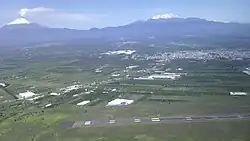


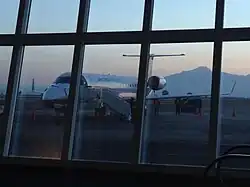
Puebla International Airport (Spanish: Aeropuerto Internacional de Puebla); officially Aeropuerto Internacional Hermanos Serdán (Hermanos Serdán International Airport) (IATA: PBC, ICAO: MMPB) is an international airport located in Huejotzingo, Puebla, Mexico.[3] It handles national and international air traffic for the Metropolitan area of Puebla, the fourth-largest metro area in Mexico. It also supports cargo services and various executive and general aviation activities.
Puebla Airport was named after Aquiles Serdán, Máximo Serdán, and María del Carmen Serdán, known as the Serdán siblings, who were leaders of the anti-reelection movement during the Mexican Revolution. It is operated by Grupo Olmeca-Maya-Mexica (GAFSACOMM), a holding company owned by the Mexican military. The airport is one of the fastest-growing in the country, crossing the one-million passenger threshold for the first time in 2024. In 2025, it handled 1,255,041 passengers.[2]
History
The airport commenced operations in 1985, with its inaugural flight arriving from Guadalajara and operated by Mexicana de Aviación. In 1993, Puebla Air Lines started connecting Puebla to major destinations within Mexico but ceased operations in 1995 due to the Mexican peso crisis. In 1996, the airport, which began as a domestic airport, was designated as the "Hermanos Serdán" International Airport.
Operadora Estatal de Aeropuertos (OEA) assumed the airport management and development in 2001, with shared ownership among the Puebla State Government (26%), Operadora Internacional de Aeropuertos (49%), and Aeropuertos y Servicios Auxiliares (25%). In 2011, OEA was dissolved by the State Government of Puebla due to budgetary issues, and Aeropuertos y Servicios Auxiliares (ASA) took over the airport operations.
Throughout the 2000s and 2010s, there were political initiatives aimed at positioning Puebla Airport, along with Toluca, Cuernavaca, and Querétaro airports, as supplementary options for serving the Mexico City Area. Various airlines, including MexicanaLink, Copa Airlines, Aeroméxico, Aero California, and American Eagle introduced flight services at the airport. However, most air travelers to Puebla still tend to use the Mexico City International Airport, which is situated less than 100 km (65 mi) west of the city and very well connected via highways and bus services. Puebla Airport's capacities remain underutilized, even though it has the potential to serve the Puebla Metropolitan Area, which is home to nearly three and a half million inhabitants.[4] Furthermore, the opening of Mexico City-Felipe Angeles Airport has made it more challenging for PBC to attract commercial flights.
In 2007, the Logistic Airport Center was established, offering comprehensive cargo management and commercial processing facilities. The airport experienced significant growth in passenger numbers, operations, and cargo handling during the 2010s. Over the years, the airport has faced temporary closures due to ash spewing from the nearby Popocatepetl volcano.[5]
In 2022, the Mexican government executed the merger of several state-operated airport companies, consolidating infrastructure entities into a larger holding company known as Grupo Olmeca-Maya-Mexica, which is under the ownership of the Department of Defense (SEDENA). This action was part of the broader strategy of the López Obrador administration to engage the armed forces not only in significant infrastructure projects but also in civilian functions. This trend of militarization extended to other endeavors such as the Tren Maya, the Felipe Angeles and Tulum airports, and the revival of Mexicana de Aviación, prompting concerns regarding accountability and transparency.[6][7]
Facilities
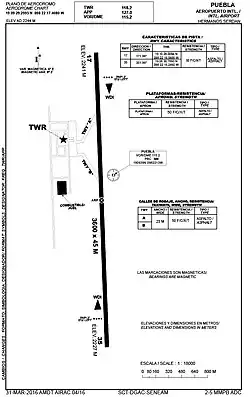
The Puebla Airport is located at an elevation of 2,244 metres (7,362 ft) above mean sea level. It features a single runway with a length of 3,600 metres (11,800 ft) and an apron featuring 6 Category D aircraft stands, accommodating both commercial and cargo operations. The airport is also equipped with facilities dedicated to general and executive aviation.
The terminal building includes arrival and departure facilities for both domestic and international flights within a single-story building. It has the capacity to cater to up to 450 passengers per hour. The departures concourse comprises five gates and an airport lounge managed by the Global Lounge Network.[8]
In addition to passenger services, Puebla Airport serves as a hub for logistics and courier companies, overseeing an annual cargo volume of two thousand tons. The cargo handled encompasses various items such as textile products, vehicle motor parts, machinery, postal items, airborne parcel services, and perishable goods like fruits and flowers.[9]
Airlines and destinations
Passengers
| Airlines | Destinations |
|---|---|
| Magnicharters | Seasonal: Cancún |
| United Express | Houston–Intercontinental[10] |
| Viva | Cancún,[10] Guadalajara,[10] Mérida,[10] Monterrey,[10] Tijuana[10] |
| Volaris | Aguascalientes (begins June 2, 2026),[11] Cancún,[10] Guadalajara,[10] Houston–Intercontinental (begins June 2, 2026),[11] Huatulco (begins June 1, 2026),[11] Ixtapa-Zihuatanejo (begins June 2, 2026),[11] León/Bajío (begins June 1, 2026),[11] Los Angeles (begins June 1, 2026),[11] Newark (begins June 2, 2026),[11] Puerto Vallarta (begins June 2, 2026),[11] San José del Cabo (begins June 1, 2026),[11] San Luis Potosí (begins June 2, 2026),[11] Tijuana,[10] Tuxtla Gutiérrez (begins June 2, 2026),[11] Villahermosa (begins June 1, 2026)[11] |
Cargo
| Airlines | Destinations |
|---|---|
| Aeronaves TSM | Laredo |
| Estafeta | Chihuahua, San Luis Potosí, Villahermosa |
Destinations map
Puebla Domestic destinations from Puebla International Airport Red = Year-round destination Blue = Future destination Green = Seasonal destination |
International destinations from Puebla International Airport Red = Year-round destination Blue = Future destination Green = Seasonal destination |



Airlines previously flying to Puebla International Airport
Statistics
Annual Traffic
| Year | Total Passengers | change % | Cargo movements (t) | change % | Air operations | change % |
|---|---|---|---|---|---|---|
| 2006 | 16,328 |  |
603 | |
201,094 |
|
| 2007 | 23,181 |  41.97% 41.97% |
593 |  1.65% 1.65% |
428,791 | 113.22%
|
| 2008 | 24,753 | 6.78% |
648 | 9.27% |
530,320 | 23.67%
|
| 2009 | 19,845 | 19.82% |
1,091 | 68.36% |
344,699 | 35.0%
|
| 2010 | 19,331 | 2.59% |
1,619 | 48.39% |
318,037 | 7.73%
|
| 2011 | 17,416 | 9.90% |
1,141 | 29.52% |
218,401 | 31.32%
|
| 2012 | 18,130 | 4.09% |
798 | 30.06% |
264,085 | 20.91%
|
| 2013 | 15,925 | 12.16% |
666 | 16.54% |
292,152 | 10.62%
|
| 2014 | 17,080 | 7.25% |
461 | 30.78% |
285,041 | 2.43%
|
| 2015 | 19,817 | 16.02% |
492 | 6.72% |
327,811 | 15.0%
|
| 2016 | 19,227 | 2.97% |
846 | 71.95% |
383,361 | 16.94%
|
| 2017 | 20,258 | 5.36% |
1,166 | 37.82% |
511,833 | 33.51%
|
| 2018 | 20,391 | 0.66% |
1,236 | 6.01% |
685,583 | 34.10%
|
| 2019 | 19,723 | 3.28% |
842 | 31.85% |
761,575 | 11.08%
|
| 2020 | 11,065 | 43.90% |
1,012 | 20.19% |
384,103 | 49.56%
|
| 2021 | 12,854 | 16.17% |
2,706 | 167.39% |
565,387 | 47.20%
|
| 2022 | 18,164 | 41.31% |
7,127 | 163.38% |
790,931 | 39.89%
|
| 2023 | 20,869 | 14.89% |
3,794 | 46.77% |
935,500 | 18.28%
|
| 2024 | 18,755 | 10.13% |
4,232 | 11.54% |
1,059,073 | 10.47%
|
| 2025 | 22,495 | 19.94% |
4,867 | 15.00% |
1,255,041 | 18.50%
|
Busiest routes
| Rank | Airport | Passengers |
|---|---|---|
| 1 |  Cancún, Quintana Roo Cancún, Quintana Roo
|
176,706 |
| 2 |  Tijuana, Baja California Tijuana, Baja California
|
169,279 |
| 3 |  Monterrey, Nuevo León Monterrey, Nuevo León
|
122,293 |
| 4 |  Guadalajara, Jalisco Guadalajara, Jalisco
|
95,533 |
| 5 |  Mérida, Yucatán Mérida, Yucatán
|
30,159 |
| 6 |  Houston–Intercontinental, United States Houston–Intercontinental, United States
|
13,281 |
See also
- List of the busiest airports in Mexico
- List of airports in Mexico
- List of airports by ICAO code: M
- List of busiest airports in North America
- List of the busiest airports in Latin America
- Transportation in Mexico
- Metropolitan areas of Mexico
- Mexico City megalopolis
- Puebla Metropolitan Area
- Central de Autobuses Puebla
References
- ^ "Aeropuerto de Puebla amplía su oferta aérea con 12 nuevas rutas de Volaris". Facebook (in Spanish). Retrieved February 6, 2026.
- ^ a b c "Estadística Operacional de Aeropuertos / Statistics by Airport". Agencia Federal de Aviación Civil. Retrieved January 30, 2026.
- ^ "Puebla International Airport". PueblaCity.com. Retrieved January 14, 2023.
Puebla International Airport, officially Hermanos Serdán International Airport (IATA: PBC, ICAO: MMPB). The airport was named for Aquiles Serdán, Máximo Serdán and María del Carmen Serdán, known as the Serdán brothers, leaders of the revolutionary Maderista anti-reelectionism.
- ^ Goytia, María José (May 27, 2022). "Puebla International Airport to Modernize Cargo Flights". Mexicobusiness.News. Retrieved January 14, 2023.
Luis Espinosa Rueda, President, CANACINTRA Puebla, highlighted the need to end the underutilization of the airport, which instead should be uses [sic] as a source of economic growth for Puebla's industries.
- ^ "Mexico: Authorities temporarily close Puebla International Airport due to volcanic ash fall May 21 2023".
- ^ "The Political Implications of Mexico's New Militarism".
- ^ "The militarisation of Mexico's economy".
- ^ "Global Lounge Network – Our Lounges".
- ^ "Aeropuerto Internacional Hermanos Serdán de Puebla".
- ^ a b c d e f g h i "Puebla Expands its Flight Map". El Incorrecto (in Spanish). February 2026. Retrieved February 5, 2026.
- ^ a b c d e f g h i j k l "Volaris triggers massive expansion with 33 new routes across North America". AviaciOnline. February 2026. Retrieved February 5, 2026.
- ^ "Estadística operacional por origen-destino / Traffic Statistics by City Pairs" (in Spanish). Agencia Federal de Aviación Civil. January 2026. Retrieved February 1, 2026.
External links
 Media related to Puebla International Airport at Wikimedia Commons
- Grupo Olmeca-Maya-Mexica
- Website
- Puebla Airport information at Great Circle Mapper
- Accident history for PBC at Aviation Safety Network
- Tourism in Puebla
- Aeronautical chart and airport information for MMPB at SkyVector
- Current weather for MMPB at NOAA/NWS