Vau i Dejës Hydroelectric Power Station
| Vau i Dejës Hydroelectric Power Station | |
|---|---|
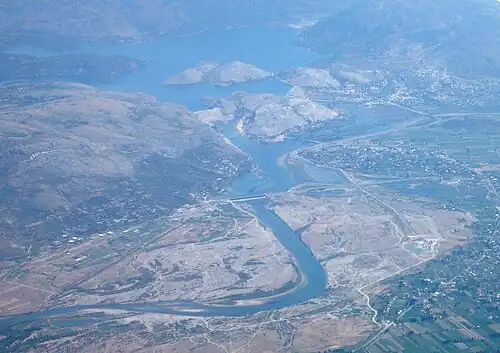 An aerial photo of the station and its reservoir | |
Interactive map of Vau i Dejës Hydroelectric Power Station | |
| Location | Vau i Dejës gorge, Albania |
| Coordinates | 42°00′49″N 19°38′09″E / 42.01361°N 19.63583°E |
| Construction began | 1971 |
| Opening date | 1973 |
| Owner | Albanian Power Corporation |
| Dam and spillways | |
| Impounds | Drin River |
| Height | Zadeja: 79 m (259 ft)[a] |
| Spillway capacity | 7,500 m3/s (16,000,000 cu ft/min) |
| Reservoir | |
| Creates | Lake Vau i Dejës (Albanian: Liqeni i Vaut te Dejës)[1]: 374 |
| Total capacity | 580,000,000 m3 (2.0×10¹⁰ cu ft) (maximum) 263,000,000 m3 (9.3×10⁹ cu ft) (active)[2]: 5 |
| Surface area | 26 km2 (10 sq mi)[1]: 374 |
| Maximum length | 20 km (12 mi) |
| Power Station | |
| Operator | Albanian Power Corporation |
| Commission date | 1967 |
| Turbines | 5 × 50 MW Francis turbines |
| Installed capacity | 250 MW |
| Annual generation | 1000 Gwh |
| Website https://www.kesh.al/en/service/hec-vau-i-dejes/ | |
The Vau i Dejës Hydroelectric Power Station (Albanian: Hidrocentrali i Vaut të Dejës), abbreviated Vau i Dejës HPP, is a hydroelectric dam on the Drin River, in Albania, near the settlement of Vau i Dejës. Completed in 1973, the project consists of five turbines of Chinese origin, each with a nominal capacity of 50 MW, totaling the installed capacity to 250 MW. It is operated by the Albanian Power Corporation.[3]
The Vau i Dejës power station is the third of three dams of the Drin River cascade,[4][1]: 374 with the power stations of Fierza and the Koman upstream.[1]: 360
The hydroelectric station has been turned into a hybrid power station, with the installation of floating photovoltaics on one of its dams. There are plans to add more photovoltaics, on its two other dams and ground-mounted photovoltaics, as well as to incorporate wind turbines.
History
In 1967, China agreed to finance the station.[5][2]: 5 Due to the Albanian–Soviet split, China assisted Albania with various major industrial processes.[6] Construction began in the autumn of 1971.[6][2]: 5 At its completion in 1973, it provided more than half of Albania's electricity[5]: 53 and was the first dam on the Drin river.[2]: 4 The dam's construction also lead to the creation of Lake Vau i Dejës, strengthened Albania's industrial base, and allowed it to become an energy exporter.[1]: 374
The power station, along with Koman Hydroelectric Power Station and Fierza Hydroelectric Power Station, was noted to be one of Albania's communist legacies. By January 1994, these dams generated 1.5 million killowatts of electricity; their reservoirs were also used for tourism and transportation.[7]
Previously, the largest hydroelectric project in Albania was the Mao Zedong Hydropower Plant,[8][6] which was also located in Vau i Dejës, specifically 10 km southeast of Shkodër on the River Drin.[8][6] Mao Ce Dun generated 250 000 kW, comprising two small hydroelectric, and two medium-sized thermal, power stations.[6] A reservoir accompanied the dam.[8]
In 2010 and 2011, the dam experienced flooding. In 2018, there were worries that it would flood again, as there was heavy rainfall and a sudden increase in temperature, which caused an increase of water flows. As the reservoir was near its capacity, the dam was forced to discharge water. Compensation was given to Shkodër because of damage from frequent flooding.[3]
In 2025, the Agence Française de Développement and the Albanian Power Cooperation signed a memorandum on the development of the Drin River's dams (including Koman, Fierza, and Vau i Dejës plants). Mainly, France focused on modernizing existing energy infrastructure through technical assistance, in hopes of developing storage capacity, mitigating flooding, and optimizing electricity generation. In the five years prior, France had been increasingly involved in Albania's energy sector.[9]
Design and operation
The dam is located on Vau i Dejës gorge, 18 km (11 mi) away from Shkodra. Other than electricity generation, it is also important for its water discharges, which have a major effect on flooding in the lowlands of Lezha and Shkodra.[2]: 5 It is the lower part of the Drin river cascade. Vau i Dejës Lake, the dam's reservoir[1]: 374 , has a maximum volume of 580,000,000 m3 (2.0×10¹⁰ cu ft), although its active volume is 263,000,000 m3 (9.3×10⁹ cu ft). It has a surface area of 26 km2 (10 sq mi) according to some estimates,[1]: 374 and 25 km2 (9.7 sq mi) according to others.[2]: 5 The station's safe maximum flow for 1 in 10,000 years is 10,000 m3/s (21,000,000 cu ft/min) and its total discharge capacity is 7,500 m3/s (16,000,000 cu ft/min). The plant operates five vertical Francis turbines, each with 50 MW of power, for a total installed power of 250 MW. To connect with a substation, the station has 3-phase synchronous generators and lifting transformers; it also contains auxiliary devices and control systems. Annually, on average, it produces 1000 Gwh of electricity. Originally, Vau i Dejës HPP employed Chinese technology and equpiment, but these were replaced with mechanical equipment from Andritz AG and electrical and control installations from Alstom, from 2003 to 2007.[2]: 5
Koman Lake experiences floods and soil erosion due to the Vau i Dejës and Fierza power stations. Vau i Dejës creates different environmental problems than the Fierza and Koman stations upstream. Solid waste pollution is less evident in Vau i Dejës Lake, as most of it is accumulated by the reservoirs upstream. In addition, there are fewer residential centres or businesses along its reservoir. Instead, wastewater and flooding are the main problems. The area around the Vau i Dejës HPP experiences numerous rainfalls throughout the year, resulting in flooding. In January and December 2010 the area experienced its biggest flood to date; the water loads in Buna were 3,600 m3/s (130,000 cu ft/s) and 4,000 m3/s (140,000 cu ft/s). The 2010 flooding had heavy environmental and social effects. Regularly, overflows in the Buna, Drin, Kir Rivers and Shkodra Lake are caused by heavy, prolonged rainfall in the winter and snowmelt in the late winter and early spring. These floods, caused by the Vau i Dejës HPP's floodgates and the non-operation of the drainage system, have affected local erosion: sediments and solid materials brought by the river result in coastal erosion because the Drin River dams prevent their deposition into the ocean. Ecosystems have been impacted by this erosion. The area around Vau i Dejës HPP is sparsely populated, yet road amortisation results in companies throwing waste into the Vau i Dejës lake and local rivers. Due to a lack of construction, chemically inert waste has decreased.[2]: 6
In 2022, Belinda Balluku, the Albanian Minister of Infrastructure and Energy, said there were ambitions to develop a wind power plant within Vau i Dejës HPP, in addition to solar projects.[10][11][12] Balkan Green Energy News thought that combining wind and solar is particularly effective at reducing intermittency of power generation: wind turbines generate power at night and in the winter, when solar outputs are lower.[11][12] As of 2023, that would have made it the first utility-scale hybrid power plant that combined solar, hydro, and wind power in the world. At the time, hybrid power plants were relatively new but increasing in an effort to reduce global emissions. Most other hybrid power plants used fossil fuels, but plans for integration of other renewable sources and batteries were on the rise.[11]
Privately owned hydropower units (Ashta 1 and 2) are located beneath Vau i Dejës HPP.[11]
Floating photovoltaics
In 2018, the Albanian Power Corporation submitted a proposal to construct a 12.9 MW floating photovoltaics plant, on the Vau i Dejës sations's reservoir, to the Ministry of Transport and Infrastructure.[13] In 2020, the European Bank for Reconstruction and Development considered giving a loan of either €9.5 million, according to pv magazine;[14] or of €9.75 million, according to Balkan Green Energy News; to the Albanian Power Corporation for the construction of the plant.[15] Ultimately, the European Bank settled on €9.1 million by 2021.[12][16] The lender said that the construction of floating solar would decrease Albania's reliance on hydroelectric resources.[14]
The new floating photovoltaics would produce €13.94 million worth of electricity, and would "strengthen [the station's] operational and financial performance" according to Balkan Green Energy News. The approval date for the loan was scheduled to be 21 October 2020. The photovoltaics, covering 11.8 ha (29 acres) of the reservoir, would prevent algae growth, reduce water evaporation, and improve water quality. At the time, an Environmental and social due diligence (ESDD) was ongoing to determine possible environmental impacts. According to Balkan Green Energy News, the new addition was a part of Albania's trend of energy diversification, driven by energy vulnerability to droughts.[15] According to Energy Industry Review, this development was a larger part of Albania's ambition to develop its solar capacity, along with the 140 MW Karavasta project and the 100 MW Spitalle project. It was also a part of the commercialization of the Albanian Power Corporation.[16]
The completed solar panels at Qyrsaq, one of the three dams of the Vau i Dejës reservoir, were predicted to have a capacity of 5.1 MW and an annual output of 7 GWh.[12] The solar unit occupies 2.5 ha (6.2 acres) of the total 3.2 ha (7.9 acres) avaliable.[11] In 2021, the Albanian Power Corporation also said that there were plans to install photovoltaic panels at Zadeja dam, and other buildings in Vau i Dejës HPP. As of 2023, it was planned to be 8.25 MW in capacity and to span 40 ha (99 acres) of the total 48.6 ha (120 acres) available.They also said that they would utilise both ground-mounted and floating solar panels. Hybrid power plants, like Vau i Dejës, provide a stabler energy supply to clients. Consequently, grid and storage costs for investors decrease. Hydropower plants, like Vau i Dejës HPP, have significant space for photovoltaic installation.[11][12] As of 2023, construction of a floating photovoltaic system on the reservoir was underway.[11] A bid for project design, engineering, construction, commissioning and a two-year maintenance was started, ending on July 3 2023. The Albanian Power Corporation valued the investment at €7.6 million, excluding value-added tax. The contractor's be responsible for installing a control and monitoring system for the solar power plants on two of Vau i Dejës HPP's dams. SENA, a subsidiary of the Albanian Power Corporation, was responsible for this and future projects.[10] In 2024, Masdar was chosen to be the contractor, thereby creating a joint venture with the Albanian Power Corporation.[17]
In total, the floating solar project would be the largest in Europe, as of 2023, with 12.9 MW of peak capacity and 17.6 GWh of average annual output. It would cover 0.45%, or 11 ha (27 acres), of Lake Vau i Dejës.[11]
See also
Notes
- ^ Zadeja is one of the three dams of Vau i Dejës HPP.
References
- ^ a b c d e f g Bakiu, Rigers (21 April 2020). Drina River (Sava’s Tributary of Danube River) and Human Impact in Albania. Springer. doi:10.1007/978-3-030-37242-2_17. ISBN 978-3-030-37242-2.
- ^ a b c d e f g h Osmani, Marilda; Hoxha, Belinda; Resmeliu, Dorina; Mazrreku, Armela; Kucaj, Enkelejda; Anira Gjoni, Ing. (November 2023). "ENVIRONMENTAL AND LIVELIHOOD IMPACTS OF DAMS: A CASE STUDY". Alblakes 4 - International Conference on “Building Resilience of water ecosystems through scientific knowledge". Supplement to "Thalassia Salentina". Elbasan, Albania. ISSN 0563-3745. Retrieved 7 February 2026.
- ^ a b "Gjiknuri in Vau i Dejës: Controlled discharges, no risk of massive flooding". Balkanweb. 7 March 2018. Retrieved 28 January 2026.
- ^ Pompejano, Federica (26 June 2023). The Planning of Socialist Urbanity: The New City of Kukës in Albania. NZL. p. 380. doi:10.55939/a5035pmg1t.
- ^ a b Strange, Austin (21 December 2023). Chinese Global Infrastructure (EPUB). Elements in Global China. Cambridge University Press. doi:10.1017/9781009090902. ISBN 978-1-009-09090-2.
- ^ a b c d e Hall, D. R. (1975). "Some Developmental Aspects of Albania's Fifth 5-Year Plan 1971-5". Geography. 60 (2): 129–130. ISSN 0016-7487.
- ^ Rugg, Dean S. (January 1994). "Communist Legacies in the Albanian Landscape". Geographical Review. 84 (1). Geographical Review: 65. doi:10.2307/215781. Retrieved 28 January 2026.
- ^ a b c Gkitsa, Dimitra (1 June 2025). "Chimneys and Electric Wires Conquering the Sky: The Great Transformation of Nature in Socialist Albania". ARTMargins. 14 (2): 90. doi:10.1162/artm_a_00414.
- ^ Spasić, Vladimir (18 April 2025). "Albania's KESH, France's AFD sign MoU on hydropower management, energy storage". Balkan Green Energy News. Retrieved 7 February 2026.
- ^ a b Todorović, Igor (7 June 2023). "Albania seeks contractor for second PV plant on hydropower dam". Balkan Green Energy News.
- ^ a b c d e f g h Todorović, Igor (2 January 2023). "Half century old hydropower plant in Albania is becoming innovative energy hub". Balkan Green Energy News. Retrieved 8 February 2026.
- ^ a b c d e Todorović, Igor (16 December 2021). "Hydropower dam in Albania gets PV plant, new RES capacities to be added". Balkan Green Energy News. Retrieved 8 February 2026.
- ^ Bellini, Emiliano (5 December 2018). "Floating PV conquers two new countries". pv magazine. Retrieved 28 January 2026.
- ^ a b Bellini, Emiliano (3 August 2020). "Albanian utility set to move forward with 12.9 MW floating PV project". pv magazine. Retrieved 28 January 2026.
- ^ a b Todorović, Igor (4 August 2020). "EBRD may lend EUR 9.75 million to KESH for floating solar power plant". Balkan Green Energy News. Retrieved 7 February 2026.
- ^ a b Energy Industry Review (2 April 2021). "KESH's First Floating Solar Photovoltaic Plant in Albania". Energy Industry Review. Energy Industry Review. Retrieved 8 February 2026.
- ^ Todorović, Igor (26 November 2024). "Albania's KESH to add pumps to hydropower cascade for energy storage". Balkan Green Energy News. Retrieved 8 February 2026.
| Oil and gas |
| ||||||||
|---|---|---|---|---|---|---|---|---|---|
| Hydroelectric | |||||||||