Shi'er lü

Shi'er lü (Chinese: 十二律; pinyin: shí'èr lǜ; Wade–Giles: shih2-êrh4 lü4; lit. '12 pitches'; Mandarin pronunciation: [ʂɻ̩˧˥ aɚ˥˧ ly˥˩]) is a standardized gamut of twelve notes used in ancient Chinese music.[1] It is also known, rather misleadingly, as the Chinese chromatic scale; it was only one kind of chromatic scale used in ancient Chinese music. The shi'er lü uses the same intervals as the Pythagorean scale, based on 3:2 ratios (8:9, 16:27, 64:81, etc.). The gamut or its subsets were used for tuning and are preserved in bells and pipes.[2]
Unlike the Western chromatic scale, the shi'er lü was not used as a scale in its own right; it is rather a set of fundamental notes on which other scales were constructed.[3]
The first reference to "standardization of bells and pitch" dates back to around 600 BCE, while the first description of the generation of pitches dates back to around 240 CE.[3]
Note names
| Traditional Chinese | Simplified Chinese | Pinyin | English | Ratio | Audio |
|---|---|---|---|---|---|
| 黃鐘 | 黄钟 | Huáng Zhōng | tonic/unison | 1 : 1 | ⓘ |
| 大呂 | 大吕 | Dà Lǚ | semitone | 37 : 211 | ⓘ |
| 太簇 | 太簇 | Tài Cù | major second | 32 : 23 | ⓘ |
| 夾鐘 | 夹钟 | Jiá Zhōng | minor third | 39 : 214 | ⓘ |
| 姑洗 | 姑洗 | Gū Xǐ | major third | 34 : 26 | ⓘ |
| 仲呂 | 中吕 | Zhòng Lǚ | perfect fourth | 311 : 217 | ⓘ |
| 蕤賓 | 蕤宾 | Ruí Bīn | tritone | 36 : 29 | ⓘ |
| 林鐘 | 林钟 | Lín Zhōng | perfect fifth | 3 : 2 | ⓘ |
| 夷則 | 夷则 | Yí Zé | minor sixth | 38 : 212 | ⓘ |
| 南呂 | 南吕 | Nán Lǚ | major sixth | 33 : 24 | ⓘ |
| 無射 | 无射 | Wú Yì | minor seventh | 310 : 215 | ⓘ |
| 應鐘 | 应钟 | Yìng Zhōng | major seventh | 35 : 27 | ⓘ |
There were 12 notes in total, which fall within the scope of one octave. Note that the mathematical method used by the ancient Chinese could never produce a true octave, as the next higher frequency in the series of frequencies produced by the Chinese system would be higher than 880 hertz.

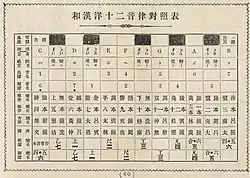
See the article by Chen Ying-shi.[4]
See also
Further reading
- Reinisch, Richard (?). Chinesische Klassische Musik, p. 30. Books On Demand. ISBN 978-3-8423-4502-7.
Sources
- ^ Joseph C.Y. Chen (1996). Early Chinese Work in Natural Science: A Re-examination of the Physics of Motion, Acoustics, Astronomy and Scientific Thoughts, p. 96. ISBN 962-209-385-X.
- ^ Chen (1996), p.97.
- ^ a b Needham, Joseph (1962/2004). Science and Civilization in China, Vol. IV: Physics and Physical Technology, p.170-171. ISBN 978-0-521-05802-5.
- ^ 一种体系 两个系统 by 陈应时 (Yi zhong ti-xi, liang ge xi-tong by Chen Ying-shi of the Shanghai Conservatory), Musicology in China, 2002, Issue 4, 中国音乐学,2002,第四 期
External links
- Graham Pont. "Philosophy and Science of Music in Ancient Greece: The Predecessors of Pythagoras and their Contribution", Nexus Network Journal.