This portal's subpages should be checked. Subpages that are no longer needed should be reported here.
Please take care when editing, especially if using automated editing software. Learn how to update the maintenance information here.
The São Tomé and Príncipe Portal
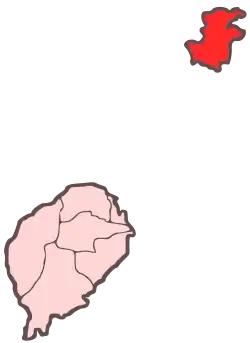
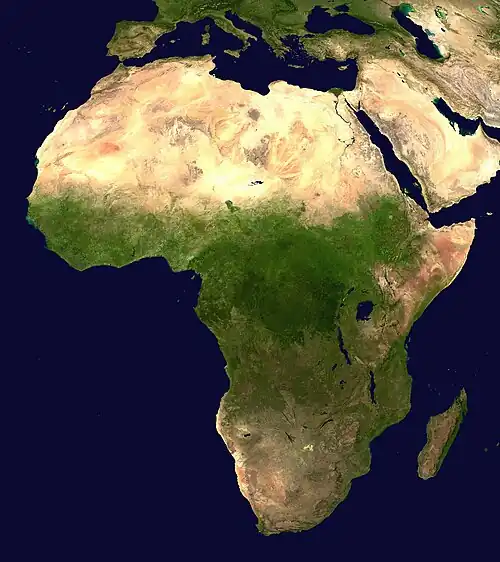
São Tomé and Príncipe, officially the Democratic Republic of São Tomé and Príncipe, is an island country in the Gulf of Guinea, off the western equatorial coast of Central Africa. It consists of two archipelagos around the two main islands of São Tomé and Príncipe, about 150 km (93.21 mi) apart and about 250 and 225 km (155 and 140 mi) off the northwestern coast of Gabon. With a population of 201,800 (2018 official estimate), São Tomé and Príncipe is the second-smallest and second-least populous African sovereign state after Seychelles.
The islands were uninhabited until Portuguese explorersJoão de Santarém and Pedro Escobar became the first to discover them in 1470. Gradually colonized and settled throughout the 16th century, they collectively served as a vital commercial and trade centre for the Atlantic slave trade. The rich volcanic soil and proximity to the equator made São Tomé and Príncipe ideal for sugar cultivation, followed later by cash crops such as coffee and cocoa. The lucrative plantation economy was heavily dependent upon enslaved Africans. Cycles of social unrest and economic instability throughout the 19th and 20th centuries culminated in peaceful independence in 1975 as a one-party communist state, which would remain in place until 1990. São Tomé and Príncipe has since remained one of Africa's most stable and democratic countries. São Tomé and Príncipe is a developing economy with a medium Human Development Index.
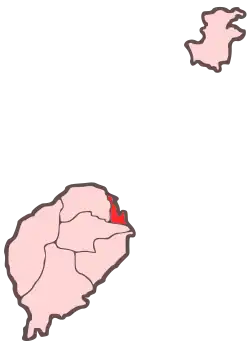
Santo António (Portuguese for Saint Anthony), also known as Santo António do Príncipe, is the main settlement of the island of Príncipe in São Tomé and Príncipe. It lies on the north east coast. It is the capital of the Autonomous Region of Príncipe. Its population is 2,620 (2012), about 35% of the island's population. The town is known for its colonial architecture and for its churches: Church of Our Lady of the Conception and Church of Our Lady of the Rosary. The town is also known for the Auto das Floripes play, which is performed by the citizens. (Full article...)
This is a Good article, which meet a core set of high editorial standards.
São Tomé and Príncipe competed at the 2016 Summer Paralympics in Rio de Janeiro, Brazil from 7 to 18 September 2016. The country's participation in Rio marked its debut appearance in the quadrennial event, although it had competed in the Summer Olympics six times since the 1996 Games. The delegation consisted of a single short-distance runner Alex Anjos, who was chosen as São Tomé and Príncipe's flag bearer for the opening ceremony. Anjos was disqualified from the men's 100 metres (T47) for arriving late and failed to advance into the final of the men's 400 metres (T47) after failing to set a fast enough lap time. (Full article...)
Image 1Map of the Gulf of Guinea, showing São Tomé, Príncipe, and Annobón. These islands, together with the island of Bioko and Mount Cameroon on the African mainland, are part of the Cameroon line of volcanoes.
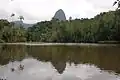
Image 2Hiking in the equatorial forest on the island of São Tomé
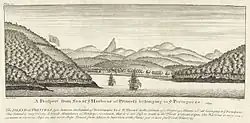
Image 4Island of Príncipe (Sao Tome and Principe), 1727. The inscription says: "The ISLAND of PRINCESS lies between the Islands of FERNANDO PO & St. THOMÉ in the Latitude of 1 Degree 30 Minutes N. all belonging to the Portuguese. This Island is very Woody and breeds abundance of Monkeys, insomuch that it is not safe to walk in the Woods without a gun. The harbour is very convenient to Careen Ships in, and most Ships Bound from Africa to America with Slaves put in here for Food, Water etc."

.jpg)


.jpg)

.jpg)


.jpg)

.jpg)






 Commons
 Wikibooks
 Wikidata
 Wikinews
 Wikiquote
 Wikisource
 Wikiversity
 Wikivoyage
 Wiktionary
 List of all portals




 Random portal
 WikiProject Portals