Portal:Africa


.svg.png)
Africa is the world's second-largest and second-most populous continent after Asia. At about 30.3 million km2 (11.7 million square miles) including adjacent islands, it covers around 20% of Earth's land area and 6% of its total surface area. With nearly 1.4 billion people as of 2021, it accounts for about 18% of the world's human population. Africa's population is the youngest among all the continents; the median age in 2012 was 19.7, when the worldwide median age was 30.4. Based on 2024 projections, Africa's population will exceed 3.8 billion people by 2100. Africa is the least wealthy inhabited continent per capita and second-least wealthy by total wealth, ahead of Oceania. Scholars have attributed this to different factors including geography, climate, corruption, colonialism, the Cold War, and neocolonialism. Despite this low concentration of wealth, recent economic expansion and a large and young population make Africa an important economic market in the broader global context, and Africa has a large quantity of natural resources.
The continent includes Madagascar and various archipelagos. It contains 54 fully recognised sovereign states, eight cities and islands that are part of non-African states, and two de facto independent states with limited or no recognition. This count does not include Malta and Sicily, which are geologically part of the African continent. Algeria is Africa's largest country by area, and Nigeria is its largest by population. African nations cooperate through the establishment of the African Union, which is headquartered in Addis Ababa.
Africa is highly biodiverse; it is the continent with the largest number of megafauna species, as it was least affected by the extinction of the Pleistocene megafauna. However, Africa is also heavily affected by a wide range of environmental issues, including desertification, deforestation, water scarcity, and pollution. These entrenched environmental concerns are expected to worsen as climate change impacts Africa. The UN Intergovernmental Panel on Climate Change has identified Africa as the continent most vulnerable to climate change.
The history of Africa is long, complex, and varied, and has often been under-appreciated by the global historical community. In African societies the oral word is revered, and they have generally recorded their history via oral tradition, which has led anthropologists to term them "oral civilisations", contrasted with "literate civilisations" which pride the written word. African culture is rich and diverse both within and between the continent's regions, encompassing art, cuisine, music and dance, religion, and dress. (Full article...)
Selected article –
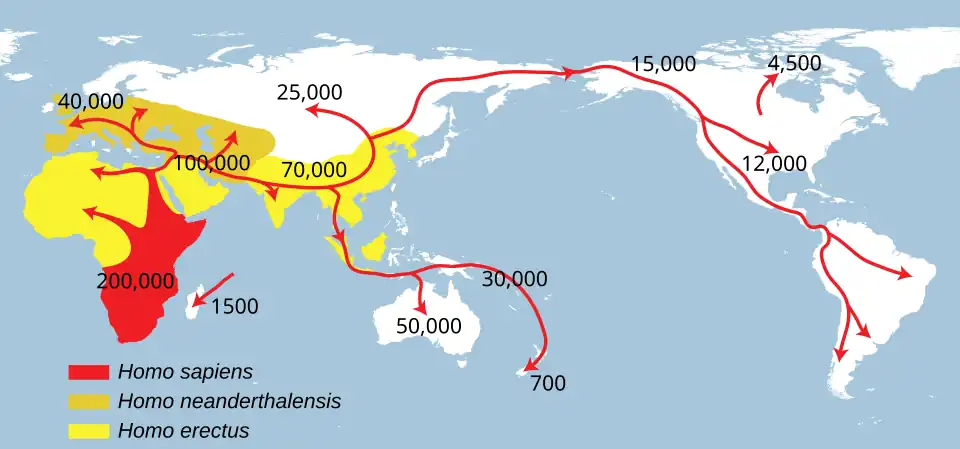
Homo erectus greatest extent (yellow)
Homo neanderthalensis greatest extent (ochre)
Homo sapiens (red)
The recent African origin of modern humans or the "Out of Africa" theory (OOA) holds that present-day humans outside Africa descend mainly from a single expansion of anatomically modern humans (Homo sapiens) from Africa about 70,000–50,000 years ago. It is the most widely accepted paleo-anthropological model of the geographic origin and early migration of the human species.
This expansion follows the early expansions of hominins out of Africa, accomplished by Homo erectus and then Homo neanderthalensis. (Full article...)
Featured pictures –
-

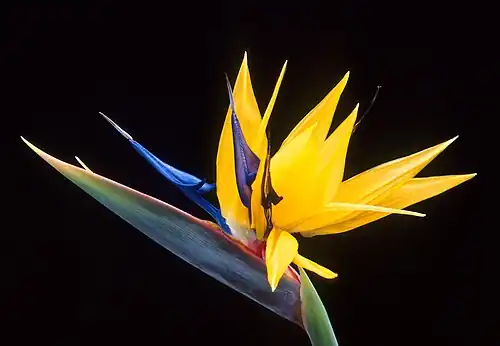
Bird of paradise flower Credit: USDAStrelitzia is a genus of five species of perennial plants, native to South Africa. It belongs to the plant family Strelitziaceae. The genus is named after Queen Charlotte of the United Kingdom. A common name of the genus is bird of paradise flower, because of a resemblance of its flowers to birds-of-paradise. In South Africa, it is commonly known as a crane flower and is featured on the reverse of the 50 cent coin. -

Male lion and cub eating a cape buffalo in Northern Sabi Sand, South Africa Photo credit: Luca Galuzzi
The lion (Panthera leo) is a mammal of the family Felidae and one of four "big cats" in the genus Panthera. The lion is the second largest feline species, after the tiger. The male lion, easily recognized by his mane, weighs between 150 and 250 kg (330–500 lb). Females range 120–150 kg (260–330 lb). In the wild, lions live for around 10–14 years, while in captivity they can live over 20 years. Though they were once found throughout much of Africa, Asia and Europe, lions presently exist in the wild only in Africa and India. They enjoy hot climates, and hunt in groups. -
 Photograph credit: Alexander SavinDallol is a cinder-cone volcano in the Danakil Depression, northeast of the Erta Ale Range in Ethiopia. The area lies up to 120 m (390 ft) below sea level, and has been repeatedly flooded in the past when waters from the Red Sea have inundated it. The Danakil Depression is one of the hottest places on Earth, and the evaporation of seawater after these flooding episodes produced thick deposits of salt, as seen in this landscape. The deposits at Dallol include significant quantities of the carbonate, sulfate and chloride salts of sodium, potassium, calcium and magnesium. Hot springs discharge brine to form the blueish ponds, and small, temporary geysers produce cones of salt.
 -
.jpg) Photograph credit: Charles James SharpThe roan antelope (Hippotragus equinus) is a species of savanna antelope found in western, central and southern Africa. Named for its reddish-brown coat, it has a black face with white patches around the eyes and the mouth, and a short erect mane of greyish brown hair extending from the back of the neck to the rump. This roan antelope, of the subspecies H. e. koba, was photographed in Senegal; the subspecies's range extends from Senegal to Benin in western Africa.
Photograph credit: Charles James SharpThe roan antelope (Hippotragus equinus) is a species of savanna antelope found in western, central and southern Africa. Named for its reddish-brown coat, it has a black face with white patches around the eyes and the mouth, and a short erect mane of greyish brown hair extending from the back of the neck to the rump. This roan antelope, of the subspecies H. e. koba, was photographed in Senegal; the subspecies's range extends from Senegal to Benin in western Africa. -
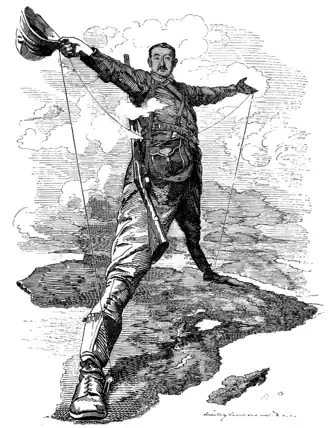
Caricature of Cecil John Rhodes, after he announced plans for a telegraph line from Cape Town to Cairo. Photo credit: Punch
The Cape to Cairo Railway is an uncompleted project to cross Africa from south to north by rail. The plan was initiated at the end of the 19th century, largely under the vision of Cecil Rhodes, in the attempt to connect adjacent African possessions of the British Empire through a continuous line from Cape Town, South Africa to Cairo, Egypt. While most sections of the Cape to Cairo railway are in operation, a major part is missing between Sudan and Uganda. -
.jpg) Banknote design credit: Deutsch-Ostafrikanische Bank; photographed by Andrew ShivaThe rupie was the unit of currency of German East Africa between 1890 and 1916. During World War I, the colony was cut off from Germany as a result of a wartime blockade and the colonial government needed to create an emergency issue of banknotes. Paper made from linen or jute was initially used, but because of wartime shortages, the notes were later printed on commercial paper in a variety of colours, wrapping paper, and in one instance, wallpaper. This two hundred rupie banknote was issued in 1915, and is now part of the National Numismatic Collection at the Smithsonian Institution.
Banknote design credit: Deutsch-Ostafrikanische Bank; photographed by Andrew ShivaThe rupie was the unit of currency of German East Africa between 1890 and 1916. During World War I, the colony was cut off from Germany as a result of a wartime blockade and the colonial government needed to create an emergency issue of banknotes. Paper made from linen or jute was initially used, but because of wartime shortages, the notes were later printed on commercial paper in a variety of colours, wrapping paper, and in one instance, wallpaper. This two hundred rupie banknote was issued in 1915, and is now part of the National Numismatic Collection at the Smithsonian Institution.
Other denominations:
'"`UNIQ--templatestyles-00000021-QINU`"'
* 1 rupie
* 5 rupie
* 10 rupie
* 20 rupie
* 50 rupie -
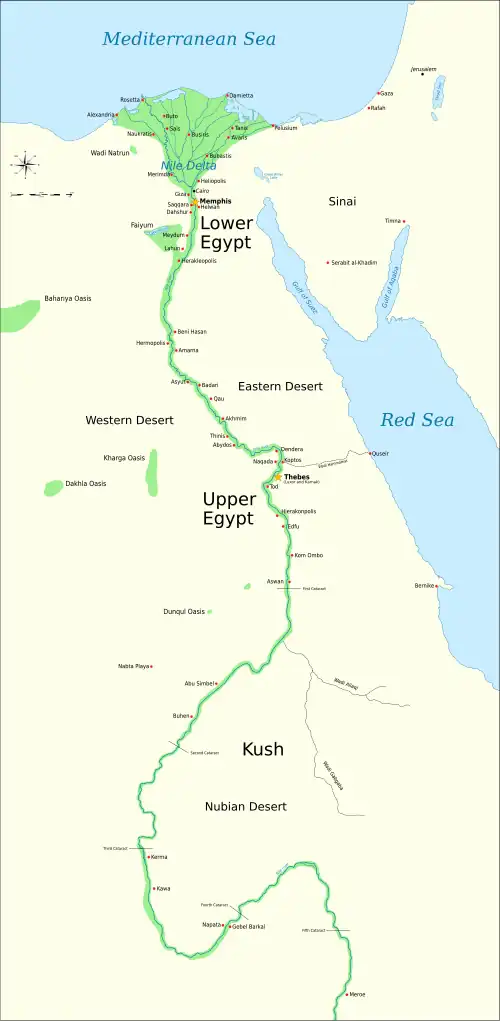
Ancient Egypt Photo credit: Jeff Dahl
Ancient Egypt was a civilization in northeastern Africa concentrated along the middle to lower reaches of the Nile River, reaching its greatest extent in the second millennium BC, during the New Kingdom. It stretched from the Nile Delta in the north as far south as Jebel Barkal at the Fourth Cataract of the Nile, in modern-day Sudan. -
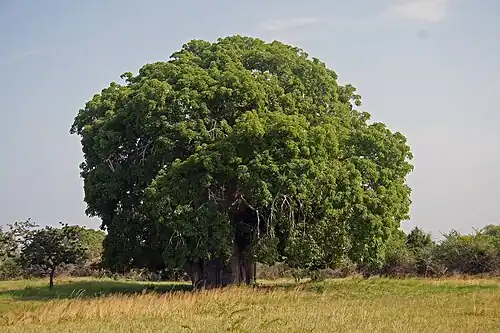 Photograph: Muhammad Mahdi KarimAdansonia digitata is a sub-Saharan African species of baobab tree. The genus, scientifically known as Adansonia, consists of nine species native to Madagascar, Africa, Arabia and Australia, and can reach heights of 5 to 30 m (16 to 98 ft) with trunk diameters of 7 to 11 m (23 to 36 ft).
 -
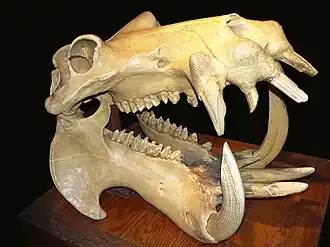
Hippopotamus skull at Disney's Animal Kingdom Photo credit: Mark Pellegrini
The hippopotamus (Hippopotamus amphibius), from the Greek ‘ιπποπόταμος (hippopotamos, hippos meaning "horse" and potamos meaning "river"), is a large, mostly plant-eating African mammal, one of only two extant and three or four extinct species in the family Hippopotamidae. -
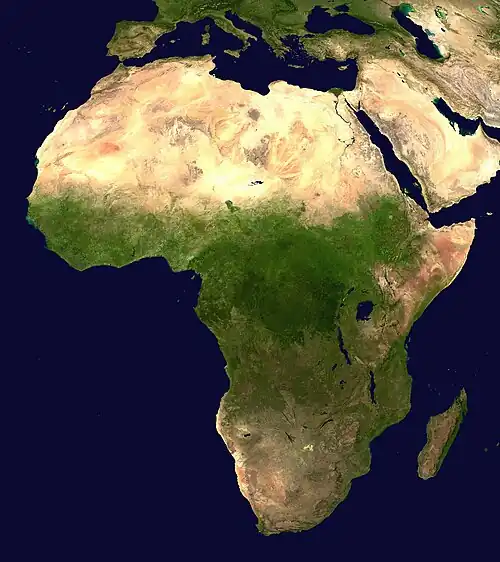
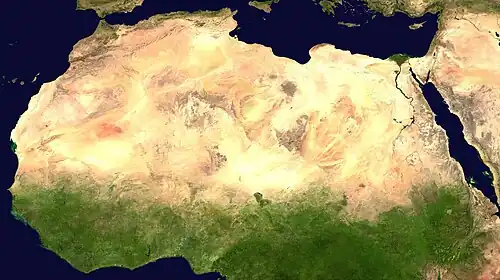
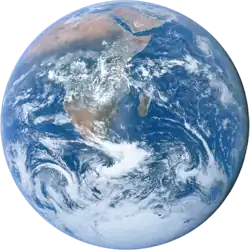
.jpg) Photo: NASAA composite satellite image of the geography of Africa, the Earth's second-largest continent, and its adjacent islands. Separated from Europe by the Mediterranean Sea and from much of Asia by the Red Sea, Africa is joined to Asia at its northeast extremity by the Isthmus of Suez. For geopolitical purposes, the Sinai Peninsula – east of the Suez Canal – is often considered part of Africa, although geographically it belongs in Asia. Africa can be divided into a number of geographic zones: The Atlas Mountains in the north, the Sahara, the coastal plains, and the inner plateaus.
Photo: NASAA composite satellite image of the geography of Africa, the Earth's second-largest continent, and its adjacent islands. Separated from Europe by the Mediterranean Sea and from much of Asia by the Red Sea, Africa is joined to Asia at its northeast extremity by the Isthmus of Suez. For geopolitical purposes, the Sinai Peninsula – east of the Suez Canal – is often considered part of Africa, although geographically it belongs in Asia. Africa can be divided into a number of geographic zones: The Atlas Mountains in the north, the Sahara, the coastal plains, and the inner plateaus. -
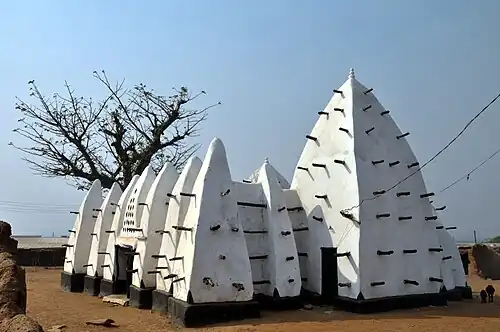 Photograph: Sathyan VelumaniThe Larabanga Mosque was built in the Sudanese architectural style in the village of Larabanga, Ghana. It is the oldest mosque in the country and one of the oldest in West Africa, and has been called the "Mecca of West Africa". It has undergone restoration several times since it was founded. The World Monuments Fund has contributed substantially to its restoration, and lists it as one of the 100 most endangered sites.
 -
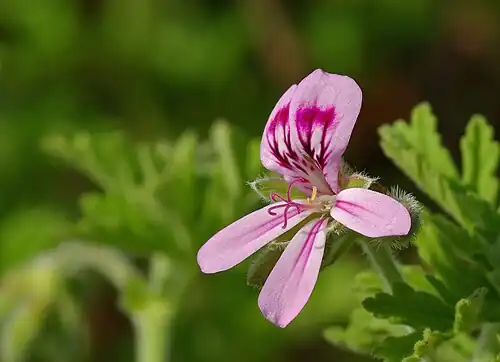 Photo credit: LaitcheThe Rose Geranium (Pelargonium graveolens) is a plant indigenous to various parts of southern Africa, and in particular South Africa. This specific species has great importance in the perfume industry. Its cultivars have a wide variety of smells, including rose, citrus, mint, coconut and nutmeg, as well as various fruits.
 -
.jpg) Banknote: Swakopmund Bookshop (courtesy of the National Numismatic Collection, National Museum of American History)The South West African mark was a temporary currency issued in South West Africa between 1916 and 1918 as part of the South West Africa campaign. Issued after the conquest of German South West Africa by South Africa, notes were denominated in marks and pfennig, as with the withdrawn German South West African Mark. Many institutions issued banknotes; this two-mark note was issued by the Swakopmund Bookshop. The South-West African mark was replaced in 1918 by the South African pound.
Banknote: Swakopmund Bookshop (courtesy of the National Numismatic Collection, National Museum of American History)The South West African mark was a temporary currency issued in South West Africa between 1916 and 1918 as part of the South West Africa campaign. Issued after the conquest of German South West Africa by South Africa, notes were denominated in marks and pfennig, as with the withdrawn German South West African Mark. Many institutions issued banknotes; this two-mark note was issued by the Swakopmund Bookshop. The South-West African mark was replaced in 1918 by the South African pound. -
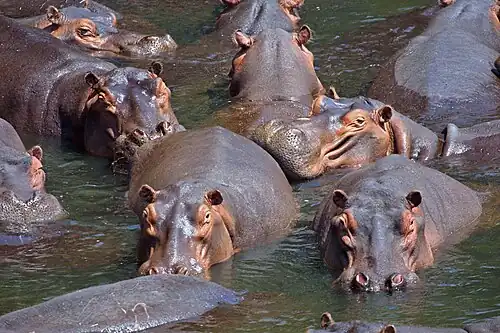
Pod of hippos in Luangwa Valley, Zambia Photo credit: Paul Maritz
The hippopotamus (Hippopotamus amphibius), from the Greek ‘ιπποπόταμος (hippopotamos, hippos meaning "horse" and potamos meaning "river"), is a large, mostly plant-eating African mammal, one of only two extant and three or four extinct species in the family Hippopotamidae. -
 Photograph: Poco a pocoPanoramic view of the Amphitheatre of El Jem, an archeological site in the city of El Djem, Tunisia. The amphitheatre, one of the best-preserved Roman ruins and a UNESCO World Heritage Site since 1979, was built around 238 AD, when modern Tunisia belonged to the Roman province of Africa. It is the third-biggest amphitheatre in the world, with axes of 148 m (486 ft) and 122 m (400 ft) and a seating capacity of 35,000, unique in Africa.
 -
Ring-tailed Lemur holding twins born the previous night in Colchester Zoo, Essex, England Photo credit: NASA
The Sahara (Arabic: الصحراء الكبرى, aṣ-ṣaḥrā´, "The Great Desert") is the world's largest hot desert at over 9,000,000 square kilometres (3,500,000 sq mi). The Sahara defines the borders of North Africa and has an intermittent history that may go back as much as 2.5 million years. -
 Photograph credit: Amada44Eswatini, formerly known as Swaziland, is a landlocked country in Southern Africa. The government is an absolute monarchy, the last of its kind in Africa, and the country has been ruled by King Mswati III since 1986. One of the country's important cultural events is Umhlanga, the reed-dance festival, held in August or September each year. This photograph shows Princess Sikhanyiso Dlamini, the eldest daughter of Mswati III, at the 2006 festival.
 -
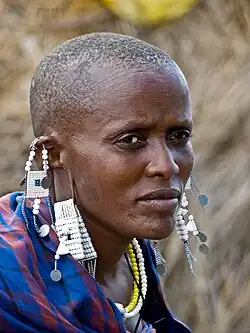 Photo: William WarbyPortrait of a Maasai woman, with shaved head, stretched earlobes, and beaded adornments, typical of the Maasai culture. The Maasai are a Nilotic ethnic group of semi-nomadic people located in Kenya and northern Tanzania. They are among the best known of African ethnic groups, due to their distinctive customs and dress and residence near the many game parks of East Africa. Their primary language Maa (ɔl Maa) is a member of the Nilo-Saharan language family that is related to Dinka and Nuer.
 -
_adult_male.jpg) Photograph credit: Charles J. SharpThe sable antelope (Hippotragus niger) is an antelope which inhabits wooded savanna in eastern and southern Africa, from the south of Kenya to South Africa, with a separate population in Angola. The species is sexually dimorphic, with the male heavier and about one-fifth taller than the female. It has a compact and robust build, characterized by a thick neck and tough skin, and both sexes have ringed horns which arch backward. The sable antelope has four subspecies.
Photograph credit: Charles J. SharpThe sable antelope (Hippotragus niger) is an antelope which inhabits wooded savanna in eastern and southern Africa, from the south of Kenya to South Africa, with a separate population in Angola. The species is sexually dimorphic, with the male heavier and about one-fifth taller than the female. It has a compact and robust build, characterized by a thick neck and tough skin, and both sexes have ringed horns which arch backward. The sable antelope has four subspecies.
This picture shows an adult male common sable antelope (H. n. niger) in the Tswalu Kalahari Reserve, South Africa.
Did you know (auto-generated) -

- ... that Armand Avril travelled in 1960 for a year in Africa, where he was inspired to assemble "bottle caps, clothespins, glue, nails and empty tin cans"?
- ... that Lea Ackermann, a German nun of the Missionary Sisters of Our Lady of Africa, fought against forced prostitution and sex tourism in East Africa?
- ... that Richard Stratton's diplomatic career took him "from South America to Japan, and from Southern Africa to the foothills of the Himalayas"?
- ... that Franklin Sonn was the first black South African ambassador to the United States?
- ... that on February 3, 1986, African Independence Party leaders Adama Touré and Adama Touré were released from detention?
- ... that François-Edmond Fortier published more than 3,300 postcards of French West Africa between 1901 and 1920?
Categories

Selected biography –
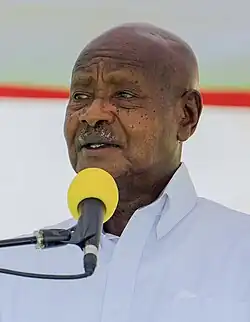
Yoweri Kaguta Museveni Tibuhaburwa (born 15 September 1944) is a Ugandan politician and former military officer who has served as the president of Uganda since 1986. Born in Ntungamo, Uganda (then under British control), Museveni studied political science from the University of Dar es Salaam where he initiated the University Students' African Revolutionary Front. In 1972, he joined the failed invasion of Uganda against Idi Amin's dictatorship.
The next year, Museveni established the Front for National Salvation and fought alongside Tanzanian forces in the Tanzania–Uganda War, which overthrew Amin. Museveni contested the subsequent 1980 general election on the platform of Uganda Patriotic Movement, though claimed electoral fraud after losing to the unpopular Milton Obote. Museveni unified the opposition under the National Resistance Movement and started the Ugandan Bush War. On 30 January 1986, after the decisive Battle of Kampala, Museveni was sworn as president. (Full article...)
Selected country –
 |
 |
|
| ||
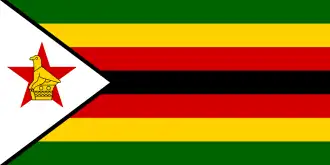
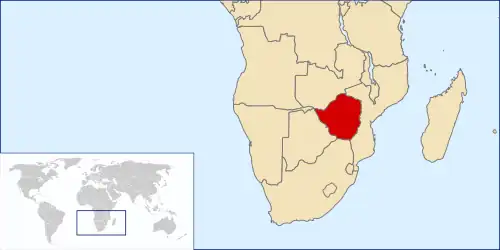
Zimbabwe, officially the Republic of Zimbabwe, is a landlocked country in southern Africa, between the Zambezi and Limpopo rivers. It borders South Africa to the south, Botswana to the southwest, Zambia to the northwest, and Mozambique to the east. The name Zimbabwe derives from "Zimba Remabwe" meaning "big house of stone" in the Shona language. Its use as the country's name is a tribute to Great Zimbabwe, site of the capital of the Empire of Great Zimbabwe. Zimbabwe's highest peak is Mount Nyangani, which lies within Nyanga National Park in the east of the country. The official language of Zimbabwe is English, however the majority of the population speaks Shona.
Under the leadership of former president Robert Mugabe and the current president Emmerson Mnangagwa, the economy of Zimbabwe declined from one of the strongest in Africa to one of the weakest and political tension has never been higher. In 1999, the Movement for Democratic Change was established and have campaigned for an end to "Mugabe's Reign of Terror". 80% of Zimbabweans are unemployed and inflation has soared to well over 15,000%. (Read more...)
Selected city –
.jpg)
Kinshasa (/kɪnˈʃɑːsə/; French: [kinʃasa]; Lingala: Kinsásá), formerly named Léopoldville from 1881–1966 (Dutch: Leopoldstad), is the capital and largest city of the Democratic Republic of the Congo. Kinshasa is one of the world's fastest-growing megacities, with an estimated population of 18.5 million in 2026. It is the most densely populated city in the DRC, the third-most populous city and third-largest metropolitan area in Africa, the world's seventh-most populous city proper (the most populous outside of China) and fourth-most populous capital city. It is the leading economic, political, and cultural center of the DRC, housing several industries including manufacturing, telecommunications, banking, and entertainment. The city also hosts some of the DRC's significant institutional buildings, such as the People's Palace, Palace of the Nation, Court of Cassation, Constitutional Court, African Union City, Marble Palace, Martyrs Stadium, Government House, Kinshasa Financial Center, and other national departments and agencies.
The Kinshasa site has been inhabited by Teke and Humbu people for centuries and was known as Nshasa before transforming into a commercial hub during the 19th and 20th centuries. The city was named Léopoldville by Henry Morton Stanley in honor of Leopold II of Belgium. The name was changed to Kinshasa in 1966 during Mobutu Sese Seko's Zairianisation campaign as a tribute to Nshasa village. Covering 9,965 square kilometers, Kinshasa stretches along the southern shores of the Pool Malebo on the Congo River. It forms an expansive crescent across flat, low-lying terrain at an average altitude of about 300 meters. Kinshasa borders the Mai-Ndombe, Kwilu, and Kwango Provinces to the east; the Congo River delineates its western and northern perimeters, constituting a natural border with the Republic of the Congo; to the south lies the Kongo Central Province. Across the river sits Brazzaville, the smaller capital of the neighboring Republic of the Congo, forming the world's closest pair of capital cities despite being separated by a four-kilometer-wide unbridged span of the Congo River. (Full article...)
In the news
- 20 February 2026 – Nigerian bandit conflict
- At least 50 people are killed and women and children are abducted in overnight attacks by gunmen on a village in Zamfara State, Nigeria. (Reuters)
- 19 February 2026 – Sudanese civil war
- Kordofan campaign
- At least three aid workers are killed and four others are injured in a drone attack by the Rapid Support Forces and Sudan People's Liberation Movement–North on an aid convoy in South Kordofan, Sudan. (Al Jazeera)
- 19 February 2026 –
- Eighteen people are killed and three others are injured when two trucks collide head-on near Port Said, Egypt. (Egypt Today)
- Five miners are trapped underground and presumed dead in a diamond mine after a mudslide in Kimberley, Northern Cape, South Africa. (AP) (Reuters)
- 18 February 2026 –
- A gas explosion at a lead mine in Bashar, Plateau State, Nigeria, kills at least 38 miners working underground and injures 27 others. (AFP via Arab News)
Updated: 13:05, 21 February 2026
General images -
-
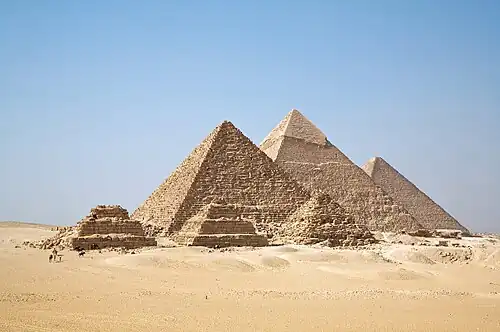 The Great Pyramids of Giza, Egypt (from Culture of Africa)
 -
_5.png) Ruby, Egyptian singer performing (from Culture of Africa)
Ruby, Egyptian singer performing (from Culture of Africa) -
Map of ancient Egypt, showing major cities and sites of the Dynastic period (c. 3150 BC to 30 BC) (from History of Africa)
-
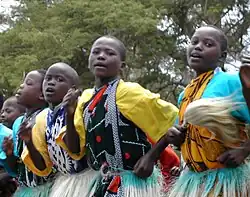 Kenyan boys and girls performing a traditional folklore dance (from Culture of Africa)
 -
 Sudan basket-tray, tabar of weaved natural plant fiber, in different colors (from Culture of Africa)
 -
 Ancient Kano City Walls, Nigeria (from Culture of Africa)
 -
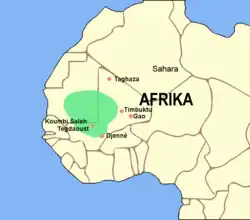 The Ghana Empire at its greatest extent (from History of Africa)
 -
-
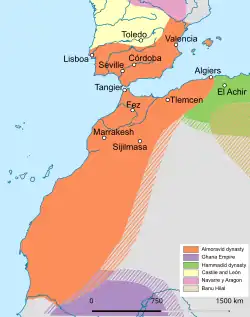 The Almoravid empire in the 12th century. (from History of Africa)
 -
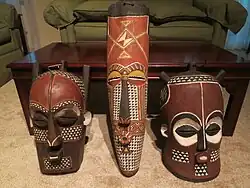
-

-
.jpg) Pre-Neolithic and Neolithic migration events in Africa. (from History of Africa)
Pre-Neolithic and Neolithic migration events in Africa. (from History of Africa) -
 The Kingdom of Aksum in the 6th century AD. (from History of Africa)
 -
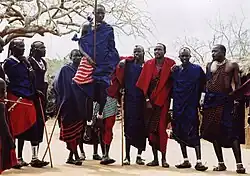 Maasai wearing traditional clothes named Matavuvale while performing Adumu, a traditional dance (from Culture of Africa)
 -
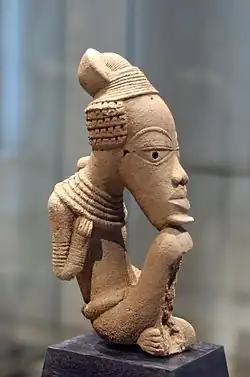 Nok sculpture (from History of Africa)
 -
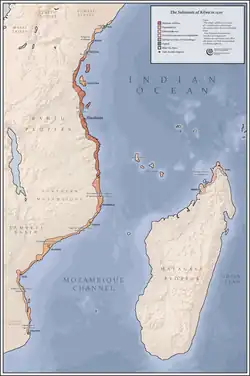 The Kilwa Sultanate in 1310 (from History of Africa)
 -
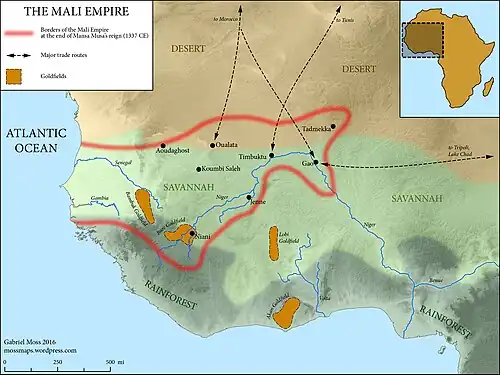 The Mali Empire in 1337 CE, with major gold fields, of Bambuk, Bure, Lobi (tended by the Gan and later Lobi people), and Akan, and trade routes, outlined. The desert should extend further south to Koumbi. The Mossi Kingdoms are located north of Lobi. (from History of Africa)
 -
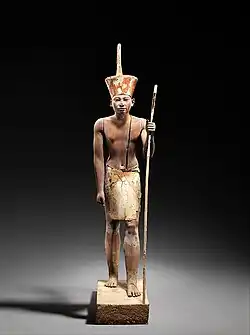 A figure wearing the red crown of Lower Egypt and whose face appears to reflect the features of the reigning king, most probably Amenemhat II or Senwosret II. It functioned as a divine guardian for the imiut, and it is wearing a divine kilt, which suggests that the statuette was not merely a representation of the living ruler. (from History of Africa)
 -
 Map of the western Sahel and Sudan (northern West Africa) c. 1200. (Songhai is Gao)
Kingdoms in this era were centred around cities and cores, with variations of influence radiating out from these points, borders here are estimates. (from History of Africa) -
 Map of trade centres and routes in precolonial Zimbabwe. (from History of Africa)
 -
.jpg)
-
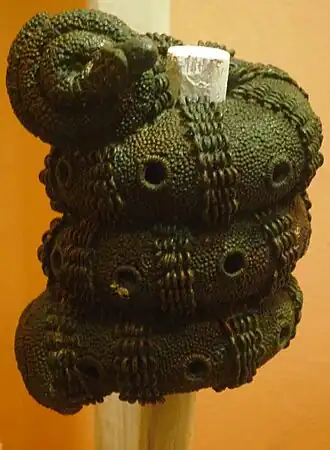 9th-century bronze staff head in form of a coiled snake, Igbo-Ukwu, Nigeria (from History of Africa)
 -
 Order of independence of African nations, 1950–2011
 -

-
-
 Traditional male dancers from Northern Nigeria (from Culture of Africa)
 -
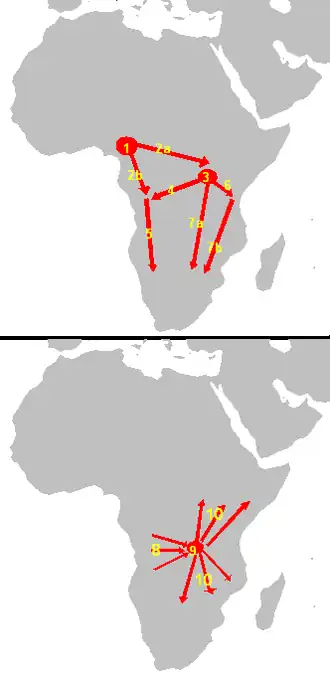
1 = 2000–1500 BC origin
2 = c. 1500 BC first dispersal
2.a = Eastern Bantu
2.b = Western Bantu
3 = 1000–500 BC Urewe nucleus of Eastern Bantu
4–7 = southward advance
9 = 500–1 BC Congo nucleus
10 = AD 1–1000 last phase (from History of Africa) -
 Potjiekos is a traditional Afrikaner stew made with meat and vegetables and cooked over coals in cast-iron pots. (from Culture of Africa)
 -
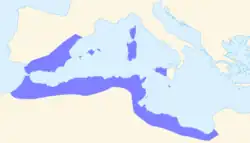 Carthaginian Empire in 323 BC (from History of Africa)
 -
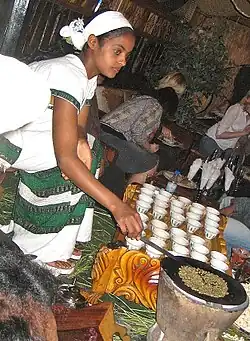 An Ethiopian woman preparing Ethiopian coffee at a traditional ceremony. She roasts, crushes, and brews the coffee on the spot. (from Culture of Africa)
 -
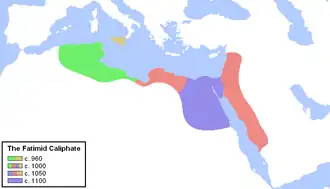 Evolution of the Fatimid Caliphate (from History of Africa)
 -
.svg.png)
-
.jpg) A realistic terracotta head sculpture (1100–1500) of the Yoruba representing the oni or king of Ife (from Culture of Africa)
A realistic terracotta head sculpture (1100–1500) of the Yoruba representing the oni or king of Ife (from Culture of Africa) -
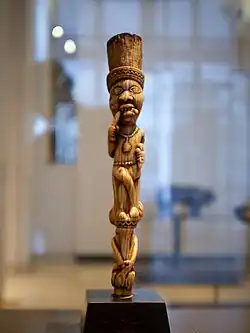 A Yombe sculpture (Louvre, Paris) (from Culture of Africa)
 -
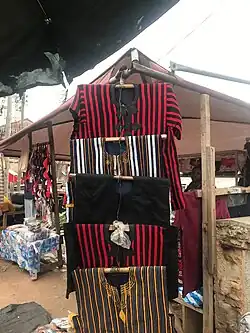 Display of African cultural apparel (smock) (from Culture of Africa)
 -
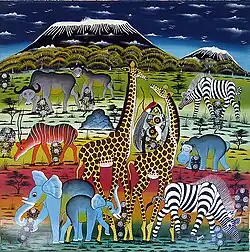 Tingatinga is one of the most widely represented forms of paintings in Tanzania, Kenya and neighbouring countries. (from Culture of Africa)
 -
 Areas controlled by European powers in 1939. British (red) and Belgian (marroon) colonies fought with the Allies. Italian (light green) with the Axis. French colonies (dark blue) fought alongside the Allies until the Fall of France in June 1940. Vichy was in control until the Free French prevailed in late 1942. Portuguese (dark green) and Spanish (yellow) colonies remained neutral. (from History of Africa)
 -
 Gateway to the Castle of Good Hope in South Africa (from Culture of Africa)
 -

-
 Fufu (right) is a staple meal in West Africa and Central Africa. It is usually served with some peanut soup. (from Culture of Africa)
 -
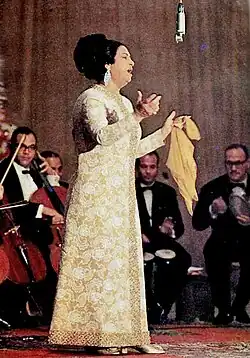 Egyptian singer Umm Kulthum, one of the most iconic singers in African history (from Culture of Africa)
 -
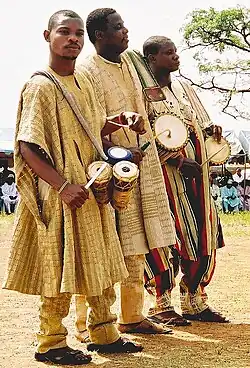
-
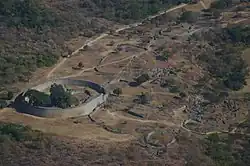 Aerial view of the Great Enclosure and Valley Complex at Great Zimbabwe, looking west (from History of Africa)
 -
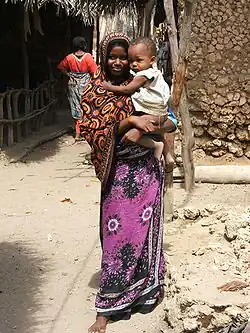
-
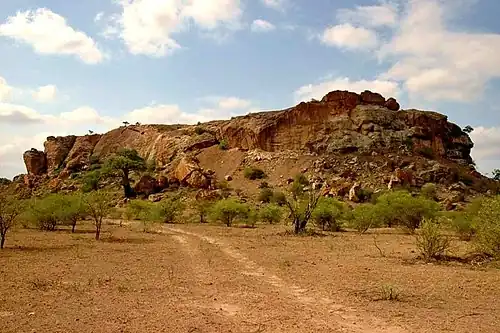 Mapungubwe Hill, which features some ancient San art in a rock shelter on the east side. (from History of Africa)
 -

-

Africa topics
More did you know –
- ...that Rukwanzi Island, an island in Lake Albert, one of the African Great Lakes, is the subject of a territorial dispute between the Democratic Republic of the Congo and Uganda?
- ...that Oumarou Sidikou, vice-governor of the Central Bank of West African States from 1988 to 1993, was a minister in the government of Nigerien Prime Minister Hama Amadou, which was ousted by a military coup in 1996?
- ...that Jason Dunford, an All-Africa Games gold medalist and runner-up for the 2006 Kenyan Sportsman of the Year award, has a younger brother who was selected "most promising sportsman" at the same awards?
- ...that Sam Mbakwe, governor of Imo State from 1979 to 1983, served in the army of the Republic of Biafra, an Igbo secessionist state in southeastern Nigeria, during the Nigerian Civil War?
Related portals
Major Religions in Africa
North Africa
West Africa
Central Africa
East Africa
Southern Africa
Associated Wikimedia
The following Wikimedia Foundation sister projects provide more on this subject:
-
 Commons
Free media repository -
 Wikibooks
Free textbooks and manuals -
 Wikidata
Free knowledge base -
 Wikinews
Free-content news -
 Wikiquote
Collection of quotations -
 Wikisource
Free-content library -
 Wikispecies
Directory of species -
 Wikiversity
Free learning tools -
 Wikivoyage
Free travel guide -
 Wiktionary
Dictionary and thesaurus
More portals
-
 List of all portals
 -

-

-

-
-

-

-

-

-

-
 Random portal
 -
 WikiProject Portals