Portal:Mesoamerica

 the Mesoamerica Portal
 _trim.png)
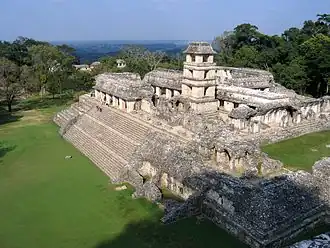
Mesoamerica (Spanish: Mesoamérica) is a region and cultural area in the Americas, extending approximately from central Mexico to Belize, Guatemala, El Salvador, Honduras, Nicaragua, and Costa Rica, within which a number of pre-Columbian societies flourished before the Spanish colonization of the Americas in the 15th and 16th centuries.
As a cultural area, Mesoamerica is defined by a mosaic of cultural traits developed and shared by its indigenous cultures. Beginning as early as 7000 BC, the domestication of maize, beans, squash and chili, as well as the turkey and dog, caused a transition from paleo-Indian hunter-gatherer tribal grouping to the organization of sedentary agricultural villages. In the subsequent formative period, agriculture and cultural traits such as a complex mythological and religious tradition, a vigesimal numeric system, and a complex calendric system, a tradition of ball playing, and a distinct architectural style, were diffused through the area. Also in this period villages began to become socially stratified and develop into chiefdoms with the development of large ceremonial centers, interconnected by a network of trade routes for the exchange of luxury goods such as obsidian, jade, cacao, cinnabar, Spondylus shells, hematite, and ceramics. While Mesoamerican civilization did know of the wheel and basic metallurgy, neither of these technologies became culturally important.
Among the earliest complex civilizations was the Olmec culture which inhabited the Gulf coast of Mexico. In the Preclassic period, complex urban polities began to develop among the Maya and the Zapotecs. During this period the first true Mesoamerican writing systems were developed in the Epi-Olmec and the Zapotec cultures, and the Mesoamerican writing tradition reached its height in the Classic Maya Hieroglyphic script. Mesoamerica is one of only five regions of the world where writing was independently developed. In Central Mexico, the height of the Classic period saw the ascendancy of the city of Teotihuacan, which formed a military and commercial empire whose political influence stretched south into the Maya area and northward. During the Epi-Classic period the Nahua peoples began moving south into Mesoamerica from the North. During the early post-Classic period Central Mexico was dominated by the Toltec culture, Oaxaca by the Mixtec, and the lowland Maya area had important centers at Chichén Itzá and Mayapán. Towards the end of the post-Classic period the Aztecs of Central Mexico built a tributary empire covering most of central Mesoamerica.
Selected article

Maya stelae (singular stela) are monuments that were fashioned by the Maya civilization of ancient Mesoamerica. They consist of tall sculpted stone shafts and are often associated with low circular stones referred to as altars, although their actual function is uncertain. Many stelae were sculpted in low relief, although plain monuments are found throughout the Maya region. The sculpting of these monuments spread throughout the Maya area during the Classic Period (250–900 AD), and these pairings of sculpted stelae and circular altars are considered a hallmark of Classic Maya civilization. The earliest dated stela to have been found in situ in the Maya lowlands was recovered from the great city of Tikal in Guatemala. During the Classic Period almost every Maya kingdom in the southern lowlands raised stelae in its ceremonial centre.
Stelae became closely associated with the concept of divine kingship and declined at the same time as this institution. The production of stelae by the Maya had its origin around 400 BC and continued through to the end of the Classic Period, around 900, although some monuments were reused in the Postclassic (c. 900–1521). The major city of Calakmul in Mexico raised the greatest number of stelae known from any Maya city, at least 166, although they are very poorly preserved.
Hundreds of stelae have been recorded in the Maya region, displaying a wide stylistic variation. Many are upright slabs of limestone sculpted on one or more faces, with available surfaces sculpted with figures carved in relief and with hieroglyphic text. Stelae in a few sites display a much more three dimensional appearance where locally available stone permits, such as at Copán and Toniná. Plain stelae do not appear to have been painted nor overlaid with stucco decoration, but most Maya stelae were probably brightly painted in red, yellow, black, blue and other colours.
Selected biography
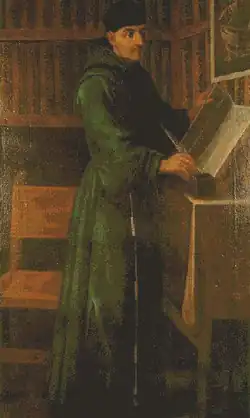
Bernardino de Sahagún (1499 – October 23, 1590) was a Franciscan friar, missionary priest and pioneering ethnographer who participated in the Catholic evangelization of colonial New Spain (now Mexico). Born in Sahagún, Spain, in 1499, he journeyed to New Spain in 1529, and spent more than 50 years conducting interviews regarding Aztec beliefs, culture and history. Though he primarily dedicated himself to the missionary task, his extraordinary work documenting indigenous worldview and culture has earned him the title “the first anthropologist.” He also contributed to the description of the Aztec language Nahuatl, into which he translated the Psalms, the Gospels and a basic manual of religious education.
Sahagún is perhaps best known as the author of Historia general de las cosas de la Nueva España (in English: General History of the Things of New Spain (hereinafter referred to as Historia General). The most famous extant manuscript of the Historia General is the Florentine Codex. It consists of 2400 pages organized into twelve books with approximately 2,000 illustrations drawn by native artists using European techniques. The text in Spanish and Nahuatl documents the culture, religious cosmology (worldview), ritual practices, society, economics, and history of the Aztec people. In the process of putting together the Historia general, Bernardino pioneered new methods for gathering ethnographic information and validating its accuracy. The Historia general has been called “one of the most remarkable accounts of a non-Western culture ever composed,” and Bernardino has been called the father of American ethnography.
Did you know?
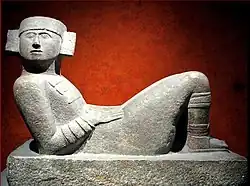
- ... that the Mesoamerican sculptures known as chacmools (example pictured) held receptacles to receive sacrificed human hearts?
Subcategories

Related portals
Selected image
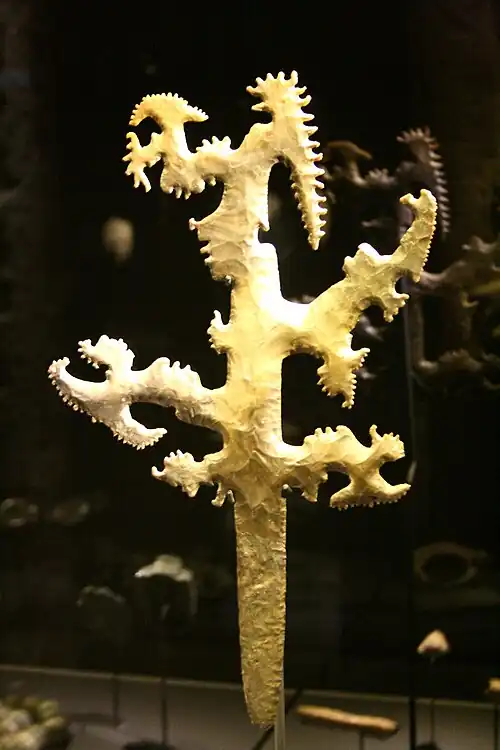 |
An eccentric flint is a chipped artefact produced by the Maya civilization of ancient Mesoamerica. Although generally referred to as "flints", they were typically fashioned from chert, chalcedony and obsidian. Eccentric flints were manufactured by specialist artisans in lithic workshops for non-utilitarian purposes and were sacred high-status objects associated with Maya elite power.
Featured articles

Good Topics
 Wikipedia:Good topics/Spanish conquest of the Maya
Good articles
 Gómez de Alvarado
- La Blanca, Peten
- Calakmul
- Bartolomé de las Casas
- Copán
- El Chal
- Haʼ Kʼin Xook
- History of chocolate
- Hotel Zone (Cancún)
- Itzam Kʼan Ahk II
- Iximche
- Kʼinich Yat Ahk II
- Kʼinich Yoʼnal Ahk I
- Macuahuitl
- Maize
- Manche Chʼol
- Mixco Viejo
- Motul de San José
- Mundo Perdido, Tikal
- North Acropolis, Tikal
- Potbelly sculpture
- William H. Prescott
- Qʼumarkaj
- Resplendent quetzal
- Seibal
- Serpent labret with articulated tongue
- Spanish conquest of Yucatán
- Spanish conquest of Chiapas
- Spanish conquest of El Salvador
- Spanish conquest of the Maya
- Tikal
- Toniná
- Western Mexico shaft tomb tradition
- Benjamin Lee Whorf
- Yoʼnal Ahk III
- Zaculeu
Topics
WikiProjects

- History
- Mesoamerica
- Aztec task force
- Archaeology
- Mesoamerica
- Mexico
- Central America
- Belize
- El Salvador
- Guatemala
- Honduras
- Indigenous peoples of the Americas
Things to do
 |
Here are some tasks awaiting attention:
|
New articles
Rules | Match log | Results page (for watching) | Last updated: 2026-02-17 19:56 (UTC)
Note: The list display can now be customized by each user. See List display personalization for details.
- Rheoheros coeruleus (edit | talk | history | links | watch | logs | tools) by Phil Fish (talk · contribs · new pages (30)) started on 2026-02-16, score: 28
- Mexitli (edit | talk | history | links | watch | logs | tools) by Michael Aurel (talk · contribs · new pages (5)) started on 2026-02-15, score: 92
- Dzibilnocac (edit | talk | history | links | watch | logs | tools) by Juan g. regino (talk · contribs · new pages (1)) started on 2026-02-15, score: 130
- Montanoa atriplicifolia (edit | talk | history | links | watch | logs | tools) by Gaiacoyote (talk · contribs · new pages (7)) started on 2026-02-14, score: 64
- Arne Helleryd (edit | talk | history | links | watch | logs | tools) by Saftgurka (talk · contribs · new pages (19)) started on 2026-02-13, score: 24
- List of ambassadors of Spain to El Salvador (edit | talk | history | links | watch | logs | tools) by TheRichic (talk · contribs · new pages (4)) started on 2026-02-11, score: 28
- Mayas de Chetumal (edit | talk | history | links | watch | logs | tools) by Cocu15 (talk · contribs · new pages (4)) started on 2026-02-09, score: 24
- Hintonia octomera (edit | talk | history | links | watch | logs | tools) by Gaiacoyote (talk · contribs · new pages (7)) started on 2026-02-03, score: 24
- Assembly of Notables (Mexico) (edit | talk | history | links | watch | logs | tools) by Setyobac (talk · contribs · new pages (1)) started on 2026-02-03, score: 26
Associated Wikimedia
The following Wikimedia Foundation sister projects provide more on this subject:
-
 Commons
Free media repository -
 Wikibooks
Free textbooks and manuals -
 Wikidata
Free knowledge base -
 Wikinews
Free-content news -
 Wikiquote
Collection of quotations -
 Wikisource
Free-content library -
 Wikiversity
Free learning tools -
 Wiktionary
Dictionary and thesaurus
-
 List of all portals
 -

-

-

-
-

-

-

-

-

-
 Random portal
 -
 WikiProject Portals