Serpent labret with articulated tongue
| Serpent labret with articulated tongue | |
|---|---|
 Serpent labret with articulated tongue, with tongue extended | |
| Material | Alloy of gold, copper, silver |
| Weight | 1.81 ounces |
| Created | c. 1300–1521 AD |
| Present location | Metropolitan Museum of Art, New York City |
| Registration | 2016.64 |
The serpent labret with articulated tongue is a gold lip plug from the Aztec culture of the mid-second millennium AD. Designed to be inserted in a piercing below the lower lip, it depicts a fanged serpent preparing to strike, with a bifurcated tongue hanging from its mouth. The tongue, which is moveable and retractable, would have swung from side to side with its wearer's movements. According to a curator at the Metropolitan Museum of Art, the labret is "perhaps the finest Aztec gold ornament to survive the crucibles of the sixteenth century".[1]
Labrets were associated with the nobility in Aztec culture, worn by rulers and meted out as honours; even then, gold labrets likely remained the province of the élite. Gold was a hallmark of divinity—"the excrement of the sun", left behind as it traversed the underworld at night—and eloquence a hallmark of nobility: the title for the leader of the Aztec Empire was huei tlahtoani, literally "Great Speaker". The serpent, too, may represent Xiuhcoatl, the fire serpent wielded as a weapon by the sun god Huītzilōpōchtli. Worn prominently on the face, the labret likely symbolised the wearer's status and eloquence, and possibly divine right.
The labret is dated to 1300–1521, the period during which the Aztecs flourished. Consisting of a gold, copper, and silver alloy, it was made by lost-wax casting; although such goldwork is traditionally ascribed to Mixtec makers, the Aztecs, particularly by the time of the Aztec Empire, may have also had their own sophisticated goldworking workshops. The labret was known by 1937, when it was placed on long-term loan at the American Museum of Natural History; it spent much of its succeeding history in private hands but on display, then was purchased in 2016 by the Met.
Background
Aztecs
The Aztecs were a Mesoamerican culture that flourished in central Mexico from around 1300 to 1521 AD. According to legend, the broad strokes of which find some support in the written and archaeological record, the Aztecs founded Tenochtitlan (modern-day Mexico City) on an island in Lake Texcoco in 1325, following several centuries of migration from Aztlán—a spot perhaps to the northwest of Mexico City and the origin of the name "Aztec", literally "person of Aztlán".[2][3][4] In 1428, after a century of various alliances and friction with the surrounding populations, the Aztec Empire was founded.[5] Also known as the Triple Alliance, the Empire was a coalition of the city-states Tenochtitlan, Texcoco, and Tlacopan.[6]
The Aztec Empire exacted a heavy tribute (or tax) of gold from the surrounding regions—perhaps amounting to 500 kilograms (1,100 lb) a year—and the Aztecs had a rich tradition of goldwork to match.[7] The manufacture of such objects at this time has traditionally been attributed to the Mixtecs to the south, or to Mixtec makers stationed in Tenochtitlan.[8][9][10] More recent research has suggested that the Aztecs had their own sophisticated goldworking operation, particularly by the end of the fifteenth century.[11][12]
Though the gold tribute would have been sufficient to manufacture tens of thousands of small- to medium-sized ornaments each year, fewer than 400 survive.[13] In 1519, the Spanish conquistador Hernán Cortés landed on the shores of Mexico, and by 1521, he had decimated the Aztec Empire.[14] The Spanish were taken by, and took, the luxury that they found; seeing the gold and silver, Cortés wrote that "no smith in the world could have done better".[15] The German artist Albrecht Dürer, who saw some of the plunder that was shipped back, claimed that "[i]n all my life I have never seen anything that has so delighted my heart as did these objects; for there I saw strange works of art and have been left amazed by the subtle inventiveness of the men of far off lands."[16] "Maddeningly enough," however, wrote the curator Jay Levenson, "although Dürer appears always to have had a sketchbook with him, no drawings of his are known of the now-lost masterpieces which he described."[17] Almost all of the gold was swiftly melted down, and turned into ingots.[1]
Labrets
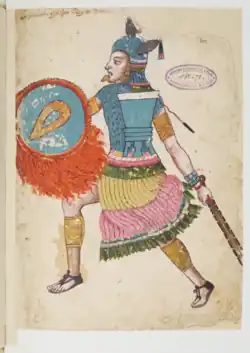
Labrets, or lip plugs, are a type of jewellery inserted through a piercing below the lower lip.[1] Called tentetl (literally, "lip stone") in the Aztec language Nahuatl, labrets were associated with status and power.[1][18] The Franciscan friar Bernardino de Sahagún, writing in the Florentine Codex, records a labret as among Moctezuma II's coronation regalia.[19] The Dominican friar Diego Durán, meanwhile, writing in The History of the Indies of New Spain, records labrets as among the presents Moctezuma bestowed upon visiting lords for the occasion.[20] Other such regalia and gifts included diadems in turquoise and gold, bracelets, calf bands, ear ornaments, and ear and nose plugs.[21] Surviving Aztec codices record, in text and in illustration, numerous different types of labrets, from plain to elaborate; many different words were used to describe the different types, and certain ones were bestowed or worn on certain occasions.[22][note 1] For example, labrets were also awarded with the honours afforded successful warriors—the Codex Mendoza depicts the highest-ranking noble-warriors wearing long, hanging labrets—and merchants who returned from perilous trips to foreign lands were sometimes rewarded by being permitted to wear gold ornaments and amber labrets to mark themselves among the nobility.[23][1]
The link between labrets and the nobility may have been reinforced by the link between the nobility and eloquence.[1][24] The title for the leader of the Aztec Empire was huei tlahtoani, literally "Great Speaker".[1][24] Eloquence was expected of nobles; according to Durán, noble children "were told to speak without stuttering, without nervousness or haste".[25] Positioned on the face directly below the lips, labrets likely highlighted the eloquence expected of nobles, and underscored their right to speak and be heard.[1][24][26] Somewhat contradictorily, however, the wearing of a labret may have made speaking more difficult.[27]

.png)
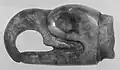
Sahagún also records apparel worn by Moctezuma when he would dance, including different types of labrets: cylinders made of crystal, turquoise, or green stone, and labrets of gold, including eagles and "fire serpents".[28] The description is reminiscent of several labrets that still survive.[28] Although most such labrets are plain,[29][30][31] made of obsidian or greenstone,[1] several are reminiscent of Sahagún's description.[28] Gold eagle labrets are held by the Metropolitan Museum of Art (the "Met"),[32] the Saint Louis Art Museum,[33] the Los Angeles County Museum of Art,[34] and the Museo Civico d'Arte Antica in Turin.[35][36] The Met also holds an eagle in jadeite.[37][1] The Turin example, in particular, closely parallels one worn by the Aztec ruler Nezahualcoyotl in his depiction in the Codex Ixtlilxochitl.[28]
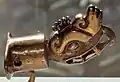
The Princeton University Art Museum owns a gold curassow labret,[38] and the Weltmuseum in Vienna a bird's head labret in gold and rock crystal;[39] another gold bird's head is held by the American Museum of Natural History in New York City,[40][41] and two others were auctioned by Giquello in 2021, for €64,202,[42] and by Sotheby's in 2024, for $10,800 (each including fees).[43] A gold bird's head, possibly of a parrot, was owned by Suzannah Beck Vaillant as of 1962.[44] Dumbarton Oaks in Washington, D.C. has a gold head of a bird, reptile, or composite animal.[45] Also in D.C., the National Museum of the American Indian holds a gold bird's head labret,[46] alongside a gold serpent that, like the Metropolitan's example, features a movable tongue.[47][1][48] The Eskenazi Museum of Art holds a gold bird's head labret that may represent the wind god Ehecatl;[49] another gold labret representing Ehecatl was auctioned in the same 2021 sale by Giquello, but was bought in against an estimate of €20–25,000.[50] The Seattle Art Museum also holds a gold labret that, while plainer, may represent the fang of a serpent or beak of a bird.[51][52]
Description
The labret is 2.625 in (6.67 cm) high, 1.75 in (4.4 cm) wide, 2.625 in (6.67 cm) deep, and weighs 1.81 ounces (51 g).[1] It is hollow, and made of an alloy of 59.3 to 64.3% gold, 26.8 to 33.1% copper, and 7.5 to 8.8% silver.[1][53]
The piece is shaped like a serpent preparing to strike, with a curled eyebrow and snout, serrated teeth, two fangs, and bifurcated tongue.[1] The snout is large, with rounded nostrils, while the eyes are set under a pronounced supraorbital plate.[1] The tongue was cast to hang freely, giving it a liveliness that allows it to be retracted or extended, and to swing from side to side with the movement of its wearer.[1][54][55] The underside of the lower jaw is covered in scales; atop the head is depicted a feathered and beaded headdress, represented in false filigree by a circle of ten spheres from which extend three loops.[1] The circles surround a small recess, perhaps once inlaid with stone.[1] The serpent is attached to a cylindrical plug, decorated with a ring of small spheres and spirals, which has a wide and plain flange to hold the labret in place within the wearer's mouth.[1]
The labret, according to the Met curator Joanne Pillsbury, is "perhaps the finest Aztec gold ornament to survive the crucibles of the sixteenth century".[1][10] It is a rare example not just of ancient goldworking, but of the highest levels of Aztec culture, "a world almost entirely obliterated when Hernán Cortés arrived on the shores of Mexico in 1519".[1]
Symbolism
Serpents were a longstanding motif of Mesoamerican art, appearing since at least the second millennium BC.[1][56] They were particularly associated with rulers, in part because of the perception that snakes were able to transcend realms, from earth, to water, to sky.[1] On the Metropolitan's labret, the use of wavy lines throughout, even more so than on the serpent owned by the National Museum of the American Indian, "gives not only a higher artistic touch to the piece," according to the art historian Pál Kelemen, "but removes it deeper into the world of fantasy".[57][58] The labret's snout and curled eyebrows, and the feathered headdress, indicate that the piece may depict Xiuhcoatl, a mythological fire serpent wielded as a weapon by the sun god Huītzilōpōchtli.[1]
The labret's material, gold, likely also carried symbolic weight.[1] According to Sahagún, Aztecs considered gold to be Tōnatiuh icuitl, the "excrement of the sun",[note 2] left behind as he traversed the underworld at night.[60][28] Such labrets, especially when worn with other gold objects, would likely have evoked a connection with divinity, and implied a ruler's divine right.[28][1] To Pillsbury, "Worn on ritual occasions and on the battlefield", the labret "would have been a terrifying sight".[1] To the art historian Dudley T. Easby Jr., however, the weight would have made it impractical to wear, and it may have instead been designed to be a funerary or votive offering.[61]
Manufacture
The labret is dated to 1300–1521, reflecting the period of time in which the Aztecs flourished,[1] and could be of Mixtec or Aztec origin.[56] It was made via lost-wax casting in three pieces.[53][1][note 3] The tongue would have been cast first, using double-thickness wax, then filed and polished.[53] The head and neck piece would then have been prepared for casting, with the finished tongue inserted into the core.[53] The core was engraved, with the head and neck modeled in wax; comma-shaped marks into the metal show where the maker used a tool to press the wax in the core's grooves.[53] This would have then been coated in a thin charcoal paste, known as teculatl.[62] This became the lining of the mould, and ensured the sharpness and accuracy of the gold cast.[62]
During the casting of the second piece the already-cast tongue appears to have shifted, displacing the wax from the top of the maxillary arch.[53] Three holes 4 mm (0.16 in) in diameter—one behind the neck, one below the jaw, one below the body—show where something such as wood or thorns was used to support the core.[53] The second piece would then have been cleaned and polished.[53] Finally, the second piece would have been fit to the core of the flanged base, and this third piece then cast.[53]
Provenance
The early history of the labret is unknown.[56] It was acquired by 1937 by Heath McClung Steele, an executive at American Metal Company, and owned by him until 1949.[63] His children—Margaret Truman Fahnestock,[64] Heath Warren Steele,[65] and David Truman Steele[66]—next owned it until 1978,[1] although throughout these periods it was on long-term loan to the American Museum of Natural History. The labret was then sold at Sotheby's in New York on 22 November 1978 for $101,000 (equivalent to $499,000 in 2025);[67] it passed into the collection of Jay C. Leff, a bank executive,[68] until 1981.[1] From there it was sold by Judith Small Nash, a dealer and collector,[69] then owned by Peter G. Wray, a major rancher,[70] until 1 March 1985.[1] It was next owned by Herbert L. Lucas through 2004.[1]
From 2004 until 2016, the labret was in a private New York collection.[1] It was then purchased by the Metropolitan Museum of Art in 2016, using funds from the 2015 Benefit Fund and the Lila Acheson Wallace Gift, and given the accession number 2016.64.[1][71][72] It its biennial report on new acquisitions, the Metropolitan noted the labret as one of its recent highlights, along with the Crown of the Andes.[73]
Exhibitions

Even before its acquisition by the Met, the labret has been on display for the majority of the time that it has been known.[1]
- 1937–1978 — American Museum of Natural History, New York, long-term loan (with interruptions, including World War II and the exhibition below)
- 1940 — Museum of Modern Art, New York, exhibition ("Twenty Centuries of Mexican Art/Veinte Siglos de Arte Mexicano")[74]
- 28 September 1983–8 January 1984 — National Gallery of Art, Washington, D.C., exhibition ("Art of Aztec Mexico: Treasures of Tenochtitlan")[48]
- Beginning 1985 (likely through at least 1992[10]) — Detroit Institute of Arts, long-term loan (T1985.198, from Herbert L. Lucas)
- 12 October 1991–12 January 1992 — National Gallery of Art, exhibition ("Circa 1492: Art in the Age of Exploration")[10]
- 6 January 1993–1 November 2004 — Metropolitan Museum of Art, long-term loan (L.1993.4, from Herbert L. Lucas)
- August 2013–February 2016 — Metropolitan Museum of Art, long-term loan (L.2013.72, from a private collection in New York)
- 16 September 2017–28 January 2018 — J. Paul Getty Museum, exhibition ("Golden Kingdoms: Luxury and Legacy in the Ancient Americas")[75][76]
- 26 February 2018–28 May 2018 — Metropolitan Museum of Art, exhibition ("Golden Kingdoms: Luxury and Legacy in the Ancient Americas")[75][76]
- 12 November 2018–24 February 2019 — Metropolitan Museum of Art, exhibition ("Jewelry: The Body Transformed")[77]
Gallery
-
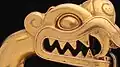 Close-up of head
 -
 Close-up of mouth
 -
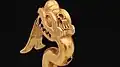 The headdress
 -
 Decorations on the plug
 -
 Front
Front -
 Back, showing base of plug and one of the three support holes from casting
 -
 Underside, showing scales beneath the jaw and the other two support holes from casting
-
 Gold serpent's head (NMAI)
 -
 Gold eagle head (Met)
 -
 Gold eagle head (Saint Louis Art Museum)
 -
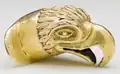 Gold eagle head (LACMA)
 -
Gold eagle head (Turin)
-
 Gold curassow head (Princeton)
 -
 Gold bird's head (NMAI)
 -
 Gold bird/reptile/composite head (Dumbarton Oaks)
 -
 Gold bird-like head, possibly Ehecatl (Eskenazi)
 -
 Jadeite eagle head (Met)
References
- ^ a b c d e f g h i j k l m n o p q r s t u v w x y z aa ab ac ad ae af ag ah ai aj Pillsbury, Joanne (2016). "Serpent Labret with Articulated Tongue". Metropolitan Museum of Art. Archived from the original on 22 September 2023. Retrieved 28 December 2023.

- ^ Boone 1994, pp. 28–45.
- ^ Levenson 1991, pp. 499–500.
- ^ Nicholson & Keber 1983, pp. 22, 181.
- ^ Boone 1994, pp. 44–49.
- ^ Boone 1994, p. 49.
- ^ King 2015, pp. 313, 315–318.
- ^ López Luján & Ruvalcaba Sil 2015, p. 43.
- ^ King 2015, p. 313.
- ^ a b c d Levenson 1991, p. 555.
- ^ López Luján & Ruvalcaba Sil 2015, pp. 43–48.
- ^ King 2015, p. 324.
- ^ King 2015, pp. 313–314.
- ^ Boone 1994, pp. 140–151.
- ^ Boone 1994, pp. 82–83.
- ^ Nicholson & Keber 1983, p. 29.
- ^ Levenson 1991, pp. 9, 20.
- ^ Olko 2014, p. 76.
- ^ Hajovsky 2015, pp. 48–49.
- ^ Hajovsky 2015, p. 54.
- ^ Hajovsky 2015, pp. 48–49, 54.
- ^ a b Olko 2014, pp. 76–79.
- ^ Hajovsky 2015, pp. 54–56, 80.
- ^ a b c Hajovsky 2015, pp. 68–70.
- ^ Hajovsky 2015, p. 70.
- ^ Houston & Cummins 2004, pp. 369–370.
- ^ Dickey, Muse & Wiencek 1982, pp. 129–131.
- ^ a b c d e f Hajovsky 2015, p. 68.
- ^ "Labret". Metropolitan Museum of Art. Archived from the original on 28 December 2023. Retrieved 28 December 2023.
- ^ "Lip Plug". Metropolitan Museum of Art. Archived from the original on 28 December 2023. Retrieved 28 December 2023.
- ^ "Lip Plug". Metropolitan Museum of Art. Archived from the original on 28 December 2023. Retrieved 28 December 2023.
- ^ "Labret, Eagle Head". Metropolitan Museum of Art. Archived from the original on 28 December 2023. Retrieved 27 December 2023.
- ^ "Lip Plug in the Form of an Eagle Head (teocuitcuauhtentetl)". Saint Louis Art Museum. Archived from the original on 28 December 2023. Retrieved 27 December 2023.
- ^ "Labret in the Form of an Eagle Head". Los Angeles County Museum of Art. Archived from the original on 28 December 2023. Retrieved 28 December 2023.
- ^ "Ornamento labiale" [Lip ornament]. Palazzo Madama (in Italian). Turin. Archived from the original on 30 December 2023. Retrieved 30 December 2023.
- ^ "Tentetl/Lip ornament". Google Arts & Culture. Archived from the original on 30 December 2023. Retrieved 30 December 2023.
- ^ "Labret". Metropolitan Museum of Art. Archived from the original on 28 December 2023. Retrieved 28 December 2023.
- ^ "Gold labret in form of a curassow, ca. A.D. 1450". Princeton University Art Museum. Archived from the original on 28 December 2023. Retrieved 28 December 2023.
- ^ "Lip ornament". Weltmuseum Wien. Archived from the original on 8 February 2026. Retrieved 8 February 2026.
- ^ Emmerich 1963, pp. 200, 242–243.
- ^ Emmerich 1965, p. 139.
- ^ "Rare Labret - Eagle Head Aztec Period Mixtec culture, Mexico - Lot 73". Giquello. 29 June 2021. Archived from the original on 9 February 2026. Retrieved 9 February 2026.
- ^ "Mixtec Gold Labret of an Avian". Sotheby's. 2024. Archived from the original on 2 December 2024. Retrieved 9 February 2026.
- ^ Vaillant & Vaillant 1962, p. 17 & pl. 30.
- ^ "Labret". Dumbarton Oaks. 8 March 2023. Archived from the original on 13 August 2022. Retrieved 8 February 2026.
- ^ "Labret/Lip plug representing a bird". National Museum of the American Indian. Washington, D.C. Archived from the original on 15 June 2025. Retrieved 8 February 2026.
- ^ "Puebla-style labret in the form of a snake's head". National Museum of the American Indian. Archived from the original on 30 April 2025. Retrieved 6 February 2026.
- ^ a b Nicholson & Keber 1983, p. 154.
- ^ "Labret". Collections Online. Eskenazi Museum of Art. Retrieved 16 February 2026.
- ^ "Labret Figuring "Ehecatl" the Wind God Mixtec culture of Azt - Lot 74". Giquello. 29 June 2021. Archived from the original on 16 February 2026. Retrieved 16 February 2026.
- ^ "Labret". Seattle Art Museum. Archived from the original on 8 February 2026. Retrieved 8 February 2026.
- ^ Smith, Elisabeth (13 April 2018). "Object of the Week: Labret". SAM Blog. Seattle Art Museum. Archived from the original on 17 April 2018. Retrieved 8 February 2026.
- ^ a b c d e f g h i Easby 1955, pp. 104–105, 114–117.
- ^ Vaillant 1944, p. 140 & pl. 47.
- ^ Vaillant & Vaillant 1962, p. 147 & pl. 45.
- ^ a b c Meyer 1970, p. 105.
- ^ Kelemen 1943a, p. 274.
- ^ Kelemen 1943b, pl. 229.
- ^ Roskamp 2010, p. 70.
- ^ Klein 1993, pp. 25–26 & n.52.
- ^ Easby 1955, p. 104.
- ^ a b Easby 1955, pp. 93–94, 104–105, 114–117.
- ^ "H. M. Steele, Native Of Knox, Dies". The Knoxville Journal. Vol. 117. Knoxville, Tennessee. 23 February 1956. p. 3. Archived from the original on 30 December 2023. Retrieved 29 December 2023 – via Newspapers.com.
- ^ "Lewis, Margaret Truman Steele Fahnestock". Death Notices. The Tennessean. Vol. 98, no. 109. Nashville, Tennessee. 19 April 2002. p. 7B. Archived from the original on 30 December 2023. Retrieved 29 December 2023 – via Newspapers.com.
- ^ "Heath Warren Steele". Obituaries. The Enterprise. Vol. 96, no. 86. Lexington Park, Maryland. 28 October 1994. p. A-10. Archived from the original on 29 December 2023. Retrieved 29 December 2023.
- ^ "David Truman Steele". Obituaries. The Enterprise. Vol. 90, no. 25. Lexington Park, Maryland. 30 March 1988. p. A-8. Archived from the original on 30 December 2023. Retrieved 29 December 2023.
- ^ Sotheby's 1978, lot 129.
- ^ Thomas, Mary (25 January 2000). "Jay C. Leff". Obituaries. Pittsburgh Post-Gazette. Vol. 73, no. 178. Pittsburgh, Pennsylvania. p. B-5. Archived from the original on 30 December 2023. Retrieved 29 December 2023 – via Newspapers.com.
- ^ "Anonymous (Cuzco School Late 18th Century)". Christie's. 2017. Archived from the original on 29 December 2023. Retrieved 29 December 2023.
- ^ Reif, Rita (8 April 1984). "Antiques View; An Abundance of Pre-Columbian Art". Antiques View. The New York Times. Vol. CXXXIII, no. 46, 008. New York. p. 2-30. Archived from the original on 29 December 2023. Retrieved 29 December 2023.
- ^ Pillsbury, Joanne (Fall 2016). "Labret in the Form of a Serpent with an Articulated Tongue". The Metropolitan Museum of Art Bulletin. LXXIV (2). New York: The Metropolitan Museum of Art: 28. JSTOR 48567953. Archived from the original on 2023-12-29. Retrieved 2023-12-29.
- ^ Pillsbury, Joanne (2016). "Serpent Labret with Articulated Tongue". MetCollects. Metropolitan Museum of Art. Archived from the original on 30 December 2023. Retrieved 29 December 2023.
- ^ Metropolitan Museum Recent Acquisitions 2016, pp. 3, 28, 39.
- ^ Twenty Centuries of Mexican Art 1940.
- ^ a b Pillsbury, Potts & Richter 2017.
- ^ a b Pillsbury 2018.
- ^ Holcomb 2018, pp. 32–33.
Notes
- ^ Other words used for more specific types of labrets included tençacatl ("lip straw", perhaps longer and thinner), tencololli ("something bent for the lips", designating curved labrets), teocuitlatentetl (gold labret), apatlactempilolli coztic teocuitlatl (gold labret shaped like a broad-leafed water plant), ahuictempilolli (labret shaped like a boating pole), atototempilolli (labret shaped like a pelican), metztempilolli (labret shaped like a crescent), xiuhcoatempilolli (labret shaped like a fire serpent), tehuilotentetl (labret made of rock crystal), and chalchiuhtençacanecuilli (curved greenstone labret).[22]
- ^ Another term for gold was teocuitlatl: "often translated (not without a sense of humor) as 'holy shit'".[59]
- ^ For a description of lost-wax casting by Aztecs, see Bray 1968, pp. 131–132.
Bibliography

- Boone, Elizabeth Hill (1994). The Aztec World. Montréal: St. Remy Press. ISBN 0-89599-040-7. LCCN 94-9830.
- Bray, Warwick (1968). Everyday Life of the Aztecs. New York: Dorset Press. ISBN 0-88029-143-5.
- Dickey, Thomas; Muse, Vance & Wiencek, Henry (1982). The God-Kings of Mexico. Treasures of the World. Chicago: Stonehenge Press Inc. ISBN 0-86706-020-4. LCCN 81-84861.
- Easby, Dudley T. Jr. (1955). "Sahagún y los orfebres precolombinos de México" [Sahagún and the pre-Columbian goldsmiths of Mexico]. Anales del Instituto Nacional de Antropología e Historia [Annals of the National Institute of Anthropology and History] (in Spanish). IX (38). Instituto Nacional de Antropología e Historia: 85–117.
- Emmerich, André (1963). Art Before Columbus. Vol. I. New York: Simon & Schuster. LCCN 63-16027.
- Emmerich, André (1965). Sweat of the Sun and Tears of the Moon: Gold and Silver in Pre-Columbian Art. Vol. I. Seattle: University of Washington Press. LCCN 65-10817.
- Hajovsky, Patrick Thomas (2015). On the Lips of Others: Moteuczoma's Fame in Aztec Monuments and Rituals. Austin: University of Texas Press. doi:10.7560/766686. ISBN 978-0-292-76668-6. JSTOR 10.7560/766686. LCCN 2014023105.
- Holcomb, Melanie, ed. (2018). Jewelry: The Body Transformed. New York: The Metropolitan Museum of Art. ISBN 978-1-58839-650-1.
- Houston, Stephen D. & Cummins, Tom (2004). "Body, Presence, and Space in Andean and Mesoamerican Rulership". In Evans, Susan Toby & Pillsbury, Joanne (eds.). Palaces Of The Ancient New World: A Symposium at Dumbarton Oaks 10th and 11th October 1998. Washington, D.C.: Dumbarton Oaks Research Library and Collection. pp. 359–398. ISBN 0-88402-300-1. LCCN 84-22035.
- King, Timothy B. (Fall 2015). "The Case for the Aztec Goldsmith". Ancient Mesoamerica. 26 (2). Cambridge University Press: 313–327. JSTOR 26301972.
- Klein, Cecelia F. (Fall 1993). "Teocuitlatl, "Divine Excrement": The Significance of "Holy Shit" in Ancient Mexico". Art Journal. 52 (3). New York: College Art Association: 20–27. doi:10.1080/00043249.1993.10791519. JSTOR 777364.
- Levenson, Jay A., ed. (1991). Circa 1492: Art in the Age of Exploration (PDF). New Haven: Yale University Press. ISBN 0-300-05167-0. LCCN 91-50590.
- López Luján, Leonardo & Ruvalcaba Sil, José Luis (January–June 2015). "El oro de Tenochtitlan: la colección arqueológica del Proyecto Templo Mayor" [Tenochtitlan’s Gold: the Archaeological Collection of the Great Temple Project] (PDF). Estudios de Cultura Náhuatl [Studies of Nahuatl Culture] (in Spanish). 49: 7–57.
- Meyer, Alfred, ed. (1970). Ancient Mexico and Central America. New York: The American Museum of Natural History.
- Mysteries of the Ancient Americas: The New World Before Columbus. Pleasantville, New York: The Reader's Digest Association, Inc. 1986. ISBN 0-89566-183-7. LCCN 84-15038.
- Nicholson, Henry B. & Keber, Eloise Quiñones (1983). Art of Aztec Mexico: Treasures of Tenochtitlan (PDF). Washington, D.C.: National Gallery of Art. ISBN 0-89468-070-6. LCCN 83-17217.
- Olko, Justyna (2014). Insignia of Rank in the Nahua World: From the Fifteenth to the Seventeenth Century. Boulder: University Press of Colorado. ISBN 978-1-60732-240-5. JSTOR j.ctt6wrrbn.
- Kelemen, Pál (1943a). Medieval American Art: A Survey in Two Volumes: Text. Vol. I. New York: The Macmillan Company.
- Kelemen, Pál (1943b). Medieval American Art: A Survey in Two Volumes: Illustrations. Vol. II. New York: The Macmillan Company.
- Republished as Kelemen, Pál (1956). Medieval American Art (one-volume ed.). New York: The Macmillan Company.
- Pillsbury, Joanne (Spring 2018). "Art on View: Golden Kingdoms: Luxury Arts in the Ancient Americas". Tribal Art. XXII (87). Arquennes, Belgium: Primedia S.P.R.L.: 78–89.
- Pillsbury, Joanne; Potts, Timothy & Richter, Kim N., eds. (2017). Golden Kingdoms: Luxury Arts in the Ancient Americas. Los Angeles: Getty Publications. ISBN 978-1-60606-548-8.
- "Recent Acquisitions: A Selection: 2014–2016". The Metropolitan Museum of Art Bulletin. LXXIV (2). New York: Metropolitan Museum of Art. Fall 2016. ISSN 0026-1521.
- Roskamp, Hans (Spring 2010). "God of Metals: Tlatlauhqui Tezcatlipoca and the Sacred Symbolism of Metallurgy in Michoacan, West Mexico". Ancient Mesoamerica. 21 (1). Cambridge University Press: 69–78. JSTOR 26309088.
- Sale Number 4181: Fine Pre-Columbian Art. New York: Sotheby Parke Bernet Inc. 1978. OCLC 171475134.
- Twenty Centuries of Mexican Art / Veinte Siglos de Arte Mexicano. Mexico City: Instituto Ae antropología e Historia de Mexico. 1940.
- Vaillant, George C. (1944). The Aztecs of Mexico: Origin, Rise and Fall of the Aztec Nation. Hammondsworth: Penguin Books.
- Revised as Vaillant, George C. & Vaillant, Suzannah B. (1962). The Aztecs of Mexico: Origin, Rise and Fall of the Aztec Nation (2nd ed.). Hammondsworth: Penguin Books.
Further reading
The below sources each picture and/or discuss the labret, but typically in less detail than those sources cited in the article.
- Dockstader, Frederick J. (1964). Indian art in Middle America. Greenwich, Connecticut: New York Graphic Society Publishers, Ltd.
- Fagan, Brian (1984). The Aztecs. New York: W. H. Freeman and Company. ISBN 0-7167-1584-8. LCCN 83-16588.
- Flor y Canto del Arte Prehispánico de México. Mexico: Fondo Editorial de la Plastica Mexicana. 1964. OCLC 1100094.
- Muller, Priscilla E. (1985). "The Old World and the Gold of the New". In Jones, Julie (ed.). The Art of Precolumbian Gold: The Jan Mitchell Collection. New York: The Metropolitan Museum of Art. pp. 14–21. ISBN 0-88029-143-5. LCCN 84-22035.
- Nicholson, Irene (1967). Mexican and Central American mythology. London: Paul Hamlyn. ISBN 0-600-02375-3.
- Published in a combined volume as Burland, Cottie; Nicholson, Irene & Osborne, Harold (1970). Mythology of the Americas. London: Hamlyn. ISBN 0-600-30017-X.
- Revised as Nicholson, Irene (1983). Mexican and Central American mythology (revised ed.). New York: Peter Bedrick Books. ISBN 0-87226-003-8. LCCN 84-45598.
- Pasztory, Esther (1983). Aztec Art. New York: Harry N. Abrams, Inc. ISBN 0-8109-0687-2. LCCN 82-11527.
- Perlingieri, Blake Andrew (2003). "Mesoamerica & Amazonia". A Brief History of the Evolution of Body Adornment in Western Culture: Ancient Origins and Today. Tribalife Publications. pp. 78–93. OCLC 55220062.