2026 in paleoichthyology
| List of years in paleoichthyology |
|---|
This list records new taxa of fossil fish that were announced or described in 2026. Other peer-reviewed publications on discoveries related to fish paleontology which occurred in that year are also detailed here.
Jawless vertebrates
| Name | Novelty | Status | Authors | Age | Type locality | Country | Notes | Images |
|---|---|---|---|---|---|---|---|---|
|
Gen. et sp. nov |
Zhang et al. |
A member of Galeaspida belonging to the group Polybranchiaspiformes. The type species is A. brachyotus. |

Jawless vertebrate research
- Evidence of presence of a pair of lateral eyes and pineal/parapineal organs likely functioning as camera-type eyes capable of image formation is reported in 6 specimens of Haikouichthys and 4 specimens of indeterminate myllokunmingids by Lei et al. (2026).[2]
- Reeves et al. (2026) provide new information on the anatomy of Jamoytius and Lasanius, including evidence of vertebrate biomineralization in both taxa and evidence of presence of complex camera-eye vertebrate eyes in Jamoytius.[3]
Cartilaginous fishes
| Name | Novelty | Status | Authors | Age | Type locality | Country | Notes | Images |
|---|---|---|---|---|---|---|---|---|
|
Gen. et sp. nov |
Valid |
Vullo et al. |
Cretaceous (Barremian–Cenomanian) |
Tiout Formation |
A member of Hybodontiformes belonging to the family Lonchidiidae. The type species is L. trifurcatum. |
| ||
|
Sp. nov |
Ribeiro & França |
Late Jurassic |
Aliança Formation |
A member of Hybodontiformes belonging to the family Lonchidiidae. |
| |||
|
Polyacrodus microdon[6] |
Sp. nov |
Wen et al. |
Early Triassic |
Luolou Formation |
A member of Hybodontiformes. |



Cartilaginous fish research
- Maisey (2026) describes the internal morphology of the holotype braincase of Tamiobatis vetustus, and considers the species to be founded upon the type specimen inadequate for definitive diagnosis.[7]
- New fossil material of distobatid, hybodontid and lonchidiid hybodontiform sharks is described from the Cenomanian Alcântara Formation (Brazil) by Neves et al. (2026), providing evidence of biogeographic links between Cretaceous shark assemblages from South America and Africa.[8]
- Gardiner et al. (2026) reconstruct changes of neoselachian diversity patterns throughout the last 145 million years, reporting evidence of a long-term diversity increase during the Cretaceous, approximately 10% decline in diversity during the Cretaceous–Paleogene extinction event, mid-Eocene diversity peak and gradual decline afterwards.[9]
- Redescription and a study on the affinities of Bavariscyllium tischlingeri is published by Stumpf et al. (2026).[10]
- Baptista et al. (2026) report the discovery of a tooth of Otodus megalodon at the Rio Grande Rise, providing evidence of presence of the species in southern Atlantic Ocean during the early–middle Miocene.[11]
- Herraiz et al. (2026) revise the fossil record of teeth of Otodus megalodon, finding no evidence of a significant differences of body size of members of Atlantic populations and Mediterranean populations other than the one known from the Miocene strata from the Reverté quarries (Spain), and interpret the Reverté assemblage as likely to be a fossil record of a nursery.[12]
- Schwenk et al. (2026) compare zinc enrichment of the enameloid of Otodus obliquus and O. megalodon, finding evidence of higher concentrations of zinc in regions of teeth of O. megalodon affected by high stress during feeding and finding evidence of less pronounced spatial variation of zinc in teeth of O. obliquus, and interpret this finding as suggestive of a shift from a fish-based diet to preying on marine mammals during the evolutionary history of otodontid sharks.[13]
- Feichtinger et al. (2026) study changes of composition of the elasmobranch assemblages from the Byala Formation (Bulgaria) during the Cretaceous-Paleogene transition, reporting evidence of stronger ecological restructuring in shallower environments compared to deep-marine and high-latitude settings, and report the first discovery of fossil material of Cretascymnus from the Danian strata, indicative of survival of members of this genus past the Cretaceous–Paleogene extinction event.[14]
Ray-finned fishes
| Name | Novelty | Status | Authors | Age | Type locality | Location | Notes | Images |
|---|---|---|---|---|---|---|---|---|
|
Aijaichthys[15] |
Gen. et sp. nov |
Valid |
Ordóñez et al. |
Late Jurassic (Tithonian) |
Tinajones Formation |
A member of Ellimmichthyiformes belonging to the family Ancashichthyidae. The type species is A. brevis Ordóñez & Arratia. |
||
|
Ancashichthys[15] |
Gen. et sp. nov |
Valid |
Ordóñez et al. |
Late Jurassic (Tithonian) |
Tinajones Formation |
A member of Ellimmichthyiformes, the type genus of the new family Ancashichthyidae. The type species is A. peruensis Ordóñez & Arratia. |
||
|
Coryphaenoides richi[16] |
Sp. nov |
Valid |
Schwarzhans, Moritz & Goedert |
Oligocene |
A species of Coryphaenoides. |
|||
|
Gen. et sp. nov |
Valid |
Ribeiro et al. |
Early Cretaceous |
Morro do Chaves Formation |
A member of Acanthomorpha of uncertain affinities. The type species is G. decollatus. |
| ||
|
Gen. et sp. nov |
Gottfried et al. |
Red Bluff Tuff Formation |
A member of the family Megalopidae. The type species is I. koehleri. |
|||||
|
Gen. et sp. nov |
Valid |
Franceschi, Marramà & Carnevale |
Early Jurassic (Sinemurian) |
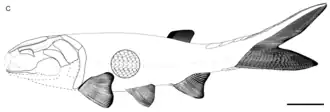
A member of Palaeoniscimorpha. The type species is O. marianii. |
| |||
|
Sp. nov |
Decat et al. |
Miocene |
A member of the family Erythrinidae. |
|||||
|
Sp. nov |
Valid |
Franceschi, Marramà & Carnevale |
Early Jurassic (Sinemurian) |
Moltrasio Formation |
||||
|
Sp. nov |
Valid |
Franceschi, Marramà & Carnevale |
Early Jurassic (Sinemurian) |
Moltrasio Formation |
||||
| Zealandorhynchus[21] | Gen. et sp. nov | Rust et al. | Eocene | Kurinui Formation |  New Zealand New Zealand
|
A billfish. The type species is Z. fordycei. Announced in 2025; the final article version was published in 2026. |






Ray-finned fish research
- Vanhaesebroucke & Cloutier (2026) study the morphological variation among Devonian and Carboniferous ray-finned fishes, and interpret their diversification as most likely driven by adaptations to diverse feeding strategies.[22]
- Zhang et al. (2026) report the first fossil evidence of presence of Saurichthys in the Early Triassic Nanzhang-Yuan'an fauna (China).[23]
- Taxonomic revision and a study on the affinities of Macromesodon and Apomesodon is published by Ebert (2026).[24]
- Veiga et al. (2026) consider Tharrhias castellanoi to be a nomen dubium, and assign its fossil material to Tharrhias cf. araripis.[25]
- Redescription of the anatomy and a study on the affinities of Palaeocentrotus boggildi is published by Schrøder, Lindow & Carnevale (2026).[26]
- Kovalchuk et al (2026) document the paleofauna of a Middle Miocene-aged locality in Rivne Oblast, Ukraine, identifying 5 genera and 3 families of ray-finned fish, and finding evidence that it represented a marginal freshwater habitat on the outskirts of the Forecarpathian Basin.[27]
Lobe-finned fishes
| Name | Novelty | Status | Authors | Age | Type locality | Location | Notes | Images |
|---|---|---|---|---|---|---|---|---|
|
Gen. et sp. nov |
Gess & Ahlberg |
Devonian (Famennian) |
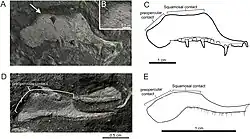
A member of the family Onychodontidae. The type species is A. mallinsonia. |
| ||||
|
Loreleia[29] |
Gen. et sp. nov |
Manuelli et al. |
Middle Triassic |
Calcaire à Cératites Formation |
A coelacanth belonging to the group Latimerioidei. The type species is L. eucingulata. |


Lobe-finned fish research
- Pawlak et al. (2026) identify lungfish aestivation burrows in the Triassic strata of the Ørsted Dal Formation (Greenland), interpreted as indicative of a seasonally dry climate in the studied area during the late Norian.[30]
- Redescription of Megalichthys pygmaeus, based on data from new fossil material from the Carboniferous Scottish Lower Coal Measures Formation (United Kingdom), is published by Elliott (2026).[31]
General research
- Evidence from the study of the fossil record of early to mid-Paleozoic fishes, interpreted as indicative of diversification of jawed vertebrates and their close jawless relatives in isolated refugia in the aftermath of the Late Ordovician mass extinction, is presented by Hagiwara & Sallan (2026).[32]
- Xian et al. (2026) report the discovery of a new vertebrate site in the Devonian (Pragian) strata of the Posongchong Formation (Yunnan, China), preserving fossil material of galeaspids, antiarchs, petalichthyids and sarcopterygians.[33]
- Jobbins et al. (2026) study the composition of the fish (placoderm and sarcopterygian) assemblage from the Devonian (Eifelian) Elm Point Formation (Manitoba, Canada), and identify a possible osteolepiform postparietal shield representing the oldest record of a tetrapodomorph from Canada reported to date.[34]
- Comans, Tobin & Totten (2026) reconstruct the thermoregulatory modes of marine predatory fishes from the Smoky Hill Chalk Member of the Niobrara Formation (Kansas, United States) on the basis stable oxygen isotope composition of tooth enameloid, interpreted as consistent with ectothermy of the majority of the studied taxa, but suggestive of elevated body temperatures consistent with endothermy in Cretoxyrhina, Ptychodus and Xiphactinus.[35]
- Crothers et al. (2026) study the composition of a diverse, actinopterygian-dominated fish assemblage from the ReBecca's Hollow locality from the Upper Cretaceous Williams Fork Formation (Colorado, United States), different from contemporary assemblages from higher latitudes and interpreted as indicative of provincialism of fish assemblages from Laramidia dating to the Campanian-Maastrichtian transition.[36]
References
- ^ Zhang, R.-R.; Zhang, N.; Li, Q.; Zhu, M.; Gai, Z.-K. (2026). "Asioaspis, a new genus of Polybranchiaspiformes (Galeaspida, stem-gnathostomes) from the Lower Devonian of Yunnan, China". Vertebrata PalAsiatica. doi:10.19615/j.cnki.2096-9899.260113.
- ^ Lei, X.; Zhang, S.; Cong, P.; Vinther, J.; Gabbott, S.; Wei, F.; Xu, X. (2026). "Four camera-type eyes in the earliest vertebrates from the Cambrian Period". Nature. 650 (8100): 150–155. doi:10.1038/s41586-025-09966-0. PMID 41565803.
- ^ Reeves, J. C.; Wogelius, R. A.; Edwards, N. P.; Manning, P. L.; Sansom, R. S. (2026). "Early vertebrate biomineralization and eye structure determined by synchrotron X-ray analyses of Silurian jawless fish". Proceedings of the Royal Society B: Biological Sciences. 293 (2063) 20252248. doi:10.1098/rspb.2025.2248. PMID 41592772.
- ^ Vullo, R.; Fragoso, L. G. C.; Bittencourt, J. S.; Pérez-García, A.; Bouchemla, I.; Benyoucef, M. (2026). "A new genus of lonchidiid hybodontiform sharks from the Cretaceous of North Africa and South America". Geological Magazine. 163 e5. doi:10.1017/S0016756825100484.
- ^ Ribeiro, L. S.; França, M. A. G. (2026). "A new species of Lonchidiidae (Hybodontiformes) from the Late Jurassic of Brazil (Aliança Formation, Jatobá Basin)". The Anatomical Record. doi:10.1002/ar.70120. PMID 41498584.
- ^ Wen, W.; Zhou, C.; Zhang, Q.; Hu, S.; Min, X. (2026). "New Discoveries of Chondrichthyan Microfossils from the Lower Triassic Luolou Formation in Daying Area,Ziyun County,Guizhou Province". Acta Palaeontologica Sinica. doi:10.19800/j.cnki.aps.2024046.
- ^ Maisey, J. G. (2026). "The neurocranium of the Paleozoic 'chipmunk ray' Tamiobatis vetustus Eastman, 1897. A brief history of research and new morphological observations based on computerized tomography". Canadian Journal of Zoology. doi:10.1139/cjz-2025-0124.
- ^ Neves, G. S.; Medeiros, M. A.; Cupello, C.; Leite Filho, D.; Brito, P. M. (2026). "Hybodontiform sharks from the Late Cretaceous Alcântara Formation, São Luís Basin, Northeast Brazil". Historical Biology: An International Journal of Paleobiology. doi:10.1080/08912963.2025.2582776.
- ^ Gardiner, A.; Mathes, G. H.; Cooper, R.; Kocáková, K.; Villafaña, J. A.; Silvestro, D.; Pimiento, C. (2026). "Revealing the hidden patterns of shark and ray diversity over the past 145 million years". Current Biology. doi:10.1016/j.cub.2025.12.017. PMID 41576926.
- ^ Stumpf, S.; Türtscher, J.; López-Romero, F. A.; Villalobos-Segura, E.; Begat, A.; Amadori, M.; Dearden, R. P.; Lauer, B.; Lauer, R.; Hecker, A.; Kriwet, J. (2026). "Reappraisal of the extinct barbelthroat shark †Bavariscyllium and the nebulous origin of carcharhiniform galeomorphs". Communications Biology. 9 158. doi:10.1038/s42003-025-09272-5.
- ^ Baptista, M. C.; Figueiredo Iza, E. R. H.; Dias Cavalcanti, J. A.; Simões, H. A.; Palmeira, L. C. M.; Pessoa, J. C. O.; Frazão, E. P.; Santos Sobrinho, V. R. (2026). "First in situ documentation of a fossil tooth attributed of †Otodus megalodon from the deep sea of Rio Grande Rise, South Atlantic Ocean". Journal of the Geological Survey of Brazil. doi:10.29396/jgsb.2026.v9.n1.3.
- ^ Herraiz, J. L.; Ferrón, H. G.; Botella, H.; Reolid, M.; Martínez-Pérez, C. (2026). "The Iberian fossil record of †Otodus megalodon rejects Mediterranean dwarfism and supports nursery use". Biology Letters. 22 (1) 20250640. doi:10.1098/rsbl.2025.0640. PMID 41560601.
- ^ Schwenk, J. L.; Perez, V. J.; Godfrey, S. J.; Bowers, G. M. (2026). "On the cutting edge: Otodus megalodon strengthened tooth edges through zinc incorporation in enameloid". Palaeontologia Electronica. 29 (1) 29.1.a6. doi:10.26879/1626.
- ^ Feichtinger, I.; Beaury, B.; Guinot, G.; Harzhauser, M.; Nichterl, T.; Stoykova, K.; Pollerspöck, J. (2026). "Revealing elasmobranch diversity across the Cretaceous-Paleogene boundary in the Central Tethys (Byala, Bulgaria)". Fossil Record. 29 (1): 57–70. doi:10.3897/fr.29.182659.
- ^ a b Ordóñez, E. K.; Arratia, G.; Tejada, L.; Chacaltana, C. (2026). "Oldest †ellimmichthyiform fishes from Peru and the early radiation of Clupei". Contributions from the Museum of Paleontology, University of Michigan. 37 (5): 93–115. doi:10.7302/28315.
- ^ Schwarzhans, W. W.; Moritz, T.; Goedert, J. L. (2026). "Coryphaenoides richi sp. nov. (Macrouridae, Teleostei) from the deep-marine, Oligocene Makah Formation of Washington State, U.S.A." Zitteliana. 100: 31–38. doi:10.3897/zitteliana.100.182311.
- ^ Ribeiro, A. C.; Mayrinck, D.; Bockmann, F. A.; Pinna, M. (2026). "The oldest acanthomorph fossil (Actinopterygii, Teleostei) from the Early Cretaceous of Gondwana (Morro do Chaves Formation, Sergipe–Alagoas Basin, NE Brazil)". Papers in Palaeontology. 12 (1) e70072. doi:10.1002/spp2.70072.
- ^ Gottfried, M. D.; Fordyce, R. E.; Robinson, J. H.; Lee, D. E. (2026). "A New Tarpon-Like Fish (Elopomorpha, Megalopidae) With Exceptional Preservation and Unusual Features From the Paleogene of Pitt Island, Chatham Islands, New Zealand". New Zealand Journal of Geology and Geophysics. 69 (1) e70022. doi:10.1002/jgo2.70022.
- ^ a b c Franceschi, F.; Marramà, G.; Carnevale, G. (2026). "Bony fishes (Osteichthyes) from the Sinemurian (Jurassic) Osteno Konservat-Lagerstätte (Como, NW Italy)". Rivista Italiana di Paleontologia e Stratigrafia. 132 (1): 9–58. doi:10.54103/2039-4942/29058.
- ^ Decat, B.; Aguilera, O.; Silva, R. C.; Araújo, O. O.; De Gracia, C.; Lopes, R. T. (2026). "Fossil record and paleogeography of Erythrinidae (Characiformes): new fossil evidence of Paleohoplias from Solimões Formation". Journal of South American Earth Sciences 105957. doi:10.1016/j.jsames.2026.105957.
- ^ Rust, Seabourne; Wium, Morne; Otero, Rodrigo A.; Terezow, Marianna (2026-02-01). "Fossil billfish (Xiphioidei) from the Eocene of Hampden, North Otago, New Zealand". Gondwana Research. 150: 301–311. doi:10.1016/j.gr.2025.09.021. ISSN 1342-937X.
- ^ Vanhaesebroucke, O.; Cloutier, R. (2026). "Morphological Disparity and Evolutionary Radiation of Early Actinopterygians Through the Devonian–Carboniferous Crisis". Diversity. 18 (2) 83. doi:10.3390/d18020083.
- ^ Zhang, Y.-T.; Wu, F.-X.; Li, Q.; Qiao, Y.; Hu, Y.-W.; Shen, X.-Y.; Liu, J. (2026). "First record of predatory fish Saurichthys from the late Early Triassic Nanzhang-Yuan'an fauna, South China". Historical Biology: An International Journal of Paleobiology. doi:10.1080/08912963.2025.2588256.
- ^ Ebert, M. (2026). "Macromesodon Blake, 1905 and Apomesodon Poyato-Ariza & Wenz, 2002 (Actinopterygii, Pycnodontiformes) from the Jurassic and lowermost Cretaceous of England, France, and Germany". Swiss Journal of Palaeontology. 145: 97–129. doi:10.3897/sjp.145.177263.
- ^ Veiga, I. M.; De Mayrinck, D.; Bergqvist, L. P.; Brito, P. M. (2026). "On the taxonomic status of Tharrhias castellanoi Duarte and Santos, 1962 (Gonorynchiformes, Chanidae)". Journal of Vertebrate Paleontology e2604599. doi:10.1080/02724634.2025.2604599.
- ^ Schrøder, A. E.; Lindow, B. E. K.; Carnevale, G. (2026). "A reappraisal of the lampridiform Palaeocentrotus boggildi Kühne, 1941 from the Eocene Fur Formation, Denmark". Bulletin of the Geological Society of Denmark. 75: 33–51. doi:10.37570/bgsd-2026-75-03.
- ^ Kovalchuk, Oleksandr; Tuzyak, Yaryna; Gorobets, Leonid; Yanenko, Vadym; Świdnicka, Ewa; Dubikovska, Anastasiia; Stefaniak, Krzysztof; Barkaszi, Zoltán (2026-01-02). "A new Sarmatian (late Middle Miocene) vertebrate assemblage from the periphery of the Forecarpathian Basin". Historical Biology. 38 (1): 279–291. doi:10.1080/08912963.2025.2461156. ISSN 0891-2963.
- ^ Gess, R. W.; Ahlberg, P. E. (2026). "High paleolatitude onychodont and rhizodont remains from the upper Famennian (Upper Devonian) Waterloo Farm lagerstätte of South Africa". Journal of Vertebrate Paleontology e2576738. doi:10.1080/02724634.2025.2576738.
- ^ Manuelli, L.; Clément, G.; Herbin, M.; Fritzsch, B.; Ahlberg, P. E.; Dollman, K.; Cavin, L. (2026). "A dual respiratory and auditory function for the coelacanth lung". Communications Biology. doi:10.1038/s42003-026-09708-6.
- ^ Pawlak, W.; Tałanda, M.; Sulej, T.; Qvarnström, M.; Niedźwiedzki, G. (2026). "High-latitude dipnoan aestivation burrows suggest seasonal aridity for early dinosaur ecosystems in the Late Triassic of East Greenland". Palaeogeography, Palaeoclimatology, Palaeoecology 113624. doi:10.1016/j.palaeo.2026.113624.
- ^ Elliott, F. M. (2026). "Recent research into the morphology of the megalichthyid Megalichthys pygmaeus Traquair, from the Midland Valley of Scotland". Scottish Journal of Geology sjg2025-005. doi:10.1144/sjg2025-005.
- ^ Hagiwara, W.; Sallan, L. (2026). "Mass extinction triggered the early radiations of jawed vertebrates and their jawless relatives (gnathostomes)". Science Advances. 12 (2) eaeb2297. doi:10.1126/sciadv.aeb2297. PMC 12787538. PMID 41512057.
- ^ Xian, Z.-M.; Mo, X.; Guan, Q.; Zhao, Y.-T.; Xue, Q.-Y.; Li, Q.; Liu, J.-P.; Zhu, M. (2026). "Early Devonian fish material from Posongchong Formation of Guangnan, Yunnan, China". Vertebrata PalAsiatica. doi:10.19615/j.cnki.2096-9899.260206.
- ^ Jobbins, M.; Mondéjar Fernández, J.; Durkin, P.; Louro Silva, R.; Brink, K. (2026). "Early vertebrate diversity of the Elm Point Formation of Manitoba, Canada, and evidence of fish faunal diversification in the Middle Devonian of North America". Canadian Journal of Zoology. doi:10.1139/cjz-2025-0113.
- ^ Comans, C. M.; Tobin, T. S.; Totten, R. L. (2026). "Evidence for endothermy from tooth enamel(oid) oxygen isotopes in marine predators of the Late Cretaceous Western Interior Seaway, USA". Palaeogeography, Palaeoclimatology, Palaeoecology 113578. doi:10.1016/j.palaeo.2026.113578.
- ^ Crothers, J.; Eberle, J.; Brinkman, D.; Wurtz, A.; Heckert, A. B.; Hunt-Foster, R. K.; Foster, J. R.; Dirkes, I. C.; Dunn, R. (2026). "An actinopterygian-dominated fish fauna from the Upper Cretaceous Williams Fork Formation, northwestern Colorado, and evidence for provinciality across Laramidia at the Campanian/Maastrichtian boundary". Cretaceous Research 106313. doi:10.1016/j.cretres.2026.106313.