War for Zadar (1181–1202)
| Croatian–Venetian War for Zadar | |||||||||
|---|---|---|---|---|---|---|---|---|---|
| Part of Croatian–Venetian wars and Fourth Crusade | |||||||||
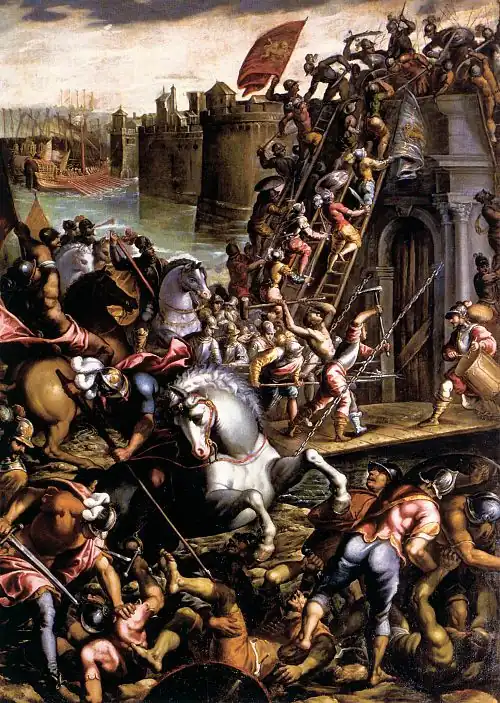 The Siege of Zadar in 1202, painted by Andrea Vicentino | |||||||||
| |||||||||
| Belligerents | |||||||||
|
Republic of Venice Crusaders |
Kingdom of Hungary Kingdom of Croatia Republic of Pisa Kingdom of Sicily Dalmatian city-states Zadar principality Byzantine Empire | ||||||||
| Commanders and leaders | |||||||||
|
Enrico Dandolo Orio Mastropiero Domenico Michiel |
Béla III of Hungary Emeric of Hungary Desinjin Damjan[a] | ||||||||
| Strength | |||||||||
| 10,000 men | Unknown | ||||||||
| Casualties and losses | |||||||||
| Unknown | Unknown | ||||||||
The Zadar War also known as Croatian–Venetian War (1180–1202) was a long conflict that lasted for forty years between the 12th and 13th centuries between the Republic of Venice and the Kingdom of Croatia–Hungary for the possession of the city of Zadar and control of Dalmatia.
Background
After the death of the Byzantine Emperor Manuel I Comnenus in 1180 and the turbulent period of minority of his successor Alexios II, Béla III of Hungary, who already boasted the title of King of Croatia, Dalmatia, and Slavonia, moved to reoccupy the Byzantine territories of Dalmatia. In doing so, however, Béla reignited the conflict between Hungary and Venice, which already controlled a large part of the coastal strip of the region. For its part, Venice had witnessed with astonishment, in 1182, the massacre of its own colonists and of the other Latins of Constantinople, ordered by the protosevast Andronicus I in the name of the ten-year-old Alexius II, who was then assassinated by Andronicus himself in 1183 to ascend to the throne as Andronicus I Comnenus.
War
Phase I: Zadar's dedication to Hungary
In the year, 1183, the Dalmatian city of Zadar, already a Venetian possession, rebelled, placing itself under the protection of Pope Lucius III and, above all, in the hands of Béla III of Hungary. This fact pushed Venice into war. The urgency of fighting the Byzantines, however, pushed both the Venetian Doge Orio Mastropiero and the Hungarian king Béla III to support the Normans of the Kingdom of Sicily in their expedition against the Greeks.[1]
After the fall of Dyrrhachium to William II of Hauteville on 11 June 1185 , shortly followed by Corfu, Cephalonia, Ithaca and Zakynthos , the loss of the important city of Thessalonica in August of the same year led to a revolt in Byzantium, which brought a new basileus, Isaac II Angelos, to the throne . The new Byzantine ruler hastened to conclude treaties with Hungary and Venice, thus leaving the two powers free to face each other for the dominion of Dalmatia, while also pushing the Republic of Pisa to sign a treaty of alliance with the Zadarians in 1188.[2]
Phase II: First Italian Expedition
Having armed their fleet with a special tax imposed by Doge Orio Mastropiero on the city's merchants, in 1187 the Venetians presented themselves before Zadar, laying siege to it, but the city, supported by Hungarian troops fortified within a mighty castle , resisted. Meanwhile, the winds of the Third Crusade began to blow across Europe : on March 27, 1188 , in the cathedral of Mainz , Emperor Frederick Barbarossa had taken the cross, and Venice prepared to take advantage once again of the great business of the Crusades. The siege of Zadar was lifted, also thanks to the Truce of God imposed by Gregory VIII, and the fleet prepared to join the enterprise in the Levant.[3]
Phase III: Second Italian Expedition
In 1190 the Doge Mastropiero armed a new fleet, but the expedition ended in defeat, so much so that Venice lost control of the islands of Pag, Ossero and Arbe.[4][5][6][7]
Phase IV: Third Italian Expedition
The war resumed after the abdication of Orio Mastropiero, with the election of Enrico Dandolo as Doge in 1193. The new Doge, having signed all the treaties necessary to ensure the tranquility of Venetian trade in Italy and the East, decided to move to reconquer Dalmatia.[8]
The Venetian fleet, under the command of Domenico Michiel, having occupied the island of Pag, thus appeared once again before Zadar in September of that year. However, Zadar had called for assistance from its ally Pisa , whose fleet, having appeared in the Adriatic in 1195, took Pula without a fight. Giovanni Morosini and Ruggero Premarin were sent to face the Pisans , and with ten galleys and six round ships, they retook the Istrian city, which, abandoned by the Pisans, surrendered, seeing its sea walls demolished as punishment. The Venetians pursued the Pisan fleet southwards, attacking a Pisan convoy of six ships laden with goods off Modone, plundering two galleys.[9]
The Pisans and the Zadarians then asked for help from Brindisi , which belonged to the Hautevilles , but the arrival of new Venetian ships recalled from the Aegean Sea and still led by Ruggero Premarin, accompanied by Giacomo Querini, finally forced the Pisans to leave the Adriatic, also as a result of the truce signed at the request of Emperor Henry IV. Brindisi suffered Venetian revenge. Despite this, Zadar, in 1196, upon the death of King Bèla, still remained firmly in Hungarian hands, despite the civil war that broke out between the sovereign's sons, Emeric and Andrew , who took control of the Kingdom of Croatia in 1197 , holding it until his defeat in 1199 on Lake Balaton. Then, in 1201, the Pisans occupied Bari, in an attempt to block access to the Adriatic, but were soon driven out.[10]
Phase V: The capture of Zadar by the Fourth Crusade
The final opportunity for the reconquest was offered to Dandolo by the Fourth Crusade, called by Innocent III. Venice had immediately offered to support the enterprise with its fleet, but when the Crusaders gathered at the port of Lido were unable to pay the agreed price for the transhipment, the Doge offered to postpone the payment in exchange for obtaining Crusader support in the reconquest of Zara.[11]
The Venetian-crusader fleet, after having attacked and subdued Trieste, headed towards Zara, which was placed under siege, falling on 23 November 1202. After the conquest of Constantinople in 1204 and the creation of the Latin Empire and the Venetian colonial empire, in 1216, finally, Andrew III of Hungary signed the peace, renouncing all claims to Zadar.[12]
See also
Notes
- ^ Prince of Zadar principality
References
- ^ AA.VV 2002, pp. 100.
- ^ AA.VV 2002, pp. 101.
- ^ Diehl 2004, pp. 221.
- ^ Romanin 1853, pp. 193.
- ^ Hodgson 1901, pp. 331.
- ^ Queller & Madden 1999, pp. 57.
- ^ Smedley 1832, pp. 54–55.
- ^ Madden 2003, pp. 90.
- ^ Curta, pp. 548.
- ^ Truhart, pp. 772.
- ^ Berend, Urbańczyk & Wisewski, pp. 373.
- ^ Madden,Venice 2003, pp. 135–141.
Bibliography
- AA.VV. (2002). Storia di Venezia (in Italian). Vol. 12 vols. Roma: Treccani.
- Diehl, Charles (2004). La Repubblica di Venezia (in Italian). Roma: Newton & Compton editori. ISBN 88-541-0022-6.
- Romanin, Samuele (1853). Storia documentata di Venezia (in Italian). Venezia: Pietro Naratovich tipografo editore.
- Curta, Florin. Eastern Europe in the Middle Ages, 500–1300.
- Truhart, Peter. International Dictionary of Historic Places.
- Berend, Nóra; Urbańczyk, Przemysław; Wisewski, Przemysław. East Central Europe in the Middle Ages, 1000–1500.
- Hodgson, Francis Cotterell (1901). The Early History of Venice, from the Foundation to the Conquest of Constantinople, A.D. 1204. London: George Allen.
- Oliphant, Margaret (1887). The Makers of Venice: Doges, Conquerors, Painters, and Men of Letters. London: Macmillan.
- Smedley, Edward (1832). Sketches from Venetian History. Vol. 1. London: John Murray.
- Queller, Donald E.; Madden, Thomas F. (1999). The Fourth Crusade: The Conquest of Constantinople. Pennsylvania: University of Pennsylvania Press.
- Madden, Thomas F. (2003). Enrico Dandolo and the Rise of Venice. Baltimore: Johns Hopkins University Press.
- Madden,Venice, Thomas F. (2003). Enrico Dandolo and the Rise of Venice. Baltimore: Johns Hopkins University Press.