Victorian Railways narrow-gauge freight vehicles
Unlike the broad-gauge, the Victorian Railways' 2 ft 6 in (762 mm) narrow-gauge network never had four-wheeled wagons or trucks in regular service (aside from a handful of trollies). Instead, a single design of 249 underframes was constructed, with identical structure, bogies, couplers and brake equipment. Different bodies were provided on these frames for each purpose. The most common, by far, was the convertible flat/open truck with over 200 examples built (and more in the preservation era), with a total of 31 other trucks built for livestock, louvre vans, insulated and boxcar types.
All the earliest vehicles were issued to service without the "N" prefix to indicate narrow gauge; this was appended later. In an incident report dated 24 December 1898 the narrow gauge open wagons were still being referred to as "QR" rather than NQR.[1] Codes for each type were equivalent to the broad gauge system, e.g. the open wagons were classed "QR". By 1910 the N superscript prefix was being added, e.g. NQR. From 1926 all of the goods stock which had triple-letter classification were simplified to double-letter classification (e.g. NMM became NM), though some NQR wagons were not recoded to NQ until much later. However, as late as 1931 occasional references were still made to, for instance, "narrow gauge QR trucks".[2]: 69
In more recent years, the Emerald Tourist Railway Board has started a process of reclassifying all previously double-letter classified goods stock back to the original identities. This is in recognition of the adopted Era of Significance for the Railway, which covers period 1900–1930, during which time they mostly had the double letter coding.
The same frame design was later used for the second generation of NBH passenger carriages, after the first had been converted from NQR flat/open trucks.
Convertible flat/open trucks—NQR

The NQR class of trucks were the staple of the Victorian Railways' narrow gauge fleet. 218 examples were constructed between 1898 and 1914,[3] designed as an open wagon with removable end panels as well as three drop-down but removable doors either side. When assembled into the open wagon format these wagons were designed to have the same capacity (weight and volume) as a normal broad gauge four-wheel open truck, to make load transferring easier at the interchange stations—Colac, Wangaratta, Upper Ferntree Gully and Moe.
The goods truck code had been derived from the conceptually similar broad-gauge QR trucks, which had removable sides to permit various types of loading. Previously, "Q" had been used for bogie flat wagons and "R" for bogie open trucks.
Letters and numbers were originally painted only on the end bulkheads and doors and the side doors, both of which could be removed as traffic dictated, and this made vehicle identification difficult until these details were transferred to the underframes of each truck. The superscript "N" changed to regular script in the goods vehicle recoding following the auto coupler conversion in 1926.
Some of these trucks were fitted with seats and frameworks supporting shelter to cater for holiday traffic on the Gembrook and Walhalla lines.[4]: 28 In particular, NQR trucks 114 and 140 were identified as having screw-type hand brakes fitted in addition to normal air brakes, permitting their use in lieu of brake vans—but only in the Up direction, and only for holiday traffic.[5]
Six wagons were modified with low level roofs to serve for sheep transport.[4]: 30
NBH
In April 1919 NQR wagons 31, 33, 36, 38, 39 and 46 were rebuilt into the first of the NBH passenger carriages, numbered 1 through 6 respectively and used for second-class passenger holiday traffic by adding seats, a removable roof on poles and tarps for wagon sides and doors. Over the years, a number of NQRs were provided with removable wood and steel frameworks with canvas roof canopies and side curtains, and internal seating to supplement the rest of the passenger stock during busy holiday periods. Puffing Billy has re-created these in modified form for emergency capacity. Five more NQRs, numbered 219–223, were built between 1990 and 1992 initially for passenger use so were fitted with the removable frames.
Flat wagons—NQ
From 1926 the class was relettered from NQR to NQ, reflecting their use more often than not as flat wagons rather than open wagons. Most of the class then remained in service until the early 1950s, when the four VR lines closed and mass scrappings of narrow-gauge stock began. The last NQR was withdrawn in 1958.[4]: 30
On 9 September 1954 six NQ wagons, nos 94, 100, 102, 153, 169 and 208, were sold from Moe station to the Forests Commission.[6] Coincidentally, the quantity of six wagons matches the number taken from Gould station to Moe after the last official train operated on 25 June 1954; the transfer was made by engine 7A and van 7NBC on 29 June 1954.[7]: 52–55
In 1965 the Victorian Railways transferred a set of two NC vans, three NU wagons and four NQ wagons, one of which (NQ149) was fitted with a water tank, to Upper Ferntree Gully, from which they were handed over to the Preservation Society, in order to assist with the extension and reopening to Emerald station.[8]: 203
Puffing Billy Railway currently has NQRs 135 and 219–223 inclusive, fitted with seats and a canopy, and NQR 146 without a canopy. All seven have a capacity of 28 passengers, and a weight of 6 long tons (6.1 t; 6.7 short tons).[9]: 44–45 In goods service are NQR wagons 21, 29, 91, 186 and 216 with a capacity of 11 long tons (11.2 t; 12.3 short tons) and a tare weight of 5 long tons (5.1 t; 5.6 short tons);[9]: 44–45 and NQR 21 can be fitted with seats if necessary to match the configuration of NQR 146.[4]: 137 [9]: 44–45
Additionally, NQ 149 is fitted with a water tank that can hold 9,000 litres (2,000 imperial gallons; 2,400 US gallons) of water; this tank was fitted by the Victorian Railways at Newport Workshops in 1965 as an alternate water supply for Emerald station in case the local supply was unavailable during the pre-reopening test trips.[8]: 203 This vehicle has a tare weight of 6 long tons (6.1 t; 6.7 short tons) and a loading capacity of 10 long tons (10.2 t; 11.2 short tons),[9]: 44–45 due to the water tank.
The Railway also possesses untraffickable trucks: NQ 19 is configured for pulpwood, and open NQRs 59, 92, 103, 125, 142, 151, 153 and 203. There are also five off-register NQR wagons, numbers 23, 26, 94, 110 and 169.[4]: 137 All of these have a tare weight of 5 long tons (5.1 t; 5.6 short tons) and a loading capacity of 11 long tons (11.2 t; 12.3 short tons).[9]: 44–45
In the period 2009 to 2017, wagons NQ149 and NQR29 were restored to service.[9]: 44–45 [4]: 137
Cattle trucks—NMM, later NM
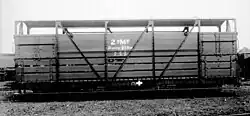
This class consisted of 15 vehicles. Construction started in 1899, but the first NMM did not enter service until 1903. After this the rest of the class followed slowly, with the last of the class not entering service until 1917. They looked similar to the MM cattle trucks, despite being built 25 years earlier.
As part of the late 1920s recoding, the class was altered to NM. Around the same time, all but the class leader had autocouplers fitted (1 NM was not converted until 1941).
In the mid-1920s there was a derailment on the Moe–Walhalla line. In the consist were NM vehicles. It was determined that the derailment was caused by "spooked" horses in an NM vehicle. The vehicle was coupled next to an NA tank engine which was running bunker first. The smoke from the funnel apparently was the reason for the distress. After this investigation, the ends of all the NM class were progressively boarded up.
As the narrow-gauge lines were closed, the trucks were sold off. Most were scrapped; 13 NMM is used by Puffing Billy on wood trains, and 6 NM was recently rescued from a farm and is currently in storage awaiting restoration.
Louvred trucks—NUU, later NU
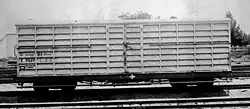
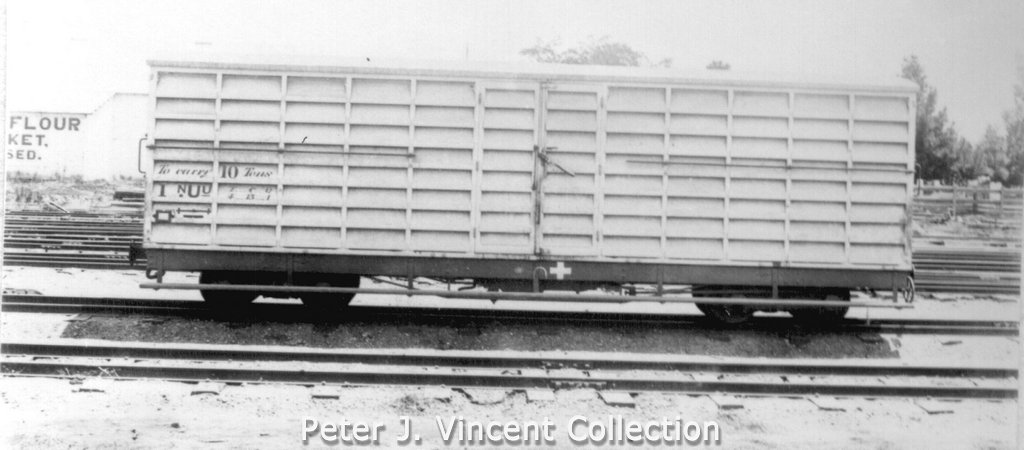
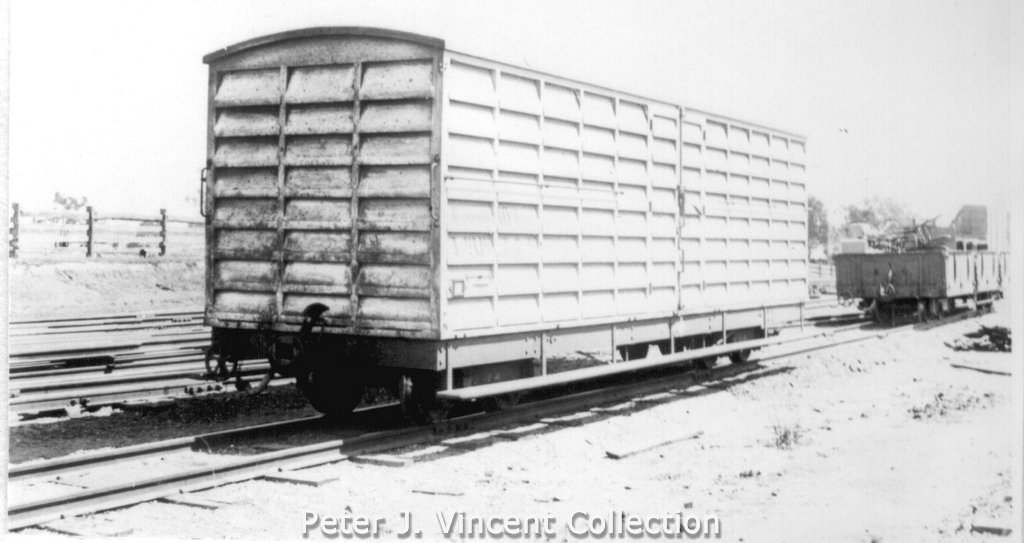
The standard louvred truck design for the Victorian narrow-gauge lines, the NUU vehicles, were constructed in three batches; the first seven from 1899 to 1901, an eighth in 1906 and the last six in 1911, for a total class of fourteen. They looked very similar to the U trucks of the broad-gauge. These trucks were painted white until approximately 1910, as shown in two photographs[10][11] of NUU 1.
NU
In 1926 the class was relettered to simply NU, with no changes to numbers.
NU 4 was scrapped in 1938, but otherwise the class remained intact until the Whitfield line closed at the end of 1953, when a number were sold off. Speed Limit 20 Plus lists 2, 7, 8, 11 and 12NU, while Vincent shows three separate sale contracts, first for 8NU on 21 December 1953, then 2, 5, 7, 11 and 12NU on 18 January 1954, and 9NU also in January 1954 but undated.[12] Speed Limit 20 Plus further notes that 8NU and 11NU were sold to the Shire of Oxley as storage units in the council depot at Moyhu; 11NU was subsequently shifted to Wangaratta, and was destroyed by fire in 1978.[4]: 139 2NU was sold to the Whitfield General Store, and has since been preserved at Erica on the former Walhalla line.[4]: 139 8NU was donated to the predecessor of the Walhalla Goldfields Railway, though it has since been forward to Puffing Billy.[4]: 139 Speed Limit 20 Plus records 7NU and 11NU,[4]: 139 circa 2017, being stored at Moyhu pending preservation; the latter is most likely 12NU, as Vincent notes 7NU and 12NU stored at Moyhu pending preservation in January 1994.
Nos. 6 and 1 were scrapped in 1957 and 1958 respectively, while in 1954 van 13 was recorded as being sold to the Puffing Billy Preservation Society. In 1977, the remaining vans 3, 10 and 14 were handed over to the Emerald Tourist Railway Board, and removed from Victorian Railways records. The Puffing Billy Railway now possesses vans 3, 8, 10, 13 and 14.
NW
Between 1972 and 1977, 10 NU was lettered as 10 NW, indicating its use as a workmen's sleeper.
Covered truck with explosives accommodation—NPH
In June 1910, it was decided that a truck for the transportation of explosives would be useful; probably for the Moe-Walhalla line as Walhalla was a gold-mining town and the rail line had been built from Moe to provide a faster means of transportation than bullock teams from the sailing boats from Melbourne to Port Albert/Sale via Heyfield.
NPH 1 was built on the standard design of underframe as most other narrow-gauge stock, but because it was not anticipated that explosives traffic would require use of the entire wagon, it was partitioned to give 4 long tons (4.1 t; 4.5 short tons) capacity for explosives, while the remaining 6 tons was for general goods. Unlike the NU and NT classes, this meant that the van had four double doors total.
However, in late March 1911 the wagon had been converted to entirely general goods use, with the partition removed and a recoding to NH 1, the "H" in the class being a reference to the broad-gauge H covered trucks then in use. The vehicle was allowed to carry 10 tons of general goods.
It gained autocouplers in 1928. After the Whitfield line was closed in late 1953 it was sold, along with a number of NU Louvre vans, to the scrap dealer Coulston & Hyder. The van was then onsold to the Shire of Oxley as a storage unit in the council depot at Moyhu. 1NH was donated to the Puffing Billy Railway in 1968 and placed in the Menzies Creek museum.[4] As of 2009 the van was recorded as on the Puffing Billy Railway's rolling stock register, but in an untrafficable condition.[9]: 45
Insulated truck—NTT, later NT

In October 1899 a single insulated truck, NTT 1, was built for the transportation of goods that needed to be kept cold, such as raw meat and dairy products. Like the NUU trucks, it was painted white from new, being repainted the standard venetian red of goods stock from about 1910. Its walls were 5+1⁄4 inches (130 mm) thick, reducing the interior space, and insulated with cow hair.[13]
The truck was originally intended for the Whitfield line,[4]: 21 but instead entered service on the Gembrook line in 1903. The truck was relettered to simply NT in 1926. It later made its way to the Crowes line, before finally being transferred to Whitfield in 1948. It was photographed abandoned at Whitfield railway station, abandoned with an NU van after that line closed,[14]: 40 though it must have been there since the bushfires in February 1952 when locomotive-hauled services ceased beyond Moyhu.[4]: 42–43
It was retained on the rolling stock register through 1958,[4]: 31 but its whereabouts were unknown until a decade later when it was discovered in a scrap metal yard in Maribyrnong; it was then donated to the Puffing Billy Railway,[4]: 148 and found its way to the Menzies Creek museum. In September 2008 it was removed from the museum and shunted via Belgrave to Emerald for restoration, as a static storage facility at Belgrave associated with the Luncheon and Night trains.[13]
Today, 1NT is used at Belgrave station for storage.
Workshop Transfer wagon Q129
Q129 is a 5 ft 3 in (1,600 mm) broad gauge skeletal flat wagon built in June 1926, initially to transfer the Garratt locomotives' engine units[a] from Newport to Colac and Moe, and later used for the NA class engines as well.[15]: 27 It is now preserved at the Menzies Creek Steam Museum adjacent to Menzies Creek railway station on the Puffing Billy Railway.[16]
Preservation era
Under the Emerald Tourist Railway Board, a range of rolling stock from other systems in Australia have been acquired and regauged for use on the Puffing Billy Railway to cater for the increased demand.[17]
The primary example of goods vehicle is the acquisition from the Tasmanian Government Railways of a number of ballast hopper trucks. QG3 was the first to be converted for narrow gauge use, with an "N" prefix added when it entered service in 1972.[18] In 2003 the truck's identity was altered to be consistent with Victorian Railways goods coding practise, with the new code of NNN1 representing the pre-1926 style.[17] The N prefix is for "narrow" gauge, and the suffix indicating that it is a bogie wagon much like NUU, NTT, etc. above. However, unlike those examples, it is likely that the Victorian Railways would have retained the "NNN" code instead of simplifying to "NN", because there was already a broad-gauge ballast vehicle of that classification.[19]
A second ex-TGR QG wagon has since entered service on Puffing Billy as NNN2,[17] formerly Tasmanian Railways ballast hopper QG18.[18]
Notes
References
- ^ "1899 Narrow Gauge Recoding". pjv101.net.
- ^ Stephen E Watson (1980). Rails to Walhalla - Part 1 - The Railway. ISBN 0-9581266-0-7.
- ^ "c445d". pjv101.net. Retrieved 25 February 2024.
- ^ a b c d e f g h i j k l m n o Puffing Billy Preservation Society (2017). Speed Limit 20 Plus. Puffing Billy Preservation Society. ISBN 978-0-9579792-8-4.
- ^ Victorian Railways, General Appendix to the Book of Rules and Regulations and to the Working Time Table, April 1919, p.350
- ^ "Data for Code NQ". PJV's Website. Retrieved 25 January 2026.
- ^ Anchen, Nick (2011). Rails to Old Walhalla. Sierra. ISBN 978-0-9807640-1-7.
- ^ a b Puffing Billy Preservation Society (2015). David Burke OAM (ed.). Saving Puffing Billy. Puffing Billy Preservation Society. ISBN 978-0-646-93078-7.
- ^ a b c d e f g Emerald Tourist Railway Board (2009). Working Time Table of the Belgrave to Gembrook Line on and after 1 November 2009.
- ^ "ae685". www.pjv101.net.
- ^ "ae687". www.pjv101.net.
- ^ "Data for Code NUU". PJV's Website. Retrieved 2 January 2026.
- ^ a b "NT". Victorian Government Narrow Gauge Railways. Archived from the original on 13 March 2016. Retrieved 19 January 2026.
- ^ John E. Thompson (2002). Focus on... Victoria's Narrow Gauge Whitfield Line. Puffing Billy Preservation Society. ISBN 0-9579792-2-3.
- ^ a b Stephen E Watson (1981). Rails to Walhalla - Part 2 - Locomotives and Rollingstock. ISBN 0-9594371-1-8.
- ^ "Victorian Railways 2'6" Transporter wagon 129Q, 1926". Retrieved 16 February 2026.
- ^ a b c "Carriage Fleet - Puffing Billy". 13 December 2017.
- ^ a b https://trainsofvictoria.info/Locos/NG/Freight/1972_NNN_Hopper_Wagon.htm
- ^ "NN - Bogie Ballast Hopper".
- Narrow Gauge Rolling Stock
- Narrow Gauge Stock
- Puffing Billy Railway Rolling Stock Archived 25 August 2011 at the Wayback Machine