Tursaansydän

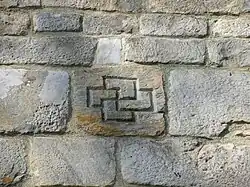
The tursaansydän or tursan sydän[2] (lit. 'heart of Tursas' or 'heart of octopus'), also called mursunsydän (lit. 'heart of the walrus'), is an ancient swastika-like symbol used in Northern Europe. The symbol originates from prehistoric times. The tursaansydän was believed to bring good luck and protect from curses, and was used as a decorative motif on wooden furniture and buildings in Finland. A brick dating to the 14th or 15th century bearing a tursaansydän motif was found during restorations of the Häme Castle.[3]
The symbol was known as mursunsydän in Nivala, and tursaansydän and turskansydän in Kainuu. In Nurmes, mursu meant the same as Tursas: a scary haltija that lived in a nest of red ants.[4]
During the 18th century the simple swastika became more popular in Finnish wood decoration than the more complex tursaansydän.
In modern usage
Author Ilmari Kianto used the tursaansydän as his logo. Kianto had found a tursaansydän carved into his childhood home's granary's door in Suomussalmi.[5]
The Slavic Union used the tursaansydän in their logo, before the organization was banned in 2010.
The Finnish Alliance approved of the tursaansydän as their symbol in 1998.[6]
See also
References
- ^ Forsman, Jaakko; Wecksell, J. A.; Havu, I.; Salovaara, Hannes, eds. (1926). "Hakaristi". Pieni Tietosanakirja [Small Encyclopedia] (in Finnish). Vol. I: A–Isonzo (2nd ed.). Helsinki: Kustannusosakeyhtiö Otavan [Otava Publishing Company]. pp. 1089–1090. Retrieved 9 February 2018 – via Project Runeberg, University of Stockholm.
- ^ "Tursan Sydän". Tursa.fi (in Finnish). 2007. Archived from the original on 3 October 2009. Retrieved 2 March 2010.
- ^ "File:Tursaansydänaiheinen kuviotiili Hämeen linnasta.jpg - Wikimedia Commons". commons.wikimedia.org. Retrieved 2025-06-15.
- ^ Häkkinen, Kaisa (2007). "Mursun ja norsun jäljillä". Virittäjä. Vol. 4. Society for the Study of Finnish. p. 484.
- ^ "Ilmari Kianto -seura". www.kianto.org. Retrieved 2024-06-18.
- ^ "Suomalaisuuden liiton tunnus". 2008-01-29. Archived from the original on 2008-01-29. Retrieved 2024-06-18.

- Talve, Ilmar (2012). Suomen Kansankulttuuri [Finnish Folk-culture] (in Finnish). Helsinki: Suomalaisen Kirjallisuuden Seura [Finnish Literature Society]. ISBN 9789522224149.