An EF3 tornado in eastern New Orleans on February 7, 2017
The U.S. state of Louisiana experiences several tornadoes per year. There have been at least 2,514 recorded tornadoes since 1950.[note 1] At least 267 people have been killed and 3,861 others have been injured by these tornadoes. Numerous other tornadoes occurred within the state prior to 1950, but only tornadoes that caused fatalities or were estimated to have been F2 or greater intensity on the Fujita scale were recorded.
The deadliest tornadoes to impact Louisiana mostly took place prior to 1950, before tornado warnings could be issued by forecasters. A total of 1,078 fatalities and 5,079 injuries were recorded during this time period, and all but one of the state's ten deadliest tornadoes had taken place. The three deadliest tornadoes took place in 1908, which impacted Concordia Parish, Amite, and Gilliam. The former two took place during the 1908 Dixie tornado outbreak, the first of which killed 39 people, and the second killed 47 people within the state. The lattermost tornado killed 49 people, making it Louisiana's deadliest tornado on record.
Starting in 1950, forecasters were allowed to issue their own tornado warnings, which led to the amount of tornado-related fatalities significantly decreasing over time. However, several deadly and destructive tornadoes still took place after 1950. In 1964, a deadly tornado produced by Hurricane Hilda killed 22 people and injured 165 others in Larose. The first and only tornado to cause F5-rated damage within the state of Louisiana took place in 1971, which destroyed multiple structures outside of Delhi and killed 11 people within the state. Louisiana's costliest tornadoes took place in 1978 and 2020, the former struck the Shreveport–Bossier City metropolitan area, causing $250 million (1978 USD) in damage and killing two people. The latter tornado struck Monroe and also caused $250 million (2020 USD) in damage.
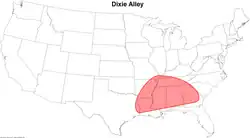
Louisiana is located in Dixie Alley, which is an expanse of land stretching from eastern Texas to southwestern North Carolina.[2] Tornadoes occur most frequently during the afternoon and early evening hours in Louisiana, and most activity occurs during the spring months of March through May. However, in the southern part of the state, tornado activity is more likely to remain consistent throughout the year, while reaching a minimum during the summer months of July and August.[3] Due to Dixie Alley's close proximity to the Gulf of Mexico, tornadic storms in that region are often high-precipitation supercells which produce rain-wrapped tornadoes that are difficult to spot, resulting in a higher risk of fatalities.[4][5] Tornadoes in Dixie Alley are also more likely than those in other regions to occur at night and tend to travel faster, making them more likely to catch people unprepared.[6]
The number of tornadoes that have been recorded within Louisiana is the highest within the 21st century. This is partially due to the fact that overall tornado counts tend to show higher numbers in more recent years, mainly due to improved detection and reporting of weak tornadoes.[7]
The deadliest tornado to impact Louisiana took place on May 13, 1908, in the community of Gilliam. This tornado touched down west of Oil City and moved directly through Gilliam, destroying many of its structures and killing 34 people. The tornado continued northeast and impacted the western side of Bolinger, where more homes sustained severe damage or destruction, and 9 people were killed. It then moved south of the Lela community before lifting just south of the Louisiana-Arkansas state border. This tornado traveled 24.5 miles (39.4 km) and had a peak width of 300 yards (270 m).[10]
This destructive tornado was first seen in Weiss just before it killed two people in the Dennis Mills community. The tornado passed near Montpelier, killing two more people, before directly striking the city of Amite, where complete destruction occurred to numerous structures and 29 people were killed. The tornado also severely damaged or destroyed structures near Wilmer, where four people were killed, and within Pine, where nine more people were killed, before crossing into Marion County, Mississippi. In total, at least 143 people were killed and 770 more were injured along the tornado's track across Louisiana and Mississippi, making it the eighth-deadliest tornado in U.S. history.[11][12][13]
At about 5:00 a.m. CST, this tornado touched down north of Lamourie, and instantly killed three people in Richland. As the tornado continued northeast, four more people were killed in the community of Ruby, and it injured 25 people as it moved between Effie and Center Point in Avoyelles Parish. As the tornado crossed into Concordia Parish, it widened to 700 yards (640 m) and leveled numerous plantations and tenant homes, causing at least 30 fatalities. After impacting Concordia Parish, the tornado crossed into Adams County, Mississippi just north of Natchez. Through the tornado's entire path across Louisiana and Mississippi, at least 91 people were killed and at least 400 people were injured.[14][12][13]
At about 4:00 p.m. CST, a violent, large tornado hit Minden, causing more damage than any other Louisiana tornado at that time. The 400-yard-wide (370 m) funnel first impacted Gillark, a community just outside Minden, killing 16 or more people. Homes there were lifted, "blown apart and scattered" aloft, according to tornado researcher Thomas P. Grazulis. In Minden the tornado destroyed or damaged 500 homes, with losses worth $1,250,000 (1933 USD). Dozens of houses were flattened, many of which were swept off their foundations.[15]
The deadliest tropical cyclone-spawned tornado to impact the United States took place on October 3, 1964, in the city of Larose. This tornado was spawned by an embedded supercell within Hurricane Hilda, and it destroyed numerous homes and vehicles within the city. The tornado killed 22 people, injured 165 others, and caused $2.5 million (1964 USD) in damage. This was only one of two tornadoes that were spawned by a tropical cyclone to reach F4 strength and the deadliest tornado to be produced by such an event since 1900.[16][17][3]
Forming just outside town, this tornado mangled oil derricks before striking Rodessa, where many homes "vanished", most of which were small and frail, according to a report quoted by Grazulis. The 200-yard-wide (180 m) tornado tore into corrugated metal buildings, ripping them to shreds. It piled up or blew machinery, automobile parts, and shacks miles away. Building debris mutilated victims. Losses totaled $250,000 (1938 USD).[18]
This tornado began south of Benton, and caused major damage in much of Cotton Valley, where 100 houses and several businesses were destroyed. An estimated 500 people became homeless following the tornado, and 14 people were killed within the town. Significant damage also took place within Dykesville and Haynesville in Louisiana before lifting north of Three Creeks, Arkansas, traveling a total path length of 59.7 miles (96.1 km) and peaking at a width of 600 yards (550 m).[9][19]
Numerous structures sustained damage from this tornado as it traveled 12.3 miles (19.8 km) across western Alexandria and Pineville, reaching a peak width of 200 yards (180 m). Fifty to sixty houses were damaged or destroyed, and several commercial buildings also sustained devastating damage. The lighting system was also knocked out in the city of Pineville, which made it diffcult to identify the extent of destruction and rescue victims in the tornado's path.[9][20]
This tornado touched down south of Converse, and it damaged or destroyed 50 homes as it moved south and east of Pleasant Hill. In the areas surrounding the town, 13 people were killed, including seven in one family. A child's body was carried for 1.5 miles (2.4 km) and a car was displaced by 0.5 miles (0.80 km). The tornado traveled a 26-mile (42 km) path and had a peak width of 200 yards (0.18 km) before lifting south of Hanna. Grazulis listed this tornado as a "probable F4."[9][21]
This tornado touched down west of Jackson, and severely damaged numerous tenant homes as it moved north of the town, killing nine people. After moving into East Feliciana Parish, the tornado impacted a lunatic asylum, killing four patients there. The tornado traveled 15.3 miles (24.6 km) in total and had a peak width of 400 yards (370 m) before it lifted north of Clinton.[9][22][23]
A total of 86 known significant[note 2] tornadoes impacted Louisiana before 1925, which killed 817 people and injured 2,716 others. During this time frame, 21 intense tornadoes impacted Louisiana. This was the state's deadliest time frame for tornadoes, with each tornado killing an average of 9.5 people. Five of the state's 10 deadliest tornadoes took place during this period, including its three deadliest tornadoes in Gilliam, Amite, and Concordia Parish, all three of which took place in 1908.[25][26]
† Deadliest in Louisiana history at time of event
‡ Tornado crossed state lines in or out of Louisiana
Intense (F3+) tornadoes in Louisiana, pre–1925[27]
A total of 132 known significant[note 2] tornadoes impacted Louisiana from 1925 to 1949, which resulted in 261 deaths and 2,363 injuries. Out of these tornadoes, 26 of these were intense, the deadliest of which struck the city of Minden, killing 28 people and injuring 400 others. Several other places were significantly impacted by intense tornadoes during this time period, including Bastrop, Pleasant Hill, Rodessa, Shreveport, and Cotton Valley. The tornadoes which impacted these cities all caused significant loss of life, with each one killing at least 10 people.[25]
‡ Tornado crossed state lines in or out of Louisiana
Intense (F3+) tornadoes in Louisiana, 1925–1949[27]
Between 1950 and 1974, a total of 432 recorded tornadoes impacted Louisiana, resulting in 184 deaths and 1,863 injuries. Forty-five of these tornadoes were intense, and the deadliest tornado was one produced by a supercell embedded within Hurricane Hilda which struck Larose and resulted in 22 fatalities.[16] Starting in 1950, following the first successful "tornado forecast" for the Tinker Air Force Base tornadoes in Oklahoma two years prior, forecasters were allowed to issue tornado warnings, which helped to significantly decrease tornado casualties.[29] Louisiana's first and only tornado to cause F5-rated damage also took place during this time frame, which was the 1971 Inverness tornado. This tornado struck Delhi and the nearby communities of Waverly and Transylvania, which killed 11 people within the state.[30]
‡ Tornado crossed state lines in or out of Louisiana
Intense (F3+) tornadoes in Louisiana, 1950–1974[31]
From 1975 to 1999, a total of 841 recorded tornadoes occurred in Louisiana, which caused 35 deaths and 1,327 injuries. During this time period, 50 intense tornadoes took place. Multiple destructive tornadoes impacted the Shreveport–Bossier City area. These included an F4 tornado on December 3, 1978, which killed two people and caused $250 million (1978 USD) in damage,[37] an F3 tornado on November 15, 1987, which killed one person and caused $50 million (1987 USD) in damage,[38] as well as the deadliest tornado to strike the state during this time frame, which was an F4 tornado that killed seven people and caused $8 million (1999 USD) on April 3, 1999.[39] In 1983, two other F4-rated tornadoes caused major damage within the cities of LaPlace and Collinston.[40][41]
‡ Tornado crossed state lines in or out of Louisiana
Intense (F3+) tornadoes in Louisiana, 1975–1999[31]
Since 2000, a total of 1,241 recorded tornadoes have impacted Louisiana, which have killed 48 people and injured 671 others. Twenty-two of these tornadoes were intense. Several tornadoes struck highly-populated cities, including two EF3 tornadoes that struck the New Orleans metropolitan area in 2017 and 2022, the latter of which killed two people.[42][43] On April 12, 2020, the Monroe tornado took place, which caused $250 million (2020 USD) in damage.[44] Another EF3 tornado struck Ruston on April 25, 2019, killing two people and causing $50 million in damage (2019 USD).[45] The 2010 Yazoo City tornado caused EF3-rated damage in areas north of Tallulah on April 24, 2010, before causing devastating damage and killing 10 people in Yazoo City, Mississippi as it traveled along a 149-mile (240 km) path.[46] Another EF4 tornado leveled homes outside of Atlanta on November 29 of the same year.[47]
‡ Tornado crossed state lines in or out of Louisiana
Intense (F3+/EF3+) tornadoes in Louisiana, 2000–present[48]
^In the United States, a tornado or twister both refer to a violently rotating column of air that reaches the ground. The National Weather Service (NWS) describes them as the "most destructive of all atmospheric phenomena".[1]
^ abDefined by Grazulis as receiving a rating of at least F2 or causing a fatality
^All recorded fatalities took place in and around Natchez, Mississippi, though it is possible that hundreds of fatalities may have taken place within Louisiana as deaths from enslaved people in the state were not officially recorded.[28]
^Thirty-nine of these fatalities took place within Louisiana.
^Forty-seven of these fatalities took place within Louisiana.
^As of December 2025, this is the deadliest tornado in Louisiana history.
^Five of these fatalities took place within Louisiana.
— (November 1990). Significant Tornadoes 1880–1989. Vol. 2. St. Johnsbury, Vermont: The Tornado Project of Environmental Films. ISBN 1-879362-02-3.
— (July 1993). Significant Tornadoes 1680–1991: A Chronology and Analysis of Events. St. Johnsbury, Vermont: The Tornado Project of Environmental Films. ISBN 1-879362-03-1.