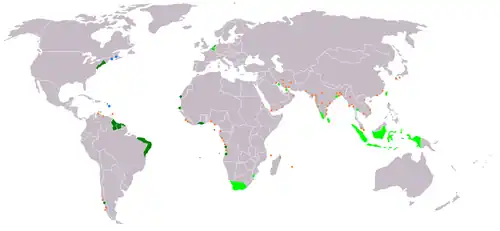
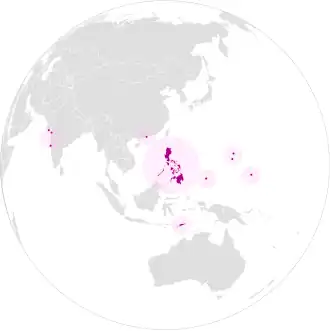
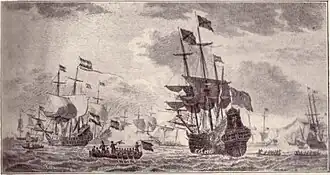
Protestant/Anti-Habsburg victory in the Indo-Pacific: Influence over the start of Portuguese Restoration War due to discontent with Spain's foreign and colonial policy.
This articles refers to the interconnected military, naval, economic, and informational developments that took place outside Europe during the Thirty Years' War (1618–1648).
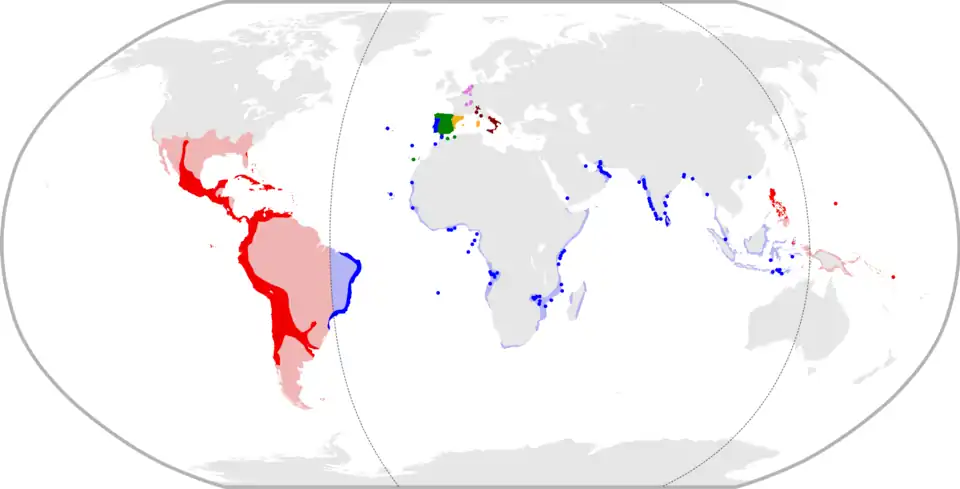
Although the conflict is traditionally portrayed as a Central European and intra-imperial war, several Atlantic, African, and Asian theatres significantly influenced its outcome. These overseas dimensions involved mainly the pro-Habsburg and Catholic Iberian Union (Spain and Portugal) against the anti-Hasburg and Protestant coalition (Dutch Republic, England, and various chartered trading companies), whose colonial rivalries reshaped the economic foundations of European states engaged in the war and were intimately related in the diplomatic and strategical area. This generally involved skirmishes and naval blockades (mainly to seizure colonial outposts or trade ships) rather than large and pitched battles.[1][2][3]
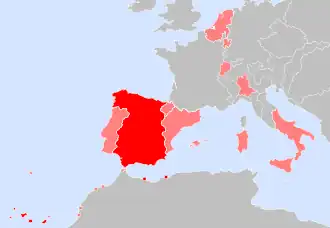
Thirty Years' War global coalitions from the Iberian Union's diplomatic perspective[9]
While the wider European significance of the war has since been fully recognized, historians like John Pike,[1] Johannes Müller,[2]Geoffrey Parker,[10]John K. Thornton,[11] Wim Klooster,[12]Peter H. Wilson,[13]Sanjay Subrahmanyam,[14]Jonathan Israel,[15] etc. have only recently begun to place it in a global context by more systematically integrating its various Trans-Oceanic side stages into their analyses. The global perspective emphasizes three main factors:[16][17]
Colonial and maritime warfare, especially Dutch–Portuguese and Dutch–Spanish conflicts.
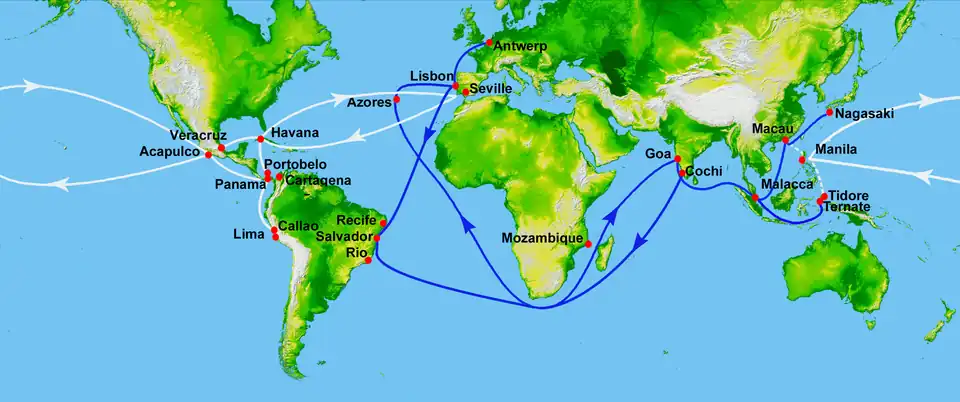
Transoceanic bullion flows, particularly the Spanish treasure fleets that financed Imperial and Habsburg armies.
A transcontinental news culture, which integrated events from Brazil, the Caribbean, West Africa, and the Indian Ocean into European political discourse.
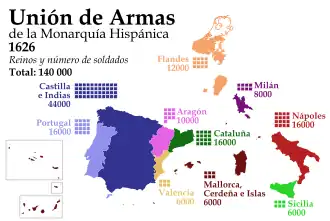
Also, the Iberian Union was a Composite monarchy administrated through a Polysynodial System and under a Legal pluralistConstitution based in Fueros (local Privileges to protect the Customary law of determinated Nations and its Estates of the realm). So, the Kingdoms, States and Lordships that comprised the Hispanic Monarchy were united through aeque principaliter, so the constituent kingdoms continued to be treated as distinct entities which retained their own traditional rights, resulting in the king not having the same powers in every territory, like in the states of the Crown of Aragon and Portugal in which his authority was considerably limited by their laws and institutions (like the Catalan constitutions or Portuguese Cortes), causing Castile to bear the greatest burden of the Monarchy's expenses and war efforts, with its economy ruined by a century of almost continuous colonial wars (did not helped that the Indies fleets often arrived late, and utilities were not what they used to be either).[26][27] That economical decline made Portuguese oversea troops to have Logistical problems for lacking Castilian financiation (similar problem had the Austrian Habsburgs), and the Spanish troops to mutiny on several occasions at the Thirty Years' War due to not receiving their pay, so the Union of Arms was proposed by Count-duke of Olivares to strengthen the collaboration of all the kingdoms of the Hispanic Monarchy in a common policy of military defense contribution, but he failed to gain acceptance from the institutions of each territory due to suspects of Centralisation and attempts to impose Legal Uniformism. This revealed the unstable internal relationship between the Spanish and Portuguese (who feared Castilianization) in developing a consistent foreign policy, which was exploited by Iberian Union's enemies.[28][29]
In July 17 of 1619, diplomatic agreements in Europe (related to the renewal of war with Spain at the Thirty Years War) convinced the Dutch States-General and English parliament to approve a pact of collaboration between the Dutch and English East India Companies (despite their rivalry in Spitzbergen, the Banda Islands and Amboina), with the goal of seizure the exploitation and defense in the Indo-Pacific region during the early 1620s.[34][36]
In the Treaty of Compiègne (1624) was stablished that Dutch colonialists should not attack French colonialists in the Far East and instead should have pacifical relations and develop trade (collaborating in the exclusion of Iberians in such), although Richeleu wanted to take a next step in pacting a militar joint-force against the Iberian colonies, the Dutch refused to allow French merchants to join voyages of the VOC.[37]
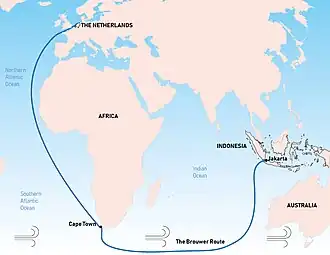
The main protagonist of the Anti-Habsburg oversea operations were the Dutch East India Company (VOC), formed to develop trade routes with the East of Cape of Good Hope, and the Dutch West India Company (WIC), formed later to do the same with the West, both to overcome the Insufficient supply of the goods which the Dutch were accustomed to obtain from the Iberian Peninsula. Known by Dutch historians as the 'Great Design' (a military plan developed to conquer Iberian positions in the Atlantic Ocean, both Americans and Africans), control of this trade would not only be extremely profitable but also deprive the Spanish of funds needed to finance their war in the Netherlands. In 1621, the Dutch West India Company was formed to achieve this militar plan to control both the lucrative sugar plantations in Brazil and the Atlantic slave trade. Dutch maritime successes deprived the Spanish monarchy of revenue and ships, indirectly shaping land campaigns in Germany, Italy, the Low Countries and even the Iberian Peninsula.[38] The principal objectives of the Dutch were on eroding Iberian trading capabilities and establishing their own commercial hegemony globally as part of a grand, multi-faceted strategy across Europe and the wider world that was planned to be achieved at the end of the Twelve Years' Truce. Such truce did not halt Dutch commercial and colonial expansion in the Caribbean and specially the East Indies,[39] even though Spain had tried to impose the dissolution of the VOC as a condition of the treaty. The Dutch Republic's minor concessions about the elimination of plans to create a Dutch West India Company and a halt to Portuguese encroachment in Asia were coming to an end, now with the support of France and England at the beginning of the Thirty Years' War to execute its aggressive campaign of commercial expansion to the New World by using privateers. By the time the truce ended, the Dutch were the aggressors in this global war for commercial interests; the initiative for armed conflict almost always came from the Dutch side, taking advantage of the emphasis on a defensive strategy among the Iberians due to the economic problems of the Hispanic monarchy.[15]
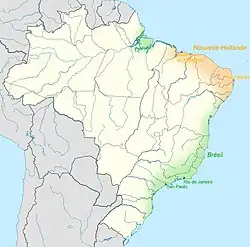
In the colonies located at the Americas (better occupied and institutionalized), the military tactics of the Anti-Habsburg coalition were mainly limited to supporting the privateering of their captains in the coastal zones of Ibero-America (mainly the Caribbean Sea), in order to drain the Spanish treasury and fill their own.[42] The main exception were the attempts to occupy the Lesser Antilles, North America, Southern Chile and specially Northeast Brazil, with some Indigenous help.[43][44] The Dutch prince Maurice of Nassau believed that the ruin of Spain would be inevitable if any of its rich American colonies were taken from it, so in 1623-24 developed 2 big expeditions, one against the Viceroyalty of Peru and the other to Portuguese Brazil, the later with a bigger success.[2][45]
The Dutch prepared an expedition against the Viceroyalty of Peru, in which a Dutch conquest of Chile (or at least consolidate a base in Chiloé or the Magellans Strait) was considered as an imperative intermediate step to prepare for a larger invasion of Peru (the jewel of the Spanish crown in South America). Due to the Destruction of the Seven Cities at the Arauco War in 1598, the Anti-Spanish coalition developed a special interest to conquer Southern Chile, which had been desoccupied by Habsburg Spain after the Disaster of curalaba and also was controlled by hostile Mapuches and Huilliches who could been potential allies against the Spaniards from the Captaincy General of Chile. Such special interest was increased by the Dutch after the Bombardment of Valparaiso (1614) by Joris van Spilbergen, since they knew firsthand the Spanish weakness in the region, and even defeated the Spaniards leaded by Rodrigo de Mendoza at Cañete (Peru), and then sack Paita (the goal of Spilbergen there was privateering than colonization).[53]
With such goal in mind, an expedition of 11 navies with 2000 soldiers was launched in 1623 by Jacques l'Hermite (a French) from Amsterdam to Southern Pacific Ocean, reaching Mala (Peru) on May 5 of 1624 and then attacking Callao from May 9 by establishing a military blockade between San Lorenzo Island and La Punta to the mouth of the Rimac River (since the attempts to land in Callao and the attacks carried out on that port had not been successful). However, due to logistical problems and the Viceroy Diego Fernández de Córdoba's staunch resistance to preventing them from landing to resupply, the Dutch decided to withdraw in September 9 after the excessive number of deaths (including L'ermite) from famine and disease among the crew.[54] The rest of the expedition, leaded now by Hugo Schapenham and Julius Wilhelm Van Verschoor, attacked Pisco, Acapulco and the Spanish East Indies until reaching Batavia.[55]
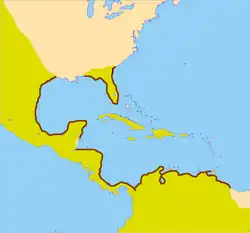
Multiple confrontations in the Caribbean—such as Dutch, English, and French raids on Spanish settlements between New Spain and New Granada—further weakened the Habsburg maritime system. These engagements contributed to the progressive erosion of Spain's Atlantic hegemony during the period, as Dutch, English and French privateers used the war to attack Spanish shipping under legal ambiguity. One of the most consequential overseas events was the 1628 capture of the Spanish treasure fleet by Dutch admiral Piet Pieterszoon Heyn in the bay of Matanzas (Cuba). The loss of American bullion was widely reported in German newspapers and perceived by contemporaries as having direct repercussions for Spanish military finance in Europe.[2]
However the Spaniards expelled English of St. Kitts in 1629 (in which the Kalinago indigenous people helped the Spaniards, seeing them as liberators from the Anglo-French Slavers) by taking advantage of Anglo-French struggles for the division of the island,[57] and then the English failed in stablishing a colony in Providencia (modern Colombia) after the Iberian capture of 1641. Also the French colonists tried to take advantage of the Anglo-Dutch-Iberian conflicts, but were not as successfully, settling in Tortuga on modern Haiti after the expulsion from St. Kitts in 1629 (desiring), but were expelled from there in 1635 by the Spaniards from Santo Domingo.[30] Despite the military successes of late 1620s and early 1630s, the Spaniards did not leave a permanent military garrison on Saint Kitts, Nevis or Tortuga, so the English and French returned later and intensified their colonization efforts in the Caribbean, focusing on the Bahamas and Saint-Domingue.[58]
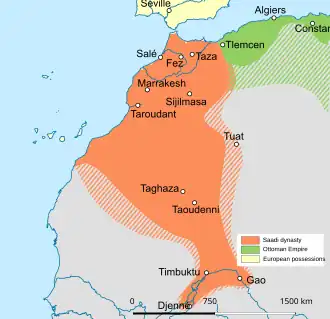
During the Portuguese Restoration War, Tangier and Ceuta make allegiance to Habsburg Spain and rejected John IV of Braganza attempts to be recognised. However, a 1643 Braganzist Rebellion in Tangier forced such colony to secede from the Hispanic Monarchy and be annexed by the reconstituted Portuguese Monarchy,[71] while Ceuta until today is a Spanish territory (despite some Portuguese conspiracies in 1641). This loyalty from Portuguese plazas at Morocco was influenced by their dependences in Subsidies from Andalusia and attempted negotiations from Braganzist Junta of Portugal to abandon those to Saadi Sultanate in exchange of Moroccan support in the European conflict (John IV and Cardinal Richelieu in 1640-42 tried to convince Moroccans to invade Spain and instigate an Andalusian rebellion like the Catalonian one).[62] During those years, the Plazas de soberanía were occasionally raided by Muslim warlords or the Anti-Habsburg allies, taking advantage of Logistical problems.[72] Other minor confrontations involved some skirmishes at the Canary Islands in which the Spaniards tried to increased the regulations over the entrancy of English, Dutch, French, Ottoman, Moroccan, German, Swedish or Danish navies (like the 1640 Christianshavn Incident), avoiding them to raid those for piracy[73][74][75] or use the islands as a scale to reach the West or East Indies and so sabotage their Colonialist projects, fearing an occupation than turn the islands into bases (like briefly did Pieter van der Does in 1599).[76] At the end, it was a Pyrrhic victory for Spain by maintaining its control in the Strait of Gibraltar (avoiding the creation of an English or Dutch colony against Spain) and not losing territories (even gaining enclaves in North Africa) at the cost of being severely damaged the Mediterranean fleet (starting with 75 vessels in 1619 to 26 vessels in 1648) and having supply problems.[63]
Initially, the Dutch failed on 1624 during the invasions of Filips van Zuylen and Piet Hein to aid Pedro II of Kongo's Angolan Wars (although the Dutch suffered treason by Garcia I of Kongo), focusing then on consolidate the Dutch conquest of Brazil and raid the Spanish Main before other African empress. Despite, the Dutch's luck changed in 1641 when they seized Portuguese slave trading hubs in Angola and São Tomé (after Capture of Luanda) with support from Dutch Brazil and the local kingdoms of Kongo leaded by Garcia II of Kongo (who restored the Dutch-Kongo alliance to rebel against Daniel da Silva) and Ndongo leaded by Queen Nzinga (whose position was threatened by Portuguese expansion), the last one being the mastermind behind the largest anti-colonial alliance of Angolan states (between Matamba, Ndongo and Kasanje, then the chiefdoms of Quiassama, Dembos and Congo Basin). The Portuguese now faced attacks from the Ndongo from the east, the Kongo from the north, the Dutch from the west coming by sea, and the Quiassama tribes from the south in the corridor between the Cuanza and Bengo rivers, concluding in the Battle of Kombi.[38][83] However, the Portuguese recover the initiative after getting reinforcement from Portuguese Brazilians while also achieving a peace agreement and alliances with locals like the kingdom of Kasanje (which, aside the Portuguese control of Caconda and Massangano, prived the Dutch to reach the Hinterland and buy Slaves to African lords), getting the Portuguese to Recapture Angola at 1648.[84]
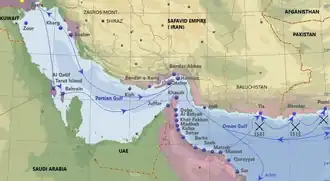
Despite that the Council of Portugal desired the formation of a Castilian-Portuguese joint force to retake Ormuz and declare war over Iran, the Hispanic Monarchy in the Junta of Persia priorized a diplomatic approach, not wanting to harm the Habsburg–Persian alliance (necessary for the balance of power in the Indo-Mediterranean against the Ottoman Caliphate),[101] which angered the Portuguese, who ignored the deplorable state of the finances of Portugal and Castile (and so, the logistical difficulty to defy the naval and economic power of the North European merchant companies, as well as the military power of the local Great powers like Abbas the Great's Iran), which were the arguments offered by the Council of Castile in avoiding to start a war with the Anglo-Iranians that would isolate more the Habsburgs in a critical situation like the Thirty Years' War.[41][29] In the other hand, although the English monarchy was not originally involved and initially George Villiers considered to demand the EIC for threatening Ibero-English relations (as there was not a formal Declaration of war yet due to the English doubts about whether to intervene in the Thirty Years' War or not and do the Spanish match against Franco-Dutch alliance),[102] he and King James I were bribed with 10,000 pounds to get Diplomatic protection and support in establishing a monopoly over Persian silk trade on the Cape route (originally offered by the Shah to Spain, although Spaniards were not interested), which soured relations between both monarchies for such conspiracy against Iberian monopoly, leading to the political tensions of 1625[103][104] and then the English intervention in the Eighty Years' War (1621–1648) by the approachment between the Crown and the House of Commons (dominated in the 1624 4th Parliament of King James I by EIC traders and Protestants hostiles to Iberians).[10] The next engagement was the Battle off Hormuz (1625) in which Portuguese stabilized their control over the Persian Gulf and reached a truce with Safavids but with heavy costs and without being capable to impede the arrival of non-Portuguese European merchants from the EIC and the VOC since 1629.[105] Also the Dutch take advantage of the English victories among the Safavid dynasty (who preferred the Protestants over Catholics due to not having pretentions of Evangelisation nor spreach their Western culture, only wanting to trade)[106] by developing trade agreements and stablishing their own Factories in the region.[107][108]
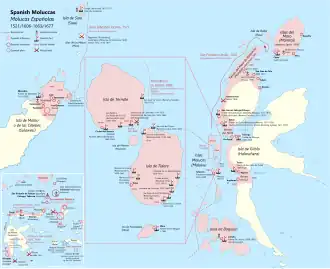
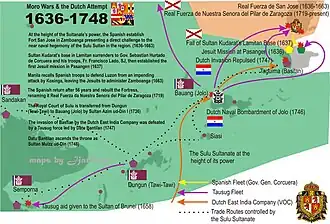
Northern Maluku-Minahasa Peninsula: By 1618, Spanish East Indies occupied Tidore, southern Ternate, northern Sulawesi (in which evangelisated the allied Manado Kingdom, who sent supplies) and some parts of Halmahera and of Morotai,[131] while the Dutch East Indies had inestability due to rebellions in Makian, Siau, Ambon and the Banda (in which also had clashes with the English, like in Amboyna), but also had more economic benefits than the Spaniards under Deficit and suffering Dutch naval blockades, becoming the riskiest and most costly territory for the Spaniards (needing fortified and large vessels to avoid attacks and get supply).[132][133][134] When the Thirty Years' War started, French and Danish were in Sulawesi by 1620–21, so Alonso Fajardo de Tenza sent constantly relief fleets to aid the Spanish Moluccas and stablished alliances with Makassar while abandoning costly positions like the forts in Jailolo and Manado. In reaction, the Dutch strengthen their alliance with the Sultanate of Ternate (rivals of Tidore and rebellious to Iberians) to invade those forts and launch raids through Kora kora ships against Iberian Galleons, while receiving aid from the corsairs Van Verschoor and Schapenham (previously raided Peru in 1624). The Spaniards answered by occupying Fort Marieko in 1621 (abandoned by the Dutch), then Fort Kalamata in 1625 while raiding Dutch Celebes and receiving aid from Madrid. The death of Saidi Berkat (exiled Ternatean Sultan in Manila) in 1628 ruined a plan of peaceful reconquest to expel the Dutch that were in a precarious position by not receiving reinforcements from Holland. Juan Niño de Tabora sent a fleet that was defeated by the VOC in the 1627 Battle of Ternate, but Pedro de Heredia triumphed in a revenge at 1628 and in in 1629. During 1630s-40s, the use of larger ships favoured Spaniards to overcome Dutch raids and intervene to aid Cachil Varo against pro-Dutch Cachil Borotalo in a Tidore's succession war (in which the Dutch win), as also the king of Manados against rebels (who expelled Spanish Friars). More clashes succeeded in Fort Oranje (mostly with Spanish victory, despite Dutch receiving help from Jailolo and Maguindanao Sultanate) until 1651 when arrived the news about the Peace of Westphalia.[135][133] Although the Spaniards triumphed over the Dutch raids, it was a Pyrrhic victory as Hamza of Ternate expanded its territory and rejected Vassalage while the Spanish costs to secure their territories from Dutch Malacca made it economically inviable, abandoning Maluku at 1656–1662 after Koxinga's menace of war and the betrayal of Tidore (remaining only Kingdom of Siau as protectorate until 1677).[136][137][138]
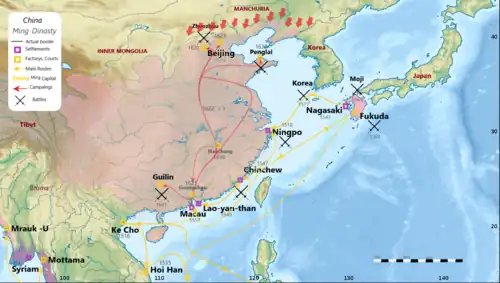
Since early 1600s, Dutch and English forces reached Ming China trying to stablish China–Netherlands and China–England economical relationships (although failed due to Portuguese protests and the Dutch alliance with Wokou pirates that caused Sino-Dutch conflicts), and by 1623 to 1636 the Portuguese lost 500 navies at colonial Macau due to their raids and aggressions, which included a blockade of Macau and Manila by an Anglo-Dutch navy commanded by Willem Janszoon.[150] These Anglo-Dutch attacks caused an increasement of collaboration between Portuguese Macau and the Captaincy General of the Philippines, integrating Macau to the Manila galleon route and occasionally receiving Castilian auxiliary forces and supplies (although being cautious, because Spaniards were potential competitors for being pro-Fujianese traders and wanting to have their own factory in mainland China).[117] One of the most important raids was the 1622 Battle of Macau, in which the VOC tried to conquer Macau to force China to open its market to them (and ruin the Iberian economical circuit between Manila, Malacca and Goa), but the Spanish-Portuguese forces succeeded.[151]
Simultaneously at the South China Sea started a series of Sino-Dutch conflicts, which were a consequence of Dutch attempts to force Ming China to close his commerce with Portuguese Macau and Spanish Philippines, demanding to open Free trade with the Dutch and the rest of Europe. This led to an informal alliance between Mings and Iberians (who wanted to maintain their economical privileges), while the angered Dutch allied with Asian pirates. Some important Sino-Dutch skirmishes were the Battle of Liaoluo Bay. An indirect consequence of this struggles were that the Imperial Chinese authorities give permission for Portuguese Macau to fortify itself and improve its walls (something banned in the XVI Century to avoid possible Iberian conquest of China) to defend Southern China from Wokou pirates backed by the Dutch.[117]
Despite Macau triumphed in securing its military defense through the war despite being one of the weakest Portuguese colony in the region, such was a Pyrrhic victory as Macau ended in economical ruin around the 1640s due to the ruin of Goa-Macau Indian trade, the Macau-New Spain trade (because Portuguese Independence) and the Macau-Japan trade (because Sakoku isolationism) caused by the consequences of Dutch expansionism and Spanish crisis at the Thirty Years' War.[117] Also Macau situation worsened by the contemporary Ming-Qing Conflict (in which Macau supported their Ming allies against the ManchuQing invasion, involving in the 1640 Siege of Galle).[152] All of this concluded in the 1640-42 Macau political crisis due to the doubts in colonial authorities to recognise John IV of Braganza (maintaining their privileges and autonomy at the cost of using the more dangerous Cape Route) or maintain allegiance to Philip IV of Habsburg Spain (maintaining the more secure Philippines-Mexico-Spain route at the cost of being more dependent of the Hispanic Monarchy); a Macau proposal of 1642 in which a Castilian-Filipino Presidio should be stablished in their city (to defend them from Anglo-Dutch and Sino-Japanese pirates) and free Mobilization for Macau people to Manila was briefly considered as a compromise to maintain the Spanish HabsburgSuzerainty, but the Cortes in Madrid rejected it due to the previous confiscation of property against Spaniards that did Macau authorities. After that, Macau joined the Anti-Habsburg coalition and the Anglo-Dutch navies began to supply them and act as intermediaries, although in 1644 and 1646 some Spanish Filipinos instigated an Austracist revolts to re-annex Macau to Spain, but failed and the Portuguese punishment was the total expulsion of Spaniards merchants and missionaries from Portuguese India.[29]
There were another conflicts in which there was an indirect participation of a European Power backing a Local Power (without sending their colonial forces) against another European Power which was in opposing sides at the time of the Thirty Years' War:
Although the Dutch gains in the West proved short-lived (as they would lost Dutch Brazil and Dutch Loango-Angola), the Dutch retained territories in the East, like the Cape Colony, as well as Portuguese trading posts on the Gold Coast, in Malacca, on the Malabar Coast, the Moluccas and Ceylon.[163] This led to the Dutch Golden Age and the consolidation of the VOC as the most profiable company of the world at the time.[43] Also a minor gain would be the Anglo-Dutch hegemony in the Caribbean Sea through their possessions in the West Indies, becoming the roots of the sugar and slave societies that will be established in the region by them (and other colonial powers), as also of the Golden Age of Piracy.[164]Rise of the Dutch Empire
By 1620s, the English consolidated colonies in Virginia, New England and some Caribbean islands in the Lesser Antilles that the Spaniards did not settle. Although initially the English West Indies were conceived as bases for Anti-Spanish Contraband and Privateering, then those would become in plantation societies through forced settlement (and others into Pirate Republics). In the other hand, the English North America would start to be colonized in mass by thousands of Puritans who departed for the New World in the 1630s, and once the colonial population had stabilized, England developed a systematic colonial policy since 1640s.[31]
In both Portuguese India and Spanish America were developed military reforms, in which Goa, Cuba, Puerto Rico, Cartagena, Chiloé,Valdivia and Callao strengthened defensive works due to fear of Dutch–English cooperation.[171] In the case of Spain, warships from the European fleet had to be sent to America constantly to push the Piracy in the Caribbean, while Castile's demography and taxation capacity fall apart due to the tax system reaching its limits and being constantly under military recruitment and levies to defend Spanish Empire across the world.[172] Another series of reforms were done in the Mining industry to overcome the Spanish bankruptcy,[173] and bigger Protectionist policies in the Viceroyalty of Peru against English, Dutch and French merchants (specially if those were Protestants) that were usually very related with the Corsairs that menaced the defense of the Pacific Ocean.[174]
Despite the 1648 Peace of Westphalia, the Dutch will continue to raid Spanish Philippines and support conspiracies from local powers hostile to Spain (like Ternate, Maguindanao, Sulu, Wokou and Moro pirates, etc.) until early XVIII century, obligating Spain to maintain a costly fleet in the region despite the big economical losses, being considered the withdrawal of Spain from its East Indies due to the debts and deficit (but prevented by the missionary objectives of converting indigenous people, more important to the monarchs than the economic objectives). Another issue was the lost of the Encomienda over Portuguese Indonesia after the Portuguese Independence, which harmed the viability of the Spanish Moluccas colony (which would be abandoned in late 1660s).[175]
In New Spain, Portuguese India and Portuguese Brazil were developed Antisemitic sentiments due to the bad reputation developed by New Christians (mainly Jews) for having collaborated with the Protestant invaders and still being granted economical privileges by the Iberian Crowns (who needed of their capabilities as investors and businessman). The Goa Inquisition and Mexican Inquisition developed a campaign of persecution against such minority to punish them and to discredit them before the crown.[29]
For contemporary European news media and chronicles (mainly in Germany), the global nature of the Thirty Years' War was a very prominent idea, as seventeenth-century observers frequently placed the military and political events of this conflict in a Transatlantic and even Global frame, reporting events from Ibero-America, South-West Africa and the East Indies alongside the campaigns in Central Europe. Periodical newspapers, newsletters and manuscript chronicles (like the ones of Volkmar Happe, Otto von Estorf, Christian II of Anhalt-Bernburg)[184] linked transoceanic events—such as the Dutch invasions of Braziland Chile, Revolts in Mexico, Portuguese-Kongo Wars, the arrival of the Spanish treasure fleet with Peruvian silver in Seville—to European military and fiscal crises, treating them as causally relevant to the fate of armies and states involucrated in the HRE's great war, seeing them as events that could alter the balance of power in Europe by weakening or strengthening metropolitan partners (specially the Superpower that represented Habsburg Spain for the general population) and so, perceiving distant events into a single narrative of universal crisis as transoceanic economic flows and colonial warfare had observable impacts on European military capacity and diplomacy (leading to the Dutch Golden Age and Decline of Iberian Union).[185]
This printed and manuscript news culture created a discourse of simultaneity and connectedness that integrated the disturbances in colonial possessions into the temporal narrative of the conflict and helped contemporaries perceive the fighting as part of a wider, interlinked contest rather than as an exclusively Local conflict or purely European war (general population saw the destiny of the German civilisation and the Christendom as something decided not only by their domestic affairs, but by battles around the world), recounting the European events that "led to the bloody Bohemian War which dragged on continuously for many years, creeping across virtually the entire world and devastating all the lands" with several Oversea theatres (traditionally treated as non-related or merely peripheral) that had structural effects on the European conflict. For example, the importance of the Battle of Matanzas Bay, in which a Spanish treasure fleet was captured by the Dutch in Cuba, having immediate implications for troop pay, mercenary financing and the diplomatic leverage of the Imperial Side in benefit of the Protestant Coallition (being used the gains to finance the Siege of 's-Hertogenbosch).[185]
^After 1640 in civil war. Some Portuguese colonies allied with the Dutch and English to re-start rivalries and disputes with Spanish colonies, while others continued to fight against the Dutch
^Also in rivalry and disputes with the Dutch in the Far East
^Initially at war with the Dutch until 1624 and the English form 1627-1629
^During Torstenson War briefly allied with Habsburgs against Dutch colonies
^Although allied with the Dutch against Habsburg Portugal, but still fought the Dutch in their colonies and sometimes allied with neighbour Spanish colonies.
^ abcdeThe Thirty Years War, 1618 - 1648: The First Global War and the end of Habsburg Supremacy: Pike, John: 9781526775757: Amazon.com: Books. ISBN 1526775751.
^ abYun-Casalilla, Bartolomé (2019), Yun-Casalilla, Bartolomé (ed.), "The Luso-Spanish Composite Global Empire, 1598–1640", Iberian World Empires and the Globalization of Europe 1415–1668, Palgrave Studies in Comparative Global History, Singapore: Springer Nature, pp. 323–376, doi:10.1007/978-981-13-0833-8_7, ISBN 978-981-13-0833-8, retrieved 2025-11-28{{citation}}: CS1 maint: work parameter with ISBN (link)
^Bentley, Jerry H.; Wiesner-Hanks, Merry E.; Subrahmanyam, Sanjay, eds. (2015), "Large-scale political formations", The Cambridge World History: Volume 6: The Construction of a Global World, 1400-1800 CE, The Cambridge World History, vol. 6, Cambridge: Cambridge University Press, pp. 269–344, ISBN 978-0-521-76162-8, retrieved 2025-12-13{{citation}}: CS1 maint: work parameter with ISBN (link)
^ abThornton, John (2016). "The Kingdom of Kongo and the Thirty Years' War". Journal of World History. 27 (2): 189–213. doi:10.1353/jwh.2016.0100. JSTOR 43901848. S2CID 163706878.
^Van Groesen, Michiel (2011). "Lessons Learned: The Second Dutch Conquest of Brazil and the Memory of the First". Colonial Latin American Review. 20 (2): 167–193. doi:10.1080/10609164.2011.585770. S2CID 218574377.
^Paquette, Publius Virgilius Rogers Professor of American History Robert L.; Paquette, Robert L.; Engerman, Stanley L. (1996). The Lesser Antilles in the Age of European Expansion. University Press of Florida. ISBN 978-0-8130-1428-9.
^Hernández, Luis Alberto Anaya (2004), Augeron, Mickaël; Tranchant, Mathias (eds.), "Huidas de cautivos y renegados de navíos corsarios berberiscos durante el siglo XVII", La violence et la mer dans l'espace atlantique : XIIe-XIXe siècle, Histoire (in Spanish), Rennes: Presses universitaires de Rennes, pp. 51–71, ISBN 978-2-7535-2535-1, retrieved 2025-12-16{{citation}}: CS1 maint: work parameter with ISBN (link)
^Thornton, John K., ed. (2020), "The Thirty Years War Comes to Central Africa", A History of West Central Africa to 1850, New Approaches to African History, Cambridge: Cambridge University Press, pp. 162–216, ISBN 978-1-107-56593-7, retrieved 2025-12-07{{citation}}: CS1 maint: work parameter with ISBN (link)
^Teles e Cunha, João (2009), Potter, Lawrence G. (ed.), "The Portuguese Presence in the Persian Gulf", The Persian Gulf in History, New York: Palgrave Macmillan US, pp. 207–234, doi:10.1057/9780230618459_12, ISBN 978-0-230-61845-9, retrieved 2025-12-17{{citation}}: CS1 maint: work parameter with ISBN (link)
^Floor, Willem (2009), Potter, Lawrence G. (ed.), "Dutch Relations with the Persian Gulf", The Persian Gulf in History, New York: Palgrave Macmillan US, pp. 235–259, doi:10.1057/9780230618459_13, ISBN 978-0-230-61845-9, retrieved 2025-12-10{{citation}}: CS1 maint: work parameter with ISBN (link)
^ abPieris, P. E. (Paulus Edward); Naish, Richard Bryant (1920). Ceylon and the Portuguese, 1505-1658. University of California Libraries. Tellippalai, Ceylon: American Ceylon Mission Press.


.svg.png)

.svg.png)
.svg.png)





.svg.png)




.svg.png)
.svg.png)
.svg.png)






.svg.png)






.svg.png)
.svg.png)
_(1554-1659).svg.png)
.svg.png)

.png)

.svg.png)
.svg.png)





.svg.png)


.svg.png)



 Kingdom of England: East India Company, Guinea Company, Council for New England, Providence Island Company.
.svg.png) Denmark-Norway: Danish East India Company.
Denmark-Norway: Danish East India Company. Swedish Empire: Swedish Indies Company, Swedish South Company
 Kingdom of France: Compagnie des Moluques, Company of One Hundred Associates, Compagnie de Saint-Christophe, Company of the American Islands.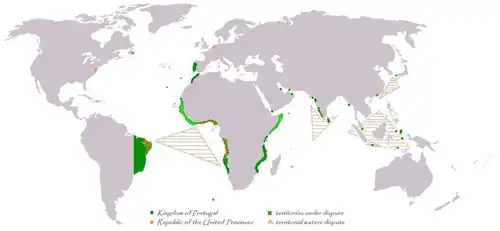

.png)








.svg.png)