The Dragon of the North
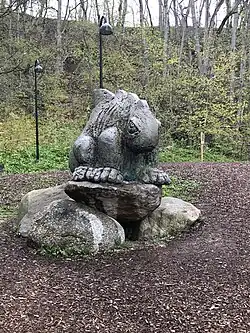
The Dragon of the North or Northern Frog (Estonian: Põhja konn) is a legendary frog-like creature in Estonian lore that was popularized by Friedrich Reinhold Kreutzwald. The frog is described as a massive, dragon-like monster that wreaks havoc on the land until it is defeated by a hero wielding a magical ring. Modern interpretations, such as those by author Andrus Kivirähk and artist Navitrolla, often reimagine the frog as a protector of Estonian language and culture.
Background
Very long ago, as old people have told me, there lived a terrible monster, who came out of the North, and laid waste whole tracts of country, devouring both men and beasts; and this monster was so destructive that it was feared that unless help came, no living creature would be left on the face of the earth.
— "The Dragon of the North," The Yellow Fairy Book, 1894[1]
The frog appeared in "The Dragon of the North" by Friedrich Reinhold Kreutzwald which was published in his 1866 collection Eestirahwa Ennemuistesed jutud, which translates to Ancient Tales of the Estonian People. In it, Kreutzwald retells the story of the tale of a young man who acquires and uses a signet ring (in some versions King Solomon's ring) to defeat a monstrous beast.[1]

According to August Annist, in adapting the dragonslayer style of story to the Estonian context, Kreutzwald made the dragon more frog-like[2] Estonian scholar Risto Järv classifies the Northern Frog as a variant of a dragon-slayer (ATU 300) using the Aarne–Thompson–Uther Index, with the frog replacing the dragon and functioning as an oicotype, or a localized version of the archetype.[3][4]
In Popular Culture
Author and historian Anatol Lieven mentioned the Northern Frog in the opening to his 1993 book The Baltic Revolution: Estonia, Latvia, Lithuania and the Path to Independence. He described the frog as an "awkward sort of beast" with a "bad temper," using it as a metaphor for the rugged and complex nature of Baltic independence. [5]
In the 2007 novel The Man Who Spoke Snakish, author Andrus Kivirähk depicts the frog as a giant, dormant protector of the Estonians against Christian crusaders.[6] The creature can only be awakened by ten thousand people speaking "snakish," a language that has nearly gone extinct by the novel's start.[6]
In 2025, the artist Navitrolla installed a statue in Võru at Tamula Beach called the Tamula konn that explicitly draws on the legend of the frog but flips the traditional narrative by positioning the frog as a protector of the Võro language rather than an agressor. The frog has spikes on its back representing defense of the language and a soap bubble in its mouth which stands for the "fragility and transience" of the Võro language[7]
See also
References
- ^ a b Lang, Andrew, ed. (1894). "The Dragon of the North". The Yellow Fairy Book. Project Gutenberg. Retrieved 17 September 2022. Cite error: The named reference "Lang1894" was defined multiple times with different content (see the help page).
- ^ Annist, August (1966). Friedrich Reinhold Kreutzwaldi muinasjuttude algupära ja kunstiline laad [The Origin and Artistic Nature of Friedrich Reinhold Kreutzwald's Fairy Tales] (in Estonian). Tallinn: Eesti Raamat.
- ^ Järv, Risto (2017). "Virumaa muinasjutud: tõe ja reaalsuse piirimail" [Fairy Tales of Virumaa: On the Boundary of Truth and Reality]. Mäetagused (in Estonian). 67: 181–218. doi:10.7592/MT2017.67.jarv.
- ^ Järv, Risto (1999). Hiiemäe, Mall; Oras, Janika; Tamm, Kadri (eds.). "Vale-Jüri kiusatus. Valekangelasest "Lohetapja" (AT 300) põhjal" [The Temptation of False-Jüri: On the False Hero Based on the "Dragon Slayer" (AT 300)]. VI: Noorte folkloristide konverents Tartu; 1998. Pro Folkloristica (in Estonian). 6. Tartu: 52–69.
- ^ Lieven, Anatol (1993). The Baltic Revolution: Estonia, Latvia, Lithuania and the Path to Independence. New Haven: Yale University Press.
- ^ a b Kivirähk, Andrus (2015). The Man Who Spoke Snakish. Translated by Moseley, Christopher. Grove Press. ISBN 9780802124111.
- ^ Lillemäe, Leevi (2025-06-03). "Võru gets its own twist on the 'Northern frog' with new statue". ERR News. Retrieved 2026-02-14.
External links
- Kangro, Tauno. "Artist Biography". Tauno Kangro Official Website. Retrieved 17 September 2022.