One of the organizers of military medicine in Russia
Awards
Russian Empire
Order of Saint Vladimir 2nd Class (1812) Order of St. Anna 1st Class (1814, since 1821 with diamonds)
Diploma of nobility of the Russian empire and approval of the annexed coat of arms (1816)
Baronet of the Russian Empire (1824) Order of Saint Alexander Nevsky 3rd Class (1828, since 1838 with diamonds) Order of Saint Vladimir 1st Class (1840)
Honorary member of the Russian Imperial Academy of Sciences
Sir James Wylie, 1st Baronet (Russian: Я́ков Васи́льевич Ви́ллие, Yakov Vasilyevich Villiye; 13 November 1768 –2 March 1854), was a Scottish physician who served as a battlefield surgeon and as a Court physician in the Russian Empire from 1790 until his death in 1854, and as President from 1808 to 1838 of the Imperial Medical and Surgical Academy at Saint Petersburg and of also its sister annex at Moscow. He is considered one of the foremost contributors to the development of military medicine in Russia by some by whom the role of the indigenous Russian Nikolay Ivanovich Pirogov as the "father of combat medicine"[1] may appear to be less valued.
Biography
James Wylie was born on 13 November 1768 at Kincardine-on-Forth, a Scottish seaport.[2][3] His parents were Janet (née Meiklejohn) and William Wylie, he a carrier, Forth cargo transporter and farmer.[2][4][5] James was the second of eight children, he and four brothers surviving infancy.[6] Inevitably, young James would have spent much time around Kincardine's busy harbour, well on its way to becoming one of Scotland's busiest by the turn of the century, and he would likely have listened to many stories about distant, exotic places from encounters with the sailors there. Nevertheless, after leaving school, James had an ambition to study medicine and he was therefore apprenticed to the local doctor, although this didn't start well as "being rather hardly used he ran off to sea" according to a grand-niece.[7] Upon learning of this, his mother walked 20 miles to the small seaport of Cramond-on-Forth, retrieved James from a sloop lying at anchor there and escorted him the 20 miles back to Kincardine, after which James returned to his apprenticeship, completed it, and thereby gained admittance to the University of Edinburgh.[7]
Wylie matriculated at the university in 1796 and studied there until 1789, these years coinciding with a golden era of that medical school's history, with him likely to have encountered that institution's foremost clinical teachers of their day in anatomy, in clinical medicine & physiology and in chemistry.[8]. He was arguably given the world's best medical instruction of the time.[9] This, together with the acquired knowledge of the medical school's teaching methods and his observations of the advanced structure and layout of the Edinburgh Royal Infirmary were major influences on Wylie and, in turn, doubtless provided a clear vision for him in his subsequent work in expanding and improving the medical teaching in Russia, in expanding and improving military & civilian medical services there and in his significant contribution to Russian pharmacology.[7][8][9][10]
Wylie left the university without graduating, not uncommon in those days, and in 1790, at the suggestion of John Rogerson, from Dumfries, a Court physician to Catherine the Great, he moved to Russia where the Empress had been trying to modernise Russian medicine by importing foreign doctors and surgeons.[9] To the Russians, who found his name impossible to pronounce, he was known as Villie.[11]
Until well into the 19th century Russia had very little in the way of an organised profession of medicine. Treatment for the Court and nobility was obtained from abroad, and for the lower classes it was mainly in the hands of the clergy.[12]
In accordance with Russian requirements he sat, and passed, the Russian State Medical Board examination for the right to practise medicine there, then worked for a time as medical attendant to the family of Prince Galitzin, afterwards signing up for service in the Russian military and being appointed in December 1790 a physician within the Eletsky regiment, stationed at that time in Lithuania.[8][9][11]
Oil painting of Wylie by Philipp Frank at Paris, 1816.
Wylie was surprised that only officers received medical assistance, with lower ranks thus more likely to succumb to their wounds, infections and diseases such as malaria, thereafter making it his personal goal to thereafter ensure that enlisted men as well as officers received medical treatment for wounds instead of being left to die on the battlefield.[9] And later, when in charge of medical services for the entire Russian army, he reorganised it so that surgeons remained in the field, often working with the enemy's wounded as well as their own.[11] Later still, understanding that it was possible for Russia to effectively train its own sons, he was responsible for discontinuing the recruitment of foreign doctors and surgeons to the Russian armed forces.[11]
In regard to Wylie's treatment of wounded enemy soldiers at this time, we find that much later (1814) after the re-instatement of the monarchy in France, the new king would award Wylie the Legion of honour for doing the same towards French soldiers.[13]
Wylie's surgical operations were particularly numerous during the regiment's participation in the Polish–Russian War of 1792, and in the 1794 Kościuszko Uprising that culminated in the Battle of Praga, and he soon attracted attention by his surgical successes and his improvements to medical treatment.[8]
It was his particularly his treatment of officers and men for malaria, common amongst soldiers and officers and known as intermittent fever at that time, which made Wylie’s reputation.[8][9] He employed a medication of his own creation which, while not a cure, was apparently so successful in relieving victims’ symptoms that he was recognised in January 1793 with a special award by the commanders of the regiment.[9][11]
One of his operations during this period, a lithotomy, involved extracting an egg-sized bladder calculus, and was particularly praised by the Headquarters Physician. Wylie also successfully performed a rare operation that year to extract a bullet embedded in a soldier's lumbar vertebra.[8]
In December 1794, Wylie finally received the degree of Doctor of Medicine, this by King's College, Aberdeen, in those days the degree of MD being generally awarded there "in recognition of general and professional attainments".[9][14]
He resigned from the army in November 1795 upon appointment as family physician to Count Boris Strogavoff in Saint Petersburg and also commenced private practice there, his reputation growing quickly and attracting many society clients.[2][8]
One year later, Catherine the Great died and the Russian crown passed to her son Paul under the title Tsar Paul I. Wylie's surgical skill, boldness and determination (at a Court where intrigue and violence were no strangers) would soon land him important appointments there.[11] Wylie having made a re-acquaintance with Dr Rogerson, Rogerson afterwards contacted his compatriot when he and a German surgeon were in despair about using a catheter to remove a stone from the urinary bladder of Baron Otto Bloom, the Danish ambassador to the Russian court. Wylie performed the lithotomy with a trocar improvised out of the catheter, thereby saving the life of a man who was a friend of Tsar Paul, and Wylie was appointed court operator on 25 February 1798.[15] In July 1799 be became Tsar Paul's Surgeon-in-Ordinary and physician to the heir apparent (the Tsar's eldest son Alexander) when, being the only surgeon with enough courage to perform the first laryngotomy operation in Russia, he saved the life of Count Ivan Kutaisov who was the Tsar's barber, closest confidant and fixer, and been ennobled by him with the title of Count.[2][9][15][16] Other cases, equally fortunate to Wylie, occurred around this time, but his position at court remained very insecure for his good fortune would have aroused much jealousy.[12] Throughout Paul's reign Wylie enjoyed his absolute trust, being awarded by him in early 1800 with the title "Doctor of Medicine and Surgery...for his skills and knowledge of medical science and for his success in the treatment of diseases".[8]
After Paul I was murdered by a group of dismissed-military officers on 23 March 1801, Wylie was the first doctor on the scene.[11] Later, Paul's body was handed over to Wylie and two other Scots doctors to dissect, with Wylie diplomatically certifying the cause of death to be apoplexy.[2][11][15][16] The next day he had the task of embalming Paul's distorted facial features to make them presentable for public viewing prior to burial, this being aided by the presentipn of Paul in his uniform.[11] Wylie's efforts were universally welcomed across the Russian Court.
The death of Tsar Paul ushered in the reign of his eldest son Grand Duke Alexander under the title of Tsar Alexander I. This did not affect Wylie's position at the Court, with Alexander appointing him to be his Body Surgeon and Physician, and he soon becoming a favourite confidant of the Tsar, accompanying him on all his travels.[8][11] Wylie retained his influence amongst the courtiers and enjoyed many privileges.[8] Wylie remained the Tsar's Body Surgeon and Physician until the Tsar's death in 1825.[11] Wylie's shrewd clinical judgement was never more obvious than when the Emperor developed severe pain and discolouration in one leg. Other Court doctors and advisers were pressing for amputation of the leg, no doubt aware of likely violent reaction to them in the streets if the Emperor were to die without them having taken any prior action. But Wylie nevertheless advised against amputation, and continued with his treatment regime. Slowly, the leg healed and was saved.[11]
Despite his exalted position he showed considerable interest in teaching students at Saint Petersburg's Medical-Surgical Academy, founded in 1798 from an existing training centre for army and fleet physicians. After obtaining permission from the Academy Council, he taught there on anatomy and instructed students about performing operations, using both living patients and cadavers. And, according to Chistovich, "... there was seldom a day when Wylie did not visit the Central Hospital of the Land Corps and did not watch treatment of patients, especially surgical ones".[8] Later (in 1808) he was to become formally responsible for this medical training via his election as President of both the Academy (renamed that year as Imperial Medical and Surgical Academy) and its annex in Mocow, positions he would retain until 1838.[17]
A few years into Alexander's reign, concerns had developed in Russia about the stability of mainland Europe posed by Napoleon. In 1804 Tsar Alexander invited Wylie back to military service, already familiar to him, appointing him Medical Inspector of the Imperial Guard.[8] This was the start of a pattern of concurrent involvement in both the academic teaching of military medicine and the personal in-field application of military medicine that Wylie was to continue to perform for much of the remainder of his long and busy career.
During early 1805, Russia, Austria and Britain formed a coalition against further French encroachment within Europe, war then breaking out in October that year. Ten or so indecisive actions in Austria that month between Austrian and French forces were followed by battles in Austria between French and incomplete Russian forces at Schöngrabern and Wischau during the following month. At Wischau, Wylie was actually on the field of battle directing the Russian medical field services.[8]
A massive and decisive battle took place on 2 December when the entire Russian and Austrian forces engaged Napoleons entire force at the Battle of Austerlitz, north of Vienna. The Tsar personally led the Russian forces, Wylie accompanying him throughout the battle. It was later noted that Wylie was one of the few that remained with him in the heat of the battle.[9] The combined Austrian and Russian force was defeated at Austerlitz, and the allied coalition fell apart once a formal peace treaty was signed between Austria and France.
A new coalition against France involving Russia, Britain, Prussia, Saxony, and Sweden formed within months of the collapse of the previous coalition. Following three indecisive battles in Poland between December 1806 and May 1807 involving the Russian and French forces (at Pultusk, Eylau and Heilsberg), a major engagement took place on 14 June 1807 at the battle of Friedland. This battle inflicted an overwhelming defeat on the Russian forces, leading to the signing of a Franco-Russian peace treaty at Tilsit: this the high point of Napoleon's power.
Wylie had attended all but one of the Russian army's battles under this coalition. He was appointed in March that year as Inspector General for the Army Board of Health. Then in 1808 he became responsible for all academic training of military medicine within Russia as a result of his election as President of both the Medical-Surgical Academy, (renamed that year as Imperial Medical and Surgical Academy) and its annex in Moscow.[17] In September that year he was awarded the 4th degree Order of St Vladimir, the first of many awards bestowed upon him during his service to Russia.[8]
The period of Franco-Russian collaboration lasted until Dec. 31, 1810, when the tsar broke one its terms by opening Russian ports to neutral ships. From that point the Tsar and his key government departments began preparations for a renewal of hostilities. In time, both a small but highly skilled Russian spy cell in Paris and the astute Russian ambassador there were able to provide the Tsar with early warning of indications that Napoleon was planning an invasion of Russia during summertime in 1812. Russia's Imperial Ministry of War immediately commenced arrangements for significant increases in the supply of munitions and uniforms, reserve army battalions and the purchase and training of additional horses for the army.[19]
In 1812 Wylie was appointed Director of the Medical Department of the Imperial Ministry of War, a position he held until his death in 1854.[8] When added to his election to President of the Medical-Surgical Academy in 1808 the concurrent involvement in both the academic teaching of military medicine and the personal in-field application of military medicine of his earlier had now become substantially magnified into concurrent oversight of all the academic teaching of military medicine throughout Russia and oversight of in-field application of military medicine throughout all of Russia's armies
With invasion imminent, the Medical Department lost no time in bringing the army's medical services to a high state of efficiency, especially in regard to ensuring ample numbers of trained field surgeons and medics, ample material for the assembly of battlefield hospitals plus sufficient ancillary army staff and carts to enable the transfer of wounded soldiers to the field hospitals or further afield, and ample supplies of medical instruments, medications and all manner of other supplies.[19]
On 24 June 1812, about 200,000 French forces crossed the Nemen river into Russia, about 450,00 or 500,00 forces in total by the end of the French campaign.[19]
On 7 September 1812 at Borodino Wylie is said to have performed about 80 operations in the field. He also attended the mortally wounded General Prince Pyotr Bagration, Commander-in-Chief of the 2nd Russian Army. On 27 August 1813 at Dresden he amputated the mortally wounded General Moreau's legs, which were shattered by a cannon shot as he was talking to the Tsar.[12]
The outcome of the pre-war efforts of the Medical Department of the Imperial Ministry of War was impressive. Russian military doctors worked throughout the campaign as part of a coherent system, with a high level of organization in evacuating the wounded from the battlefield to field hospitals for operations and recuperation. This complex mechanism was set up by Wylie. And through concerted efforts on his part, the number of non-combat losses in peacetime in the Russian army fell to ten per cent by the mid-19th century. A huge drop in modern terms, this was an even greater achievement in an era when every fourth European soldier died of disease.[20]
Wylie became so well known for his work in the training and direction of military surgeons that both the Austrian and the Russian emperors requested him to reorganise the medical corps of their armies.[2]
Wylie accompanied Alexander I during his visit to England in 1814, and on 10 June at the Ascot races he was knighted at Alexander's request by the Prince Regent, becoming Sir James Wylie. On 2 July 1814, again at the Tsar's request, Wylie was created a baronet in the name and on behalf of George III.[16][21] In early 1816, Tsar Alexander ordered that the diploma of nobility of the Russian Empire be made out to Wylie and approved the arms annexed to it.[22] On 2 February 1824 his title as a British baronet was recognized by the State Council of the Russian Empire, making him the only baronet in the country's history. He also became an honorary member of the Russian Imperial Academy of Sciences.[15]
From September 1814 to June 1815, Wylie attended Tsar Alexander at the Congress of Vienna, a tortuous series of convoluted international diplomatic meetings to discuss and agree upon a possible new layout of the European political and constitutional order in the wake of napoleon's downfall.
On 10 January 1816, Tsar Alexander ordered the diploma of Nobility of the Russian Empire to be made out to Wylie, and to approve the coat of arms annexed to it.[23]
Wylie attended Alexander I at the Congress of Verona in 1822, and was with the Tsar during his last tour to the South of Russia, which was ended by Alexander's death at Taganrog on 1 December 1825.
A standout achievement of these years was his 1823 foundation of the Voenno-Meditsinskii Zhurnal (Journal of Military Medicine), one of Russia's most significant journal and nowadays the oldest Russian peer-reviewed scientific journal.[2]
The Scottish doctor continued to enjoy imperial confidence under Alexander's brother and successor, Nicholas I.[12]
In early 1826 during the Russo-Turkish War (1828–29), Wylie by then aged 60 took part in several battles leading the medical corps.[9] After delays stemming from confusion about the legitimate heir to the crown and the resulting Decembrist revolt, Nicholas was finally crowned Emperor on 3 September 1826. Among the individuals honoured at the coronation by a notice of the new Emperor, was Wylie to whom he presented a valuable snuff-box, accompanied by a rescript, expressing his acknowledgement of Wylie's services as Chief of the Medical Staff.[24]
In 1841, Wylie was promoted to the rank of Actual Privy Councillor 2nd grade of the Table of Ranks.[25]
Wylie remained a lifetime bachelor. He had twice come close to marriage. The first instance involved an Englishwoman but she required that they reside in England so he gave her back his word.[26] Then, in August 1823, during a courtship at the small town of Novomyrhorod, south of Kyiv, his wedding arrangements fell through as a result of him being confined to bed for a prolonged period of time due to a compact fracture of the knee and injury to his hip incurred in a carriage accident near there.[26]
Afterwards, Wylie continued to be held in high regard in Russia: the Military Medical Encyclopaedic Dictionary describing him in 1946 as: "A man of great gifts and talents, a good surgeon, talented administrator and organiser who enjoyed great authority in the country."[2]
Memory
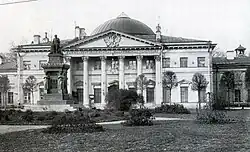
Monument to Sir James Wylie in front of the Imperial Military Medical Academy in 1914 (as photographed by Karl Bulla)Monument to Sir James Wylie in garden of Military Medical AcademyMonument to Sir James Wylie in garden of Military Medical AcademySir James Wylie's Sarcophagus at Volkovo Lutheran Cemetery
Wylie's Russian will was challenged by his family and there was held to be an intestacy in relation to funds he had left in the British public funds.[27] Some £50,000 was shared among his wider family as he had no wife nor direct heirs. But Wylie had successfully bequeathed a considerable fortune of 1.5 million roubles for the construction of a hospital attached to the Imperial Medical and Surgical Academy. This cluster of five buildings assembled in his honour into the shape of a W was finished in 1873. Before the October Revolution of 1917 it was known as the Mikhailovskaya Baronet Wylie Clinical Hospital in recognition of Grand Duke Michael Pavlovich, youngest son of the former tsar, Alexander I. These days the hospital is in use for clinics of the S.M. Kirov Military Medical Academy; the Intermediate-level Therapy & Military Field Surgery clinics and the Clinic for Child Diseases[26].
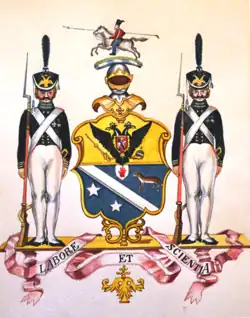
In 1859 a large monument in to him designed by Andrei Stakenschneider and sculpted in grey marble by David Jensen was erected in front of the main building of the Medical and Surgical Academy in Saint Petersburg, with Wylie depicted in full military uniform bearing his medals, while sitting on a rock reading his reformed Statutes of the Academy, and with the each side of the monument's base featuring a panel showing his name and brief facts carved in large gold lettering, and three bronze panels showing respectively; his baronet's coat of arms designed personally for him by Tsar Alexander I, him addressing the Academy, and him attending to the wounded in the field of battle.[26][28][29] In 1949 –1951 by decision of the S.M. Kirov Military Medical Academy headship it was removed to the courtyard of the former Clinical Hospital built with Wylie's funds.
Wylie's well-preserved gravesite at the Volkovo Lutheran Cemetery in Saint Petersburg features a massive black sarcophagus placed upon a podium of granite flagstones. Its rear face features a modern (2014) enamelled photograph of one of Wylie's portraits. On a polished white marble plate attached to the front face of the sarcophagus is carved in relief the following inscription in four lines of English: SIR JAMES WYLIE BARONET 1766–1854. The sides of the sarcophagus each feature a large panel with relief inscriptions in Russian about Wylie's life and his services to Russia, one of these translating as:
"Matters of administration and assistance to the suffering did not divert baronet Yakov Vasilyevich Villie from service to science: he wrote essays about yellow fever, plague, cholera, diseases typical of hot climates, a military pharmacopoeia, the management of operational surgery, the first in the Russian language, and he founded the first Russian medical journal, which is published to this day. Having warmly fallen in love with Russia and in his will naming it his second fatherland, he allotted his entire inheritance, more than a million roubles, for the benefit of medical education in Russia and for good works. Passed away 11 February 1854." [NB: Julian Calendar]
Wylie was depicted by Leo Tolstoy as a character in his epic novel War and Peace, Wylie named therein as Doctor Villier, an anglicized version of Russian Villiye.
Works
On the American yellow fever (1805). St. Petersburg. [in Russian, a copy bring held at the British Library]. Printed in Russian.
A brief manual on the most important surgical operations (1806). St. Petersburg: Medical Printing House. Printed in Russian.
Manual for physicians performing recruit selection. (1806, 2nd edn. 1810). St. Petersburg. Printed in Russian.
Pharmacopeia castrensis Ruthena – transl. as Russian military pharmacopoeia (1808, later editions 1812, 1818, 1840). St. Petersburg: Medical Printing House. Wylie's remarkable tome, printed in Latin. NB: a copy at the National Library of Scotland.
Prakticheskie zamechaniia o chume–transl. as Practical observations on the plague (1929). St. Petersburg. Printed in Russian.
Practical observations on diseases related to tropical climates (1929). St. Petersburg. Wylie's Russian translation of an English language work.
Practical observations about intermittent fevers and weakening fevers(1829). St. Petersburg. Printed in Russian.
Sir James Wylie's Sarcophagus at Volkovo Lutheran CemeteryOfficial report to his imperial majesty on the comparative value of the therapeutic methods applied in the military hospitals and at Saint Petersburg to subjects struck with the epidemic disease known as the cholera morbus, with practical observations to the nature of the plague and what one learnsby opening the corpses (1831). St Petersburg. Printed in French.
Description of the conjunctivitis that prevailed among the troops (1835). St. Petersburg. Printed in French.
Awards and honours
Dedication to Wylie in a 1816 book by Gotthelf Fischer von WaldheimWylie's 1840 medal for 50 years of service to Russian medicineCoat of arms designed for him by Tsar Alexander I
Wylie's government roles, honours and memberships are well summarised in a dedication to him given in a mineralogical book published by Gotthelf Fischer von Waldheim at Moscow in 1816.[30] The author spent most of his adult life in Russia, and this dedication reflects a general admiration of Wylie among men of science within that country.
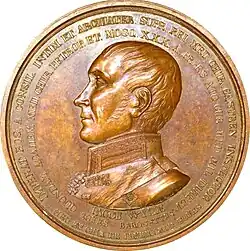
in 1840, Wylie received a gold medal for his 50 Years of service to Russian medicine. The obverse side has bust of him together with his name and the titles of his principal roles stated in Russian around the rim. The reverse side has twelve lines of Latin, the translation stating: "To the most distinguished gentleman under the auspices of the triumphant Emperor. Dedicated to the most outstanding gentleman in the field of Medicine in Russia exercising the healing art for fifty years. Respectfully the doctors of Russia congratulate him at St Petersburg 9-12-1840."
The medal was presented to him by Grand Duke Michael at a jubilee held in his honour at Saint Petersburg in December 1840, translation of a French description of the event reading as: "... details of the half-century jubilee of doctor James William baron Wylie, doctor and privy councillor to the emperor, grand cross of several orders, etc. All of the most distinguished within Russia were associated with this festival. From the early morning a great number of people had gathered in Mr. Wylie’s house; at ten o’clock, the members in charge of the provisions of the festival presented their congratulations to the honourable doctor and invited him to a banquet …. the heir grand-duke Alexandre Nicolavitsch condescended to go in person to the illustrious old man to congratulate him. At a quarter hour past mid-day the banquet room began to fill with those who had been invited, among whom could be found the grand-duke Michael, the ambassador of England, Lord Klanricard, field-marshal prince de Varsovie, prince Volkonsky, minister for the court, the minister for war count Tchernicheff, the vice-chancellor of the empire count de Nesselrode, the minister of the interior, count Strogonoff, the minister for justice, count Panin, the director-general of communication, count Toll, the controller of the empire Chitrovo, the marshal of the nobility, the grand-equerry, prince Dolgorouki, Blondoff, president of the department of the laws of the council of the empire, the auditor-general, prince Schackousky, general of the general staff of the Russian armies, count de Kleinmichael. At half past four doctor Wylie appeared. The minister for war complimented him in the most flattering terms, and on behalf of the emperor presented him with the grand cross of the order of St. Vladimir, whose star and ribbon were placed on the doctor by grand-duke Michael. At the end of the meal, which was the most brilliant, they presented to baron Wylie a silver vase of very great value and an immense gold medal, struck in his honour".[31][32] NB: some copies of the medal were subsequently minted in bronze; the order of St Vladimir received by Wylie was his third, this one being the highest (1st ) class.
United kingdom: Knighthood (10 June 1814), Baronetcy (2 July 1814) and a coat of arms designed for him by Tsar Alexander I
United States: An international member, of the American Philosophical Society <https://en.wikipedia.org/w/index.php?title=Category:International_members_of_the_American_Philosophical_Society&pagefrom=Richter%2C+Gerhard%0AGerhard+Richter#mw-pages>
Appleby, John H. (1 September 1987). "Through the looking glass; Scottish doctors in Russia". In The Caledonian phalanx: Scots in Russia. Edinburgh, National Library of Scotland. pp. 59-63.
Beveridge, David (1885). Culross and Tulliallan, or, Perthshire on Forth, its history and antiquities with elucidations of Scottish life and character, from the burgh and kirk records. Edinburgh and London, W. Blackwood and Sons. pp. 351-354, Vol. 2.
Boase, Frederick (1901). Modern English biography. Truro, Netherton and Worth. pp. 1534-1535, Vol. 3.
Burgon, Rev. John W. M.A. A memoir of Patrick Fraser Tyttler. London, John Murray. pp 92-110.
Comrie. John D. (1932). History of Scottish medicine. Baillière, Tindal and Cox. pp. 767-768, Vol. 2. NB: a PDF available at the Wellcome Collection, London: https://wellcomecollection.org/works/p3bwpd8b
Gordon, T. Crouther (1960). Four notable Scots. Stirling, Scotland, Aneas Mackay. pp. 101-126.
Lieven, Dominic (2009). Russia against Napoleon, the battle for Europe, 1807 to 1814. London, Allan Lane. 672 pages.
McGrigor, Mary (2010). The Tsar's doctor: The Life and Times of Sir James Wylie. Edinburgh, Birlinn Limited.
Mieklejohn, William, Rev, M.A. (1990). Four lads o' pairts: Sir James Wylie, Sir James Dewar, Robert Maule J.P., Sir Robert Maul. How and Blackwell, Berwik-upon-Tweed. Edited for electronic publishing by Colin Anderson in 2014. pp. 1-23.
Materials on the history of the Baronet Villie's Mikhailovskaya Clinical Hospital. Saint Petersburg, Typography of Ministry of Internal Affairs. 1899. pp. 1-24. In Russian. NB: a PDF available at the Wellcome Collection, London: https://wellcomecollection.org/works/r8hyyqrb
Oxford dictionary of national biography, Oxford, Oxford University Press. 2004. pp. 648-649, Vol 60.
Journals:
Berman, Alex. (April 1960). "Early Russian military and naval formularies 1765-1840". American Journal of Hospital Pharmacy. 17:210-218.
Hutchison, Robert (June 1928). "A medical adventurer. Biographical note on Sir James Wylie, Bart., M.D., 1758 to 1854". Proceedings of the Royal Society of Medicine. 21(8):1406–1408.
McIntyre, Neil (1 November 2000). "Medical statues – Sir James Wylie (1768-1854)." Journal of Medical Biography. 8(4):243.
Müller-Dietz, H. (1969): "J. Wylie and the Medico-Surgical Academy in St. Petersburg. On the 200th anniversary of Sir James Wylie's birth]".Clio Medica. 4:99–107. In German. NB: a copy held at the Wellcome Collection, London.
Novik A. A., Mazurov, V. I., Semple P. A. (August 1996). "The life and times of Sir James Wylie Bt., MD., 1768–1854, body surgeon and physician to the Czar and chief of the Russian Military Medical Department". Scottish Medical Journal. 41(4):116-120.
Shabunin, A., Semple, P. d'A. (1999). "Achievements in Russia of Sir James Wylie, Bt., MD. – a Scottish graduate". Proceedings of the royal college of physicians of Edinburgh. 29:76-82.
Tyukin, V. P., Churilov, L. P. (2006). "Yakov Vasilyevich Wylie: half a century at the head of Russian medicine", Medicine in the 21st century. 4(5): 100-107. In Russian.
Wilson, John B. M,D. (April and May 1973). "Three Scots in the service of the czars". The practitioner. 10: 572-574 (Part I) and 10: 706-708 (Part II).
Zaytsev, E. I. (2009). "Yakov Vasilyevich Wylie (1768–1854)", The I. I. Grekov Journal of Surgery. 168(4):9-10. In Russian.
Nicholson, Stuart (20 April 2004). "Doctor to the czars; Scots surgeon became a legend in Russia, but is still almost unknown in the land of his birth". Daily Mail(London).
^ abcdefghOxford dictionary of national biography. Oxford: Oxford University Press. 2004. pp. 648–649, Vol. 60.
^Beveridge, David (1885). Culross and Tulliallan, or, Perthshire on Forth, it’s history and antiquities with elucidations of Scottish life and character, from the burgh and kirk records. Edinburgh and London: W. Blackwood and Sons. pp. 351, Vol. 2.
^Nicholson, Stuart (20 April 2004). "Doctor to the czars; Scots surgeon became a legend in Russia, but is still almost unknown in the land of his birth". Daily Mail (London).
^Mitchell, John Fowler; Mitchell, Sheila (1968). Monumental inscriptions pre-1855 in Clackmannanshire, Scotland. p. 62.
^Microfilm 1040141: Old parochial registers for Tulliallan – Baptisms, 1673-1777, Mortcloth dues 1698. Microfilm 1040193: Tulliallan old parish registers of baptisms 1777-1854, marriages 1673-1854 and deaths 1680-1781, 1807 and 1820-53, held by Church of Jesus Christ of Latter-day Saints, Salt Lake City, USA (genealogy collections).
^ abcMeiklejohn, William Rev MA. (1990). Four Lads o’ pairts: Sir James Wylie, Sir James Dewar, Robert Maule J.P., Sir Robert Maule. Berwick-upon-Tweed: How and Blackhall, Edited for electronic publishing by Colin Anderson in 2014. pp. 1–2.
^ abcdefghijklmnoShabunin, A; Semple, P.d'A. (1999). "Achievements in Russia of Sir James Wylie Bt., MD. – a Scottish graduate". Proceedings of the Royal College of Physicians of Edinburgh. 29: 76–82.
^Berman, Alex (April 1960). "Early Russian military and naval formularies 1765-1840". American Journal of Hospital Pharmacy. 17: 210–218.
^ abcdefghijklWilson, John B. M.D. (1973). "Three Scots in the service of the czars". The practitioner. 10: 572-574 (Part I, April 1973) and 706-708 (Part II, May 1973).
^ abcdRobert Hutchison (June 1928), "A medical adventurer. biographical note on Sir James Wylie, Bart., M.D., 1758 to 1854". Proceedings of the Royal Society of Medicine.21(8):1407.
^Evening News, 30 September 1814, page 146. Under the heading: Paris Sept. 26.
^Anderson, Peter (1893). Officers and graduates of University of Kings College Aberdeen, 1495-1860. Aberdeen: New Spalding Club.
^ abcdAppleby, John H. (1 September 1987). "Through the looking glass; Scottish doctors in Russia". In The Caledonian phalanx: Scots in Russia. National Library of Scotland. pp. 59-63.
^ abcBoase, Frederick (1901). Modern English biography – &c. Truro: Netherton and Worth. pp. 1534-1535 (Vol. 3).
^ abE. I. Zaytsev, (2009). "Yakov Vasilyevich Wylie (1768–1854)". Vestnik Khirurgii im. I. I. Grekova – transl. as The I. I. Grekov Journal of Surgery.168(4):9. In Russian.
^The Salisbury and Winchester Journal (30 March 1807). Under the heading: From the London Gazette of March 24.
^ abcLieven, Dominic (2009). Russia against Napoleon: The battle for Europe, 1807 to 1814 (1st ed.). London: Allan Lane (published 1 October 2009). ISBN 9780713996371.
^The London Gazette, 5 July 1814, pp. 1340-1341, under the heading: Whitehall, July 2, 1814.
^The Scots magazine and Edinburgh literary miscellany, page 156, February 1816, under the section headed Appointments.
^The Public Ledger and Daily Newspaper, 9 February 1816. Untitled news item.
^Bell's Weekly Messenger, 23 October 1826. Untitled news article.
^V. P. Tyukin, L. P. Churilov, "Yakov Vasilyevich Wylie: half a century at the head of Russian medicine", Medicina v XXI veke – transl. as Medicine in the 21st century. (2006). 4(5):103 -104. In Russian.
^ abcdDolinin, Valentin A.; Tyrenko, Anna (2014). Life and work milestones of James Wylie. Saint Petersburg: S. M. Kirov Military Medical Academy. pp. 14, 16.
^Iwan Wassilyewitch Enohin v Anne Wylie, Walter Wylie, [1862] EngR 567; 11 ER 924; (1862) 10 HLCas 1
^Gordon, T. Crouther (1960). Four notable Scots. Stirling, Scotlald: Eneas Mackay. p. 124.
^McGrigor, Mary (2010). The Tsar's doctor: the life and times of Sir James Wylie. Edinburgh, Scotland: Birlinn Liimited. p. 204. ISBN 978 1 84158 881 0.
^Fischer, Gotthelf (1816). Essai sur la turquoie et sur la calaite [Essay on turquoise and calaite]. Moscow: Imperial University Printing House. pp. 3 (the book's dedication to Wylie).
^Bulletin et annales de l'Académie d'archéologie de Belgique,by Académie d'archéologie de Belgique (1843). Anvers: Chez Froment, pp. 470-471
^The Newcastle Courant, 26 February 1841. Untitled news article.