Siege of Kaluga (1617–1618)
| Siege of Kaluga (1617–1618) | |||||||
|---|---|---|---|---|---|---|---|
| Part of Polish–Russian War (1609–1618) and Prince Władysław's March on Moscow | |||||||
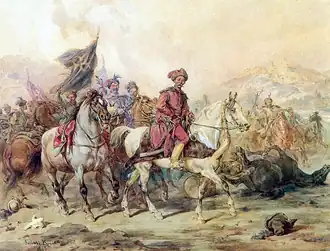 Painting of the army by Juliusz Kossak | |||||||
| |||||||
| Belligerents | |||||||
 Polish-Lithuanian Commonwealth Polish-Lithuanian Commonwealth |
.svg.png) Tsardom of Russia Tsardom of Russia | ||||||
| Commanders and leaders | |||||||
| Stanisław Czapliński | Dmitry Pozharsky | ||||||
| Strength | |||||||
| Unknown | 6,000–7,000 | ||||||
| Casualties and losses | |||||||
| Unknown | Unknown | ||||||
The Siege of Kaluga 1617–1618 was an attempt by Polish-Lithuanian invaders to capture Kaluga at the final stage of the Polish–Russian War (1609–1618) during the Moscow campaign of Prince Władysław.
Siege
The Polish advance on Moscow was conducted on three fronts: northern (Volokolamsk), central (Mozhaisk), and southern (Kaluga). On the Kaluga front, these were primarily the Lisovtsy, led by Colonel Stanislav Chaplinsky.[3] They captured Meshchovsk and Kozelsk, after which, plundering and burning everything in their path, they spread across the Kaluga region. The Kaluga residents sent a delegation to Tsar Mikhail Fyodorovich asking him to send Prince Dmitry Pozharsky for their protection, remembering his brave fight on their soil against Alexander Lisovsky. The Tsar granted their request, but due to the dire situation on other fronts, he could only send a small detachment of 300 strelets and 20 nobles and residents to accompany Pozharsky. Pozharsky was tasked with creating a fighting force on the spot. For this task, he enlisted the help of the Cossacks, being one of the few tsarist commanders who enjoyed high authority among the Cossacks and knew how to establish cooperation with them. The court valued this quality of Pozharsky's, allocating him a large sum to pay the Cossacks.[4] According to various sources, Pozharsky's army numbered up to seven thousand men.[5]
Having broken into Kaluga in October 1617, the prince immediately began preparing the city for a siege. Meanwhile, regular Polish detachments led by Piotr Opaliński came to the aid of the Lisovtsy.[6] The Poles established a fortified camp near Tovarkovo and then advanced on Kaluga. Pozharsky encountered the enemy in mid-December near the Laurentian Monastery, where a fierce battle ensued that lasted all day. The Poles retreated, but Pozharsky's young nephew was captured. Ten days later, according to the New Chronicle, the Poles launched a night attack on Kaluga.[7] However, thanks to the strong outposts and guards posted by Pozharsky, they were discovered in time.[8] They were deliberately allowed to reach the city walls and then annihilated by an attack by Russian troops that suddenly emerged from the fortress. According to one version, the Poles were deliberately lured into a trap by former Cossacks of Ivan Zarutsky, who falsely promised to defect to their side during the night assault on Kaluga.[9]
However, the camp in Tovarkovo continued to exist, and raids were launched from it against Obolensk and Serpukhov. Pozharsky organized a guerrilla war against the invaders, individually intercepting and destroying individual detachments of Lisovtsy and regular Polish troops. Ultimately, Pozharsky's cavalry units managed to break into the camp near Tovarkovo and destroy a significant portion of the provisions, weapons, and ammunition. This occurred in May 1618. The significantly depleted Polish army retreated to the main forces of Prince Vladislav in Vyazma.[10] The immediate threat looming over Kaluga was eliminated through the efforts of Dmitry Pozharsky. After this, the prince and his noble-Cossack army took part in the Battle of Mozhaysk.[11]
Aftermath
Kaluga enjoyed only a few months of security. In late 1618, the Zaporozhian Cossacks of Hetman Petro Sahaidachny approached. Their numerous forces stormed the city's trading quarters and besieged the tsar's garrison in the Kaluga. Only after the Truce of Deulino did the enemy troops withdraw from Kaluga, leaving the trading quarters a ruin.[12]
References
- ^ Эскин 2018.
- ^ Курков 2021, pp. 21–28.
- ^ Курков 2021, pp. 21.
- ^ Курков 2021, pp. 22.
- ^ Dunning 2001, pp. 221.
- ^ Курков 2021, pp. 23.
- ^ MacKenzie & Curran 1986, pp. 138.
- ^ Riasanovsky 2011, pp. 172.
- ^ Курков 2021, pp. 24–26.
- ^ Курков 2021, pp. 26–28.
- ^ Freeze 1993, pp. 232.
- ^ Курков 2021, pp. 28.
Bibliography
- Курков, В. В. (2021). "Казачество и князь Пожарский в боях с польскими захватчиками на калужской земле на заключительном этапе Смутного времени". Альманах «Казачество» (in Russian) (51).
- Эскин, Ю. М. (2018). Дмитрий Михайлович Пожарский (in Russian). Moscow: Квадрига.
- Freeze, Gregory L. (1996). The Russian Church and the Politics of Reform. Cambridge University Press.
- Dunning, Chester S. L. (2001). Tsars and Imposters: False Dmitrii and the Time of Troubles. Cambridge University Press.
- Riasanovsky, Nicholas V. (2011). A History of Russia. Oxford: Oxford University Press. ISBN 978-0-19-534197-3.
- MacKenzie, David; Curran, Michael W. (1986). A History of Russia, the Soviet Union, and Beyond. Belmont, CA: Wadsworth. ISBN 978-0-534-10691-1.