Siege of Herat (652)
| Siege of Herat | |||||||||
|---|---|---|---|---|---|---|---|---|---|
| Part of the Muslim conquest of Persia | |||||||||
| |||||||||
| Belligerents | |||||||||
|
House of Karen Hephthalites | Rashidun Caliphate | ||||||||
| Commanders and leaders | |||||||||
| Unknown | Al-Ahnaf ibn Qays | ||||||||
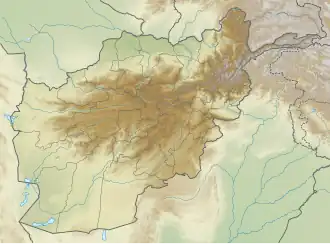  Location within Afghanistan | |||||||||
The Siege of Herat was part of the Muslim conquest of Persia and was commanded by the Arab commander Al-Ahnaf ibn Qays.
Background
The second Rashidun caliph Umar (634–644) launched an offensive against the Sasanian Empire in 642, and by 651 the empire was destroyed. However, parts of Khorasan were held by Sasanian loyalists helped by their Hephthalite allies.
In 651 the task of conquering Khorasan was assigned to Al-Ahnaf ibn Qays by Abd Allah ibn Amir. Abd Allah started to march in 650 from Fars and took a short and less frequented route via Rayy, while Al-Ahnaf then marched north directly to Merv.[1] Later Al-Ahnaf was sent by Abd Allah to lead the vanguard of the Banu Tamim and 1000 Asawira through Quhistan. The people of Tabasyin later revolted against the Caliphate but were reconquered by Al-Ahnaf, who now exacted heavier tool of tax. Al-Ahnaf continued to advance, and Herat agreed to pay the Jizya in exchange for peace.[2]
Battle
In 652, Al-Ahnaf was forced to attack Herat again after the latter had again rebelled. He defeated the ruler of Herat and made a treaty with him once more. However, the ruler of Herat along with the Karenids and many other natives of Khorasan, later rebelled against the Arabs, but were defeated at the Battle of Badghis.
See also
References
- ^ The Muslim Conquest of Persia by A.I. Akram. Ch:17. 1 September 2009 ISBN 0-19-597713-0,
- ^ The Oxford Handbook of Iranian History edited by Touraj Daryaee