Shahanshah (Shirvanshah)
| Shahanshah | |
|---|---|
 | |
| Shirvanshah | |
| Reign | c. 1180 – c. 1203 |
| Predecessor | Akhsitan I |
| Successor | Farrukhzad I |
| Died | c. 1203 |
| Dynasty | Kasranids |
| Father | Manuchihr III |
Shahanshah (died c. 1203) was a ruler of the Shirvanshah dynasty from c. 1180 to c. 1203.[1] He was a son of Shirvanshah Manuchihr III (r. 1120 – after 1160). He had three brothers, Akhsitan I, Afridun II, and Farrukhzad I.[2]
Background
The Shirvanshahs were a Persianized dynasty ruling in the region of Shirvan (modern Azerbaijan) from the 9th century until the 16th century. By the 12th century, they were part of the Kasranids line, descended from Yazid ibn Mazyad but heavily integrated into Iranian culture and politics.[3] Shirvan was strategically located between the Caucasus mountains and the Caspian Sea, often caught between larger powers such as the Seljuks and the Atabegs of Azerbaijan.
Reign
Shahanshah’s reign is primarily reconstructed through numismatic evidence, as few narrative sources survive.[4] Coin mints demonstrate that his rule coincided with those of his brothers Akhsitan I and Afridun II, as well as Afridun’s son Fariburz II. This suggests that upon Manuchihr III’s death, the kingdom may have been divided among his sons.[5]
Shahanshah’s coins were minted in Shamakhi, indicating that he ruled from the traditional capital of Shirvan.[6] Afridun II and Fariburz II appear to have controlled the western part of the kingdom, while Akhsitan I may have shifted his base to Baku, especially after the devastating earthquake of 1191 that damaged Shamakhi.[7]
It has also been proposed that Shahanshah may have succeeded Akhsitan I directly, rather than ruling concurrently, though the overlapping coinage makes this uncertain.[5] His reign reflects the complex dynastic politics of Shirvan in the late 12th century, when multiple princes issued coins simultaneously, perhaps as semi‑autonomous rulers under nominal suzerainty of the Atabegs of Azerbaijan.[4]
Cultural Context
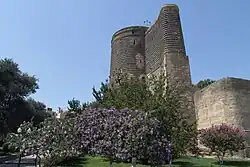
The late 12th century was a flourishing period for Persian literature and architecture in Shirvan. Poets such as Khaqani Shirvani and Falaki Shirvani were active at the Shirvanshah court, producing works that praised the dynasty and reflected its cultural prestige.[3] Architectural projects in Baku, including fortifications and possibly the Maiden’s Tower, are often attributed to this era, showing the dynasty’s investment in urban development and defense.
Death and Succession
Shahanshah died around 1203.[1] He was succeeded by his brother Farrukhzad I, who continued the Kasranid line. His reign, though poorly documented, is significant for illustrating the fragmentation of Shirvan’s monarchy and the reliance on coinage as historical evidence.[4]
References
- ^ a b Kouymjian 1969, p. 241.
- ^ Kouymjian 1969, p. 242.
- ^ a b Minorsky 1958, p. xx.
- ^ a b c Kouymjian 1969, pp. 184–194.
- ^ a b Kouymjian 1969, p. 188.
- ^ Kouymjian 1969, p. 193.
- ^ Kouymjian 1969, pp. 190–191.
Sources
- Kouymjian, Dickran (1969). A Numismatic History of Southeastern Caucasia and Adharbayjan based on the Islamic Coinage of the 5th/11th to the 7th/13th Centuries. Columbia University.
- Minorsky, Vladimir (1958). A History of Sharvan and Darband in the 10th–11th Centuries. Cambridge University Press.