Senate of Bangladesh
Senate of Bangladesh বাংলাদেশ সিনেট বাংলাদেশ অধিষদ | |
|---|---|
| Type | |
| Type | |
| Established | 17 February 2026 to within 180 working days. |
| Structure | |
| Seats | 105 |
Political groups | Proposed composition according to the proportional representation, and election result.
Government (50)
Opposition (40)
|
Length of term | Up to five years |
| Elections | |
| |
| Meeting place | |
| Jatiya Sangsad Bhaban, Sher-e-Bangla Nagar, Dhaka, Bangladesh | |
| Constitution | |
| Constitution of Bangladesh | |
 |
|---|
 
 |
|
|
 |
 Bangladesh portal Bangladesh portal |
.jpg)


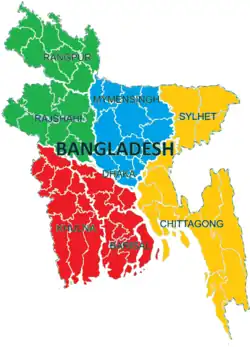
The Senate of Bangladesh (Bengali: বাংলাদেশ সিনেট) is the proposed upper house of the Jatiya Sangsad, the bicameral legislature of Bangladesh. It is going through transition phase following the success of the 2026 Bangladeshi constitutional referendum on February 12, 2026, [1]
Background
Since independence in 1971, Bangladesh has had a unicameral legislature, the Jatiya Sangsad. After the political reforms following the July Revolution, the National Consensus Commission developed the July Charter, which proposes changes to the constitution, governance, and election framework and creating a bicameral parliament with a Senate as the upper house.
Under the "July Charter implementation order" which has approved and gazetted in November 2025, the Senate proposal is formally included as part of the constitutional referendum question to be held alongside the 2026 general election.[2]
Structure
The Parliament of Bangladesh would be restructured into two chambers:
| Bangladeshi Parliament | |
|---|---|
| National Assembly | Senate |
| Lower House | Upper House |
|
|
Proposed Composition According to July Charter
Proposed composition according to the proportional representation, and election result.[3]
- Government (50)
- BNP (50)
- Opposition (40)
- 11 Party Alliance (40)
- IAB (3)
- Independent (6)
- Vacant (1)
Functions and Powers
Under the charter’s framework:
- Legislative Review: The Senate would debate and suggest changes to bills passed by the lower house.
- Constitutional Amendments: Any constitutional change would require approval by a majority of the Senate, adding a check to constitutional revisions.
- The Senate is not intended to duplicate the lower house’s functions but to act as a deliberative and revisory chamber.[4]
References
- ^ "July Charter and Constitutional Reforms in Bangladesh". ConstitutionNet. Retrieved 2026-01-06.
- ^ "July Charter referendum: What it is and why it's confusing". Dhaka Tribune. Retrieved 2026-01-06.
- ^ "BNP got 49.97% votes, while Jamaat 31.76%: EC | The Daily Star". www.thedailystar.net. Retrieved 2026-02-15.
- ^ Ahmed, Rajib (2025-11-14). "July Charter implementation order: How much of each party's demands accommodated". Prothomalo. Retrieved 2026-01-06.
23°45′44″N 90°22′43″E / 23.76222°N 90.37861°E
Parliaments of Asia | |
|---|---|
| Sovereign states |
|
| States with limited recognition | |
| Dependencies and other territories |
|
| |

