Robert Newman (sexton)

Robert Newman (March 20, 1752 – May 26, 1804) was an American sexton at the Old North Church in Boston, Massachusetts. He is considered a Patriot in the American Revolution for hanging lanterns, along with two fellow patriots, in his church's steeple on April 18, 1775, part of a warning signal[1][2][3][4] devised by Paul Revere, on the eve of the Battles of Lexington and Concord.
Early life
In 1741, Newman's parents purchased a three-storied, prominent house in Boston's North End and moved with their young children.[5] Newman was born eleven years later, in 1751, the last of five children. His father, Thomas, had been a successful merchant until his sudden disappearance in 1754, when he was lost at sea, leaving the family in a financial lurch. Newman's older brothers were educated alongside John Hancock, Sam Adams and Paul Revere at the North Writing School and went on to have careers as a watchmaker, teacher and organist.[6] Yet, with the dramatic change in family fortune, Newman was unable to be formally educated and instead apprenticed as a leather britches maker and later serving as sexton to Christ Church (now known as Old North Church).
Career

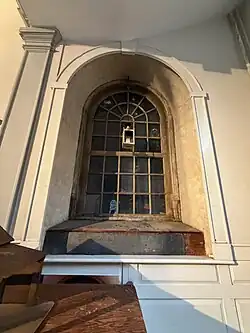
Newman had become sexton of Christ Church in 1772. He was a member of the Sons of Liberty and resided in the North End. The Newman family was quartering British regulars in their home, a common practice in 1775 while the city was under siege. After pretending to go to bed on the night of April 18, Newman snuck out of his house undetected by the regulars and joined vestryman John Pulling and Pastor Thomas Bernard, who assisted him with the signal. Bernard served as a lookout while Pulling and Newman went to the belfry, the tallest structure in the area. Using a code devised by Revere, Newman hung two lanterns in the church's belfry to warn Patriots that the British were about to descend upon Lexington via the Charles River. The signal was spotted across the river and allies began spreading the word. British regulars also witnessed the display and encircled the church. According to local legend, Newman escaped out the right side rear window of the church and fled for home. General Thomas Gage arrested him the following day, April 19, yet nothing could be proven against Newman, and he was released three days later.[7] He reported passing the keys of the church to Pulling, and when British authorities went to question Pulling, he had already escaped to Nantucket, where he remained until it was safe to return.[8]
Newman joined the Society of Free Masons on January 15, 1783, and continued as sexton of the Old North Church until his death. The famous steeple was toppled by the Snow Hurricane of 1804 in the fall after Newman died. He was survived by his second wife, Mary Hammon, whom he married in 1790. He is buried at Copp's Hill Burying Ground in Boston. His collected letters were published on the bicentennial of his signal, in 1975.[1] One of the two original lanterns remains and is on display at the Concord Museum in Concord, Massachusetts.
Notable family members
Newman's maternal great-grandfather was Reverend George Burroughs, the Harvard educated, non-ordained minister who was sentenced for witchcraft and hanged in Salem in 1692.
Isaiah Thomas, first cousin to Newman, was the editor of the Massachusetts Spy and founder of the American Antiquarian Society.
References
- ^ a b Sheets, Robert Newman (1975). Robert Newman: His Life and Letters 1752–1804. Commonwealth Book Company, Inc.
- ^ Charlestown, Mailing Address: Boston National Historical Park 21 Second Ave; Us, MA 02129 Phone: 617 242-5601 Contact. "Old North Church - Boston National Historical Park (U.S. National Park Service)". www.nps.gov. Retrieved October 2, 2023.
{{cite web}}: CS1 maint: numeric names: authors list (link) - ^ "Captain John Pulling Jr. Historical Marker". www.hmdb.org. Retrieved October 2, 2023.
- ^ "History of Old North Church | The Old North Church". The Old North Church & Historic Site. Retrieved October 2, 2023.
- ^ name="sheets1975">Sheets, Robert Newman (1975). Robert Newman: His Life and Letters 1752–1804. Commonwealth Book Company, Inc.
- ^ name="sheets1975">Sheets, Robert Newman (1975). Robert Newman: His Life and Letters 1752–1804. Commonwealth Book Company, Inc.
- ^ Waters, Henry Fitz-Gilbert (1877). The New England historical and genealogical register, Volume 31. The Society
- ^ Goldfeld, Alex R. (2009). The North End: A Brief History of Boston's Oldest Neighborhood. The History Press, ISBN 978-1-59629-518-6