Richard Ashworth (headmaster)
Richard Ashworth | |
|---|---|
 | |
| Born | 16 April 1869 |
| Died | 25 December 1928 (aged 59) |
| Burial place | Edmonton Cemetery |
| Education | University of London (B.A.) |
| Occupation | Headteacher |
| Years active | 1887–1928 |
| Known for | First headmaster of The Latymer School on Haselbury Road |
| Spouse | Caroline Lydia Joscelyne |
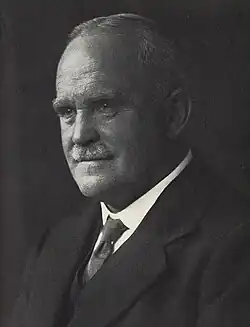
Richard Ashworth (16 April 1869–25 December 1928) was an English headmaster, known for his role as the first headmaster of The Latymer School on Haselbury Road in Edmonton, London, from 1910 to 1928. Beginning his career as a teacher in Tottenham, he led several schools, including the successful Tottenham Pupil Teachers' Centre, before overseeing the growth of Latymer from a small institution into a major secondary school. Ashworth was also a prominent figure in local civic life, known for his activism in the Liberal Party and his public lectures on social reform.
Early life and education
Richard Ashworth was born on 16 April 1869 in Tottington, a village near Bury in south Lancashire.[1] He grew up in an industrial area that was recovering from the economic difficulties caused by the American Civil War and the subsequent cotton famine.[2] His father, Robert Ashworth, worked as a calico printer and part-time farmer, while his mother, Alice Ashworth, was a power-loom weaver.[3][2] He had two younger siblings, a brother named Joseph, born in 1871, and a sister named Lilian, born in 1877.[4]
Family history played a significant role in shaping Ashworth's later political views; a close associate noted that Ashworth frequently spoke of the Peterloo Massacre of 1819, where a relative had sustained injuries that eventually proved fatal. This family tragedy was cited as the root of his "ardent" support for political reform."[5]
Ashworth's early education is not well-documented, but at the age of twelve, he attended the New Jerusalem School in Ramsbottom, run by the Swedenborgian Society.[6] The school focused on subjects like mathematics and science, which Ashworth pursued with interest.[7] At sixteen, following the death of his grandfather, Ashworth received a modest inheritance which helped support his further education.[6] He worked as a pupil-teacher while studying, and in 1887, he received a Queen's Scholarship to Homerton College in London.[7]
Career
Tottenham
After completing his training at Homerton College, Ashworth began his teaching career in Tottenham.[8] He first held a probationary post at Seven Sisters School, a typical "board school" with separate departments for infants, girls, and boys.[8] Shortly after, on 7 July 1890, Ashworth secured a formal appointment as an Assistant Master at Noel Park Boys' School.[9] The selection process was highly competitive; the board minutes record that Ashworth was selected only after three rounds of balloting by the board members, eventually securing the post with an annual salary of £70.[9]
In 1892, at the age of twenty-three and still on probation, he was promoted to second master of the boys' department at the Lancastrian School, a large institution in one of Tottenham's poorest areas.[8][10] The school faced severe challenges, including extreme poverty, high truancy rates, and frequent epidemics of scarlet fever and smallpox.[8] Despite these difficulties, Ashworth became known for his dedication and was noted for his ability to maintain discipline and improve attendance, frequently deputising for the headmaster.[11] During this period, Ashworth continued his own studies, completing a B.A. from the University of London in 1899.[12]
In 1900, Ashworth was appointed headmaster of Woodlands Park Boys' School in Tottenham.[13][14] His appointment was noted by some as politically influenced, given his prominent role as the Secretary of the local Liberal and Radical Union.[15] Under his leadership, the school saw rapid growth, with the number of students increasing significantly. Ashworth's management and teaching methods were praised in annual inspections, and the school's success reflected his effective organisation, enthusiasm, and commitment to both his staff and students.[16][17]
In February 1904, following a ballot of seven candidates, Ashworth was appointed Principal of the Tottenham Pupil Teachers' Centre, succeeding the late Mr. T. E. Margerison.[18] Upon his departure from Woodlands Park to take up the role, his staff presented him with a silver tea and coffee service; the second master, Mr. Emery, noted that the staff 'could not have had a more considerate' headmaster.[16] Under his care, the Centre expanded rapidly, and its students achieved the highest percentage of success in the preliminary examinations in the country.[19][20][21] However, the educational philosophy shifted, leading to the proposal for the abolition of such centres. The Tottenham Centre was closed down in July 1910. The official note marking its closure included a tribute to Ashworth's work.[22]
Edmonton Latymer School (1910–1928)
Appointment and early role

Ashworth was appointed headmaster on 22 May 1910, at the Guildhall, Westminster.[23] He secured the post against considerable opposition, only succeeding on the third ballot.[24]
The new school building, intended initially for 150 pupils, opened on 26 September 1910, with 27 pupils ranging in age from 9 to 18. Eleven pupils held scholarships (including two from Essex), and seventeen paid fees.[23][25][26] Ashworth's first monthly report, dated 18 October 1910, noted that the standard of admission must be "seriously raised," replacing an erased remark stating "The pupils are bright" with the more cautious appraisal, "The pupils on the whole are hopeful material."[26] He appointed key staff, including Jano Davies as Senior Mistress and James North as Senior Master, and praised their abilities and zeal in his early reports.[25] He also introduced the Latin motto Qui Patitur Vincit ("He who is willing to endure, in the end, conquers.").[25][27]
Growth and wartime impact
Under Ashworth, the school grew from its small beginnings. He implemented strategies to increase enrolment, including the introduction of a preparatory department for younger pupils (ages 8–10) and offering financial assistance (scholarships, maintenance grants) and school meals.[28][29] Ashworth was acutely aware of Latymer's inadequate science facilities and the time pupils wasted commuting to the Technical Institute for lessons, which fuelled his push for school expansion.[30][31] By December 1912, enrolment was approaching the initial capacity of 150, and by 1913, the school was full.[30][32]
The outbreak of World War I in 1914 impacted the school under Ashworth's direction. Male staff enlistments led to replacements by women teachers.[33] The school faced acute overcrowding as pupil numbers rose significantly, reaching 268 by September 1917 and 289 by October 1918.[29][34] Despite these challenges, Ashworth guided the school community in extensive philanthropic activities during the war, raising money and entertaining soldiers, driven by his aim of fostering character through altruism.[35][36] He also used the war context to publicly advocate for his liberal educational views, arguing against lowering the school leaving age and promoting character formation over vocational training.[37] He consistently sought salary increases for his overworked staff throughout the war, though applications were sometimes vetoed by the Middlesex Education Committee.[34]
Post-war development and administrative struggles

Post-war, the demand for places continued to grow due to the school's increasing academic successes. Expansion became urgent, leading to debates over funding, with Ashworth navigating the conflict between the Board of Education's desire to use Latymer Foundation funds and local opposition advocating for these funds to support scholarships.[38][39] Ultimately, using increased income from Foundation property, Ashworth oversaw major extensions completed in 1926 and 1928, increasing capacity to 900 pupils. The expanded school was officially opened by the Duke and Duchess of York in October 1928.[40][41][42]
The rapid growth and changing economic conditions resulted in a more diverse student body, including many from poorer backgrounds unable to stay for the full course. Ashworth noted that this influx of "raw juniors" and fewer "seniors" presented challenges to maintaining the school's academic profile and tone in later reports.[43] He faced criticism from rival schools in Edmonton and encountered difficulties with the Middlesex Education Committee regarding funding for resources and perceived administrative pressures.[44] Ashworth, described as not primarily an organiser, increasingly relied on his deputy, James North, to manage the administrative complexities of the large institution, finding his methods suited for a small school inadequate for the larger one.[45] The strain of managing the school's rapid growth and administrative pressures was significant, contributing to his declining health; he had experienced a nervous breakdown around 1920.[46]
Philosophy and leadership style
Across his career, Ashworth's leadership was defined by a consistent educational philosophy that prioritised character formation and social responsibility over purely vocational training. In public addresses, he argued that the goal of education was not just to prepare for a livelihood, but for life itself.[37] He defined an educated person as one who possessed "knowledge, imagination, sympathy, tolerance, powers of suspending judgment, the habit of work, and a philosophy of life," championing subjects like English literature as essential for moulding young people into well-rounded adults.[47]
During the 1915 Speech Day, he argued that while academic results were important, there was 'something which escaped computation' (which he called the 'soul of a school') found in the character-building activities that formed its real life.[29] His commitment to Edmonton's working-class families was also reflected in his successful 1910 advocacy for the reduction of school fees, ensuring the school remained accessible to poorer parents.[38] This belief was reflected in his frequent public lectures on social issues such as 'The Housing Problem and Overcrowding' (1900), 'Sparta and the Spartans' (1904), 'National Ideals' (1913), and 'The Futility of War' (1912).[48][49] He frequently used these platforms to advocate for the 'unequal incidence of the education rate,' arguing that the financial burden of schooling pressed too heavily on populous districts like Tottenham.[50]
His management style was consistently marked by a deep and public appreciation for his staff. At his departure from Woodlands Park School, his colleagues described him as a "most considerate" headmaster, while he in turn praised them as the "most loyal staff anywhere."[51] This practice of publicly crediting his colleagues for institutional successes continued at the Pupil Teachers' Centre and The Latymer School.[25][52] This approach fostered a culture of mutual respect and high morale, which was reflected in the strong academic results achieved by the institutions under his leadership, most notably the Pupil Teachers' Centre, whose students achieved the highest examination success rates in England.[53] Ashworth was known for a "happy knack of saying the right things at the right time," and despite his professional standing, he was affectionately known by the nickname of "Dickie" among students and those who knew him well.[54][5]
Personal life
Ashworth married Caroline Lydia Joselyne, on 2 August 1896, at St Magnus and Martyr church in Lower Thames Street, London, they had met the same year while studying at the University of London.[55] The couple had no children.[56] Caroline supported his work, frequently attending school events and remaining connected to The Latymer School.[36][57][56] Ashworth resided in Tottenham and later Edmonton.[58]
Beyond his professional duties, Ashworth was deeply embedded in the civic and political life of his community. He was a committed activist for the Liberal and Radical Party, serving as an honorary secretary for local branches and frequently appearing as a speaker or chairman at political meetings.[59] His political influence was such that by 1906 he was serving as the political agent for the Liberal reformer Percy Alden, M.P.[60] His active participation extended to social clubs, where he is noted as assisting with catering arrangements for the St. Ann's Constitutional Club.[61] Ashworth was also a prominent figure in the Pleasant Sunday Afternoon movement, a non-denominational public forum where he delivered numerous lectures on pressing social issues like poverty, revolutions, housing, and education.[62][63][64][65]
Ashworth was also known for his personal philanthropy; in 1914, he cooked a hot dinner for 153 of the poorest children in South Tottenham free of charge and provided a horse and cart to transport the requisites for the event.[66] He was also a supporter of the temperance movement; in 1916, his name appeared on a 'grave appeal' to the Cabinet calling for the prohibition of alcohol during the war effort.[67]
For several years, he served as the Chairman of the Edmonton Branch of the League of Nations Union, a cause in which he was a "strong believer" and which occupied much of his time outside of school duties."[68]
In his later years, Ashworth took up golf and driving a motor car, but found both stressful, which colleagues speculated may have contributed to his declining health.[69] In late 1928, likely driven by mounting professional pressures, Ashworth became a Freemason and the first initiate of the Edmonton Latymer Lodge, but he died before ever attending a meeting.[70]
Death and funeral
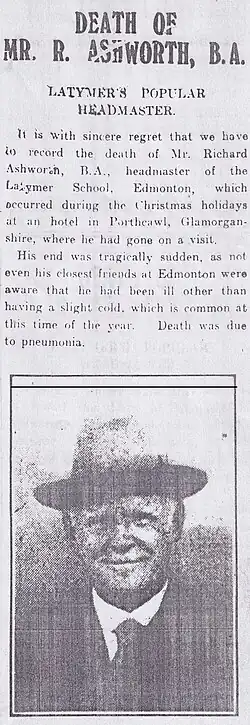
In December 1928, accompanied by his wife, Ashworth travelled to Porthcawl, Wales, for the Christmas holidays. He departed London on Thursday, 20 December, but contracted a chill during the train journey. Already in a "generally run down condition" due to professional overwork, his health deteriorated rapidly upon arrival.[54] He was confined to bed at the Seabank Hotel immediately. Despite constant medical attendance and a brief rally, he suffered a violent relapse on Christmas morning and died of pneumonia later that day.[54]
News of his death reached Edmonton initially only through vague reports in daily papers, causing shock in the community where few knew he had been ill.[54] His body was returned to his residence at 9 Whitley Road, Bruce Grove, preparatory to the funeral.[54]
The funeral took place on Monday, 31 December 1928. The service began at All Saints' Church, Edmonton, which was described as crowded, with pupils of the Latymer School occupying the north and south aisles.[5] The service was conducted by the Vicar of Edmonton, the Rev. R. C. Evill (who was also Chairman of the School Governors), assisted by the Rev. F. J. Keely Wright of the Edmonton Independent Church. Interment followed at Edmonton Cemetery. Contemporary reports noted that despite a "bitterly cold wind," a representative gathering of several hundred people stood at the graveside.[5]
The chief mourners were led by his widow, Caroline, his sister Lilian, and extended family members. The public attendance included significant figures from local government and education, including the Members of Parliament for Edmonton (Frank Broad) and North Tottenham (Robert Morrison), alongside County Councillor Darlington (Chairman of the Middlesex Higher Education Committee) and Sir Benjamin Gott. The school staff were represented by Senior English Master Arthur Gibbs and Senior Mistress Dorothy Abbott; the Senior Assistant Master, James North, was unable to attend.[5]
The floral tributes, numbering approximately ninety, were described as numerous enough to require a separate carriage. Beyond the expected wreaths from the family, school governors, and students (including the Junior Boys' Choir), tributes were sent by the diverse organizations Ashworth was involved with. these included the Edmonton Latymer Lodge of Freemasons, the Potters Bar Golf Club, the Edmonton Branch of the League of Nations Union, the Tottenham District Nursing Association, and the North Tottenham Women's Liberal Association.[5]
In the weeks following his death, tributes were paid from local pulpits and in the press. The Rev. F. J. Keely Wright described Ashworth's death as a "sharp, stinging, shattering cloud" that had fallen upon the community.[5] Thomas Frederick Abel, a close political associate, wrote a lengthy appreciation highlighting Ashworth's "sterling life and character," noting that the "man and the moment met" in his leadership of the school.[5]
Legacy

Ashworth's tenure had a significant impact on The Latymer School's development and reputation. His educational philosophy, which emphasized character development alongside academics, became a core part of the school's culture, sometimes referred to as the "Ashworth tradition" or "Latymer spirit."[71] According to school histories and alumni recollections, he was considered a major influence by many former pupils and colleagues.[72] Several staff members who worked under him later became headteachers at other schools influenced by his principles.[71] During his headship, The Latymer School's public standing improved from a new and relatively unknown institution to a respected secondary school within the local community.[73]
His legacy is also associated with the successful establishment of co-education at Latymer and his role in the expansion of secondary education in Middlesex.[74] Following his death, the school magazine published a tribute with a photograph and the inscription: "to live on in the hearts of those we love is not to die."[75]
Ashworth is commemorated at The Latymer School through a house named after him[76] and the Ashworth Memorial Library.[77] His headship is a central focus of Joseph Acton Morris's book A History of The Latymer School at Edmonton. His impact is further detailed in published collections of student memories, including a volume compiled by Andrew Granath.[78][79]
References
- ^ "Manchester, England, Church of England Births and Baptisms, 1813–1915". Ancestry.com. Retrieved 2025-09-08.
- ^ a b Morris 1975, p. 224.
- ^ "1871 England Census". Ancestry.com. Retrieved 2025-09-08.
- ^ "1881 England Census". Ancestry.com. Retrieved 2025-09-08.
- ^ a b c d e f g h "Funeral of the Late Mr. Ashworth". Tottenham and Edmonton Weekly Herald. 4 January 1929.
- ^ a b Morris 1975, p. 225.
- ^ a b Morris 1975, pp. 225–226.
- ^ a b c d Morris 1975, p. 226.
- ^ a b Minute Book of the Tottenham School Board. Tottenham: Bruce Castle Museum & Archive. 7 July 1890. pp. 4–6.
- ^ "Tottenham School Board". Hornsey & Finsbury Park Journal. 7 July 1900. p. 3. Retrieved 19 September 2025.
- ^ Morris 1975, pp. 226–227.
- ^ "UK, University of London Student Records, 1836–1945". Ancestry.com. Retrieved 2025-09-08.
- ^ "Woodlands Park Schools". Tottenham and Edmonton Weekly Herald. 6 July 1900. p. 5. Retrieved 7 September 2025.
- ^ "Public Opening of New Schools at West Green". Middlesex Gazette. 28 July 1900. p. 8. Retrieved 14 September 2025.
- ^ "Tottenham School Board". Tottenham and Edmonton Weekly Herald. 13 July 1900. p. 3. Retrieved 7 September 2025.
- ^ a b "Presentation at Woodlands Park School". Tottenham and Edmonton Weekly Herald. 8 April 1904. p. 6. Retrieved 7 September 2025.
- ^ "Prize Distribution at Woodlands Park School". Tottenham and Edmonton Weekly Herald. 2 October 1903. p. 11. Retrieved 7 September 2025.
- ^ "New Principal for Pupil Teachers Centre". Tottenham and Edmonton Weekly Herald. 26 February 1904. p. 7. Retrieved 7 September 2025.
- ^ "Long List of Successes". Tottenham and Edmonton Weekly Herald. 29 June 1910. p. 4. Retrieved 7 September 2025.
- ^ "Long List of Successes". Tottenham and Edmonton Weekly Herald. 1 July 1910. p. 7. Retrieved 7 September 2025.
- ^ "Pupil Teachers Centre". Tottenham and Edmonton Weekly Herald. 16 September 1910. p. 5. Retrieved 7 September 2025.
- ^ "Pupil Teachers Centre". Tottenham and Edmonton Weekly Herald. 14 September 1910. p. 3. Retrieved 7 September 2025.
- ^ a b "Edmonton". Tottenham and Edmonton Weekly Herald. 27 May 1910. p. 8. Retrieved 7 September 2025.
- ^ Morris 1975, p. 231.
- ^ a b c d "Latymer Secondary School". Tottenham and Edmonton Weekly Herald. 29 November 1912. p. 8. Retrieved 7 September 2025.
- ^ a b Morris 1975, p. 242.
- ^ Morris 1975, p. 236.
- ^ "Foundation Scholarships ETC". Tottenham and Edmonton Weekly Herald. 28 July 1911. p. 7. Retrieved 14 September 2025.
- ^ a b c "Edmonton Latymer School – Speech Day". Tottenham and Edmonton Weekly Herald. 8 December 1915. p. 4. Retrieved 7 September 2025.
- ^ a b "Latymer School Prize-Giving". Tottenham and Edmonton Weekly Herald. 5 December 1913. p. 5. Retrieved 7 September 2025.
- ^ The National Archives, Board of Education: Series ED 35, File 5413
- ^ Morris 1975, pp. 245–247.
- ^ Morris 1975, p. 251.
- ^ a b Morris 1975, p. 253.
- ^ "Belgian Sterilizers Fund". Tottenham and Edmonton Weekly Herald. 29 October 1915. p. 2. Retrieved 7 September 2025.
- ^ a b "Latymer Secondary School". Tottenham and Edmonton Weekly Herald. 31 March 1916. p. 3. Retrieved 7 September 2025.
- ^ a b "Edmonton Teachers Association". Tottenham and Edmonton Weekly Herald. 24 March 1916. p. 6. Retrieved 7 September 2025.
- ^ a b "Odds and Ends". Tottenham and Edmonton Weekly Herald. 28 June 1918. p. 3. Retrieved 7 September 2025.
- ^ Tottenham and Edmonton Weekly Herald. 28 March 1924
- ^ "Royalty At Edmonton". Tottenham and Edmonton Weekly Herald. 2 November 1928. pp. 1, 16
- ^ Morris 1975, p. 260.
- ^ British Pathé (2014-04-13). Duke And Duchess Of York (1928). Retrieved 2025-05-10 – via YouTube.
- ^ Morris 1975, p. 262.
- ^ Tottenham and Edmonton Weekly Herald. 13 March 1925
- ^ Morris 1975, p. 266.
- ^ Morris 1975, p. 261-262.
- ^ "Earlsmead Evening School". Tottenham and Edmonton Weekly Herald. 31 October 1913. p. 7. Retrieved 8 September 2025.
- ^ "The W.M.B.C." Tottenham and Edmonton Weekly Herald. 30 March 1900. p. 4.
- ^ "West Green P.S.A." Tottenham and Edmonton Weekly Herald. 7 June 1912. p. 7.
- ^ "The Education Question". Tottenham and Edmonton Weekly Herald. 19 June 1908. p. 6.
- ^ "Presentation at Woodlands Park School". Tottenham and Edmonton Weekly Herald. 8 April 1904. p. 6. Retrieved 7 September 2025.
- ^ "Long List of Successes". Tottenham and Edmonton Weekly Herald. 1 July 1910. p. 7. Retrieved 7 September 2025.
- ^ "Long List of Successes". Tottenham and Edmonton Weekly Herald. 29 June 1910. p. 4. Retrieved 7 September 2025.
- ^ a b c d e "Death of Mr. R. Ashworth, B.A.". Tottenham and Edmonton Weekly Herald. 28 December 1928. p. 8.
- ^ "London, England, Church of England Marriages and Banns, 1754–1940". Ancestry.com. Retrieved 2025-09-08.
- ^ a b Morris 1975, p. 227.
- ^ "Tottenham P.T. Centre – Old Students Association". Tottenham and Edmonton Weekly Herald. 12 July 1907. p. 5. Retrieved 7 September 2025.
- ^ The National Archives of the UK (TNA); Kew, Surrey, England; Census Returns of England and Wales, 1911
- ^ "Tottenham and Wood Green Liberal and Radical Federation". Tottenham and Edmonton Weekly Herald. 28 July 1911. p. 6. Retrieved 7 September 2025.
- ^ "Women's Suffrage". Tottenham and Edmonton Weekly Herald. 5 September 1906. p. 3.
- ^ "St. Ann's Constitutional Club". Tottenham and Edmonton Weekly Herald. 28 February 1912. p. 3. Retrieved 7 September 2025.
- ^ "Woodlands Park "Men's Own" P.S.A." Tottenham and Edmonton Weekly Herald. 9 December 1904. p. 9. Retrieved 7 September 2025.
- ^ "West Green P.S.A." Tottenham and Edmonton Weekly Herald. 16 January 1907. p. 4. Retrieved 7 September 2025.
- ^ "Woodlands Park "Men's Own" P.S.A." Tottenham and Edmonton Weekly Herald. 12 February 1904. p. 6. Retrieved 7 September 2025.
- ^ "West Green P.S.A." Tottenham and Edmonton Weekly Herald. 22 October 1915. p. 9. Retrieved 7 September 2025.
- ^ "Poor Children's New Year's Dinner". Tottenham and Edmonton Weekly Herald. 9 January 1914. p. 5.
- ^ "A Grave Appeal". Tottenham and Edmonton Weekly Herald. 10 November 1916. p. 5.
- ^ "Death of Mr. R. Ashworth, B.A.". Tottenham and Edmonton Weekly Herald. 28 December 1928. p. 8.
- ^ Morris 1975, pp. 240, 265.
- ^ Morris 1975, pp. 265–266.
- ^ a b Morris 1975, p. 267.
- ^ Granath 1995, p. 17.
- ^ Morris 1975, p. 254.
- ^ Morris 1975, pp. 230, 234.
- ^ Granath 1995, p. 35.
- ^ Morris 1975, p. 282.
- ^ "Facebook". www.facebook.com. Retrieved 2025-05-05.
- ^ Morris 1975, Chapter Nine: Qui Patitur Vincit.
- ^ Granath 1995, p. FOREWORD.
Bibliography
- Morris, Joseph Acton (1975). A History of The Latymer School at Edmonton. The Latymer Foundation at Edmonton. ISBN 978-0-9504862-0-8.
- Granath, Andrew (1995). Latymer Remembered Memories Of Latymer School 1882 - 1945. The Latymer Foundation at Edmonton. ISBN 0950541524.