Raja Rao Ranbha Bahadur
Raja Rao Ranbha Bahadur | |
|---|---|
 Raja Rao Ranbha in a grand military procession with Khushhal Khan "Anoop" (c. 1804). | |
| Native name | राव रंभा निंबाळकर |
| Birth name | Rambhaji Rao Nimbalkar |
| Died | c. 1804–1806 |
| Buried | |
| Allegiance | Nizam of Hyderabad |
| Rank | General (Amir-ul-Umara) |
| Commands | 20,000 Cavalry |
| Conflicts | Battle of Kolar (1781) Battle of Pangal (1789) Battle of Kharda (1795) |
Raja Rao Ranbha Bahadur (born Rambhaji Rao Nimbalkar; died c. 1804–1806) was a Maratha military commander and high-ranking nobleman active in the court of the Nizam of Hyderabad during the late 18th and early 19th centuries.[1] He is historically recognized as a significant patron of the arts, particularly for commissioning the illustrated musical treatise Ragadarshan.[1] Holding the prestigious rank of Amir-ul-Umara (Commander of Commanders), he played a central role in the military maneuvers of the Hyderabad State during the transition to British subsidiary rule.[2]
Lineage and Early Life
Rao Ranbha belonged to the Nimbalkar dynasty, a Suryavanshi Kshatriya clan of Maharashtra. According to family records, the clan was originally associated with a place called Nimbala (near Delhi) before settling in the Deccan.[3] His family was related by marriage to the family of Chhatrapati Shivaji Maharaj and served as the Naiks of Phaltan.[4][3] His family established a "Maratha-Nizam" military tradition, leading large Hindu cavalry contingents within the Asaf Jahi administration.[4]
Career and Court Life
Raja Rao Ranbha served as a military commander within the Hyderabad State.[1] His military identity was defined by his command of a massive cavalry force, estimated at 20,000 men, which functioned as a private army within the state structure.[2] He was a constant fixture in the Nizam’s military campaigns, including the Battle of Kolar (1781) and the Battle of Pangal (1789).[5]
His personal interests and courtly activities are preserved in a series of miniatures within the Rāg darshan manuscript, which depict him hunting on horseback with hounds, birds, and a cheetah, as well as observing horsemen and participating in courtly assemblies.[1]

He is frequently illustrated alongside contemporary figures such as the musician and author Khushhāl Khān and Mah Laqa Bai.[1]
Battle of Kharda and Political Rise
In 1795, Rao Ranbha led his cavalry at the Battle of Kharda against the unified Maratha army.[5] Following the Nizam’s defeat and the subsequent hostage-taking of Prime Minister Arastu Jah to Pune, Ranbha's political influence reached its peak. In 1797, he was appointed as the Dewan (Prime Minister) of Hyderabad.[6] However, upon Arastu Jah's return later that year, Ranbha was displaced as the state shifted toward a Subsidiary Alliance with the British.[2]
Resistance to British Influence
Under the reign of Sikander Jah, Asaf Jah III, Rao Ranbha became a central figure in the anti-British faction of the court.[7] Alongside Raja Mahipat Ram, he was suspected by the British Resident of engaging in "treasonous discussions" with British sepoys and attempting to persuade the Nizam to defy British authority.[7] In 1806, under heavy pressure from Resident Sydenham, the Nizam was forced to dismiss and banish Ranbha from the court.[5][8]
Religious Life and Syncretism
Despite his Hindu background, Rao Ranbha and the Nimbalkar family were devout observers of Muharram and participants in Azadari.[3] This tradition originated with his great-grandfather, Rhambaji Baji Rao, who vowed to celebrate the occasion after being released from the Red Fort prison in Delhi.[9]
Rao Ranbha famously vowed to offer Niaz and install a Tazia in the name of Imam Hussain in exchange for a male heir. Upon the birth of his son, he constructed a dedicated Ashurkhana within his palace in Hyderabad.[3] A 1971 Census monograph noted that his family traditionally wore green attire during the processions and distributed food and sherbet to the poor, a tradition maintained for over a century.[3]
Patronage of the Arts
In 1799, Ranbha commissioned Khushhāl Khān to author the Rāg darshan, a theoretical work on the modes of Hindustani classical music written in the Dakhini language (using Nastaliq).[1] The work is based on the fifth chapter of Mirza Khan's Tuḥfat al-hind.[1]
.jpg)
The manuscript contains 52 miniatures completed by the court artist Haji Mir Ghulam Hasan by 1804.[1] The iconography of these images follows the tradition of Amber in Rajasthan and utilises the Hanuman system of Raga classification.[1] The work positioned Ranbha as a rightful heir to Mughal courtly sophistication during a period of political volatility.[10]
Association with Mah Laqa Bai

Raja Rao Ranbha was a major patron of the renowned poet and courtesan Mah Laqa Bai (also known as Māh-i Liqā or Chanda Bibi).[2] Their relationship was characterised by intellectual and cultural synergy; both were expert horse-riders and shared a passion for hunting.[10] The Rāg darshan manuscript serves as a primary visual record of their association, containing rare contemporary depictions of Mah Laqa Bai, including scenes showing the pair playing Holi (folio 23v) and Mah Laqa Bai performing a dance for the Raja (folio 24r).[1][2]
He is also credited with commissioning a ceremonial arch at the Moula Ali hill in her honor, which still stands near her tomb complex.[3]
Provenance of Commissioned Works
The Rāg darshan commissioned by Ranbha has a documented history of royal ownership. It was at one time held in the Anūpa Saṃskr̥ta Pustakālaya (the Bīkāner royal library) before entering private collections in the 20th century.[1] In the 19th century, it was associated with Salar Jung III (Mir Yousuf Ali Khan).[1] The manuscript was eventually donated to the University of Pennsylvania as part of the Lawrence J. Schoenberg Collection.[1]
Death and Burial
Rao Ranbha died between 1804 and 1806 and was buried at the foot of the Moula Ali Hill in Hyderabad.[10] He is buried in proximity to Khushhal Khan and Mah Laqa Bai.[2]
Gallery
-
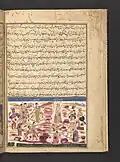 Full Folio 23v: Mah Laqa Bai and Raja Rao Ranbha playing Holi.
 -
 Folio 24r: Chanda Bibi (Mah Laqa Bai) performing a dance for the Raja.
 -
 Folio 2v: Raja Rao Ranbha and Chanda Bibi (Mah Laqa Bai) with attendants.
References
- ^ a b c d e f g h i j k l m "Oversize LJS 63 Rāg darshan". University of Pennsylvania Libraries. Retrieved 2026-02-08.
- ^ a b c d e f Schofield, Katherine Butler (2023). Music and Musicians in Late Mughal India: Histories of the Ephemeral, 1748–1858. Cambridge University Press. pp. 119, 139. ISBN 9781108420624.
- ^ a b c d e f Salim, Saquib (14 July 2024). "Chief of Nizam's army Raja Rao Rambha performed Azadari on Muharram". Awaz-the Voice. Retrieved 2026-02-08.
- ^ a b "NIZAM". Maharashtra Gazetteers. Retrieved 2026-02-08.
- ^ a b c Chaudhuri, Nani Gopal (2016). British Relations with Hyderabad (1795-1857) (Thesis). University of Calcutta. pp. 49–54.
- ^ Briggs, H.G. (1861). The Nizam: His History and Relations with the British Government. Vol. 1. Bernard Quaritch. pp. 86–91.
- ^ a b Mallampalli, C. (2017). A Muslim Conspiracy in British India? Politics and Paranoia in Early Nineteenth Century Deccan. Cambridge University Press. pp. 74, 94. ISBN 9781108419215.
- ^ Rao, Veldurti Manik (2017). Freedom Struggle in Hyderabad. Publications Division, GOI. pp. 54–55.
- ^ Mudiraj, K. Krishna Swamy (1929). Pictorial Hyderabad. Vol. 2. Chandrakanth Press. pp. 611–613.
- ^ a b c Schofield, Katherine Butler (2023). "Eclipsed by the Moon: Mahlaqa Bai and Khushhal Khan Anup in Nizami Hyderabad". Music and Musicians in Late Mughal India. Cambridge University Press. pp. 117–146.