Rail transport in Mexico

Rail transport in Mexico is made up of a combination of freight and passenger networks. The railway system provides freight and passenger service throughout the country, connecting major industrial centers with ports and with rail connections at the United States border.
From 1938 to 1997, rail transport in Mexico was under the control of the state-owned Ferrocarriles Nacionales de México (N de M). N de M was created in 1908 under Porfirio Díaz, and in 1938 it was nationalized under President Lázaro Cárdenas.[1] In 1997, President Ernesto Zedillo began a privatization process of N de M that ultimately led to various concession agreements with private operators such as Kansas City Southern (today known as CPKC) and Ferromex (part of Grupo México). Most passenger rail services ceased to operate as a result.[2] CPKC, Ferromex, and Ferrosur are now the three largest freight rail operators in the country.[3]
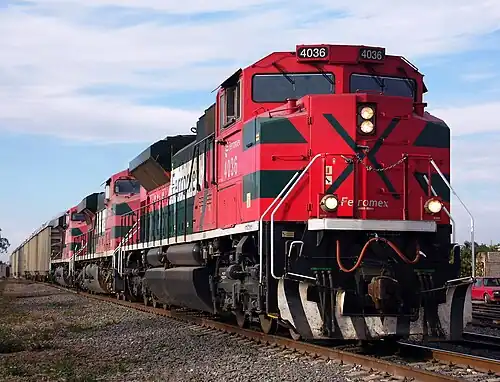
From 1997 to 2018, passenger rail services were limited to urban transit networks and a number of tourist trains. Ferromex continued to operate the Ferrocarril Chihuahua al Pacífico (known as the Chepe Express) between Chihuahua and Los Mochis. In 2008, Ferrocarril Suburbano de la Zona Metropolitana de México was inaugurated as Mexico's first commuter rail service between Mexico City and Cuautitlán the State of Mexico. In 2014, President Enrique Peña Nieto announced plans for the construction of a high-speed rail line between Mexico City and Querétaro, but the project was subsequently canceled.[4] Rapid transit and light rail services continued to operate and expand in Mexico City, Guadalajara, and Monterrey.
In 2018, President Andrés Manuel López Obrador proposed a massive revival and expansion of both the passenger and freight rail networks. In 2020, he launched the construction of the Tren Maya in southeast part of the country that plans to connect the states of Campeche, Chiapas, Quintana Roo, Tabasco, and Yucatán. The train will connect major cities such as Cancún, Mérida, and S.F. Campeche with local attractions such as Chichen Itza, Palenque, and Tulum.[5][6] Service began in various stages in 2023 and 2024. López Obrador also launched plans to rehabilitate the Ferrocarril del Istmo de Tehuantepec.[7] Passenger and freight service on Line Z (which runs between Coatzacoalcos in Veracruz and Salina Cruz in Oaxaca) began in December 2023.[8] Launched and started under Peña Nieto, López Obrador inaugurated the Sante Fe-Zinacantepec leg of the Tren El Insurgente in 2023, which will run between Mexico City and Toluca in the state of Mexico.[9]
President Claudia Sheinbaum has continued the railway projects and programs López Obrador began. She outlined plans to construct approximately 3,000 kilometers of railroad, comprising the Mexico–Pachuca, Mexico–Nuevo Laredo, and Mexico–Nogales lines, to be completed in four phases. In February 2026, she inagurated the final leg of the Tren El Insurgente between Santa Fe and Observatorio.[10][11][12][13]
Beginning in January 2026, under a decree created by Sheinbaum, railways will fall under the umbrella of a new federal agency known as the Agencia de Trenes y Transporte Público Integrado (ATTRAPI).[14][15]
History
Construction
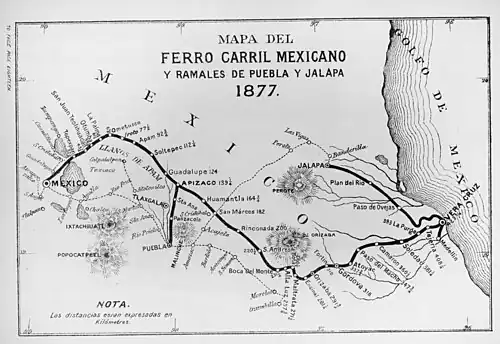

Mexico's rail history began in 1837, with the granting of a concession for a railroad to be built between Veracruz, on the Gulf of Mexico, and Mexico City. However, no railroad was built under that concession.
In 1857, Don Antonio Escandón secured the right to build a line from the Atlantic Ocean port of Veracruz to Mexico City and on to the Pacific Ocean. Revolution and political instability stifled progress on the financing or construction of the line until 1864, when, under the regime of Emperor Maximilian, the Imperial Mexican Railway Company began construction of the line. Political upheaval continued to stifle progress, and the initial segment from Veracruz to Mexico City was inaugurated nine years later on January 1, 1873 by President Sebastián Lerdo de Tejada.
President Lerdo and his successor Porfirio Díaz encouraged further rail development through generous concessions that included government subsidies for construction.
Impacts of the Diaz Administration
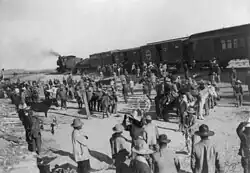
At the beginning of his first term Díaz inherited 398 miles (640.5 km) of railroads consisting almost exclusively of the British-owned Mexican Railway.[16] By the end of his second term in 1910, Mexico boasted 15,360 miles (24,720 km) of in-service track, mostly built by American, British and French investors.[17]
From a small start, the railway network expanded significantly, linking many parts of the country previously isolated. The Interoceanic Railway linked Mexico City to the port of Veracruz; the Monterrey and Mexican Railroad linked that northern city with the Gulf Coast port of Tampico; the Southern Pacific of Mexico linked west coast cities from Guaymas to Mazatlan; the Sonora Railway linked Nogales to the port of Guaymas; and the Mexican Central Railroad went north to the U.S. border at El Paso, Texas.[18] The British invested £7.4 million in railways during the decade of the 1880s, jumping to £53.4 million in 1910s. The decade-total of new investment in mining went from £1.3 million in 1880s to £11.6 million in 1910s. Investments in land and other properties rose from near zero in 1880s to £19.7 million in 1910s. The totals reached £135 million, almost as much as the United States.[19]
In the late nineteenth century, railroads were becoming symbols of centralized power, political and monetary, in Mexico. The institution of rail systems in the country required new regulations and legislation for residents and railroad development.[20] There was great debate surrounding the early railroads in Mexico, regarding how much they were truly improving the country. Scholars view the rail systems as simultaneously encouraging rapid economic growth and commercial relationships while displacing the population and creating widespread poverty within the sectors that were run by the rail systems. Porfirio Díaz had developed his country but at the expense of his people. Much of the criticism levied toward Díaz regarded his rapid modernization in a country still rebuilding from its internal conflicts.[20]
Growing nationalistic fervor in Mexico led the Díaz administration to bring the bulk of the nation's railroads under national control through a plan drafted by his Minister of Finance, José Yves Limantour. The plan, implemented in 1909, created a new government corporation, Ferrocarriles Nacionales de México (FNM), which would exercise control of the main trunk rail lines through a majority of share ownership.
Nationalization
Ferrocarril Nacional de México, incorporated in Colorado in 1880 as Mexican National Railway, was built on narrow-gauge railroad tracks under the instruction of General William Jackson Palmer of the Denver and Rio Grande Railway. The main line from Mexico City to Nuevo Laredo was constructed using the 3-ft narrow gauge tracks.[21] From Saltillo, Coahuila to Concepción del Oro, Zacatecas, the FCNM built narrow-gauge tracks in 1903 to service mining operations.[22] A likely reason for this, aside from General Palmer’s preference for the narrow gauge in use of mining, is that narrow gauge is more cost efficient.[23] In 1901, however, the tracks began conversion to standard gauge.[21]
The rail system deteriorated greatly from neglect during the period of the Mexican Revolution. Following the Revolution, the entirety of the Mexican rail system was nationalized between 1929 and 1937.
During the 1950s, the Yucatan Peninsula experienced successful development as it integrated into the national network.[24] In Oaxaca, on June 26, 1958, union workers from the Sindicato de Trabajadores Ferrocarrileros de la República Mexicana (STFRM), led by railroad worker and union activist Demetrio Vallejo, began a series of strikes seeking higher wages. When their demands remained unmet, a system-wide strike was called on January 18, 1959. The strike escalated on the afternoon of January 25 when Ferrocarriles Nacionales (the National Railway) officially began their strike action. By 10 a.m. the following day, an agreement had been reached that included medical care for workers' families, higher wages, and an allocation of 30 million pesos for the construction of affordable rental housing for the workers.[25]
In 1987 the government merged its five regional railroads into FNM. During the later period of national ownership, FNM suffered significant financial difficulties, running an operating deficit of $552 million (37 percent of its operating budget) in 1991. Competition from trucking and shipping decreased railroad's share of the total freight market to about 9 percent, or about half of rail's share a decade earlier.
Privatization

In 1995, the Mexican government announced that the FNM would be privatized and divided into four main systems. As part of the restructuring for privatization, FNM suspended passenger rail service in 1997.
In 1996, Kansas City Southern (KCS), in a joint venture with Transportacion Maritima Mexicana (TMM), bought the Northeast Railroad concession that linked Mexico City, Monterrey, the Pacific port at Lázaro Cárdenas and the border crossing at Laredo. The company was initially called Transportación Ferroviaria Mexicana (TFM), but was renamed Kansas City Southern de México (KCSM) in 2005 when KCS bought out TMM's interests. KCS's systems in the United States and Mexico jointly form end-to-end rail system linking the heartlands of Mexico and the United States.
The Northwest Railroad concession, connecting Mexico City and Guadalajara with the Pacific port of Manzanillo and various crossings along the United States border was sold to a joint venture between Grupo México and Union Pacific Railroad in 1998 during the presidency of Dr. Ernesto Zedillo (which later occupied the position of Director of the Board of Union Pacific). The company operates as Ferrocarril Mexicano or Ferromex. Ferromex's freight volumes have increased; it hauled a record 22,365 million tonne-km in the first 6 months of 2010. Also, Ferrosur, the railroad serving Mexico City and cities/ports southeast of Mexico City, hauled their own record 3,565 million tonne-kilometers.[26]
There were two southern concessions, merged in 2000 to form Ferrosur. Ferrosur operates the line between Mexico City and the Gulf of Mexico port of Veracruz. In 2005, Ferrosur was bought by Ferromex's parent company. KCSM challenged the acquisition and the merger failed to receive regulatory approval. However, in March 2011, a tribunal ruled in Grupo México's favor, and the merger was permitted.[27]
The three major Mexican railroads jointly own Ferrocarril y Terminal del Valle de México (Ferrovalle) which operates railroads and terminals in and around Mexico City.
Revival of passenger service
In 2006, the Secretariat of Communications and Transport of Mexico proposed a high-speed rail link[28] that would have transported passengers from Mexico City to Guadalajara, Jalisco, with stops in the cities of Querétaro, Guanajuato, Leon and Irapuato, along with a branch running from the port city of Manzanillo to Aguascalientes. The train would travel at 300 km/h,[29] and would allow passengers to travel from Mexico City to Guadalajara in just 2 hours[29] at an affordable price (the same trip by road takes 7 hours). The network was foreseen to eventually connect to Monterrey, Chilpancingo, Cuernavaca, Toluca, Puebla, Tijuana, Hermosillo, Cordoba, Veracruz, Oaxaca, Colima, Zacatecas, Torreon, Chihuahua, Puebla, San Luis Potosi, Mexicali, Saltillo, and Acapulco by 2015.[28] The whole project was projected to cost 240 billion pesos, or about 25 billion dollars.[28] Despite Mexican billionaire Carlos Slim's expressed interest in investing in high-speed rail,[30] no progress was made on the proposal.
President Enrique Peña Nieto proposed a return to services of intercity trains. His administration's proposals included the Toluca–Mexico City commuter rail, which successfully launched construction in 2014 and went into service in 2023. They also included the Tren Maya, which would run throughout the Yucatan Peninsula, and whose construction eventually began in 2020 before opening in December 2023, and a Mexico City-Querétaro high speed rail line.
A consortium of China Railway Construction Corporation, Prodemex, Teya and GHP was awarded the contract to build the Mexico City-Querétaro high speed rail, at a cost of $3.75 billion dollars. However, the contract was cancelled the following year due to a series of corruption scandals.[31] In 2015, Mexico opened a new tender, which was again revoked, leading to the Mexican government paying China Railway Construction Corporation a 1.31 million USD indemnification.[32] The project was revived in July 2023 as an extension of the Cuatitlan commuter rail, when the Mexican government signed an agreement with Canadian Pacific Kansas City Railroad to study the viability of a passenger rail line from Mexico City to the city of Queretaro.[33]
In September 2018, President-elect Andrés Manuel López Obrador announced a US$7.4 billion plan to build a tourist and freight railway on the Yucatán Peninsula. The project, named the Tren Maya, began construction in 2020 and will connect Palenque to Cancún, but remains controversial with environmentalists and indigenous rights activists.[34][35] The new service debuted in 2023 and marked yet another chapter in the intercity revival, becoming the first train services in years to serve southern Mexico.
Railways
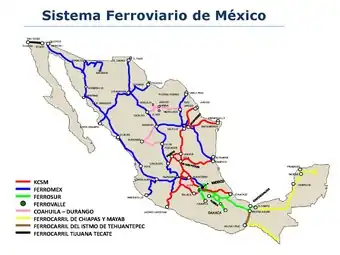
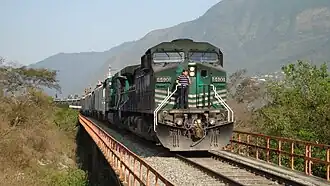
The major 'Class I' freight railroads in Mexico include:
Short line railroads include:
- Baja California Railroad (BJRR)
- Ferrocarriles Chiapas-Mayab (FCCM)
- Ferrocarril y Terminal del Valle de México (Ferrovalle)
- Ferrosur (FSRR)
- Línea Coahuila Durango (LFCD)
- Tren Interoceánico
Passenger rail lines include:
- Chihuahua al Pacífico, a tourist train running through the Copper Canyon.
- Tequila Express, a tourist train running from Guadalajara, Jalisco to a tequila distillery in Amatitán.
- Tren Suburbano (commuter rail system in the Mexico City metro area. Under construction, will reach the Felipe Ángeles International Airport in 2024[36])
- El Insurgente (commuter rail system with 6 initial stations and 1 more opening in 2025)
- Tren Maya, a passenger service on the Yucatán Peninsula with top speeds of up to 99 miles per hour (159 km/h).
- Tren Interoceánico, a service with two current passenger lines (Line FA and Line Z) and one upcoming passenger line (Line K).
.jpg)
Railway equipment manufacturers include:
- Ferrovías del Bajío, which made diesel powered rail cars for the airport shuttle in Pnomh Penh, Cambodia[37][38]
- Construcciones y Auxiliar de Ferrocarriles in Huehuetoca, which made trains for the LRT Line 1 (Metro Manila).[39]
- Bombardier Transportation México in Ciudad Sahagún
Mass transit
Urban rail transit systems in Mexico include four light rail or rapid transit systems: The Guadalajara light rail system, the Mexico City Metro, the Xochimilco Light Rail line (in Mexico City) and the Monterrey Metro. In 2017, the Puebla–Cholula Tourist Train opened in Puebla City;[40] service ended in December 2021.
Expansion
Since 2018, Mexico's railway network has experienced major expansions and enhancements. President Andrés Manuel López Obrador has launched a series of railway projects throughout country and has supported rail initiatives proposed by governments of many states. López Obrador's main objective was to expand rail service in the southeast part of Mexico, which is much more economically challenged compared to the rest of the country. His successor, Claudia Sheinbaum, has continued the projects and initiatives he started. She launched new projects in the central and northern parts of the country. She committed to further expanding Mexico's passenger rail network by publishing a constitutional amendment that restored the Mexican State's authority to use railway lines for passenger transport services.[41]
Tren Maya

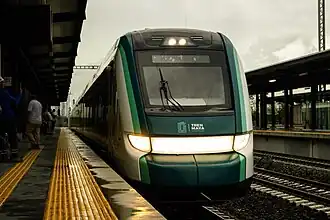
In September 2018, López Obrador, then president-elect, announced plans for the Tren Maya project. The new rail system would connect the states of Campeche, Chiapas, Quintana Roo, Tabasco, and Yucatán. He held a referendum on the project in December 2018 shortly after taking office.[42] French company Alstom will design and supply rolling stock and related equipment at their facility in Ciudad Sahagún, Hidalgo. A total of 219 cars would be built, 32 of them will be electro-diesel multiple units and 10 will be standard diesel multiple units. The route will also have European Train Control System signalling and control equipment. The rolling stock model was officially named X'Trapolis Tsíimin K'áak and is part of Alstom's X'Trapolis series. The rolling stock model will have three types: Xiinbal, which will be used for regular passenger service; Janal, which adds a dining car to the previous set; and P'atal; which will be designed for long-distance travel and will feature sleeping cabins.[43]
Tren Maya opened in various stages between December 2023 and December 2024. The first segment open between Cancún Airport station and San Francisco de Campeche station on 15 December 2023. Two weeks later on 31 December 2023, the segment between S.F. Campeche station and Palenque station opened. The segment from Cancún Airport station and Playa del Carmen station opened on 29 February 2024. Service to Tulum, Tulum Airport, and Felipe Carrillo Puerto began on 20 September 2024. President Claudia Sheinbaum inaugurated the final segment to Chetumal Airport station and its new connection to Escárcega's Centenario station in December 2024.[44]
Tren Interocéanico
_3.jpg)
On 7 June 2020, López Obrador launched the rehabilitation of Ferrocarril del Istmo de Tehuantepec. The railway line is expected to become a global logistics network focused on the manufacture and movement of goods between the Pacific Ocean and the Atlantic Ocean through the Isthmus of Tehuantepec. The service is branded as the Tren Interocéanico or Ferrocarril Interocéanico.[45]
There will be three lines that will make up the new service:
- Line FA: Between Coatzacoalcos station in Veracruz and Palenque station in Chiapas. There will be a connection to the Tren Maya at Palenque.
- Line K: Between Ixtepec station in Oaxaca to Ciudad Hidalgo in Chiapas. At Cuidad Hidalgo, there will be a connection to Guatemala's railway network.
- Line Z: Between Coatzacoalcos station in Veracruz and Salina Cruz station in Oaxaca. It will be the main trunk line that will follow the Isthmus of Tehunatepec.
Unlike the Tren Maya, service on the Tren Interocéanico will have used rolling stock. One set of rolling stock will be ex-British Rail Class 43 locomotives and Mark 3 passenger cars, which composes the InterCity 125 train set. Additional rolling stock will be locomotives and rail cars previously used in the United States. These include the EMD F59PH and EMD SD70 locomotives along with Amfleet and Budd SPV-2000 passenger cars.
Tren El Insurgente

In July 2014, President Enrique Peña Nieto launched construction of the Mexico City-Toluca interurban train, better known as El Insurgente. Construction continued under the tenure of both López Obrador and Sheinbaum.
Construction work lasted 12 years and involved the development of multiple long viaducts, a tunnel, and brand new stations. The entire route will be electrified and have European Train Control System signalling and control equipment. Its Mexico City terminus will be located at the existing Observatorio station on Line 1 of the Mexico City Metro. New stations to be constructed include Vasco de Quiroga, Santa Fe, Lerma, Metepec, Toluca Centro, and Zinacantepec. The segment between Lerma and Zinacantepec opened on 15 September 2023. The segment from Santa Fe and Lerma opened on 31 August 2024 and the final leg to Observatorio opened on 2 February 2026. Trains now run around every 15 minutes throughout all days of the weeks. Weekday service will start at 5:00am and end at 12:00am of the next day. Saturday and Sunday/Holiday service begans at 6:00am and 7:00am respectively.[46][47][48]
Spanish railway manufacturer CAF built 30 sets of brand new electric-multiple-units for the service.[49]
Tren Suburbano Extension to Felipe Ángeles International Airport (AIFA)

As part of the development of the new Felipe Ángeles International Airport (better known as AIFA) in Zumpango, State of Mexico, President López Obrador announced that a new branch of the Tren Suburbano will be built. It intends to be a direct rail link between central Mexico City and AIFA. The service will start at Buenavista station and follow the existing route until Lechería. From there, the service will split off the existing line and run on new dedicated tracks paralleling an existing freight rail line. New stations on the new branch include Cueyamil, Los Agaves, Teyahualco, Prados Sur, Nextlalpan, Xaltocan, and AIFA. It is expected that the new service will use the same new CAF equipment being used on the Tren El Insurgente. The new airport opened in March 2022 without the branch line being completed.[50][51] There have been multiple delays throughout the construction process, with the latest projected completion date being April 2026.[52]
Trenes Mexico–Pachuca, Mexico–Nuevo Laredo, and Mexico–Nogales
In July 2024, then-President-elect Claudia Sheinbaum announced plans for the construction of three passenger rail lines that she will undertake during her sexieno: Tren Mexico–Pachuca, Tren Mexico–Nuevo Laredo, and Tren Mexico–Nogales.[53][54][55][56]
On 22 March 2025, Sheinbaum announced the start of construction of the new Tren Mexico–Pachuca at a ceremony in Zempoala, Hidalgo. The train will start at Buenavista station in Mexico City and terminate at a brand new station in Pachuca, Hidalgo. New intermediate stations to be constructed include Xaltocan II, Tizayuca, Temascalapa, Tepojaco, and Xolox in the state of Mexico, and Empalme El Rey, Platah, and Jagüey de Téllez in the state of Hidalgo. At Xaltocoan II, there will be a connection to the new AIFA branch of the Tren Suburbano. Service is expected to begin in early-mid 2027.[57]
On 27 April 2025, Sheinbaum announced the start of construction of the Mexico–Querétaro leg of the Tren Mexico–Nuevo Laredo at an event in Pedro Escobedo, Querétaro alongside Querétaro Governor Mauricio Kuri González. The route will began at Buenavista station in Mexico City and end at the planned La Corregidora station in Santiago de Querétaro. La Corregidora station will be next to the site of the old train station that closed in the late 1990s as result of the privatization of national railways under Ernesto Zedillo. New intermediate stations include Huehuetoca in the state of Mexico, Tula de Allende in the state of Hidalgo, and San Juan del Río in the state of Querétaro. Service is expected to begin in 2027-2028.[58]
Sheinbaum subsequently announced the construction of the Saltillo–Nuevo Laredo segment on 9 September 2025 alongside Nuevo León Governor Samuel García Sepúlveda. Saltillo, Coahuila and Nuevo Laredo, Tamaulipas (across the U.S border from Laredo, Texas) will have brand new stations, and there will be a major intermediate stop built in Monterrey. Additional stops will also built in smaller towns along the route. Service is expected to begin in 2027-2028.[59]
On 18 September 2025, Sheinbaum announced the construction of the Querétaro–Irapuato leg of the Tren Mexico–Nogales. The route will begin at Querétaro's La Corregidora station and end at a new train station in Irapuato, Guanajuato. Proposed intermediate stations include Apaseo el Grande, Celaya, Cortazar/Villagrán, and Salamanca, all in the state of Guanajuato. Service is expected to begin 2027.[60]
Urban Mass Transit Expansion
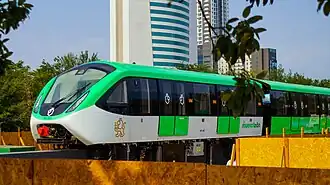
The urban mass transit networks of Mexico City, Guadalajara, and Monterrey also have ongoing and proposed rail expansion projects.
Nuevo León Governor Samuel García launched the construction of the new Lines 4 and 6 of the Metrorrey in September 2022 and February 2023 respectively. Both lines will have a monorail design, with rolling stock being supplied by Chinese manufacturer CRRC. García declared that both lines will be mostly operational in time for the 2026 World Cup. Line 6 is expected to provide a new direct rail link between central Monterrey and General Mariano Escobedo International Airport by 2027. García launched the construction of Line 5 in November 2024 and, unlike Lines 4 and 6, it will be designed as autonomous rail rapid transit (ART). García has also proposed the development of the Tren Suburbano de Monterrey, but construction has not yet begun.[61][62][63][64]

In Guadalajara, President López Obrador and Jalisco Governor Enrique Alfaro launched the construction of the new Line 4 of the SITEUR on 22 May 2022. It will run alongside an existing freight rail line and will connect the municipality of Tlajomulco with Tlaquepaque. Line 4 will not directly connect to the existing Lines 1, 2, and 3. Passenger will be able to connect to the Mi Macro Calzada BRT line at the Las Juntas station. Line 4 opened on 15 December 2025. There were plans to construct a Line 5 that would've provided a direct rail link to Miguel Hidalgo y Costilla International Airport, but officials have instead decided to build the service as a bus rapid transit line.[65][66]
Line 12 of the Mexico City Metro is being planned to be extended from its current terminus at Mixcoac station to Observartorio station where it will connect with Line 1 and the Tren El Insurgente. Construction began in 2017 and was expected to be completed in 2021, but as of 2026, construction still remains ongoing.[67]
On 13 January 2026, State of Mexico officials announced plans for the construction of a new light rail line that will connect the existing La Paz metro station with Texcoco de Mora.[68]
Other Projects
In January 2022, the Mexican Secretary of communications and transport approved a 180 Kilometer rail expansion in the Durango-Mazatlan corridor. It has an estimated cost of 1.2 billion dollars to revive and expand the abandoned corridor under a private-public partnership with the company Caxxor Group, as part of the USMCA agreement.[69][70][71][72]
Museums
There are several rail museums in Mexico including the Railway Museum in San Luis Potosi,[73] the Old Railway Station Museum in Aguascalientes, Aguascalientes; a former station along the Interoceanic Railway of Mexico in Cuautla, Morelos which serves as a museum; the Museo de las Ferrocarilles en Yucatán is in Mérida, Yucatán;[74] and the National Railway Museum in Puebla, Puebla.[75] The former station in Monterrey, Nuevo Leon is now used as an art museum.
Railway links with adjacent countries
 United States – freight only – same 1,435 mm (4 ft 8+1⁄2 in) standard gauge
 Guatemala – at Ciudad Tecún Umán, – break-of-gauge 1,435 mm (4 ft 8+1⁄2 in) standard gauge / 914 mm (3 ft) (a short section near the international border rebuilt as standard gauge in 2019[76])
See also
- List of Mexican railroads
- List of street railways in Mexico (all-time, historical list)
- Transportation in Mexico
References
- ^ Transportes, Secretaría de Infraestructura, Comunicaciones y. "Compañía de los Ferrocarriles Nacionales de México". gob.mx (in Spanish). Retrieved February 13, 2026.
{{cite web}}: CS1 maint: multiple names: authors list (link) - ^ Téllez, Mariel (May 6, 2024). "¿Qué paso con Ferrocarriles Nacionales de México?". Grupo Milenio (in Spanish). Retrieved February 13, 2026.
- ^ "Railways – Proyectos México". Retrieved February 13, 2026.
- ^ "Mexico cancels China contract for high-speed train line". BBC News. November 7, 2014. Retrieved February 13, 2026.
- ^ República 2018-2024, Presidencia de la. "President AMLO leads the inaugural run of the Maya Train, first stage". gob.mx (in Spanish). Retrieved February 13, 2026.
{{cite web}}: CS1 maint: numeric names: authors list (link) - ^ Rainsford, Cat (April 7, 2023). "Mexico in Numbers: The Maya Train". Mexico News Daily. Retrieved February 13, 2026.
- ^ "El histórico corredor interoceánico que revivió AMLO". dw.com (in Spanish). Retrieved February 13, 2026.
- ^ Varela, Micaela (December 22, 2023). "López Obrador echa a andar el tren Interoceánico que unirá el golfo de México con el Pacífico". El País México (in Mexican Spanish). Retrieved February 13, 2026.
- ^ República 2018-2024, Presidencia de la. "Presidente AMLO inaugura primera etapa de "El Insurgente", Tren Interurbano México-Toluca". gob.mx (in Spanish). Retrieved February 13, 2026.
{{cite web}}: CS1 maint: numeric names: authors list (link) - ^ Zerega, Georgina (November 28, 2024). "El Gobierno iniciará las obras de cuatro tramos de trenes de pasajeros en el primer semestre de 2025". El País México (in Mexican Spanish). Retrieved February 13, 2026.
- ^ Staff, M. N. D. (July 12, 2024). "Sheinbaum to start term with 3 passenger train projects; railway sector responds". Mexico News Daily. Retrieved February 13, 2026.
- ^ Valadez, Roberto (July 23, 2024). "Proyecto de trenes de pasajeros de Claudia Sheinbaum es viable". Grupo Milenio (in Spanish). Retrieved February 13, 2026.
- ^ República, Presidencia de la. "Presidenta Claudia Sheinbaum inaugura tramo Santa Fe-Observatorio del Tren "El Insurgente"; se conecta Toluca con la Ciudad de México". gob.mx (in Spanish). Retrieved February 13, 2026.
- ^ "Agencia de Trenes y Transporte Público Integrado | Gobierno | gob.mx". www.gob.mx. Retrieved February 13, 2026.
- ^ "Mexico Formalizes ATTRAPI to Lead Passenger Rail Reform". Mexico Business. January 14, 2026. Retrieved February 13, 2026.
- ^ Bazant, Jan (1977). A Concise History of Mexico from Hidalgo to Cardenas 1805–1940. New York: Cambridge University Press. p. 111. ISBN 0-521-29173-9.
- ^ Fred Wilbur Powell, the Railroads of Mexico, 1921
- ^ Coatsworth, John H. Growth Against Development: The Economic Impact of Railroads in Porfirian Mexico. DeKalb: Northern Illinois University 1981.
- ^ Tenenbaum, Barbara A. and James N. McElveen, "From speculative to substantive boom: the British in Mexico, 1821–1911." in Oliver Marshall, ed. English speaking communities in Latin America (Macmillan, 2000): 51–79, at p 69.
- ^ a b Van Hoy, Teresa Miriam (2008). A social history of Mexico's railroads: peons, prisoners, and priests. Jaguar books on Latin America series. Lanham, Md.: Rowman & Littlefield. ISBN 978-0-7425-5327-9.
- ^ a b Powell, Fred Wilbur (1921). The railroads of Mexico. Rutgers University Libraries. Boston, Stratford.
- ^ "Preserved Narrow Gauge Steam in Mexico 2012, Part 2". www.internationalsteam.co.uk. Retrieved April 11, 2024.
- ^ "Railways - The World Factbook". www.cia.gov. Retrieved April 11, 2024.
- ^ "Mexico's golden age of railways | Geo-Mexico, the geography of Mexico". geo-mexico.com. November 30, 2014. Retrieved April 22, 2024.
- ^ "Mexican railroad workers strike for wages and union rights, 1958-1959 | Global Nonviolent Action Database". nvdatabase.swarthmore.edu. Retrieved April 22, 2024.
- ^ "A record half". Railway Gazette International. London. September 9, 2010. Archived from the original on September 12, 2010. Retrieved October 12, 2010.
- ^ "Mexican Tribunal OKs Grupo Mexico Railroad merger". Reuters. March 28, 2011. Archived from the original on April 1, 2011.
- ^ a b c Hawley, Chris (January 6, 2006). "Mexico reviving travel by train". Arizona Republic. Phoenix.
- ^ a b "Systra : Project for a Mexico City - Guadalajara High Speed Line. Rail transport engineering, public transport engineering". Archived from the original on May 1, 2011. Retrieved October 30, 2010.
- ^ "Slim to invest in Santa Cruz" (Press release). Corporate Mexico. The America's Intelligence Wire. January 21, 2005.
- ^ O‘Boyle & Graham, Michael & Dave (November 7, 2014). "Mexico scraps $3.75 bln China rail deal ahead of state visit". Reuters.
- ^ "Mexico to pay China rail firm for cancelling project". BBC. May 22, 2015.
- ^ Rogers, David (July 13, 2023). "Mexico revives Querétaro high-speed railway nine years after cancelling it". Global Construction Review. Retrieved December 12, 2023.
- ^ Pskowski, Martha (February 22, 2019). "Mexico's 'Mayan Train' Is Bound for Controversy". CityLab. Retrieved February 23, 2019.
- ^ Varillas, Adriana (November 23, 2018). "Everything you need to know about the Mayan Train project". El Universal. Retrieved February 23, 2019.
- ^ "Tren al AIFA estará listo el primer trimestre de 2024". Mexico City government. July 29, 2023.
- ^ "DMU". Ferrovías del Bajío. April 9, 2024.
- ^ "Mexican DMUs ordered to work Phnom Penh airport rail link". Railway Gazette. March 12, 2018.
- ^ "CAF termina de surtir pedido filipino de trenes" (in Spanish). El Economista. October 27, 2022.
- ^ "Puebla tram-train inaugurated". Metro Report International. January 25, 2017. Retrieved December 11, 2017.
- ^ Jornada, La; Urrutia, Alma E. Muñoz y Alonso (October 30, 2024). "Sheinbaum firma decreto que "devuelve Pemex y CFE al pueblo de México"". La Jornada (in Spanish). Retrieved February 14, 2026.
- ^ "Tren Maya: así es el ambicioso proyecto que propone AMLO y tiene un costo de miles de millones de dólares para México". BBC News Mundo (in Spanish). Retrieved February 15, 2026.
- ^ Carrillo, Emmanuel (May 28, 2021). "Xiinbal, Janal y P'atal: así serán los convoyes del Tren Maya". Forbes México (in Spanish). Retrieved February 15, 2026.
- ^ Staff, M. N. D. (December 15, 2023). "President López Obrador inaugurates first 3 sections of Maya Train". Mexico News Daily. Retrieved February 15, 2026.
- ^ Guzmán, Karen (July 7, 2022). "Corredor del Istmo, la próxima megaobra que inaugurará la 4T: Yorio". Grupo Milenio (in Spanish). Retrieved February 15, 2026.
- ^ "Qué implica el tren interurbano "El Insurgente" para la movilidad y la vida urbana del valle de México". Yahoo News (in Spanish). February 9, 2026. Retrieved February 15, 2026.
- ^ "Cómo Funciona – Tren El Insurgente" (in Spanish). Retrieved February 15, 2026.
- ^ Brito;Redacción, Gaspar Vela;Monserrat Mata;Omar (February 2, 2026). "Sheinbaum inaugura tramo completo del Tren Insurgente". Grupo Milenio (in Spanish). Retrieved February 15, 2026.
{{cite web}}: CS1 maint: multiple names: authors list (link) - ^ Zayago, César (September 13, 2023). "Vagones del Tren Interurbano México-Toluca. Así son por dentro | FOTOS". Grupo Milenio (in Spanish). Retrieved February 15, 2026.
- ^ "Siguen labores para concluir los Cetram de ruta al AIFA". El Universal (in Spanish). Retrieved February 15, 2026.
- ^ "Avanza obra del Tren Suburbano al AIFA, pero crece inconformidad en Tultepec - La Prensa | Noticias policiacas, locales, nacionales". OEM (in Spanish). Retrieved February 15, 2026.
- ^ República, Presidencia de la. "Presidenta Claudia Sheinbaum anuncia que Tren Lechería-AIFA estará listo en el primer trimestre de 2026". gob.mx (in Spanish). Retrieved February 15, 2026.
- ^ "Claudia Sheinbaum anuncia un plan para construir tres nuevas rutas de tren de pasajeros en México". CNN (in Spanish). July 12, 2024. Retrieved February 15, 2026.
- ^ "Sheinbaum Anuncia Plan para Tres Nuevas Rutas de Trenes de Pasajeros en México". N+ (in Mexican Spanish). July 10, 2024. Retrieved February 15, 2026.
- ^ Megamedia, Grupo (July 10, 2024). "¿Más Tren Maya? Claudia Sheinbaum anuncia nuevas rutas de trenes de pasajeros". Diario de Yucatán (in Spanish). Retrieved February 15, 2026.
- ^ "México prevé expansión de la red de trenes de pasajeros hasta la frontera con EEUU". Voz de América (in Spanish). July 10, 2024. Retrieved February 15, 2026.
- ^ República, Presidencia de la. ""Hoy inicia la construcción del Tren México-Pachuca": Presidenta da arranque a las obras; beneficiará a 1.2 millones de personas". gob.mx (in Spanish). Retrieved February 14, 2026.
- ^ República, Presidencia de la. "Inicia Presidenta Claudia Sheinbaum obras del tren Ciudad de México - Querétaro; será inaugurado en el año 2027". gob.mx (in Spanish). Retrieved February 14, 2026.
- ^ Transportes, Secretaría de Infraestructura, Comunicaciones y. "SICT da banderazo de inicio de obra al Tren del Norte, tramo Saltillo-Nuevo Laredo". gob.mx (in Spanish). Retrieved February 14, 2026.
{{cite web}}: CS1 maint: multiple names: authors list (link) - ^ República, Presidencia de la. "Arranca construcción del Tren Querétaro-Irapuato; beneficiará a más de 2 millones de personas y generará cerca de 10 mil empleos". gob.mx (in Spanish). Retrieved February 14, 2026.
- ^ INFO7 (February 14, 2026). "Samuel García presume avances en Líneas 4 y 6 desde monorriel". INFO7 (in Mexican Spanish). Retrieved February 15, 2026.
{{cite web}}: CS1 maint: numeric names: authors list (link) - ^ González, Víctor (October 13, 2025). "Nuevo León reporta avance en construcción de Líneas 4 y 6 del Metro". Grupo Milenio (in Spanish). Retrieved February 15, 2026.
- ^ Rivera, Marbella (November 19, 2024). "Pospone Gobierno de NL construcción de Línea 5 del Metro de Monterrey". Grupo Milenio (in Spanish). Retrieved February 15, 2026.
- ^ "Anuncian Tren Suburbano en Monterrey; será construido por el gobierno federal y la empresa Kansas City". Yahoo News (in Spanish). December 13, 2023. Retrieved February 15, 2026.
- ^ Jornada, La; corresponsal, Juan Carlos G. Partida (December 15, 2025). "Inauguran Línea 4 del tren ligero de Guadalajara con obras pendientes". La Jornada (in Spanish). Retrieved February 15, 2026.
- ^ Jornada, La; corresponsal, Juan Carlos G. Partida (August 19, 2025). "Morena cuestiona al gobernador Pablo Lemus proyecto de Línea 5 de Guadalajara". La Jornada (in Spanish). Retrieved February 15, 2026.
- ^ en, Por Luz CoelloSeguir (February 3, 2026). "Qué pasará con la ampliación de la Línea 12 del Metro CDMX tras la inauguración del Tren Interurbano hasta Observatorio". infobae (in European Spanish). Retrieved February 15, 2026.
- ^ López, Mellissa (January 15, 2026). "Tren Ligero Texcoco-La Paz contará con 12 estaciones cuáles son". Grupo Milenio (in Spanish). Retrieved February 15, 2026.
- ^ "Tren de durango a mazatlan/ mil millones de dolares". El Monitor de parral. Archived from the original on January 2, 2022. Retrieved March 16, 2022.
- ^ "Dan aval a proyecto de tren Durango - Mazatlan". El Siglo De Durango. December 30, 2021. Retrieved March 16, 2022.
- ^ "En Mazatlán comenzará a construirse un nuevo tren en septiembre". Obras por Expansion. Grupo Expansion. May 20, 2021. Retrieved March 16, 2022.
- ^ Mahoney, Noi (April 7, 2021). "Canadian construction firm picked for $1B Mexico-Canada rail link project". Freight Waves. Retrieved March 16, 2022.
- ^ "Railroad Museum, Jesus Garcia Corona". www.mexicoescultura.com.
- ^ Gorbman, Beryl (February 24, 2010). "Trains and The Merida Railway Museum". Archived from the original on August 17, 2011. Retrieved May 10, 2011.
- ^ Álvarez, Samantha; Minsk, Todd R. (March 2005). "Mexico's National Railway Museum". Journal of Transport History. Vol. 26, no. 1. Manchester University Press. p. 112. ISSN 0022-5266. Archived from the original on August 13, 2019. Retrieved May 11, 2011.
- ^ "Railway between Guatemala and Mexico, connectivity across Puerto Chiapas". www.puertochiapas.com.mx.
Further reading
- Coatsworth, John H. "Indispensable railroads in a backward economy: the case of Mexico." Journal of Economic History 39.04 (1979) pp: 939–960. in JSTOR
- Coatsworth, John. "Railroads, landholding, and agrarian protest in the early porfiriato." Hispanic American Historical Review (1974) pp: 48–71. in JSTOR
- Knapp, Frank A. "Precursors of American investment in Mexican railroads." Pacific Historical Review (1952): 43–64. in JSTOR
- Lewis, Daniel. Iron Horse Imperialism: The Southern Pacific of Mexico, 1880–1950 (University of Arizona Press, 2007)
- Matthews, Michael. The Civilizing Machine: A Cultural History of Mexican Railroads, 1876–1910 (2014) excerpt
- Miller, Richard Ulric. "American railroad unions and the national railways of Mexico: An exercise in nineteenth‐century proletarian manifest destiny," Labor History 15.2 (1974) pp: 239–260.
- Powell, Fred Wilbur. The Railroads of Mexico (1921)
- Van Hoy, Teresa. A social history of Mexico's railroads: peons, prisoners, and priests (Rowman & Littlefield, 2008)
- Donovan, Frank and Kerr, John Leeds. Destination Topolobampo: The Kansas City, Mexico & Orient Railway (Golden West Books, 1968)
External links

- The Mexican Railways
- History of Mexico's Railroads Archived July 11, 2011, at the Wayback Machine (in Spanish)
- The Railroads of Mexico by Fred Wilbur Powell on Google Books
- Ferrocarril Coahuila Durango
- Ferromex Archived February 4, 2010, at the Wayback Machine
- Ferrosur
- Kansas City Southern
- Ferrocarril Y Terminal Del Valle De Mexico
- Mexican government: Secretary of Communication & Transport
- Mexico Infrastructure and Rail Projects
- Union Pacific Railroad Company
- Kansas City Southern Railway Company
- Pictures of restored(non-operational) train station in Durango, Mexico