Proportional representation in the United States
Proportional representation (PR) in the United States refers to the multi-winner electoral systems, usually single transferable vote, used in several cities historically and currently in the US. Several electoral reform groups have advocated for the use of proportional representation to elect Congressmembers, instead of the current winner-take-all plurality system.
History
The Proportional Representation League advocated for the use of single transferable vote (STV), a ranked-choice, proportional vote system, in cities in the 1890s[1] and the early 20th century.[2] The league preferred at-large proportional representation as opposed to district models.[3]
Between 1915 and 1962, 22 cities used STV, including Cincinnati, Sacramento, and most notably New York City.[4] The first city to use PR the US was Ashtabula, Ohio in 1915 via referendum. Kalamazoo, Michigan used PR for two elections before the Supreme Court of Michigan overturned the system.[3]
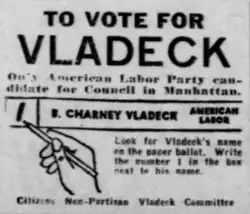

New York City's first election using PR was in 1937. The city used a quota system, wherein each borough was entitled to one councilmember for every 75,000 votes cast (plus one more for a remainder of 50,000 or more).[6] Ballot guides were widely distributed during the election, and the system was credited for making it easier to prevent vote tampering and a having a higher percentage of votes going to elect a candidate than the previous single-member district system.[7]
Proportional representation fell out of favor and began to be repealed after racial and political minorities began to win seats.[2]
Contemporary usage
Currently, multi-member elections for Congress are banned under the Uniform Congressional District Act.[8][9] The act was intended to ban general tickets (a type of block voting),[10] which had been controversial since the 1840s,[11] but it also banned proportional systems.
Multiple cities use proportional representation to elect their city councils,[5] including Portland, Minneapolis, Charlottesville, and Cambridge.[12] Portland's form of STV elects candidates who reach a victory threshold, but it does not ensure party proportional representation due to the races being formally nonpartisan.[13] Portland first used STV in its 2024 city council election.
Background

United States House of Representatives seats are elected by plurality vote (whoever gets the most votes wins). House seats in Maine and Alaska use ranked-choice voting (RCV) instead of plurality voting.[14] Since the 1960s, all House congressional districts have been single-member districts.[15]
Since 1913, after the ratification of the 17th Amendment, US senators have been elected by plurality vote in at-large, statewide elections.[16] Some states use runoffs[17] or RCV[14] instead to elect senators by a majority instead of a plurality. According to a 1992 DOJ memorandum opinion, Senate races must be at-large and may not be broken into two single-member district races.[18]
Contemporary support and opposition
Support
Reform groups such as FairVote,[19] Protect Democracy,[20] and Fix Our House advocate for proportional representation for federal races.

Every Congressional session since the 115th United States Congress, Congressman Don Beyer has introduced the Fair Representation Act,[21][22] which would split states into multi-member districts that would elect 3-5 representatives using STV, similar to the Dáil Éireann (lower house in Ireland). Representative Sean Casten's Equal Voices Act would expand the size of the House of Representatives and allow for the optional use of multi-member districts.[23][24][25]
The ProRep Coalition advocates for use of proportional representation in the California state legislature,[26] citing increasing poverty, perceived lack of representation for left-of-center ideas in the Democratic Party, and lack of Republican influence on state legislation.[27] The coalition consists of third parties such as the Green Party, Libertarian Party, Forward California, and the American Solidarity Party,[28] as well as advocacy groups such as Represent Women, Californians for Electoral Reform, and Cal RCV.[28]
Opposition
In January 2026, House Republicans introduced the Make Elections Great Again Act, which would prohibit ranked-choice voting for federal elections (prohibiting STV) and prohibit any federal system that "permits a voter to vote for more than one candidate for the same office."[29][30] No modern federal Republican politician has endorsed federal legislation to enact proportional representation.[31]
New York University School of Law professor Richard Pildes argued that political tensions are not inherent to first-past-the-post (FPTP) systems and that Brexit was an aberrance in the political climate of the United Kingdom. He also questioned how many parties would form without reform to the Senate. Pildes suggested state legislature multi-member district (MMD) reform efforts to be a better starting place than federal races and recommended nonpartisan reforms to the primary process.[32]
Effects
Historical
In New York City, under STV, 80% of legislation was passed unanimously.[33] In the 1939 election, Genevieve Earle formed a multiracial women's committee to attempt to elect a Black candidate that she had beaten the previous election. Commentators said this showed no resentment between the two.[33]
PR prevented vote splitting and undermined the effects of political machines in cities that used it in the 1920s.[3]
Proposed
Federal
Proponents of federal proportional representation argue it could give more electoral sway to minority groups who do not currently live in majority-minority districts. PR may also expand national focus from swing races to unrepresented groups, such as Republicans in Democratic Congressional districts.[31]
PR elections could introduce three or more political parties to Congress, requiring collaborative coalitions to elect a Speaker of the House.[34][31][32]
See also
- 1993 New Zealand electoral reform referendum
- Electoral reform in the United States
- Proportional representation in the United Kingdom
References
- ^ The two-country base of the PR League is shown by proposal to have the League's executive council composed of one member from each U.S. state and each Canadian province. https://archive.org/details/jstor-1009042/page/n5/mode/2up
- ^ a b Leppert, Drew DeSilver, Carrie Blazina, Janakee Chavda and Rebecca (2021-06-29). "More U.S. locations experimenting with alternative voting systems". Pew Research Center. Retrieved 2026-02-05.
{{cite web}}: CS1 maint: multiple names: authors list (link) - ^ a b c Hoag (1923). "Proportional Representation in the United States. Its Spread, Principles of Operation, Relation to Direct Primaries, and General Results". The Annals of the American Academy of Political and Social Science. 106 – via JSTOR.
- ^ Allen, Joe (2023-09-13). "Lessons from the history of proportional representation in America". Protect Democracy. Retrieved 2026-02-04.
- ^ a b By. "In 1930s NYC, Proportional Representation Boosted the Left". jacobin.com. Retrieved 2026-02-04.
- ^ "N.Y. City Council Results Slowed". Rochester Democrat and Chronicle. Associated Press. November 3, 1937. Retrieved May 5, 2019 – via Newspapers.com.
- ^ "New York's 1937 election and its results". National Municipal Review. January 1938. doi:10.1002/ncr.4110270110 – via Wiley Online Library.
- ^ "2 U.S. Code § 2c - Number of Congressional Districts; number of Representatives from each District". LII / Legal Information Institute. Retrieved 2026-02-04.
- ^ Wang, Hansi Lo (2023-11-18). "Many voters say Congress is broken. Could proportional representation fix it?". NPR. Retrieved 2026-02-04.
- ^ Leppert, Drew DeSilver, Carrie Blazina, Janakee Chavda and Rebecca (2021-06-29). "More U.S. locations experimenting with alternative voting systems". Pew Research Center. Retrieved 2026-02-05.
{{cite web}}: CS1 maint: multiple names: authors list (link) - ^ "The Apportionment Act of 1842: "In All Cases, By District" | US House of Representatives: History, Art & Archives". history.house.gov. Retrieved 2026-02-05.
- ^ "Proportional RCV Information". FairVote. Retrieved 2026-02-04.
- ^ "Portland City Elections: Toward Two Parties, More, or None?". Manhattan Institute. Retrieved 2026-02-10.
- ^ a b "Murkowski, Peltola reelected in Alaska's ranked-choice voting, ABC News reports". ABC News. Retrieved 2026-02-10.
- ^ DeSilver, Drew (2025-12-19). "U.S. stands out globally in how it draws legislative districts". Pew Research Center. Retrieved 2026-02-10.
- ^ "U.S. Senate: Landmark Legislation: The Seventeenth Amendment to the Constitution". www.senate.gov. Retrieved 2026-02-10.
- ^ "Could the Texas Senate race be headed for a runoff? New data offers clues". khou.com. 2026-02-09. Retrieved 2026-02-10.
- ^ Flanigan, Timothy (August 20, 1992). "Whether a State May Elect Its United States Senators From Single-Member Districts Rather Than At-Large".
- ^ "Proportional Representation". FairVote. Retrieved 2026-02-05.
- ^ Allen, Joe (2023-09-13). "Lessons from the history of proportional representation in America". Protect Democracy. Retrieved 2026-02-05.
- ^ "H.R.3057 - Fair Representation Act". congress.gov. 14 July 2017. Retrieved 2021-10-04.
- ^ "House Delegation Reintroduces Fair Representation Act to Reform Congressional Elections". U.S. Representative Don Beyer. 2025-07-23. Retrieved 2026-02-05.
- ^ "Text of H.R. 4125: Equal Voices Act (Introduced version)". GovTrack.us. Retrieved 2026-02-10.
- ^ "Casten Introduces Legislation to Increase Size of House and Senate, Change SCOTUS' Jurisdiction | U.S. Congressman Sean Casten". casten.house.gov. Retrieved 2026-02-10.
- ^ "Sean Casten floats some big ideas for Congress, Supreme Court". Crain's Chicago Business. 2023-02-03. Retrieved 2026-02-10.
- ^ "What is Proportional Representation?". ProRep Coalition. Retrieved 2026-02-05.
- ^ "Representing the Golden State: The Road to Multiparty Democracy in California" (PDF). ProRep Coalition. January 2024.
- ^ a b "ProRep California Coalition | Electoral Reform & Multiparty Push". ProRep Coalition. Retrieved 2026-02-05.
- ^ Greene, Connor. "The Sweeping Elections Changes Republicans Are Proposing". TIME. Archived from the original on 2026-01-30. Retrieved 2026-02-05.
- ^ Rep. Steil, Bryan [R-WI-1 (2026-01-30). "Text - H.R.7300 - 119th Congress (2025-2026): Make Elections Great Again Act". www.congress.gov. Retrieved 2026-02-05.
{{cite web}}: CS1 maint: numeric names: authors list (link) - ^ a b c Wang, Hansi Lo (2023-11-18). "Many voters say Congress is broken. Could proportional representation fix it?". NPR. Retrieved 2026-02-05.
- ^ a b Pildes, Richard. "Why Proportional Representation Could Make Things Worse" (PDF).
- ^ a b Perry, Elisabeth. After the Vote: Feminist Politics in La Guardia's New York. doi:10.1093/oso/9780199341849.003.0009.
- ^ Wegman, Jesse; Drutman, Lee (2025-01-14). "Opinion | How to Fix America's Two-Party Problem". The New York Times. ISSN 0362-4331. Retrieved 2026-02-05.