Portal:Uruguay

 WikiProject WikiProject | Portal | Participants | Templates | Tasks | Assessment | Popular Pages | Requests |
The Uruguay Portal
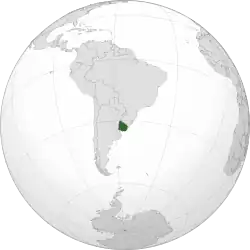
Uruguay, officially the Oriental Republic of Uruguay, is a country in South America. It shares borders with Argentina to its west and southwest and Brazil to its north and northeast, while bordering the Río de la Plata to the south and the Atlantic Ocean to the southeast. It is part of the Southern Cone region of South America. Uruguay covers an area of approximately 176,215 square kilometers (68,037 sq mi). It has a population of almost 3.5 million people, of whom nearly 2 million live in the metropolitan area of its capital and largest city, Montevideo. The area that became Uruguay was first inhabited by groups of hunter gatherers 13,000 years ago. The first European explorer to reach the region was Juan Díaz de Solís in 1516, but the area was colonized later than its neighbors. At the time of European arrival, the Charrúa were the predominant tribe, alongside other groups such as the Guaraní and the Chaná. However, none of these peoples were socially or politically organized in large groups, which contributed to their decline. Amid territorial disputes, the Portuguese established Colônia do Sacramento in 1680, and the Spanish founded Montevideo as a military stronghold. Uruguay secured its independence between 1811 and 1828, following a four-way struggle involving Portugal, Spain, and later the United Provinces of the Río de la Plata and the Empire of Brazil. In 1830, the country enacted its constitution and was formally established as an independent state. During the early years following its independence, Uruguay remained subject to foreign influence and intervention, along with a series of internal conflicts and political turmoil. From the second half of the 19th century, the country saw significant waves of European migration—mainly from Spain, Italy, and France—which greatly influenced its demographics and laid the foundation for modern-day Uruguayan culture and society. National politics were dominated by two political parties: the Colorado Party and the National Party, which clashed in several civil wars during the 19th century and are collectively known as the 'Traditional Parties'. In the early 20th century, a series of pioneering economic, labor, and social reforms laid the foundations of an advanced welfare state. Combined with a period of sustained political stability, these developments earned the country the reputation of being the “Switzerland of the Americas.” A series of economic crises and the fight against far-left urban guerrilla warfare in the late 1960s and early 1970s culminated in the 1973 coup d'état, which established a civic-military dictatorship until 1985. Uruguay is today a democratic constitutional republic, with a president who serves as both head of state and head of government. Uruguay is highly ranked in international measurements of democracy, government transparency, economic freedom, social progress, income equality, per capita income, innovation, and infrastructure. It is classified as a high-income economy. It is also highly socially liberal, and has fully legalized cannabis—the first country in the world to do so—as well as same-sex marriage, abortion and euthanasia. Uruguay is also a founding member of the United Nations, the OAS, and Mercosur. (Full article...) Selected article -.svg.png) The Empire of Brazil (Portuguese: Império do Brasil) was a 19th-century state that broadly comprised the territories which form modern Brazil and Uruguay until the latter achieved independence in 1828. The empire's government was a representative parliamentary constitutional monarchy under the rule of Emperors Pedro I and his son Pedro II. A colony of the Kingdom of Portugal, Brazil became the seat of the Portuguese Empire in 1808, when the Portuguese Prince regent, later King Dom John VI, fled from Napoleon's invasion of Portugal and established himself and his government in the Brazilian city of Rio de Janeiro. John VI later returned to Portugal, leaving his eldest son and heir-apparent, Pedro, to rule the Kingdom of Brazil as regent. On 7 September 1822, Pedro declared the independence of Brazil and, after waging a successful war against his father's kingdom, was acclaimed on 12 October as Pedro I, the first Emperor of Brazil. The new country was huge, sparsely populated, and ethnically diverse. Unlike most of the neighboring Hispanic American republics, Brazil had political stability, vibrant economic growth, constitutionally guaranteed freedom of speech, and respect for civil rights of its subjects, albeit with legal restrictions on women and slaves, the latter regarded as property and not citizens. The Empire's bicameral parliament was elected under comparatively democratic methods for the era, as were the provincial and local legislatures. This led to a long ideological conflict between Pedro I and a sizable parliamentary faction over the role of the monarch in the government. He also had to face other obstacles. The unsuccessful Cisplatine War against the neighboring United Provinces of the Río de la Plata in 1828 led to the secession of the province of Cisplatina (later to become Uruguay). In 1826, despite his role in Brazilian independence, he became the king of Portugal; he abdicated the Portuguese throne in favor of Maria, his eldest daughter. Two years later, she was usurped by Pedro I's younger brother Miguel. Unable to deal with both Brazilian and Portuguese affairs, Pedro I abdicated his Brazilian throne on 7 April 1831 and immediately departed for Europe to restore his daughter to the Portuguese throne. (Full article...) Selected picture - José Carbajal "El Sabalero" performing in Atlántida, Uruguay. Did you know -
CategoriesSelect [►] to view subcategories
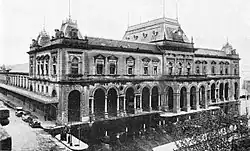
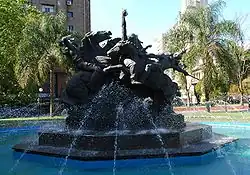
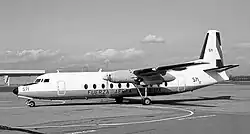
Uruguay Uruguay-related lists Buildings and structures in Uruguay Culture of Uruguay Economy of Uruguay Education in Uruguay Geography of Uruguay Government of Uruguay Health in Uruguay History of Uruguay Images of Uruguay Organizations based in Uruguay Uruguayan people Politics of Uruguay Society of Uruguay Uruguay stubs People -China Zorrilla (Spanish: [ˈtʃina soˈriʝa]; born Concepción Matilde Zorrilla de San Martín y Muñoz del Campo; 14 March 1922 – 17 September 2014) was an Uruguayan theater, film, and television actress, also director, producer and writer. An immensely popular star in the Rioplatense area, she is often regarded as a "Grande Dame" of the South American theater stage. After a long career in the Uruguayan theater, Zorrilla made over fifty appearances in Argentina's film, theater and TV. Her career took off in Uruguay in the 1950 and 1960s, later she settled in Argentina, where she lived for over 35 years and was popular on TV, theater, and cinema. At 90, she retired and returned to Uruguay, where she died in 2014. (Full article...) General imagesThe following are images from various Uruguay-related articles on Wikipedia.
Related portalsTopicsRecognized content
Featured articlesGood articlesFeatured pictures
Associated WikimediaThe following Wikimedia Foundation sister projects provide more on this subject:
Award
Things you can do
Articles that need Attention
Discover Wikipedia using portals
| |||||||||||||






.jpg)

.jpg)








_flock_in_flight_Colonia.jpg)