Portal:Stars

IntroductionA star is a luminous spheroid of plasma held together by self-gravity. The nearest star to Earth is the Sun. Many other stars are visible to the naked eye at night; their immense distances from Earth make them appear as fixed points of light. The most prominent stars have been categorised into constellations and asterisms, and many of the brightest stars have proper names. Astronomers have assembled star catalogues that identify the known stars and provide standardized stellar designations. The observable universe contains an estimated 1022 to 1024 stars. Only about 4,000 of these stars are visible to the naked eye—all within the Milky Way galaxy. A star's life begins with the gravitational collapse of a gaseous nebula of material largely comprising hydrogen, helium, and traces of heavier elements. Its total mass mainly determines its evolution and eventual fate. A star shines for most of its active life due to the thermonuclear fusion of hydrogen into helium in its core. This process releases energy that traverses the star's interior and radiates into outer space. At the end of a star's lifetime, fusion ceases and its core becomes a stellar remnant: a white dwarf, a neutron star, or—if it is sufficiently massive—a black hole. Stellar nucleosynthesis in stars or their remnants creates almost all naturally occurring chemical elements heavier than lithium. Stellar mass loss or supernova explosions return chemically enriched material to the interstellar medium. These elements are then recycled into new stars. Astronomers can determine stellar properties—including mass, age, metallicity (chemical composition), variability, distance, and motion through space—by carrying out observations of a star's apparent brightness, spectrum, and changes in its position in the sky over time. Stars can form orbital systems with other astronomical objects, as in planetary systems and star systems with two or more stars. When two such stars orbit closely, their gravitational interaction can significantly impact their evolution. Stars often form part of much larger gravitationally bound structures, such as star clusters and galaxies. (Full article...) Selected star -.png) Photo credit: Digitized Sky Survey, NASA
Arcturus (/ɑːrkˈtjʊərəs/; α Boo, α Boötis, Alpha Boötis) of the constellation Boötes is the brightest star in the northern celestial hemisphere. With a visual magnitude of −0.04, it is the fourth brightest star in the night sky, after −1.46 magnitude Sirius, −0.86 magnitude Canopus, and −0.27 magnitude Alpha Centauri. It is a relatively close star at only 36.7 light-years from Earth, and, together with Vega and Sirius, one of the most luminous stars in the Sun's neighborhood. Arcturus is a type K0 III orange giant star, with an absolute magnitude of −0.30. It has likely exhausted its hydrogen from its core and is currently in its active hydrogen shell burning phase. It will continue to expand before entering horizontal branch stage of its life cycle. Arcturus is a type K0 III Red giant star. It is at least 110 times more luminous than the Sun in visible light wavelengths, but this underestimates its strength as much of the "light" it gives off is in the infrared; total (bolometric) power output is about 180 times that of the Sun. The lower output in visible light is due to a lower efficacy as the star has a lower surface temperature than the Sun. As the brightest K-type giant in the sky, it was the subject of an atlas of its visible spectrum, made from photographic spectra taken with the coudé spectrograph of the Mt. Wilson 2.5m telescope published in 1968, a key reference work for stellar spectroscopy. Selected article -Photo credit: NASA
In astronomy, stellar classification is a classification of stars based on their spectral characteristics. The spectral class of a star is a designated class of a star describing the ionization of its chromosphere, what atomic excitations are most prominent in the light, giving an objective measure of the temperature in this chromosphere. Light from the star is analyzed by splitting it up by a diffraction grating, subdividing the incoming photons into a spectrum exhibiting a rainbow of colors interspersed by absorption lines, each line indicating a certain ion of a certain chemical element. The presence of a certain chemical element in such an absorption spectrum primarily indicates that the temperature conditions are suitable for a certain excitation of this element. If the star temperature has been determined by a majority of absorption lines, unusual absences or strengths of lines for a certain element may indicate an unusual chemical composition of the chromosphere. Most stars are currently classified using the letters O, B, A, F, G, K, and M (usually memorized by astrophysicists as "Oh, be a fine girl/guy, kiss me"), where O stars are the hottest and the letter sequence indicates successively cooler stars up to the coolest M class. According to informal tradition, O stars are called "blue", B "blue-white", A stars "white", F stars "yellow-white", G stars "yellow", K stars "orange", and M stars "red", even though the actual star colors perceived by an observer may deviate from these colors depending on visual conditions and individual stars observed. The current non-alphabetical scheme developed from an earlier scheme using all letters from A to O; the original letters were retained but the star classes were re-ordered in the current temperature order when the connection between the stars' class and temperatures became clear. A few star classes were dropped as duplicates of others. Selected image -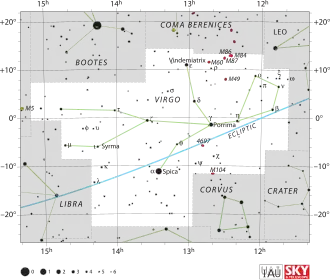 Photo credit: IAU and Sky & Telescope magazine
Virgo is one of the constellations of the zodiac. Its name is Latin for virgin. Lying between Leo to the west and Libra to the east, it is the second largest constellation in the sky (after Hydra). It can be easily found through its brightest star, Spica. Did you know?SubcategoriesTo display all subcategories click on the ►
Stars Stars by luminosity class Stars by metallicity Stars by spectral type Stars by type Stars with proper names Lists of stars Star types Astronomical catalogues of stars Star atlases Coats of arms with stars Flags with stars Star symbols Stars in the Andromeda Galaxy Star clusters Fiction about stars Stellar groupings Hypothetical stars Star images Stellar astronomy Stellar dynamics Sun Star systems Wikipedia categories named after stars Star stubs Sun Atmospheric radiation Solar calendars Coats of arms with sunrays Coats of arms with suns Sun in culture Day Horizontal coordinate system Missions to the Sun Solar observatories Solar phenomena Solar alignment Solar eclipses Solar energy Sun tanning Sundials Sun stubs Galaxies Astronomical catalogues of galaxies Galaxies by year of discovery Galaxies by century of discovery Fiction about galaxies Galaxy clusters Galaxy filaments Galaxy superclusters Lists of galaxies Morphological types of galaxy Active galaxies Barred galaxies Dark galaxies Dwarf galaxies Elliptical galaxies Field galaxies Hypothetical galaxies Galaxy images Interacting galaxies Irregular galaxies Lenticular galaxies Low surface brightness galaxies Overlapping galaxies Peculiar galaxies Polar-ring galaxies Protogalaxies Ring galaxies Spiral galaxies Supermassive black holes Galaxy stubs Wikipedia categories named after galaxies Black holes Fiction about black holes Intermediate-mass black holes Physical horizons Stellar black holes Supermassive black holes Tidal disruption events White holes Supernovae Fiction about supernovae Historical supernovae Hypernovae Superbubbles Discoverers of supernovae Supernova remnants Selected biography - Photo credit: Unknown artist, uploaded by User:ArtMechanic
Johannes Kepler (27 December 1571 – 15 November 1630) was a German astronomer, mathematician, astrologer, natural philosopher and music theorist. He is a key figure in the 17th-century Scientific Revolution, best known for his laws of planetary motion, and his books Astronomia nova, Harmonice Mundi, and Epitome Astronomiae Copernicanae. The variety and impact of his work made Kepler one of the founders and fathers of modern astronomy, the scientific method, natural science, and modern science. He has been described as the "father of science fiction" for his novel Somnium. Kepler was a mathematics teacher at a seminary school in Graz, where he became an associate of Prince Hans Ulrich von Eggenberg. Later he became an assistant to the astronomer Tycho Brahe in Prague, and eventually the imperial mathematician to Emperor Rudolf II and his two successors Matthias and Ferdinand II. He also taught mathematics in Linz, and was an adviser to General Wallenstein. Kepler lived in an era when there was no clear distinction between astronomy and astrology, but there was a strong division between astronomy (a branch of mathematics within the liberal arts) and physics (a branch of natural philosophy). Kepler also incorporated religious arguments and reasoning into his work, motivated by the religious conviction and belief that God had created the world according to an intelligible plan that is accessible through the natural light of reason. Kepler described his new astronomy as "celestial physics", as "an excursion into Aristotle's Metaphysics", and as "a supplement to Aristotle's On the Heavens", transforming the ancient tradition of physical cosmology by treating astronomy as part of a universal mathematical physics. Additionally, he did fundamental work in the field of optics, being named the father of modern optics, in particular for his Astronomiae pars optica. He also invented an improved version of the refracting telescope, the Keplerian telescope, which became the foundation of the modern refracting telescope, while also improving on the telescope design by Galileo Galilei, who mentioned Kepler's discoveries in his work. He postulated the Kepler conjecture. Kepler influenced among others Isaac Newton, providing one of the foundations for his theory of universal gravitation. (Full article...) TopicsWikiProjects
More science WikiProjects...
Things to do
Related portals
More science portals...
Associated WikimediaThe following Wikimedia Foundation sister projects provide more on this subject:
Discover Wikipedia using portals
|