Portal:South Korea

 |
대한민국 포털
The South Korea Portal

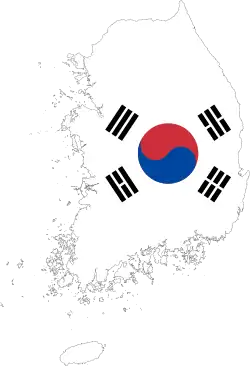
South Korea, officially the Republic of Korea (ROK), is a country in East Asia. It constitutes the southern half of the Korean Peninsula and borders North Korea along the Korean Demilitarized Zone, with the Yellow Sea to the west and the Sea of Japan to the east. South Korea claims to be the sole legitimate government of the entire peninsula and adjacent islands. It has a population of about 52 million, of which half live in the Seoul metropolitan area, the ninth most populous metropolitan area in the world; other major cities include Busan, Daegu, and Incheon.
The Korean Peninsula was inhabited as early as the Lower Paleolithic period. Its first kingdom was noted in Chinese records in the early seventh century BC. From the mid first century BC, various polities consolidated into the rival kingdoms of Goguryeo, Baekje, and Silla. The lattermost eventually unified most of the peninsula for the first time in the late seventh century AD, while Balhae succeeded Goguryeo in the north. The Goryeo dynasty (918–1392) achieved lasting unification and established the basis for the modern Korean identity. The subsequent Joseon dynasty (1392–1897) generated cultural, economic, and scientific achievements and also established isolationism starting from the mid-17th century. The succeeding Korean Empire (1897–1910) sought modernization and reform but was annexed in 1910 into the Empire of Japan. Japanese rule ended following Japan's surrender in World War II, after which Korea was divided into two zones: the Soviet-occupied northern zone and the United States-occupied southern zone. After negotiations on reunification failed, the southern zone became the Republic of Korea in August 1948, while the northern zone became the communist Democratic People's Republic of Korea the following month.
In 1950, a North Korean invasion triggered the Korean War, one of the first major proxy conflicts of the Cold War, which saw extensive fighting involving the American-led United Nations Command and the Soviet-backed People's Volunteer Army from China. The war ended in 1953 with an armistice and left three million Koreans dead and the economy in ruins; due to the lack of a peace treaty, the Korean conflict is still ongoing. South Korea endured a series of dictatorships punctuated by coups, revolutions, and violent uprisings, but also experienced a soaring economy and one of the fastest rises in average GDP per capita, leading to its emergence as one of the Four Asian Tigers. The June Democratic Struggle of 1987 ended authoritarian rule and led to the establishment of the current Sixth Republic. (Full article...)
Selected article -
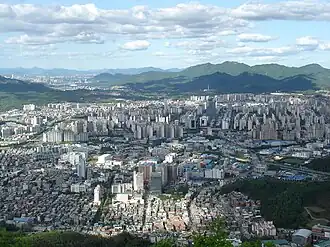
Anyang (Korean: 안양; Korean pronunciation: [a.njaŋ]) is a city in Gyeonggi Province, South Korea. With a population of approximately 600,000, it is the 20th largest city in South Korea. It is a satellite city of Seoul and located approximately 21 km (13 mi) south of Seoul, and 19 km (12 mi) north of Suwon. It is connected to Seoul via the Seoul Subway Line 1 and Line 4. The City motto of Anyang is "Livable city, Proud citizens". City symbols are a grape mascot named 'Podong-i', Forsythia (flower), Ginkgo (tree), and eagles. (Full article...)
Selected image

The 2010 G-20 Seoul summit was the fifth meeting of the G-20 heads of government to discuss the global financial system and the world economy. It was held in Seoul, South Korea.
More did you know -
- ... that Mo Tae-bum, a South Korean long track speed skater, won a 2010 Olympic gold medal on his 21st birthday?
- ... that Jeon Ok, a Korean actress and the mother of actress Kang Hyo-shil, was referred to as "Queen of Tears" for her excellence at acting for tragic dramas?
- ... that Cho Jae-hyun, a South Korean actor, is commonly referred to as a persona of director Kim Ki-duk due to his appearances in almost all of Kim's films?
In the news
- 19 February 2026 – Arrest of Yoon Suk Yeol
- Former South Korean president Yoon Suk Yeol is sentenced to life in prison after being found guilty of leading an insurrection when he declared martial law on December 3, 2024. (The Korea Herald) (Reuters)
- 6 February 2026 – Capital punishment in North Korea, Mass media in North Korea
- Amnesty International reports that North Koreans are being executed for watching the South Korean series Squid Game and listening to K-pop. (Sky News)
- 28 January 2026 – Corruption in South Korea
- A court in Seoul, South Korea, sentences former first lady Kim Keon Hee to 20 months in prison for corruption. (AP)
- 23 January 2026 – Scam centers in Cambodia, Cambodia–South Korea relations
- South Korea repatriates 73 nationals suspected of participating in fraud operations in scam centers in Cambodia. (DW)
- 22 January 2026 –
- South Korea's benchmark KOSPI index surpasses 5,000 points for the first time, rising by more than two percent in early trading. (AFP via Gulf News)
- 22 January 2026 – AI boom, Regulation of artificial intelligence, Science and technology in South Korea
- South Korea enacts a law that requires human oversight of high-impact artificial intelligence (AI) systems, mandates disclosure and labeling of certain AI uses, and institutes fines of up to ₩30 million (around US$20,400) for violations. (Reuters)
 Good article -
Kim Ki-young (Korean: 김기영; October 10, 1919 – February 5, 1998) was a South Korean film director, known for his intensely psychosexual and melodramatic horror films, often focusing on the psychology of their female characters. Kim was born in Seoul during the colonial period, raised in Pyongyang, where he became interested in theater and cinema. In Korea after the end of World War II, he studied dentistry while becoming involved in the theater. During the Korean War, he made propaganda films for the United States Information Service. In 1955, he used discarded movie equipments to produce his first two films. With the success of these two films Kim formed his own production company and produced popular melodramas for the rest of the decade.
Kim Ki-young's first expression of his mature style was in The Housemaid (1960), which featured a powerful femme fatale character. It is widely considered one of the best Korean films of all time. After a "Golden Age" during the 1960s, the 1970s were a low-point in the history of Korean cinema because of government censorship and a decrease in audience attendance. Nevertheless, working independently, Kim produced some of his most eccentric cinematic creations in this era. Films such as Insect Woman (1972) and Iodo (1977) were successful at the time and highly influential on the younger generations of South Korean filmmakers both at their time of release, and with their rediscovery years later. By the 1980s, Kim's popularity had declined, and his output decreased in the second half of the decade. Neglected by the mainstream during much of the 1990s, Kim became a cult figure in South Korean film Internet forums in the early 1990s. Widespread international interest in his work was stimulated by a career retrospective at the 1997 Pusan International Film Festival. He was preparing a comeback film when he and his wife were killed in a house fire in 1998. The Berlin International Film Festival gave Kim a posthumous retrospective in 1998, and the French Cinémathèque screened 18 of Kim's films, some newly rediscovered and restored, in 2006. Through the efforts of the Korean Film Council (KOFIC), previously lost films by Kim Ki-young continue to be rediscovered and restored. Many current prominent South Korean filmmakers, including directors Im Sang-soo, Bong Joon-ho and Park Chan-wook, claim Kim Ki-young as an influence on their careers. (Full article...)
General images -
-
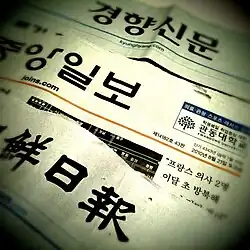 Korean newspapers (from Culture of South Korea)
 -
.jpg) Yoon takes the presidential oath of office outside the National Assembly, 10 May 2022. (from History of South Korea)
Yoon takes the presidential oath of office outside the National Assembly, 10 May 2022. (from History of South Korea) -
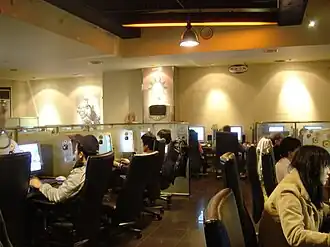 An Internet cafe in Seoul (from Culture of South Korea)
 -
 President Park Geun-hye with chaebol business magnates Lee Kun-hee and Chung Mong-koo, May 2013 (from History of South Korea)
 -

-

-
 President Kim Dae-jung, the 2000 Nobel Peace Prize recipient for advancing democracy and human rights in South Korea and East Asia and for reconciliation with North Korea, was sometimes called the "Nelson Mandela of Asia." (from History of South Korea)
 -
 Samsung Galaxy Tab (from Culture of South Korea)
 -
 Syngman Rhee, the 1st President of South Korea (from History of South Korea)
 -
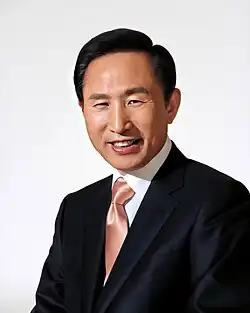 Lee Myung-bak, President of South Korea from 2008 to 2013 (from History of South Korea)
 -
 Lyuh Woon-hyung (far right) at the US-Soviet Joint Commission in 1947 (from History of South Korea)
 -
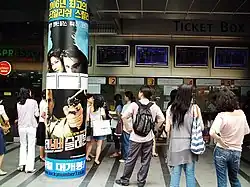 Sinchon movie theatre (from Culture of South Korea)
 -
 South Korean President Chun Doo-hwan with U.S. President Ronald Reagan in Seoul, November 1983 (from History of South Korea)
 -
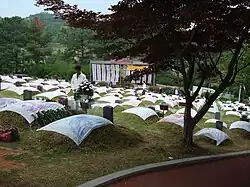 Burial grounds of the victims of the Gwangju Uprising at Mangwol-dong cemetery (from History of South Korea)
 -
 North Korean leader Kim Jong Un and South Korean President Moon Jae-in shaking hands inside the Peace House on 27 April 2018 (from History of South Korea)
 -
.jpg) Inauguration of the 21st President of South Korea Lee Jae-myung. (from History of South Korea)
Inauguration of the 21st President of South Korea Lee Jae-myung. (from History of South Korea) -
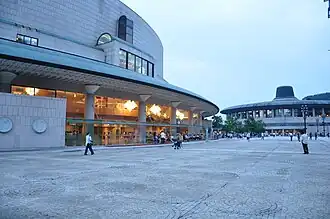
-
_Presidential_Portrait.jpg) President Park Chung Hee, who ruled South Korea from 1961 to 1979 (from History of South Korea)
President Park Chung Hee, who ruled South Korea from 1961 to 1979 (from History of South Korea) -
 A card portrait of Park Chung Hee during a military parade on Armed Forces Day, 1 October 1973 (from History of South Korea)
 -
 Fireworks during the closing ceremonies of the 1988 Summer Olympics (from History of South Korea)
Did you know (auto-generated)

- ... that a senior colonel with 30 years' experience in North Korean intelligence agencies defected to South Korea in 2014?
- ... that anti-Korean sentiment, due to South Korea's economic growth, motivated Djuna to write the sci-fi novel Counterweight?
- ... that the melody of "Dokdo Is Our Land" is commonly used by South Korean students as a study tool?
- ... that the Indonesia–Korea Comprehensive Economic Partnership Agreement covered access to South Korean online video games in Indonesia?
- ... that Kang Ju-hyeok became the youngest player in FC Seoul's history at the age of 17 years, 9 months, and 6 days?
- ... that South Korean sources reported in January 2024 that several thousand North Korean migrant workers occupied a factory and took hostages?
WikiProjects
See WikiProject Korea for collaborating on South Korea topics, and more broadly, on all things Korea-related.
Categories


.svg.png)






.svg.png)








Related portals
East Asia
Associated Wikimedia
The following Wikimedia Foundation sister projects provide more on this subject:
-
 Commons
Free media repository -
 Wikibooks
Free textbooks and manuals -
 Wikidata
Free knowledge base -
 Wikinews
Free-content news -
 Wikiquote
Collection of quotations -
 Wikisource
Free-content library -
 Wikiversity
Free learning tools -
 Wikivoyage
Free travel guide -
 Wiktionary
Dictionary and thesaurus
Web resources
- The official website of the Republic of Korea (Korea.net)
- The Official Korea Tourism Guide Site
- Korea National Statistical Office
- Video on South Korea-US Relations from the Dean Peter Krogh Foreign Affairs Digital Archives
- "South Korea". The World Factbook (2025 ed.). Central Intelligence Agency.
- A Country Study: South Korea in the Library of Congress
- South Korea from UCB Libraries GovPubs
- Korea OECD
- South Korea profile from the BBC News
- South Korea Encyclopædia Britannica entry
- The War Memorial of Korea
- Key Development Forecasts for South Korea from International Futures
Sources
-
 List of all portals
 -

-

-

-

-

-

-

-

-

-
 Random portal
 -
 WikiProject Portals