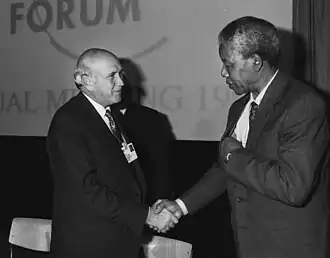
South Africa has the largest population of people of European descent in Africa, one of the largest Indian population outside of Asia, as well as the largest Coloured (of mixed European, Asian and African descent) community in Africa, making it one of the most ethnically diverse countries on the continent. Racial and ethnic strife between the black majority and the white minority have played a large part in the country's history and politics. The National Party began introducing the policy of apartheid after winning the general election of 1948; however, it was the same party under the leadership of F.W. de Klerk who started to dismantle it in 1990 after a long struggle by the black majority, as well as many white, coloured and Indian South Africans.
The country is one of the few in Africa never to have had a coup d'état, and regular free and fair elections have been held since 1994, making it a regional power and among the most stable and liberal democracies in Africa.
South Africa is ranked as an upper-middle income economy by the World Bank. It has the second largest economy in Africa after Nigeria, and the 34th-largest in the world. By purchasing power parity, South Africa has the 7th highest per capita income in Africa. Although being the second largest economy, South Africa has the most sophisticated economy in the continent, with modern infrastructure common throughout the country. The country is considered to be a newly industrialized country according to the World Bank classifications.
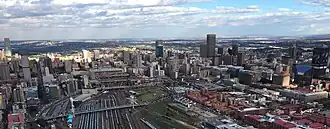
Johannesburg (/dʒoʊˈhænɪsbɜːrɡ/joh-HAN-iss-burg, US also /-ˈhɑːn-/-HAHN-, Afrikaans:[jʊəˈɦanəsbœrχ]; Zulu and Xhosa: eGoli[ɛˈɡɔːli]; colloquially known as Jozi, Joburg or "The City of Gold") is the most populous city in South Africa. The City of Johannesburg itself has a population of 5,538,596, the City of Johannesburg Metropolitan Municipality has a population of 6,599,190 making it one of the 100 largest urban areas in the world. Johannesburg is the provincial capital of Gauteng, the wealthiest province in South Africa, and seat of the country's highest court, the Constitutional Court. Situated on the mineral-rich Witwatersrand hills, the city has long been at the epicentre of the international mineral and gold trade. The richest city in Africa by GDP and private wealth, Johannesburg functions as the economic capital of South Africa and is home to the continent's largest stock exchange, the Johannesburg Stock Exchange.
Johannesburg was established in 1886, following the discovery of gold, on what was once farmland. Within a decade, the population surged to over 100,000, driven by the large gold deposits found along the Witwatersrand. Modern Johannesburg is an amalgamation of formerly separate cities, townships and settlements, reflecting apartheid-era spatial segregation policies. Soweto ("South-Western Townships"), designated a "blacks only" city until 1994, is one of the most historically significant areas for modern South Africa. Home to key anti-apartheid leaders, including Nelson Mandela and Desmond Tutu, it became the epicenter of the 1976 Soweto Uprising, where peaceful student protests were met with brutal force. In contrast, Lenasia is predominantly populated by English-speaking Indo-South Africans (people of Indian and South Asian descent). Formerly "white-only" areas include Sandton, known as "Africa's richest square-mile", Randburg and Roodeport. (Full article...)
Originally called the Rand Regiments Memorial and dedicated to British soldiers that lost their lives during the Second Boer War, it was rededicated on 10 October 1999 to all people who died during the Second Boer War and renamed the Boer War Memorial.
Did you know... -
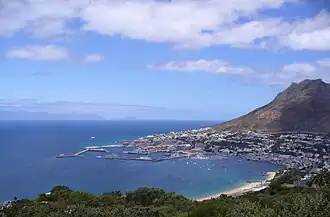
... that the streets in Jamestown(pictured), in the Western Cape province of South Africa, are named after varieties of the main agricultural crop grown there since 1902?
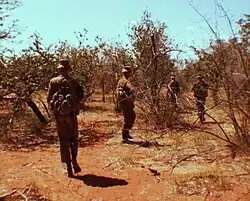
The MPLA and UNITA had different roots in Angolan society and mutually incompatible leaderships, despite their shared aim of ending colonial rule. A third movement, the National Front for the Liberation of Angola (FNLA), having fought the MPLA with UNITA during the Angolan War of Independence, played almost no role in the Civil War. Additionally, the Front for the Liberation of the Enclave of Cabinda (FLEC), an association of separatist militant groups, fought for the independence of the province of Cabinda from Angola. With the assistance of Cuban soldiers and Soviet support, the MPLA managed to win the initial phase of conventional fighting, oust the FNLA from Luanda, and become the de facto Angolan government. The FNLA disintegrated, but the U.S.- and South Africa-backed UNITA continued its irregular warfare against the MPLA government from its base in the east and south of the country. (Full article...)
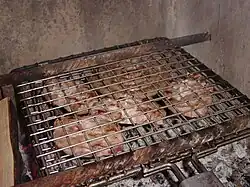
Bobotie (Afrikaans pronunciation:[bəˈbuəti]ⓘ) is a South African dish consisting of spiced minced meat baked with an egg-based topping. (Full article...)
Image 3Map of the black homelands in South Africa at the end of apartheid in 1994 (from History of South Africa)
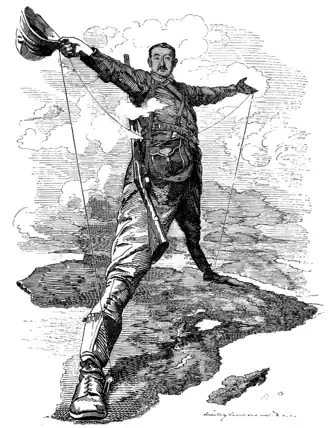
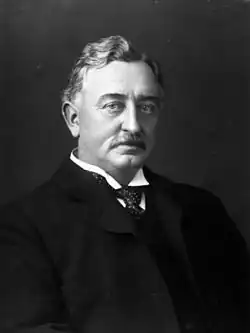
Image 4Cecil John Rhodes, co-founder of De Beers Consolidated Mines at Kimberley (from History of South Africa)
Image 5Boer Voortrekkers depicted in an early artist's rendition (from History of South Africa)
Image 6The British Empire is red on the map, at its territorial zenith in the late 1910s and early 1920s. (India highlighted in purple.) South Africa, bottom centre, lies between both halves of the Empire. (from History of South Africa)
Image 23Statue of Bartolomeu Dias at the High Commission of South Africa in London. He was the first European navigator to sail around the southernmost tip of Africa. (from History of South Africa)
Wikipedia:WikiProject South Africa/Recognized content
New articles
This list was generated from these rules. Questions and feedback are always welcome! The search is being run daily with the most recent ~14 days of results. Note: Some articles may not be relevant to this project.
Rules | Match log | Results page (for watching) | Last updated: 2026-02-16 20:22 (UTC)
Note: The list display can now be customized by each user. See List display personalization for details.
Helderberg (House of Assembly of South Africa constituency) (edit | talk | history | links | watch | logs | tools) by Moondragon21 (talk · contribs ·new pages (123)) started on 2026-02-15, score: 92






.jpg)



_-_The_Voortrekkers.jpg)








.JPG)





.jpg)
.jpg)


.jpg)