Nihonium was first reported to have been created in experiments carried out between 14 July and 10 August 2003, by a Russian–American collaboration at the Joint Institute for Nuclear Research (JINR) in Dubna, Russia, working in collaboration with the Lawrence Livermore National Laboratory in Livermore, California, and on 23 July 2004, by a team of Japanese scientists at Riken in Wakō, Japan. The confirmation of their claims in the ensuing years involved independent teams of scientists working in the United States, Germany, Sweden, and China, as well as the original claimants in Russia and Japan. In 2015, the IUPAC/IUPAP Joint Working Party recognised the element and assigned the priority of the discovery and naming rights for the element to Riken. The Riken team suggested the name nihonium in 2016, which was approved in the same year. The name comes from the common Japanese name for Japan (日本, Nihon). (Full article...)
Image 2
The Shuttle–Mir program (Russian: Программа «Мир»–«Шаттл») was a collaborative space program between Russia and the United States that involved American Space Shuttles visiting the Russian space stationMir, Russian cosmonauts flying on the Shuttle, and an American astronaut flying aboard a Soyuz spacecraft to allow American astronauts to engage in long-duration expeditions aboard Mir.
The project, sometimes called "Phase One", was intended to allow the United States to learn from Russian experience with long-duration spaceflight and to foster a spirit of cooperation between the two nations and their space agencies, the National Aeronautics and Space Administration (NASA) and the Russian Space Agency (PKA). The project helped to prepare the way for further cooperative space ventures; specifically, "Phase Two" of the joint project, the construction of the International Space Station (ISS). The program was announced in 1993, the first mission started in 1994 and the project continued until its scheduled completion in 1998. Eleven Space Shuttle missions, a joint Soyuz flight and almost 1,000 cumulative days in space for American astronauts occurred over the course of seven long-duration expeditions. In addition to Space Shuttle launches to Mir the United States also fully funded and equipped with scientific equipment the Spektr module (launched in 1995) and the Priroda module (launched in 1996), making them de facto U.S. modules during the duration of the Shuttle-Mir program. (Full article...)
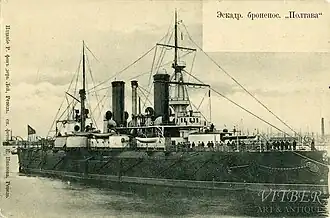
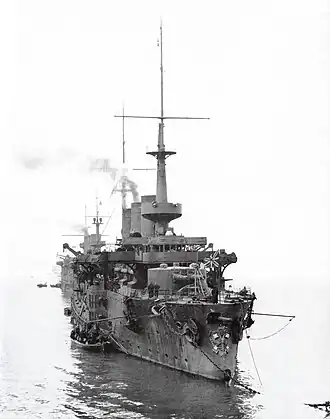
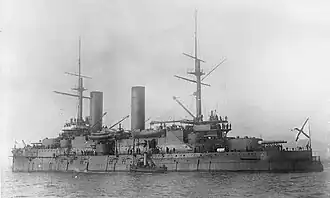
Poltava was salvaged after the Japanese captured Port Arthur and incorporated into the Imperial Japanese Navy. The ship, renamed Tango in Japanese service, participated in the Battle of Tsingtao in late 1914, during World War I. She was sold back to the Russians in 1916 and renamed Chesma as her original name was in use by another battleship. The ship became the flagship of the Russian Arctic Flotilla in 1917, and her crew supported the Bolsheviks later that year. Chesma was seized by the British in early 1918 when they intervened in the Russian Civil War, abandoned by them when they withdrew and scrapped by the Soviets in 1924. (Full article...)
Image 4
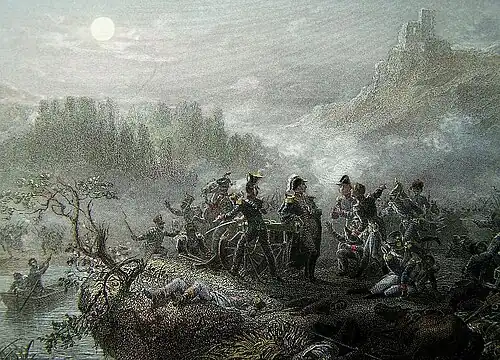
Marshal Mortier at the battle of Durenstein in 1805, by Auguste Sandoz
The Battle of Dürenstein (German: Schlacht bei Dürnstein; also known as Dürrenstein, Dürnstein and Diernstein) or the Battle of Krems (Russian: Сражение при Кремсе), on 11 November 1805, was an engagement in the Napoleonic Wars during the War of the Third Coalition. Dürenstein (modern Dürnstein), Austria, is located in the Wachau valley, on the river Danube, 73 kilometers (45 mi) upstream from Vienna, Austria. The river makes a crescent-shaped curve between Dürnstein and nearby Krems an der Donau, and the battle was fought in the flood plain between the river and the mountains.
At Dürenstein, a combined force of Russian and Austrian troops trapped a French division commanded by Théodore Maxime Gazan. The French division was part of the newly created VIII Corps, the so-called Corps Mortier, under command of Édouard Mortier. In pursuing the Austrian retreat from Bavaria, Mortier had over-extended his three divisions along the north bank of the Danube. Mikhail Kutuzov, commander of the Coalition force, enticed Mortier to send Gazan's division into a trap and French troops were caught in a valley between two Russian columns. They were rescued by the timely arrival of a second division, under command of Pierre Dupont de l'Étang. The battle extended well into the night, after which both sides claimed victory. The French lost more than a third of their participants, and Gazan's division experienced over 40 percent losses. The Austrians and Russians also had heavy losses—close to 16 percent—but perhaps the most significant was the death in action of Johann Heinrich von Schmitt, one of Austria's most capable chiefs of staff. (Full article...)
Image 5
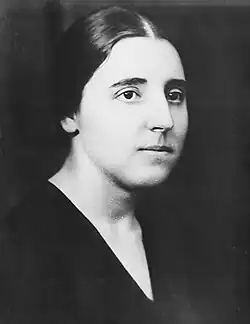
Nadezhda Sergeyevna Alliluyeva (Russian: Надежда Сергеевна Аллилуева; 22 September [O.S. 9 September] 1901 – 9 November 1932) was the second wife of Joseph Stalin. She was born in Baku to a friend of Stalin, a fellow revolutionary, and was raised in Saint Petersburg. Having known Stalin from a young age, they married when she was 18, and had two children. Alliluyeva worked as a secretary for Bolshevik leaders, including Vladimir Lenin and Stalin, before enrolling at the Industrial Academy in Moscow to study synthetic fibres and become an engineer. She had health issues, which had an adverse impact on her relationship with Stalin. She also suspected he was unfaithful, which led to frequent arguments with him. On several occasions, Alliluyeva reportedly contemplated leaving Stalin, and after an argument, she fatally shot herself early in the morning of 9 November 1932. (Full article...)
Tsereteli was born and raised in Georgia when it was part of the Russian Empire. A member of the Menshevik faction of the RSDLP, Tsereteli was elected to the Duma in 1907, where he gained fame for his oratorical skill. Shortly after entering the Duma, Tsereteli was arrested and charged with conspiracy to overthrow the Tsarist government, and exiled to Siberia. A dedicated Social Democrat who believed in the Menshevik ideology, Tsereteli was one of the leading figures of the movement in Russia. In 1915, during his Siberian exile, Tsereteli formed what would become known as Siberian Zimmerwaldism, which advocated for the role of the Second International in ending the war. He also developed the idea of "Revolutionary Defensism", the concept of a defensive war which only allowed for the defence of territory, and argued it was not being utilized. (Full article...)
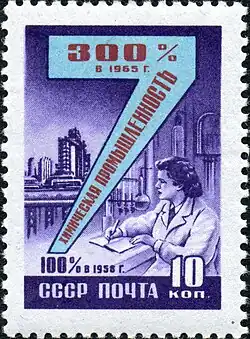
A Soviet postage stamp from 1959. The stamp celebrates growth in the chemical industry. During the Khrushchev era, especially from 1956 through 1962, the Soviet Union attempted to implement major wage reforms intended to move Soviet industrial workers away from the mindset of overfulfilling quotas that had characterised the Soviet economy during the preceding Stalinist period and toward a more efficient financial incentive.
Throughout the Stalinist period, most Soviet workers had been paid for their work based on a piece-rate system. Thus their individual wages were directly tied to the amount of work they produced. This policy was intended to encourage workers to toil and therefore increase production as much as possible. The piece-rate system led to the growth of bureaucracy and contributed to significant inefficiencies in Soviet industry. In addition, factory managers frequently manipulated the personal production quotas given to workers to prevent workers' wages from falling too low. (Full article...)
Rimsky-Korsakov believed in developing a nationalistic style of classical music, employing Russian folk song and lore along with exotic harmonic, melodic and rhythmic elements in a practice known as musical orientalism, and eschewing traditional Western compositional methods. Rimsky-Korsakov appreciated Western musical techniques after he became a professor of musical composition, harmony, and orchestration at the Saint Petersburg Conservatory in 1871. He undertook a rigorous three-year program of self-education and became a master of Western methods, incorporating them alongside the influences of Mikhail Glinka and fellow members of The Five. Rimsky-Korsakov's techniques of composition and orchestration were further enriched by his exposure to the works of Richard Wagner. (Full article...)
Of mixed Russian and French heritage, Trubnikova was orphaned at an early age and subsequently raised by a wealthy relative. She married at 19, and she and her husband, Konstantin, had seven children. In adulthood, Trubnikova hosted a women-only salon in Saint Petersburg which became a center of feminist activism. She also maintained international connections to fellow feminists in England, France, and other countries. Alongside Anna Filosofova and Nadezhda Stasova, whom she mentored, Trubnikova was one of the earliest leaders of the Russian women's movement. (Full article...)
Serving in the Baltic Sea during World War I, Slava was the largest ship of the Russian Gulf of Riga Squadron that fought the German High Seas Fleet in the Battle of the Gulf of Riga in August 1915. She repeatedly bombarded German positions and troops for the rest of 1915 and during 1916. During the Battle of Moon Sound in 1917, Slava was badly damaged by the German dreadnoughtSMS König, significantly increasing her draft. The shallow channel made it impossible to escape and she was scuttled in the Moon Sound Strait between the island of Muhu (Moon) and the mainland. The Estoniansscrapped her during the 1930s. (Full article...)
Soviet and German deployments near Prokhorovka on the eve of the engagement of 12 July. Positions of the II SS-Panzer Corps are in blue. The red dashed line shows the position of Soviet forces directly opposing the SS-Panzer Corps. The black dashed line is the railway running from Prokhorovka southwest through the Psel corridor (the strip of land between the Psel River and a tributary of the Northern Donets River).
In April 1943, the German leadership began preparing for Operation Citadel, with the objective of enveloping and destroying the Soviet forces in the Kursk salient by attacking and breaking through the base of the salient from north and south simultaneously. The German offensive was delayed several times because of the vacillation of the leadership (Hitler repeatedly delayed launching the attack so that more Tiger tanks could be delivered to the front, hoping that a technical advantage would help him win the offensive) and the addition of more forces and new equipment. The Soviet high command, Stavka, had learned of the German intentions and so used the delay to prepare a series of defensive belts along the routes of the planned German offensive. The Soviet leadership also massed several armies deep behind their defences as the Stavka Reserve. The army group, the Steppe Front, was to launch counteroffensives once the German strength had dissipated. The 5th Guards Tank Army was the primary armoured formation of the Steppe Front. (Full article...)
Photo: Herman Mishkin; Restoration: Fallschirmjäger
Maxim Gorky (1868–1936) was a Russian political activist and writer who helped establish the Socialist Realism literary method. This portrait dates from a trip Gorky made to the United States in 1906, on which he raised funds for the Bolsheviks. During this trip he wrote his novel The Mother.
A female Siberian tiger (Panthera tigris altaica), a subspecies of tiger native to Central Asia, and her cub. The Siberian tiger is the largest of the extant tiger subspecies as well as the largest felid, attaining 320 kg (710 lb) in an exceptional specimen. Considered an endangered subspecies, the wild population is down to several hundred individuals and is limited to eastern Siberia.
Image 6
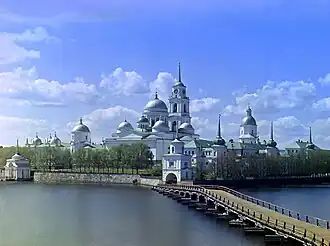
Nilov Monastery on Stolobnyi Island in Lake Seliger in Tver Province, Russia
This photo of the Nilov Monastery on Stolobny Island in Tver Oblast, Russia, was taken by Sergey Prokudin-Gorsky in 1910 before the advent of colour photography. His process used a camera that took a series of monochrome pictures in rapid sequence, each through a different coloured filter. By projecting all three monochrome pictures using correctly coloured light, it was possible to reconstruct the original colour scene.
An Alaskan parchment scrip banknote in the denomination of 1 ruble, printed on vellum or parchment by the Russian-American Company. On the obverse, the horizontal text immediately beneath the double-headed eagle reads "Seal of the Russian American Company". The oval text reads "under august protection of His Imperial Majesty", and under the oval is the value of the note "one ruble".
Alaskan parchment scrip was used as a form of company scrip in Alaska when it was a possession of the Russian Empire. In circulation from 1816 to 1867, such scrip could be printed on vellum, parchment, or pinniped skin. Denominations of 10, 25, 50 kopecks and 1, 5, 10, and 25 rubles were issued.
Saint Michael's Castle is a former royal residence in the historic centre of Saint Petersburg, Russia. It was built for Emperor Paul I between 1797 and 1801, and named after Saint Michael, the patron saint of the royal family. Constructed like a castle around a small octagonal courtyard, the four facades were built in different architectural styles, including French Classicism, Italian Renaissance and Gothic. The emperor was assassinated in the castle forty days after taking up residence. After his death, the imperial family returned to the Winter Palace and the building was transferred to the Russian Army's Main Engineering School. In 1990, it became a branch of the Russian Museum, and now houses its portrait gallery.
Kombat (Russian for 'battalion commander') is a black-and-white photograph by Soviet photographer Max Alpert. It depicts a Soviet military officer, armed with a TT pistol, raising his unit for an attack during World War II. This work is regarded as one of the most iconic Soviet World War II photographs, yet neither the date nor the subject is known with certainty. According to the most widely accepted version, it depicts junior politruk Aleksei Gordeyevich Yeryomenko, minutes before his death on 12 July 1942, in Voroshilovgrad Oblast, now part of Ukraine. The photograph is in the archives of RIA Novosti, a Russian state-owned news agency.
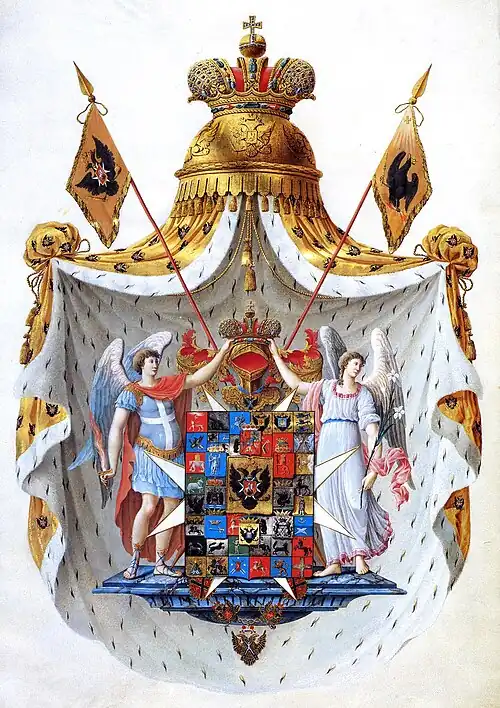
The Great Coat of Arms of the Russian Empire, as presented to Emperor Paul I in October 1800. The use of the double-headed eagle in the coat of arms (seen in multiple locations here) goes back to the 15th century. With the fall of Constantinople and the end of the Byzantine Empire in 1453, the Grand Dukes of Moscow came to see themselves as the successors of the Byzantine heritage, a notion reinforced by the marriage of Ivan III to Sophia Paleologue. Ivan adopted the golden Byzantine double-headed eagle in his seal, first documented in 1472, marking his direct claim to the Roman imperial heritage and his assertion as sovereign equal and rival to the Holy Roman Empire.
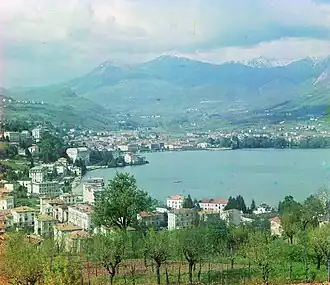
Although James Clerk Maxwell made the first color photograph in 1861, the results were far from realistic until Prokudin-Gorsky perfected the technique with a series of improvements around 1905. His process used a camera that took a series of monochrome pictures in rapid sequence, each through a different colored filter. Prokudin-Gorskii then went on to document much of the country of Russia, travelling by train in a specially equipped darkroomrailroad car.
The Last Day of Pompeii is an oil painting on canvas completed by the Russian artist Karl Bryullov between 1830 and 1833. The painting is based on sketches the artist completed in 1828 while visiting Pompeii, a city destroyed by the eruption of Mount Vesuvius in 79 AD. It is now held in the State Russian Museum.
A Boyar Wedding Feast is an oil-on-canvas painting created by Russian artist Konstantin Makovsky in 1883. The boyars were members of the highest rank of the feudal aristocracy of Russia in the 16th and 17th centuries, and a wedding was an important social event. In this painting, the guests are depicted toasting a newlywed couple. They stand at the head of the table, where the groom sees his bride without her veil for the first time; she appears timid and bashful as the men toast for the first kiss. Behind the couple, the Lady of Ceremony gently urges on the bride. A roasted swan is being brought in on a large platter, the last dish to be served before the couple retires to the bedroom. The work is in the collection of the Hillwood Estate, Museum & Gardens, in Washington, D.C.
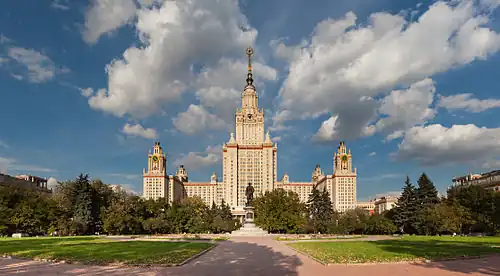
The current main building of the Moscow State University in Sparrow Hills, Moscow, Russia. Designed by Lev Rudnev and completed by 1953, the 240-metre (790 ft) tall structure was the tallest building in Europe until the completion of the Messeturm in 1990.
Did you know...
... that Russian Jewish painter Marc Chagall created the windows of the St Stephan church(pictured) in Mainz as a sign of Jewish-German reconciliation?
Chicken Kiev, also known as chicken Kyiv, is a dish made of chickenfillet pounded and rolled around cold butter, then coated with egg and bread crumbs, and either fried or baked. Since fillets are often referred to as suprêmes in professional cookery, the dish is also called "suprême de volaille à la Kiev". Stuffed chicken breast is generally known in Russian and Ukrainian cuisines as côtelette de volaille. Though it has disputed origins, the dish is particularly popular in the post-Soviet states, as well as in several other countries of the former Eastern Bloc, and in the English-speaking world. (Full article...)
At the 2008 NHL entry draft, Filatov was selected sixth overall by the Blue Jackets. Filatov was the top-ranked European skater by the NHL Central Scouting Bureau. Filatov played two seasons with the Blue Jackets organization. During the 2009–10 season, Filatov was unhappy with his situation in Columbus and was loaned to CSKA Moscow for the remainder of the season. At the 2011 NHL entry draft, the Blue Jackets then traded him to Ottawa in exchange for a third-round draft pick. In December 2011, the Senators loaned Filatov to CSKA Moscow for the balance of the 2011–12 season. The following season, Filatov signed with Salavat Yulaev. The Senators chose not to tender Filatov a qualifying offer, making him a free agent. (Full article...)
WikiProject Countries
• WikiProject Asia
• WikiProject Europe
Main project
WikiProject Russia
Sister projects
WikiProject Caucasia
• WikiProject Soviet Union
• Russian, Soviet and CIS military history task force of the Military history WikiProject
• Soviet and post-Soviet cinema task force of the Film WikiProject
What are WikiProjects?
Selected quote
Featured content
Extended content
This is a list of recognized content, updated weekly by JL-Bot (talk · contribs) (typically on Saturdays). There is no need to edit the list yourself. If an article is missing from the list, make sure it is tagged or categorized (e.g. Category:WikiProject Russia articles) correctly and wait for the next update. See WP:RECOG for configuration options.
Deletion sorting: Please see the collection of discussions on the deletion of articles related to Russia - compiled by WikiProject Deletion sorting
Help out with articles placed in Category:Russia articles needing attention
Notability: Articles with notability concerns, listed at WikiProject Notability
Rate the Unassessed Russia articles in the Russia WikiProject.
Requested articles:Russian Union of Journalists, Bureau for Russian Emigrants in Manchuria, Assel River, Todzha Depression, Municipal reform of Catherine II, Vennik, More...






.jpg)
.jpg)

.jpg)





.jpg)




_Google_Cultural_Institute.jpg)


.jpg)