Mungiu and cinematographer Oleg Mutu shot it in Bucharest and other Romanian locations in 2006. After making its world premiere at Cannes, 4 Months, 3 Weeks and 2 Days made its Romanian debut on 1 June 2007, at the Transilvania International Film Festival. It opened to critical acclaim, and was noted for its minimalism and intense themes. (Full article...)
"Liubi, Liubi, I Love You" represented Romania in the Eurovision Song Contest 2007, held in Helsinki, Finland after winning the pre-selection show Selecția Națională. In Helsinki, Romania automatically qualified to the final due to their top ten placement in the previous year and finished in 13th place with 84 points. "Liubi, Liubi, I Love You" was promoted through performances in Belarus and a music video shot in Romania by Dan Manoliu. It charted at number 82 on the Romanian Top 100. (Full article...)
Image 3
Christopher depicted in Franz Christoph Khevenhüller's Conterfet Kupfferstich
Christopher's brother, Stephen Báthory, who succeeded John Sigismund in 1571, made Christopher captain of Várad (now Oradea in Romania). After being elected King of Poland, Stephen Báthory adopted the title of Prince of Transylvania and made Christopher voivode in 1576. Christopher cooperated with Márton Berzeviczy, whom his brother appointed to supervise the administration of the Principality of Transylvania as the head of the Transylvanian chancellery at Kraków. Christopher ordered the imprisonment of Ferenc Dávid, a leading theologian of the Unitarian Church of Transylvania, who started to condemn the adoration of Jesus. He supported his brother's efforts to settle the Jesuits in Transylvania. (Full article...)
"Give Me Your Everything" is a song recorded by Romanian singer Alexandra Stan for her second studio album, Unlocked (2014). It was made available for digital download on 20 August 2014 through Victor Entertainment. "Give Me Your Everything" was written by Stan, Serban Cazan, LeAnna James, Naz Tokio and Andrei Mihai, while production was solely handled by Cazan. A music video for the song was directed by Vlad Fenesan and uploaded onto the singer's YouTube channel, where it has amassed over three million views. The clip shows Stan chasing a masked man in a dark landscape. Upon its release, the video aroused controversy for a scene in which Stan is wearing a white robe with masonic symbols inscribed on its back. Particularly, Urban.ro named the clip "her most bizarre video ever".
The recording was met with positive reviews. Some music critics praised the song's "Caribbean groove" and the singer's "hypnotic" and "crystalline" vocals, while others comparing "Give Me Your Everything" to the material featured on Rihanna's A Girl like Me (2006). The style of the song has been described as "urban" and "tribal". During an interview in Spain, Stan explained that "Give Me Your Everything" was written as a present for her Asian and Arabic fans, due to the song's more oriental style and spiritual meaning. (Full article...)
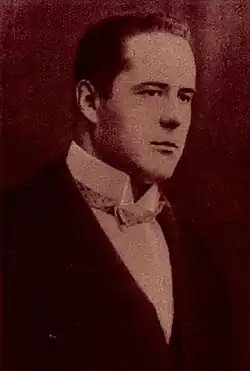
Ilie V. Cătărău (Romanian pronunciation:[iˈli.ekətəˈrəw], reportedly born Katarov, last name also Cătărău-Orhei; 21 July 1888 – c. 1955) was a Bessarabian-born political adventurer, soldier and spy, who spent parts of his life in the Kingdom of Romania. A mysterious figure, he is widely held to have been the main perpetrator of two bomb attacks, which sought to exacerbate tensions between Romania and Austria-Hungary in the buildup to World War I. Beyond his cover as a refugee from the Russian Empire, and his public commitment to Romanian nationalism, Cătărău was a double agent, working for both Russian and Romanian interests; he may also have been linked to the Black Hundreds. His terrorist actions, and especially the letter bomb which he sent to the Hungarian Catholic Bishopric in Debrecen, occurred shortly before, and are probably connected with, the Sarajevo Assassination.
Cătărău managed to flee prosecution, settling in Egypt (which deported him), and later in China. He continued to make return trips to Romania, which finally arrested him upon entering the war—though he managed to escape, he remained on Romanian soil, only leaving on return visits to the Russian Republic. By 1917, as leader of the "Romanian Nationalist-Revolutionary Party", Cătărău was formally committed to anarchism and communism, allying himself with Bessarabia's Bolshevik insurgents. Profiting from favorable circumstances, and nominally serving the anti-Bolshevik Moldavian Democratic Republic, he became commander of its 1st Moldavian Regiment in late 1917. In short time, his position and his application of a communist program eroded the Republic's prestige, and his soldiers began openly threatening the Bessarabian government. Cătărău was deposed and arrested by Military Director Gherman Pântea and a unit of Amur Cossacks, and sent into exile. (Full article...)
Image 7
Romania was represented at the Eurovision Song Contest 2007 with the song "Liubi, Liubi, I Love You", written by Vlad Crețu, Kamara Ghedi, and Bogdan Tașcău, and performed by the group Todomondo. The Romanian participating broadcaster, Televiziunea Română (TVR), held the national final Selecția Națională 2007 in order to select its entry for the contest. Controversy surrounded the event, as TVR disqualified several entries over the course of the competition.
Prior to Eurovision, "Liubi, Liubi, I Love You" was promoted by a music video and a promotional tour in Belarus. Todomondo ultimately achieved 13th place in the contest's Grand Final on 12 May 2007, scoring 84 points. Their performance saw the use of pyrotechnics. (Full article...)
Image 8
The Bolokhovians, Bolokhoveni or Bolokhovens (Romanian: Bolohoveni; Old Slavic: Болоховци, Bolokhovtsy) were a 13th-century ethnic group that resided in the vicinity of the principalities of Galicia, Volhynia and Kiev, in the territory known as the "Bolokhovian Land" centered at the city of Bolokhov or Bolokhovo (not identified yet). Their ethnic identity is uncertain. Archeological evidence and the Hypatian Chronicle (which is the only primary source that documents their history) suggest that they were a Slavic people. Romanian scholars, basing on an interpretation of the ethnonym, identify them as Romanians (who were called Vlachs in the Middle Ages). Their princes, or knyazes, were in constant conflict with Daniel, the prince of Galicia–Volhynia, between 1231 and 1257. After the Mongols sacked Kiev in 1240, the Bolokhovians supplied them with troops, but the Bolokhovian princes fled to Poland. The Bolokhovians disappeared after Daniel defeated them in 1257. (Full article...)
Image 9
"I Think I Love It" is a song by Romanian singer Alexandra Stan, digitally released through Universal Music Romania on 28 June 2019 as the first single from Stan’s fifth album Rainbows. It was written by Krishane and Radu Bolfea, while the production was handled by Stan, Bolfea, Cătălin Safta, Achi, Adelina Stinga and Vlad Lucan. A reggae pop track, the song's lyrics discuss the theme of love and freedom. An accompanying music video for the song was uploaded to Stan's YouTube channel on 1 July 2019, directed by Criss Blaziny. Making use of several explicit scenes, it features the singer and model Geni Olaru driving a red Corvette car and posing in different ways. Further promoted by several live performances, the song peaked at number 38 on Romania's Airplay 100 ranking. (Full article...)
Image 10
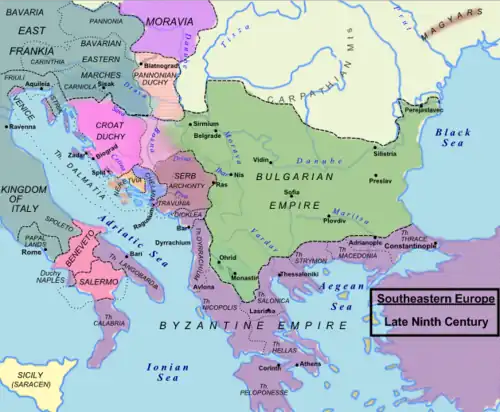
Glad (Bulgarian: Глад, Hungarian: Galád, Romanian: Glad, Serbian: Глад) was the ruler of Banat (in present-day Romania and Serbia) at the time of the Hungarian conquest of the Carpathian Basin around 900 AD, according to the Gesta Hungarorum. The Gesta, which was written by an author known in modern scholarship as Anonymus in the second half of the 12th century or in the early 13th century, is the earliest extant Hungarian chronicle. The Gesta did not refer to the enemies of the conquering Hungarians (or Magyars), who had been mentioned in earlier annals and chronicles, but wrote of a dozen persons, including Glad, who are unknown from other primary sources of the Hungarian Conquest. Therefore, modern historians debate whether Glad was an actual enemy of the conquerors or only a "fictitious person" made up by Anonymus. In Romanian historiography, based on the mention by Anonymus some 300 years later, Glad is described as one of the three Romanian dukes who ruled a historical region of present-day Romania in the early 10th century.
According to the Gesta, Glad came from Vidin in Bulgaria. He occupied Banat with the assistance of "Cumans" before the arrival of the Magyars. Anonymus wrote that Cumans, Bulgarians, and Vlachs (or Romanians), supported Glad against the invading Magyars, but the latter annihilated their united army in a battle near the Timiș River. The Gesta presents Ahtum, who ruled Banat in the early 11th century, according to the longer version of the Life of St Gerard, as Glad's descendant. (Full article...)
Image 11
"Te Vas" (English: "You Go" or "You Leave") is a song by Romanian singer Inna, digitally released on 31 May 2019 by Global Records as the fifth single from her sixth studio album Yo (2019). It was written by Inna and Cristina Maria Chiluiza, while production was handled by Sebastian Barac, Marcel Botezan, David Ciente and Alexandru Cotoi. A Spanish-language house song reminiscent of Inna's past material, the track lyrically discusses the bond between two separated lovers.
An accompanying music video for "Te Vas" was uploaded onto Inna's YouTube channel on 30 May 2019. Directed by Bogdan Păun, it features the singer and Dragoș Istvan performing a mixture of contemporary dance and acrobatics, representing an on-and-off relationship. For further promotion, Inna performed "Te Vas" for Romanian radio station Kiss FM in June 2019. The track peaked at number 36 on Romania's Airplay 100 chart. It was included in a The Baker and the Beauty episode. (Full article...)
Image 12
"It's My Life" is a song recorded by Romanian singer Cezar, released as part of a CD single in 2013 through the Romanian Television (TVR). It was solely written and produced by Cristian Faur. Musically, the track has been described as an operatic pop and dubstep song, with the latter genre being predominantly present in the track's bridge. A love song, its instrumentation consists of electronic beats, while Cezar prominently uses his "feminine" falsetto register. Reviewers likened his vocal delivery to the works of Scottish singer Jimmy Somerville and Australian musician Nick Cave.
"It's My Life" represented Romania in the 2013 Eurovision Song Contest in Malmö, Sweden after winning the pre-selection show Selecția Națională. The country reached 13th place in a field of 26, scoring a total of 65 points. Cezar's show featured him dressed in a black sequin cloak standing between fluorescent lighting tubes, while dancers who emerged from a red material placed under him performed interpretive dance. The performance was met with mixed reactions and often featured in publications' lists of Eurovision's most outstanding and peculiar performances. The track itself received similar reviews, with critics arguing over its catchiness, originality, composition and dance nature, as well as over Cezar's vocals. (Full article...)
Image 13
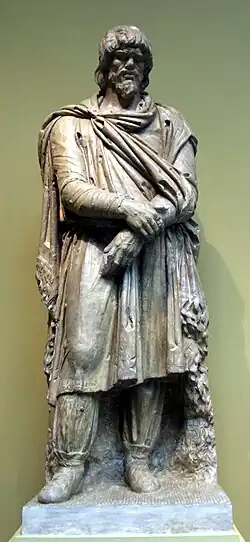
The Early Middle Ages in Romania started with the withdrawal of the Roman troops and administration from Dacia province in the 270s. In the next millennium a series of peoples, most of whom only controlled two or three of the nearly ten historical regions that now form Romania, arrived. During this period, society and culture underwent fundamental changes. Town life came to an end in Dacia with the Roman withdrawal, and in Scythia Minor – the other Roman province in the territory of present-day Romania – 400 years later. Fine vessels made on fast potter's wheels disappeared and hand-made pottery became dominant from the 450s. Burial rites changed more than once from cremation to inhumation and vice versa until inhumation became dominant by the end of the 10th century.
"Don't Break My Heart" is a song recorded by Romanian singer Nicola for her greatest hits albumBest of Nicola (2003) and fourth studio album De mă vei chema (2004). Written by Nicola and produced by her then-husband Mihai Alexandru, it was released as a CD single in 2003 by Cat Music. Musically, "Don't Break My Heart" is an uptempo dance recording.
The track represented Romania in the Eurovision Song Contest 2003 in Riga, Latvia after winning the pre-selection show Selecția Națională. In Riga, Nicola was automatically qualified to the Grand Final, where she finished in tenth place with 73 points. During her show, the singer performed in front of background dancers who were rotating overdimensional discs in the colors of the Romanian flag. Although a remix of the song received airplay on multiple radio stations in the United States, it failed to impact any national chart. (Full article...)
A French Open junior champion and former junior world No. 1, Halep first broke into the world's top 50 at the end of 2011, the top 20 in August 2013, and the top 10 in January 2014. She won her first six WTA titles in the same season in 2013, the first to do so since Steffi Graf in 1986. This led to her being named the WTA Most Improved Player of the year. Halep finished runner-up at three majors—the 2014 French Open, 2017 French Open, and 2018 Australian Open—before winning her first major title at the 2018 French Open. Halep also finished runner-up at the 2014 WTA Finals to Serena Williams, whom she went on to defeat to claim the 2019 Wimbledon Championships. From 27 January 2014 to 8 August 2021, Halep was ranked in the top 10 for 373 consecutive weeks, the eighth-longest streak in WTA history. During this seven-year span, she finished each year ranked within the world's top four. (Full article...)
Romani slaves belonged to boyars (aristocrats), Orthodox monasteries, or the state. They were used as blacksmiths, goldsmiths and agricultural workers, but when the principalities were urbanized, they also served as servants. (Full article...)
George Enescu (Romanian:[ˈdʒe̯ordʒeeˈnesku]ⓘ; 19 August [O.S. 7 August] 1881 – 4 May 1955), known in France as Georges Enesco, was a Romanian composer, violinist, pianist, conductor, teacher and statesman. He is regarded as one of the greatest musicians in Romanian history. (Full article...)
... that in 1906, composer Robert Winterberg gave a concert for the queen of Romania?
... that according to the poet Eugen Constant, he persuaded his questioner of the validity of Marxism while being interrogated by Romanian authorities?
... that Tudor Arghezi, "perhaps the strongest personality in all of 20th-century Romanian literature", claimed that he could identify people with cancer by their smell?
More did you know
...that Bucharest's RATB mass transit network is the fourth largest in Europe?
General images
The following are images from various Romania-related articles on Wikipedia.
Image 101941 stamp depicting a Romanian and a German soldier in reference to the two countries' common participation in Operation Barbarossa, the text below reads the holy war against Bolshevism (from History of Romania)
Image 19Romania has seen its largest waves of protests against judicial reform ordinances of the PSD-ALDE coalition during the 2017–2019 Romanian protests (from History of Romania)
Image 26The upper map shows Dacia’s territory at the beginning of Burebista’s rule, while the lower map depicts its territory at the end of his reign. (from History of Romania)
Image 52Map depicting the Dacian Kingdom, including its annexed territories and areas of approximate influence including Pannonia and Bohemia. (from History of Romania)
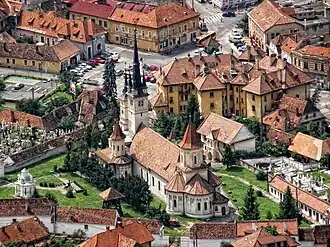
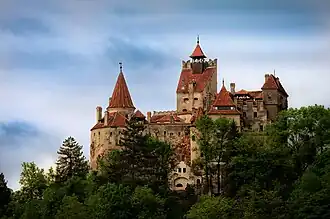
Image 61Bran Castle (German: Törzburg, Hungarian: Törcsvár) built in 1377, is commonly known as Dracula's Castle and is situated in the center of present-day Romania. In addition to its unique architecture, the castle is famous because of persistent myths that it was once the home of Vlad III Dracula. (from History of Romania)
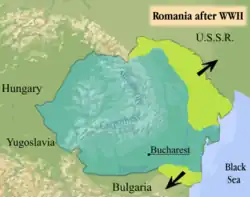
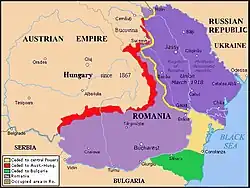
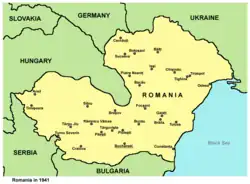
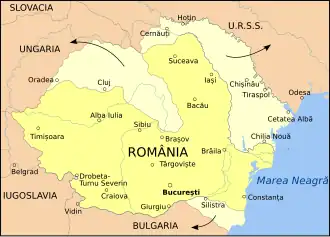
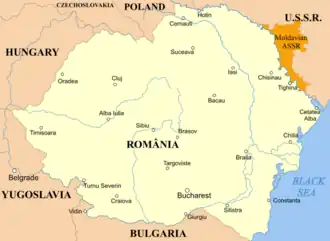
Image 71Romania after the territorial losses of 1940. The recovery of Bessarabia and Northern Bukovina was the catalyst for Romania's entry into the war on Germany's side. (from History of Romania)
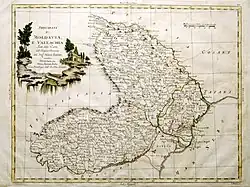
Image 72The Principalities of Moldavia and Wallachia in 1786, Italian map by G. Pittori, since the geographer Giovanni Antonio Rizzi Zannoni (from History of Romania)
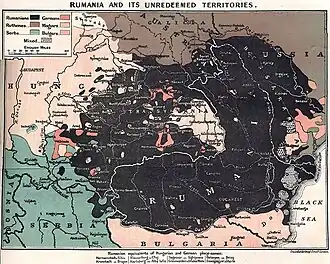
Image 84Ethnic map of Greater Romania according to the 1930 census. Sizeable ethnic minorities put Romania at odds with Hungary, Bulgaria, and the Soviet Union throughout the interwar period. (from History of Romania)
This is a list of recognized content, updated weekly by JL-Bot (talk · contribs) (typically on Saturdays). There is no need to edit the list yourself. If an article is missing from the list, make sure it is tagged (e.g. {{WikiProject Romania}}) or categorized correctly and wait for the next update. See WP:RECOG for configuration options.



_(cropped).jpg)


.jpg)

.jpg)


.jpg)
.svg.png)
















.png)


.svg.png)







.jpg)





.svg.png)


.JPG)















_female_underside_Dobruja.jpg)
_in_flight_Danube_delta_2.jpg)
_R%C3%A1k%C3%B3czi_(1593-1648)_-_Rembrandt_van_Rijn_%2526_Jan_Gillisz._van_Vliet.jpg)
_Danube_delta.jpg)
_form_prorsa_underside_Piatra_Craiului.jpg)
.jpg)
.jpg)
.jpg)
_female_with_bee_prey_Babadag.jpg)

%252C_figurino_di_Adolf_Hohenstein_per_La_Wally_(1892)_-_Archivio_Storico_Ricordi_ICON004639_-_Restoration.jpg)



 Commons
 Wikibooks
 Wikidata
 Wikinews
 Wikiquote
 Wikisource
 Wikiversity
 Wikivoyage
 Wiktionary
 List of all portals





 Random portal
 WikiProject Portals