Portal:Ontario
The Ontario Portal
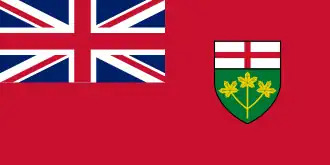
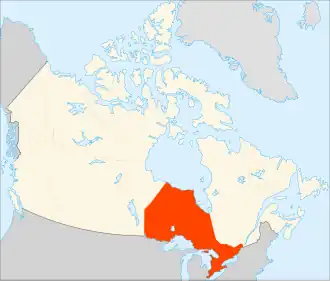
Ontario is the southernmost province of Canada. Located in Central Canada, Ontario is the country's most populous province. As of the 2021 Canadian census, it is home to over 14 million people, which is 38.5% of the country's population. Ontario is the second-largest province by total area (after Quebec) and the fourth-largest jurisdiction of all the Canadian provinces and territories. It is home to the nation's capital, Ottawa, and its most populous city, Toronto, which is Ontario's provincial capital.
Ontario is bordered by the province of Manitoba to the west, Hudson Bay and James Bay to the north, and Quebec to the east and northeast. To the south, it is bordered by the U.S. states of (from west to east) Minnesota, Michigan, Ohio, Pennsylvania (through Lake Erie), and New York. Almost all of Ontario's 2,700-kilometre (1,700 mi) border with the United States follows rivers and lakes: from the westerly Lake of the Woods, eastward along the major rivers and lakes of the Great Lakes/Saint Lawrence River drainage system. There is only about 1 kilometre (0.62 mi) of actual land border, made up of portages including Height of Land Portage on the Minnesota border.
The great majority of Ontario's population and arable land are in Southern Ontario, and while agriculture remains a significant industry, the region's economy depends highly on manufacturing. In contrast, Northern Ontario is sparsely populated with cold winters and heavy forestation, with mining and forestry making up the region's major industries. (Full article...)
Selected article -
The history of Ontario covers the period from the arrival of Paleo-Indians thousands of years ago to the present day. The lands that make up present-day Ontario, the most populous province of Canada as of the early 21st century have been inhabited for millennia by groups of Aboriginal people, with French and British exploration and colonization commencing in the 17th century. Before the arrival of Europeans, the region was inhabited both by Algonquian (Ojibwa, Cree and Algonquin) and Iroquoian (Iroquois, Petun and Huron) tribes.
French explorer Étienne Brûlé surveyed part of the area in 1610–12. The English explorer Henry Hudson sailed into Hudson Bay in 1611 and claimed the area for England, but Samuel de Champlain reached Lake Huron in 1615. In their effort to secure the North American fur trade, the English / British and the French established a number of fur trading forts in Ontario during the 17th and 18th centuries; with the former establishing a number of forts around Hudson Bay, and the latter establishing forts throughout the Pays d'en Haut region. Control over the area remained contested until the end of the Seven Years' War, when the 1763 Treaty of Paris awarded the colony of New France to the British.
Following the American Revolutionary War, the province saw an influx of loyalist settle the area. In response to the influx of loyalist refugees, the Constitutional Act of 1791 was enacted, splitting the colony of Quebec into Lower Canada (present day southern Quebec) and Upper Canada (present day southern Ontario). The Canadas were reunited as the Province of Canada by the Act of Union 1840. On July 1, 1867, the Province of Canada, New Brunswick, and Nova Scotia were united to form a single federation. The Province of Canada was split into two provinces at Confederation, with the area east of the Ottawa River forming Quebec, and the area west of the river forming Ontario. (Full article...)
General images
-
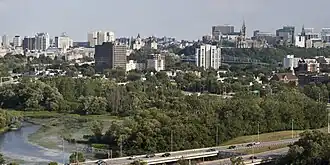 Ottawa (from Eastern Ontario)
 -
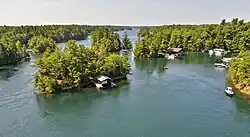
-
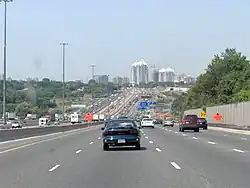 Highway 401 at the Don Valley Parkway in Toronto (from Southern Ontario)
 -
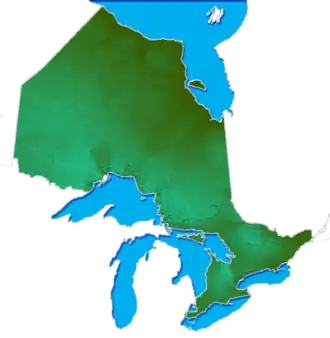
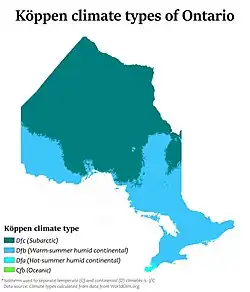 Köppen Climate Map of Ontario (from Eastern Ontario)
 -

-
 Typical Great Lakes beach (from Southern Ontario)
 -
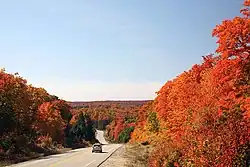
-
 Science North in Sudbury. (from Northern Ontario)
 -
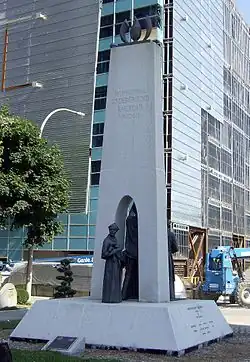 Underground Railroad monument, Windsor (from Southern Ontario)
 -
 Ottawa in 2005 (from Southern Ontario)
 -
 North Bay is often considered to be the "Gateway" to Northern Ontario (from Northern Ontario)
 -

-
.jpg) Forests, lakes, and rivers dominate much of the Northern Ontario landscape. (from Northern Ontario)
Forests, lakes, and rivers dominate much of the Northern Ontario landscape. (from Northern Ontario) -

Surrounding areas
Places adjacent to Ontario | |
|---|---|


Selected biography -

Dalton James Patrick McGuinty Jr. OOnt ECO (born July 19, 1955) is a Canadian former politician who served as the 24th premier of Ontario from 2003 to 2013. He was the first Liberal leader to win two majority governments since Mitchell Hepburn nearly 70 years earlier. In 2011, he became the first Liberal premier to secure a third consecutive term since Oliver Mowat after his party was re-elected in that year's provincial election.
McGuinty was born in Ottawa. He studied science at university, but ended up taking a law degree and practiced law in Ottawa. His father served as a Liberal member of Provincial Parliament (MPP) from 1987 until his death in 1990. A provincial election was called for later that year and McGuinty successfully ran in his father's seat, though the incumbent Liberal government was defeated. After party leader Lyn McLeod resigned due to her leading the Liberals to a second defeat in the 1995 election, McGuinty was elected leader in the 1996 leadership election. McGuinty lost the 1999 election to Progressive Conservative Premier Mike Harris, but won a resounding majority in 2003. (Full article...)
Selected image
-
 The Niagara Falls are voluminous waterfalls on the Niagara River, straddling the international border between the Canadian province of Ontario and the U.S. state of New York.
 -
.jpg) A view of Ruskview, Ontario in 2017, an unincorporated rural community in Mulmur Township, Dufferin County, Ontario
A view of Ruskview, Ontario in 2017, an unincorporated rural community in Mulmur Township, Dufferin County, Ontario -
 A panoramic view of Hamilton, Ontario
 -
 Sunset on North Tea Lake in Algonquin Provincial Park, Ontario Canada
 -
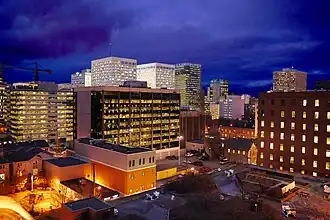 Downtown Ottawa is the central area of Ottawa
 -

-
 The CN Tower, located in downtown Toronto, Ontario, Canada, is a communications and observation tower standing 553.3 metres (1,815 ft) tall.
 -
 Waterloo, Ontario taken from the North East corner of the Uptown Parkade
Did you know? -
- ... that in 1987, Royal Society of Canada fellow Kathryn Brush was one of the first women to be hired for a full-time position in art history at the University of Western Ontario?
Related projects and portals
Topics

Categories

Things you can do
- Help expand stub articles: There are numerous stub articles relating to Ontario. You can help by expanding them. See Ontario stubs for a list. Also, for geographical (places) stubs, refer to:
- Eastern Ontario: Eastern Ontario geography stubs
- Toronto: Toronto geography stubs
- Ottawa: Ottawa stubs - All stubs relating to Ottawa in general
- Northern Ontario: Northern Ontario geography stubs
- Western Ontario: Western Ontario geography stubs
- Golden Horseshoe: Golden Horseshoe geography stubs
Associated Wikimedia -
The following Wikimedia Foundation sister projects provide more on this subject:
-
 Commons
Free media repository -
 Wikibooks
Free textbooks and manuals -
 Wikidata
Free knowledge base -
 Wikinews
Free-content news -
 Wikiquote
Collection of quotations -
 Wikisource
Free-content library -
 Wikiversity
Free learning tools -
 Wikivoyage
Free travel guide -
 Wiktionary
Dictionary and thesaurus
-
 List of all portals
 -

-

-

-
-

-

-

-

-

-
 Random portal
 -
 WikiProject Portals