Portal:North Korea

 The North Korea Portal The North Korea PortalIntroduction North Korea, officially the Democratic People's Republic of Korea (DPRK), is a country in East Asia. It constitutes the northern half of the Korean Peninsula and borders China and Russia to the north at the Yalu (Amnok) and Tumen rivers, and South Korea to the south at the Korean Demilitarized Zone (DMZ). The country's western border is formed by the Yellow Sea, while its eastern border is defined by the Sea of Japan. North Korea claimed to be the sole legitimate government of the Korean Peninsula and adjacent islands until 2024, when it abandoned the Korean unification plan and designated South Korea as a hostile country. Pyongyang is the capital and largest city. The Korean Peninsula was first inhabited as early as the Lower Paleolithic period. Its first kingdom was noted in Chinese records in the early 7th century BCE. Following the unification of the Three Kingdoms of Korea into Silla and Balhae in the late 7th century, Korea was ruled by the Goryeo dynasty (918–1392) and the Joseon dynasty (1392–1897). The succeeding Korean Empire (1897–1910) was annexed in 1910 into the Empire of Japan. In 1945, after the Japanese surrender at the end of World War II, Korea was divided into two zones along the 38th parallel, with the north occupied by the Soviet Union and the south occupied by the United States. In 1948, separate governments were formed in Korea: the socialist and Soviet-aligned Democratic People's Republic of Korea in the north, and the capitalist, Western-aligned Republic of Korea in the south. The North Korean invasion of South Korea in 1950 started the Korean War. In 1953, the Korean Armistice Agreement brought about a ceasefire and established a demilitarized zone (DMZ), but no formal peace treaty has ever been signed. Post-war North Korea benefited greatly from economic aid and expertise provided by other Eastern Bloc countries. However, Kim Il Sung, North Korea's first leader, promoted his personal philosophy of Juche as the state ideology. Pyongyang's international isolation sharply accelerated from the 1980s onwards as the Cold War came to an end. The fall of the Soviet Union in 1991 then brought about a sharp decline to the North Korean economy. From 1994 to 1998, North Korea suffered a famine with the population continuing to suffer from malnutrition. In 2024, the DPRK formally abandoned efforts to reunify Korea. North Korea is a totalitarian dictatorship with a comprehensive cult of personality around the Kim family. Amnesty International considers the country to have the worst human rights record in the world. Officially, North Korea is a communist state that self-designates as an "independent socialist state" which holds democratic elections; however, outside observers have described the elections as unfair, uncompetitive, and pre-determined. The Workers' Party of Korea (WPK) is the sole ruling party of North Korea. According to Article 3 of the constitution, Kimilsungism–Kimjongilism is the official ideology of North Korea. The means of production are owned by the state through state-run enterprises and collectivized farms. Most services—such as healthcare, education, housing, and food production—are subsidized or state-funded. The country follows Songun, a "military first" policy which prioritizes the Korean People's Army in state affairs and the allocation of resources. It possesses nuclear weapons. Its active-duty army of 1.28 million soldiers is the fourth-largest in the world. In addition to being a member of the United Nations since 1991, North Korea is also a member of the Non-Aligned Movement, the G77, and the ASEAN Regional Forum. (Full article...) Selected article -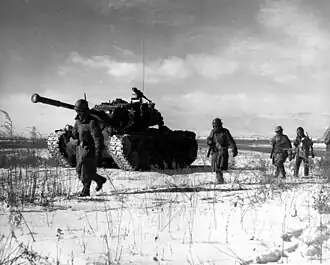 The Korean War (25 June 1950 – 27 July 1953) was an armed conflict on the Korean Peninsula fought between North Korea (Democratic People's Republic of Korea; DPRK) and South Korea (Republic of Korea; ROK) and their allies. North Korea was supported by China and the Soviet Union, while South Korea was supported by the United Nations Command (UNC) led by the United States. The conflict was one of the first major proxy wars of the Cold War. After the end of World War II in 1945, Korea, which had been a Japanese colony for 35 years, was divided by the Soviet Union and the United States into two occupation zones at the 38th parallel, with plans for a future independent state. Due to political disagreements the zones formed their own governments in 1948. North Korea was led by Kim Il Sung in Pyongyang, and South Korea by Syngman Rhee in Seoul; both claimed to be the sole legitimate government of all of Korea. On 25 June 1950, the Korean People's Army (KPA), equipped and trained by the Soviets, launched an invasion of the south. In the absence of the Soviet Union's representative, the UN Security Council denounced the attack and recommended member states to repel the invasion. UN forces comprised 21 countries, with the United States providing around 90% of military personnel. Seoul was captured by the KPA on 28 June, and by early August, the Republic of Korea Army (ROKA) and its allies were nearly defeated, holding onto only the Pusan Perimeter in the peninsula's southeast. On 15 September, UN forces landed at Inchon near Seoul, cutting off KPA troops and supply lines. UN forces broke out from the perimeter on 18 September, re-captured Seoul, and invaded North Korea in October, capturing Pyongyang and advancing towards the Yalu River—the border with China. On 19 October, the Chinese People's Volunteer Army (PVA) crossed the Yalu and entered the war on the side of the North. UN forces retreated from North Korea in December, following the PVA's first and second offensive. Communist forces captured Seoul again in January 1951 before losing it to a UN counter-offensive two months later. After an abortive Chinese spring offensive, UN forces retook territory roughly up to the 38th parallel. Armistice negotiations began in July 1951, but dragged on as the fighting became a war of attrition and the North suffered heavy damage from UN bombing. (Full article...) Categories Select [►] to view subcategories
North Korea North Korea-related lists Buildings and structures in North Korea Culture of North Korea Economy of North Korea Education in North Korea Environment of North Korea Foreign charities operating in North Korea Geography of North Korea Government of North Korea Health in North Korea History of North Korea North Korean studies Organizations based in North Korea North Korean people Politics of North Korea Society of North Korea North Korea stubs Related portalsCommunist countries in Asia Other countries North Korea in the news
Selected image -.jpg) Did you know (auto-generated)
More did you know
General images -The following are images from various North Korea-related articles on Wikipedia.
North Korea topicsThings you can do
Associated WikimediaThe following Wikimedia Foundation sister projects provide more on this subject:
Web resources
Notes Discover Wikipedia using portals
|