This portal's subpages have been checked by an editor, and are needed.
Please take care when editing, especially if using automated editing software. Learn how to update the maintenance information here.
Welcome to the Military history of Australia portal!
The military history of Australia spans the nation's 230-year modern history, from the early Australian frontier wars between Aboriginal people and Europeans to the ongoing conflicts in Iraq and Afghanistan in the early 21st century. Although this history is short when compared to that of many other nations, Australia has been involved in numerous conflicts and wars, and war and military service have been significant influences on Australian society and national identity, including the Anzac spirit. The relationship between war and Australian society has also been shaped by the enduring themes of Australian strategic culture and the unique security challenges it faces.
The six British colonies in Australia participated in some of Britain's wars of the 19th century. In the early 20th century, as a federated dominion and later as an independent nation, Australia fought in the First World War and Second World War, as well as in the wars in Korea, Malaya, Borneo and Vietnam during the Cold War. In the Post-Vietnam era Australian forces have been involved in numerous international peacekeeping missions, through the United Nations and other agencies, including in the Sinai, Persian Gulf, Rwanda, Somalia, East Timor and the Solomon Islands, as well as many overseas humanitarian relief operations, while more recently they have also fought as part of multi-lateral forces in Iraq and Afghanistan. In total, nearly 103,000 Australians died during these conflicts. (Full article...)
Featured articles -
Featured articles are displayed here, which represent some of the best content on English Wikipedia.
Image 1
Elwyn Roy King, c. 1917–18
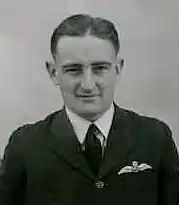
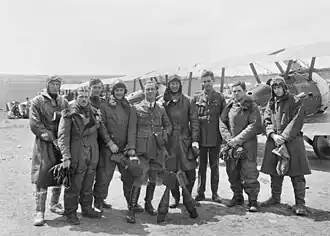
Elwyn Roy King, DSO, DFC (13 May 1894 – 28 November 1941) was a fighter ace in the Australian Flying Corps (AFC) during World War I. He achieved twenty-six victories in aerial combat, making him the fourth highest-scoring Australian pilot of the war, and second only to Harry Cobby in the AFC. A civil pilot and engineer between the wars, he served in the Royal Australian Air Force (RAAF) from 1939 until his death.
Born in Bathurst, New South Wales, King initially saw service as a lighthorseman in Egypt in 1916. He transferred to the AFC as a mechanic in January 1917, and was subsequently commissioned as a pilot. Posted to No. 4 Squadron, he saw action on the Western Front flying Sopwith Camels and Snipes. He scored seven of his "kills" in the latter type, more than any other pilot. His exploits earned him the Distinguished Flying Cross, the Distinguished Service Order, and a mention in despatches. Returning to Australia in 1919, King spent some years in civil aviation before co-founding a successful engineering business. He joined the RAAF following the outbreak of World War II and held several training commands, rising to the rank of group captain shortly before his sudden death in November 1941 at the age of forty-seven. (Full article...)
Image 2
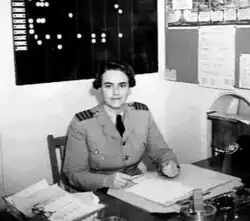
Clare Grant Stevenson, AM, MBE (18 July 1903 – 22 October 1988) was the inaugural Director of the Women's Auxiliary Australian Air Force (WAAAF), from May 1941 to March 1946. As such, she was described in 2001 as "the most significant woman in the history of the Air Force". Formed as a branch of the Royal Australian Air Force (RAAF) in March 1941, the WAAAF was the first and largest uniformed women's service in Australia during World War II, numbering more than 18,000 members by late 1944 and making up over thirty per cent of RAAF ground staff.
Born and educated in Victoria, Stevenson was an executive with the Berlei company when she was appointed Director WAAAF. Initially ranked squadron officer, she rose to become group officer by April 1942. Stevenson resumed her civilian career following her discharge from the Air Force in 1946. Long active in adult education and social welfare, she helped form aid organisations including the Carers Association of New South Wales (now Carers NSW) after retiring from Berlei in 1960. Stevenson was appointed a Member of the Order of the British Empire and a Member of the Order of Australia for her services to the community and to female veterans. (Full article...)
Melbourne was laid down for the Royal Navy as the lead ship of the Majestic class in April 1943, and was launched as HMS Majestic (R77) in February 1945. At the end of the Second World War, work on the ship was suspended until she was purchased by the RAN in 1947. At the time of purchase, it was decided to incorporate new aircraft carrier technologies into the design, making Melbourne the third ship to be constructed with an angled flight deck. Delays in construction and integrating the enhancements meant that the carrier was not commissioned until 1955. (Full article...)
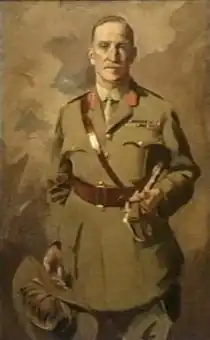
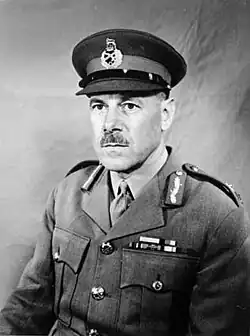
The son of a grazier, Chauvel was commissioned as a second lieutenant in the Upper Clarence Light Horse, a unit organised by his father, in 1886. After the family moved to Queensland he was commissioned as a second lieutenant in the Queensland Mounted Infantry in 1890, and saw service during the 1891 Australian shearers' strike. He became a regular officer in 1896, and went to the United Kingdom as part of the Queensland contingent for the 1897 Diamond Jubilee of Queen Victoria. In 1899 he commanded one of two companies of Queensland Mounted Infantry that were Queensland's initial contribution to the Boer War. After the war, he was closely involved with the training of the Australian Light Horse. (Full article...)
Image 5
No. 1 Flying Training School (No. 1 FTS) is a school of the Royal Australian Air Force (RAAF). It is one of the Air Force's original units, dating back to the service's formation in 1921, when it was established at RAAF Point Cook, Victoria. By the early 1930s, the school comprised training, fighter, and seaplane components. It was re-formed several times in the ensuing years, initially as No. 1 Service Flying Training School (No. 1 SFTS) in 1940, under the wartime Empire Air Training Scheme. After graduating nearly 3,000 pilots, No. 1 SFTS was disbanded in late 1944, when there was no further requirement to train Australian aircrew for service in Europe.
The school was re-established in 1946 as No. 1 FTS at RAAF Station Uranquinty, New South Wales, and transferred to Point Cook the following year. Under a restructure of flying training to cope with the demands of the Korean War and Malayan Emergency, No. 1 FTS was re-formed in 1952 as No. 1 Applied Flying Training School (No. 1 AFTS); it moved to RAAF Base Pearce, Western Australia, in 1958. For much of this period the school was also responsible for training the RAAF's air traffic controllers. Its pilot trainees included Army, Navy, and foreign students as well as RAAF personnel. The RAAF's reorganisation of aircrew training in the early 1950s had led to the formation at Uranquinty of No. 1 Basic Flying Training School (No. 1 BFTS), which transferred to Point Cook in 1958. In 1969, No. 1 AFTS was re-formed as No. 2 Flying Training School and No. 1 BFTS was re-formed as No. 1 FTS. Rationalisation of RAAF flying training resulted in the disbandment of No. 1 FTS in 1993. (Full article...)
Image 6
Australian soldiers from the 2/16th Infantry Battalion arriving at Kaiapit after the area was captured by the 2/6th Independent Company
Australian soldiers from the 2/16th Battalion arriving at Kaiapit on 20 September after the area was captured by the 2/6th Independent Company
The Australian 2/6th Independent Company flew in to the Markham Valley from Port Moresby in 13 USAAFC-47 Dakotas, making a difficult landing on a rough airstrip. Unaware that a much larger Japanese force was also headed for Kaiapit, the company attacked the village on 19 September to secure the area so that it could be developed into an airfield. The company then held it against a strong counter-attack. During two days of fighting the Australians defeated a larger Japanese force while suffering relatively few losses. (Full article...)
U.S. Army soldiers landing at Arawe on 15 December 1943
The Battle of Arawe (also known as Operation Director) was fought between Allied and Japanese forces during the New Britain campaign of World War II. The battle formed part of the Allied Operation Cartwheel and was a diversion before a larger landing at Cape Gloucester in late December 1943. The Japanese military was expecting an Allied offensive in western New Britain and was reinforcing the region at the time of the Allied landing in the Arawe area on 15 December 1943. The Allies secured Arawe after about a month of intermittent fighting with the outnumbered Japanese force.
Initial Allied goals for the landing at Arawe included securing a base for American PT boats and diverting Japanese forces away from Cape Gloucester. The PT boat base was subsequently deemed unnecessary and not built. Only a small Japanese force was stationed at Arawe at the time, although reinforcements were en route. The main Allied landing on 15 December was successful despite a failed subsidiary landing and problems coordinating the landing craft. American forces quickly secured a beachhead and dug in. Japanese air units made large-scale raids against the Arawe area in the days after the landing, and in late December Imperial Japanese Army (IJA) troops unsuccessfully counterattacked the American force. In mid-January 1944 the American force, reinforced with additional infantry and tanks, launched a brief offensive that pushed the Japanese back. The Japanese units at Arawe withdrew from the area towards the end of February as part of a general retreat from western New Britain. (Full article...)
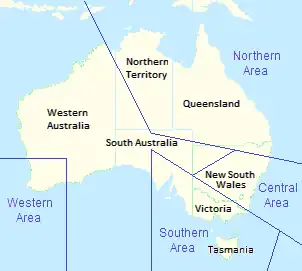
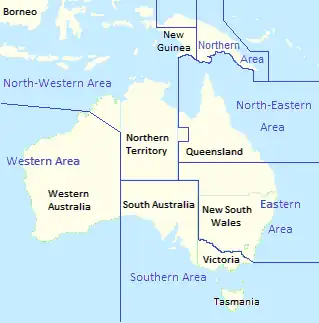
The area command continued to operate after the war, but its assets and staffing were much reduced. Its responsibilities were subsumed in February 1954 by the RAAF's new functional commands: Home (operational), Training, and Maintenance Commands. Western Area headquarters was disbanded in November 1956. (Full article...)
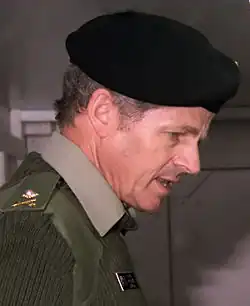
Lieutenant General Simon Stuart, the incumbent Chief of Army, has held the post since 2 July 2022. (Full article...)
Image 4
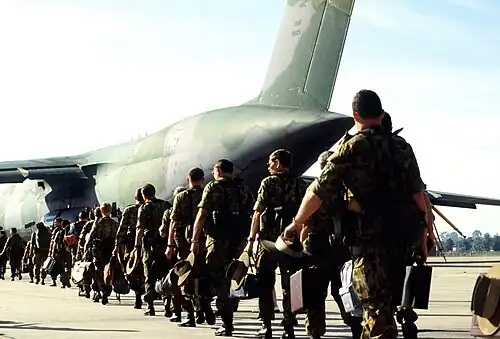
Australia joined a U.S.-led coalition in the Iraq War. Declassified documents reveal that the decision to go to war was taken primarily with a view to enhancing its alliance with the United States.
The Howard government supported the disarmament of Iraq during the Iraq disarmament crisis. Australia later provided one of the four most substantial combat force contingents during the 2003 invasion of Iraq, under the operational codename Operation Falconer. Part of its contingent were among the first forces to enter Iraq after the official "execute" order. The initial Australian force consisted of three Royal Australian Navy ships, a 500-strong special forces task group, two AP-3C Orion maritime patrol aircraft, two B707 Air-to-Air refuelling aircraft, C-130 Hercules transport aircraft and No. 75 Squadron RAAF (which included 14 F/A-18 Hornet fighters). Combat forces committed to Operation Falconer for the 2003 Invasion were withdrawn during 2003. Under the name Operation Catalyst, Australian combat troops were redeployed to Iraq in 2005, however, and assumed responsibility for supporting Iraqi security forces in one of Iraq's southern provinces. These troops began withdrawing from Iraq on 1 June 2008 and were completely withdrawn by 28 July 2009. (Full article...)
Captain Harry Cobby (centre), Lieutenant Roy King (fourth from right), and other officers of "A" Flight, No. 4 Squadron AFC, with their Sopwith Camels on the Western Front, June 1918
In 1911, at the Imperial Conference held in London, it was decided that aviation should be developed by the national armed forces of the British Empire. Australia became the first member of the Empire to follow this policy. By the end of 1911, the Army was advertising for pilots and mechanics. During 1912, pilots and mechanics were appointed, aircraft were ordered, the site of a flying school was chosen and the first squadron was officially raised. On 7 March 1913, the government officially announced formation of the Central Flying School (CFS) and an "Australian Aviation Corps", although that name was never widely used. (Full article...)
The New South Wales Marine Corps was a battalion-sized unit of the British Marine Forces created to guard convicts aboard the First Fleet to Australia, and to preserve "subordination and regularity" in the colony of New South Wales. Established in 1786, the unit served in New South Wales from 1788 to 1792, and was instrumental in establishing the colony's rule of law. Study of the complete New South Wales Marine complement indicates they were chosen from the Plymouth and Portsmouth Divisions, with only one exception. Beginning with guards arriving with the 2nd and 3rd fleets but officially with the arrival of HMS Gorgon on 22 September 1791, the New South Wales Marines were relieved by a newly formed British Army regiment of foot, the New South Wales Corps. (Full article...)
Operation Okra was the Australian Defence Force (ADF) contribution to the military intervention against the Islamic State. The deployed forces formed part of Joint Task Force 633 in the Middle East. The operation commenced on 31 August 2014, and its initial stated aim was to combat ISIL threats in Iraq. In September 2015, the Australian airstrikes were extended to Syria. In June 2017, flights in Syria were temporarily halted in response to American forces shooting down a Syrian Air Force jet, before later being resumed.
Operation Okra concluded in December 2024. (Full article...)
Image 10
The above map shows how the network of fortresses defended the approaches to Hobart. The shaded white areas show the effective range of the fort's gun positions.
The Hobart coastal defences are a network of now defunct coastal batteries, some of which are inter-linked with tunnels, that were designed and built by British colonial authorities in the nineteenth century to protect the city of Hobart, Tasmania, from attack by enemy warships. During the nineteenth century, the port of Hobart Town was a vital re-supply stop for international shipping and trade, and therefore a major freight hub for the British Empire. As such, it was considered vital that the colony be protected. In all, between 1804 and 1942 there were 12 permanent defensive positions constructed in the Hobart region.
Prior to Australian Federation, the island of Tasmania was a colony of the British Empire, and as such was often at war with Britain's enemies and European rivals, such as France and later Russia. The British had already established the colony of Sydney at Port Jackson in New South Wales in 1788, but soon began to consider the island of Tasmania as the potential site of a useful second colony. It was an island, cut off from the mainland of Australia and isolated geographically, making it ideal for a penal colony, and was rich in timber, a resource useful to the Royal Navy. In 1803, the British authorities decided to colonise Tasmania, and to establish a permanent settlement on the island that was at the time known as Van Diemen's Land, primarily to prevent the French from doing so. During this period tensions between Great Britain and France remained high. The two nations had been fighting the French Revolutionary Wars with each other through much of the 1790s, and would soon be engaging each other again in the Napoleonic Wars. (Full article...)
Selected picture
Photo credit: PH1 Terry Cosgrove USN
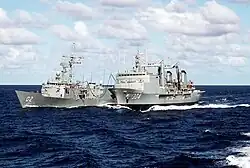
The guided missile frigate HMAS Canberra refuels from the underway replenishment tanker HMAS Success as the vessels takes part in exercise RIMPAC '88 off the coast of Hawaii.
...that Major General John Paton commanded the rear party during the evacuation of Anzac Cove in World War I and was one of the last Australian soldiers to leave the beach?
...that HMAS Biloela was the first ship to be built entirely from Australian materials to an Australian design?
These are Good articles, which meet a core set of high editorial standards.
Image 1
Australian Fusiliers of the 45th Battalion in Russia, 1919
The Russian Civil War (1917–1921) began after the provisional government collapsed and the Bolshevik party assumed power in October 1917. The principal fighting occurred between the Bolshevik Red Army and the forces of the White Army, a group of loosely allied anti-Bolshevik forces. During the war several foreign armies took part, mostly fighting against the Red Army—including the Western allies—and many foreign volunteers fought for both sides. Other nationalist and regional political groups also participated in the war, including the Ukrainian nationalist Green Army, the Ukrainian anarchist Insurgent Army and Black Guards, and warlords such as Ungern von Sternberg. Despite some pressure from Britain, the Australian Prime Minister, William Hughes, had refused to commit forces to Russia following the end of World War I in 1918.
Although no Australian units were engaged in operations, many individuals did become involved through service with the British Army during the North Russia Campaign. They served in many roles, including as advisors to White Russian units as part of the North Russian Expeditionary Force (NREF). About 150 men of the Australian Imperial Force who were still in England awaiting repatriation following the end of World War I enlisted as infantry in the North Russia Relief Force (NRRF), where they were involved in several sharp battles. The Royal Australian Navy was also involved, the destroyer HMAS Swan being briefly engaged in an intelligence-gathering mission in the Black Sea in late 1918 on behalf of the British military mission then advising the White Russian general, Anton Denikin. Several Australians acted as advisers to this mission as well, and others served as advisers with Admiral Aleksandr Kolchak in Siberia. (Full article...)
Second Lieutenant Clive Williams during orders with his section commanders.
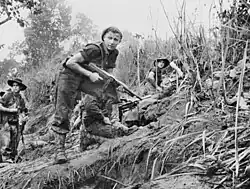
The Battle of Gang Toi (8 November 1965) was fought during the Vietnam War between Australian troops and the Viet Cong. The battle was one of the first engagements between the two forces during the war and occurred when A Company, 1st Battalion, Royal Australian Regiment (1 RAR) struck a Viet Cong bunker system defended by Company 238 in the Gang Toi Hills, in northern Biên Hòa Province. It occurred during a major joint US-Australian operation codenamed Operation Hump, involving the US 173rd Airborne Brigade, to which 1 RAR was attached. During the latter part of the operation an Australian rifle company clashed with an entrenched company-sized Viet Cong force in well-prepared defensive positions. Meanwhile, an American paratroop battalion was also heavily engaged in fighting on the other side of the Đồng Nai River.
The Australians were unable to concentrate sufficient combat power to launch an assault on the position and consequently they were forced to withdraw after a fierce engagement during which both sides suffered casualties, reluctantly leaving behind two men who had been shot and could not be recovered due to heavy machine-gun and rifle fire. Although they were most likely dead, a battalion-attack to recover the missing soldiers was planned by the Australians for the next day, but this was cancelled by the American brigade commander due to rising casualties and the need to utilise all available helicopters for casualty evacuation. The bodies of the two missing Australian soldiers were subsequently recovered more than 40 years later, and were returned to Australia for burial. (Full article...)
Image 4
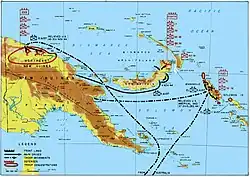
The RAAF's wartime area commands: originally to have been called Northern Area, Northern Command was formed in April 1944, re-designated Northern Area in December 1945, and disbanded in February 1947.
Frederick Birks, VC, MM (16 August 1894 – 21 September 1917) was a Welsh-born Australian First World War soldier and recipient of the Victoria Cross, the highest decoration for gallantry "in the face of the enemy" that can be awarded to members of the British and Commonwealth forces.
Born in Buckley, Flintshire, Birks served in the Royal Artillery for three years before emigrating to Australia in 1913. After serving as a non-commissioned officer during the landing at Gallipoli and the Battle of the Somme, Birks was commissioned as a second lieutenant on 4 May 1917. On 20 September, during the Battle of Passchendaele, while advancing in Glencorse Wood, Ypres, Birks, alongside a corporal, forced a garrison to surrender and captured sixteen men in another attack. His actions were later recognised with the Victoria Cross. The following day, Birks was killed by a shell while attempting to save some of his men. (Full article...)
Image 7
Chinese dead on the approaches to the Hook, late July 1953
During the action, the PVA attempted to make a breakthrough to the Imjin River along the divisional boundary between the US 1st Marine Division and the 1st Commonwealth Division to turn the 1st Marine Division's flank. Yet with well-coordinated indirect fire from the divisional artillery, including the 16th Field Regiment, Royal New Zealand Artillery, and support from British Centurion tanks of the 1st Royal Tank Regiment, 2 RAR successfully thwarted both assaults, holding the Hook. UN sources estimated PVA casualties at 2,000 to 3,000 killed, with the majority of them inflicted by the New Zealand gunners. Meanwhile, on the left flank, US Marines endured the brunt of the attack, repelling the PVA onslaught with infantry and artillery. Only a few hours later, the armistice agreement was signed, ultimately ending the war. Both sides subsequently withdrew 2 kilometres (1.2 mi) within 72 hours to create the 4-kilometre (2.5 mi) Korean Demilitarised Zone. (Full article...)
Image 8
Beaufort crew of No. 7 Squadron, which operated under the control of No. 75 Wing in 1943–44
A No. 5 Airfield Construction Squadron bulldozer working in a coral quarry at Noemfoor Island during December 1944
A No. 5 Airfield Construction Squadron bulldozer working in a coral quarry at Noemfoor Island during December 1944
No. 5 Airfield Construction Squadron (5ACS) was a Royal Australian Air Force (RAAF) construction squadron. The unit was first formed in July 1942 and served in the New Guinea Campaign and Borneo Campaign during World War II. The squadron was one of only a few RAAF airfield construction units to be retained at the end of the war, and formed part of Australia's contribution to the occupation of Japan from 1945 until it was disbanded in June 1949. 5ACS was re-raised in August 1951 and worked on several RAAF airfields in Australia. It also provided small detachments of engineers to support RAAF deployments to South Vietnam and Thailand during the Vietnam War. The squadron was the RAAF's only airfield construction unit from 1961 onward, and was disbanded in December 1974. (Full article...)
Image 10
Australian soldiers returning to Bien Hoa airbase following Operation Rolling Stone, late February 1966.
The Battle of Suoi Bong Trang (23–24 February 1966) was an engagement fought between US, Australian and New Zealand forces, and the Viet Cong and North Vietnamese Army during the Vietnam War. The battle occurred during Operation Rolling Stone, an American security operation to protect engineers building a tactically important road in the vicinity of Tan Binh, in central Binh Duong Province, 30 kilometres (19 mi) north-west of Bien Hoa airbase. During the fighting, soldiers from the US 1st Brigade, 1st Infantry Division and the 1st Battalion, Royal Australian Regiment (1 RAR), which had been attached for the operation, fought off a regimental-sized Viet Cong night assault. Repulsed by massed firepower from artillery and tanks, the Viet Cong suffered heavy casualties and were forced to withdraw by morning. After the attack, the Americans and Australians made no attempt to pursue the Viet Cong, focusing on securing the battlefield and evacuating their own casualties. The Viet Cong continued to harass the American sappers with occasional sniper and mortar fire, but these tactics proved ineffective, and the road was completed by 2 March. (Full article...)
General images -
The following are images from various military history of Australia-related articles on Wikipedia.
Image 22A No. 10 Squadron Sunderland departing for a patrol over the Atlantic in 1941 (from Australia in World War II)
Image 23"He's coming south — It's fight, work or perish", a propaganda poster warning of the danger of Japanese invasion. (from Australia in World War II)
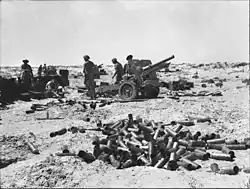
Image 24Guns of the 2/8th Field Regiment at El Alamein in July 1942 (from Australia in World War II)
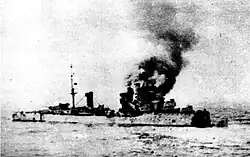
Image 53The light cruiser HMAS Hobart showing torpedo damage inflicted by a Japanese submarine on 20 July 1943. Hobart did not return to service until December 1944. (from History of the Royal Australian Navy)
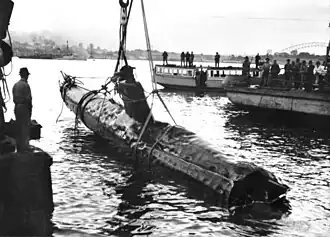
Image 63Australian sailors take possession of a midget submarine at a Japanese naval base near Tokyo in September 1945. (from History of the Royal Australian Navy)
Image 79Women, friends, and family on the wharf waving farewell to the departing troop ship RMS Strathallan carrying the Advance Party of the 6th Division to service overseas. They include George Alan Vasey's wife Jessie Vasey (second from the left). The photograph is especially poignant because Vasey did not survive the war. (from Australia in World War II)
Image 80Australian soldiers and local civilians on Labuan Island. The soldier on the left is armed with an Australian-designed Owen gun. (from Australia in World War II)
Auckland Regiment • Canterbury Regiment (currently a redirect) • 7th Brigade (New Zealand) • 11th Brigade (New Zealand) • 12th Brigade (New Zealand) • South Australian Imperial Bushmen • Tasmanian Citizen Bushmen • Tasmanian Mounted Infantry • Tasmanian Imperial Bushmen (currently redirect) • 1st Military Police Battalion (Australia) • Victorian Citizen Bushmen • Victorian Imperial Bushmen • Western Australian Mounted Infantry (currently redirect) • Western Australian Citizen Bushmen • 2nd/4th Battalion, Royal New Zealand Infantry Regiment • 3rd/6th Battalion, Royal New Zealand Infantry Regiment • No. 83 (Army Cooperation) Wing • No. 52 Squadron RNZAF • No. 51 Squadron RNZAF • No. 43 Squadron RNZAF • No. 12 Squadron RNZAF • No. 11 Squadron RNZAF • No. 10 Squadron RNZAF • CAC/North American Avon Sabre in Australian service • GAF/Dassault Mirage III in Australian service • Harry Charles Bundock • Grant Cavenagh • Frederick Hay Christison • John August Clareborough • Jack Kerr Coffey • John Craven • Ralph Daly • Charles Stewart Davies • Harold Charles de Low • William Huggett Douglas • Herbert Frederick Henry Durant • Leslie Glanville Howard Dyke • Henry Herrick Edwards • Cyril Maurice Lloyd Elliott • Frederick Percy Herbert Fewtrell • Alexander Moore Forbes • Stephen Gilbert Friend • Vivian Harrold Gatliff • Arthur Harry Langman Godfrey • Leonard George Goss • Peter Haddad • William Allan Hailes • Neville Gordon Hatton • Health Services Wing RAAF • William Alexander Henderson • John Hill • Frederick Brock Hinton • Oswald Vick Hoad • Austin Claude Selwyn Holland • Maurice Barber Bevan Keating • Douglas Oswald Luke Kitto • Errol Knox • Ian Lillie • Thomas Steane Louch • John Walter Main • Gordon Edward Manchester • James Eric Gifford Martin • Athelsan Markham Martyn • John Maxwell • Patrick Sanfield McGrath • Eric George Henderson McKenzie • Kenneth Alan McKenzie • Douglas Murray McWhae • Arthur James Mills • Raymond Frederic Monaghan • Gerald Vincent Moriarty • New Zealand Infantry Brigade (currently a redirect) • Edward Michael Neylan • Francis Roger North • Harry Scott Nurse • David O'Brien • Douglas Paine • William Edward Hill Pascoe • Michael Phelps • Claude Esdaile Prior • Ralph Carlyle Geoffrey Prisk • Beauchamp Worters Pulver • John Herbert Rasmussen • John David Rogers • Henry Gordon Rourke • Harry Blamyre Sewell • Colin McOlvin Sharp • Edward Lonergan Sheehan • James Thomas Simpson • Fritz Peter Max Solling • William Howard St. Clair • Robert Mackay Stodart • Roy Buchanan Sutherland • Harold Bourue Taylor • Percy Chamberlin Thompson • Roy Meldrum Thompson • Walter James Urquhart • Donald Norwood Veron • Roy William Whiston Walsh • Augustine William Wardell • Thomas Edgar Weavers • David Welch • Frank Elwyn Wells • Allan Respen Wendt • Ernst Morgan Williams • Kenneth Williams • Kenneth Agnew Wills • Roy Gordon • New Zealand Rarotongan Company • Joint Task Force 633



_underway_1967.jpeg)

.jpg)




.jpg)

.jpg)

.PNG)
.jpg)

.jpg)
.JPG)

.jpg)
.jpg)
.jpg)
_with_US_destroyers_on_9_August_1942.jpg)


.jpg)
.jpg)
.jpg)
_cropped.jpg)
.jpeg)
.jpg)

.jpg)


.jpg)
.jpg)
.jpg)
_refuels_HMAS_Hobart_(D39)_off_Vietnam_in_1967.jpg)


.jpg)

.jpg)

.jpg)
_San_Diego_1977.jpeg)
.jpg)
_with_destroyers_c1962.jpg)


.jpg)

_at_Espiritu_Santo_on_23_July_1943.jpg)


.jpg)
.jpg)
.jpg)
.jpg)
.jpg)
%252C_drives_a_Rigid_Hull_Inflatible_Boat_(RHIB)_back_to_her_ship_after_making_a_passenger.jpg)

.jpg)
.jpg)

.jpg)
.jpg)
.jpg)
.jpg)
.jpg)
.jpg)

.jpg)
.jpg)

.jpg)
_passing_through_the_Panama_Canal_in_March_1935.jpg)





 Commons
 Wikibooks
 Wikidata
 Wikinews
 Wikiquote
 Wikisource
 Wikiversity
 Wiktionary
 List of all portals





 Random portal
 WikiProject Portals