Portal:Dominican Republic

Introduction
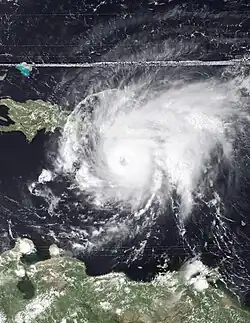
The Dominican Republic is a country on the Caribbean island of Hispaniola in the Greater Antilles of the Caribbean Sea in the North Atlantic Ocean. It shares a maritime border with Puerto Rico to the east and a land border with Haiti to the west, occupying the eastern five-eighths of Hispaniola which, along with Saint Martin, is one of only two islands in the Caribbean shared by two sovereign states. In the Antilles, the country is the second-largest nation by area after Cuba at 48,671 square kilometers (18,792 sq mi) and second-largest by population after Haiti with approximately 11.4 million people in 2024, of whom 3.6 million reside in the metropolitan area of Santo Domingo, the capital city. The Dominican Republic has the largest economy in the Caribbean and the seventh-largest in Latin America. Over the last 25 years, the Dominican Republic has had the fastest-growing economy in the Western Hemisphere – with an average real GDP growth rate of 5.3% between 1992 and 2018. GDP growth in 2014 and 2015 reached 7.3 and 7.0%, respectively, the highest in the Western Hemisphere. Recent growth has been driven by construction, manufacturing, tourism, and mining. The country is the site of the third largest (in terms of production) gold mine in the world, the Pueblo Viejo mine. The gold production of the country was 31 metric tonnes in 2015. The Dominican Republic is the most visited destination in the Caribbean. A geographically diverse nation, the Dominican Republic is home to both the Caribbean's tallest mountain peak, Pico Duarte, and the Caribbean's largest lake and lowest point, Lake Enriquillo. The island has an average temperature of 26 °C (78.8 °F) and great climatic and biological diversity. The country is also the site of the first cathedral, palace, monastery, and fortress built in the Americas, located in Santo Domingo's Colonial Zone, a World Heritage Site. (Full article...) Selected article -Hurricane David was a devastating tropical cyclone that struck Dominica and the Dominican Republic in August 1979, causing widespread destruction and numerous fatalities. It remains the most intense hurricane to make landfall in the Dominican Republic’s recorded history. A long-lived Cape Verde hurricane, David was the fourth named storm, second hurricane, and first major hurricane of the 1979 Atlantic hurricane season. David formed on August 25, in the eastern tropical Atlantic Ocean near Cape Verde off the coast of West Africa. Two days later, the storm reached hurricane strength, then underwent rapid intensification, strengthening into a Category 5 hurricane and reaching peak sustained winds of 175 mph (282 km/h) on August 28. By the time the system dissipated on September 8, it had traversed the Leeward Islands, Greater Antilles, The Bahamas, the East Coast of the United States, and Atlantic Canada. David was the first hurricane to affect the Lesser Antilles since Hurricane Inez in 1966 and the deadliest to hit Dominica since the 1834 Padre Ruíz hurricane, which killed over 200 people. There, strong winds from David damaged or destroyed 80% of homes, leaving 75% of the island's population homeless. Agriculture was also severely impacted, with 75% of crops ruined, including a complete loss of bananas. David killed 56 people and injured 180 others on Dominica. In addition, similar destruction occurred on Guadeloupe and Martinique, with hundreds left homeless and extensive damage to crops. Guadeloupe and Martinique also had $50 million and $100 million in damage, respectively. In Puerto Rico, flooding and high winds combined resulted in $70 million in damage and seven fatalities, four from electrocution. With winds of 175 mph (282 km/h), David was one of only two storms of Category 5 intensity to strike the Dominican Republic in the 20th century, the other also being Inez, and the deadliest since the 1930 San Zenón hurricane, killing over 2,000 people in its path. Entire villages were destroyed and numerous others were left isolated because of damage or destruction to many roads. Thousands of houses were destroyed, leaving over 200,000 homeless in the aftermath of the hurricane. Additionally, nearly 70% of the country's crops were ruined. (Full article...) General images -The following are images from various Dominican Republic-related articles on Wikipedia.
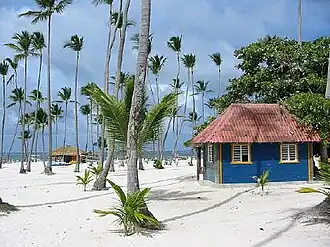
Selected picture -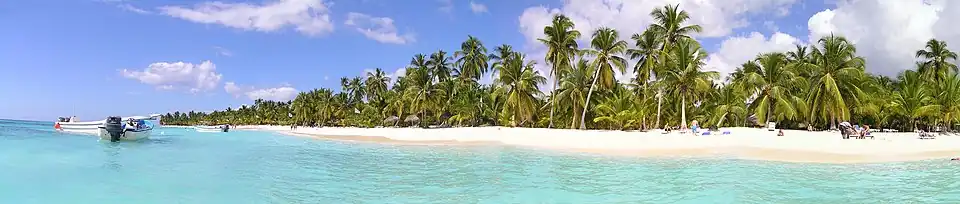 Credit: Tamas Iklodi A beach on Saona Island, a tropical island located a short distance from the mainland on the south-east tip of the Dominican Republic.
Selected biography -Juan Luis Guerra Seijas (born 7 June 1957) is a Dominican musician, singer, composer, and record producer. Throughout his career, he has won numerous awards including 31 Latin Grammy Awards, three Grammy Awards, and one Latin Billboard Music Award. He won 3 Latin Grammy Awards in 2010, including Album of the Year. In 2012, he won the Latin Grammy Award for Producer of the Year. He has sold 15 million records worldwide, making him one of the best-selling Latin music artists. Guerra is one of the most internationally recognized Latin artists of recent decades. His popular style of merengue and Latin fusion has garnered him considerable success throughout Latin America. He is also credited for popularizing bachata music on a global level and is often associated with the genre, although his distinct style of bachata features a more traditional bolero rhythm and aesthetic mixed with bossa-nova influenced melodies and harmony in some of his songs. He does not limit himself to one style of music, instead, his music incorporates a wide arrange of diverse rhythms such as merengue, bachata, bolero, balada, fusion, salsa, cumbia, mambo, cha-cha-cha, pop, rock and roll, reggae, classical, R&B, folk, blues, jazz, funk, soul, rock, hip-hop/rap, son cubano, and religious, amongst many others. Ojalá Que Llueva Café is one of his most critically acclaimed pieces. (Full article...) Related portalsTopics
Categories Select [►] to view subcategories
Dominican Republic Dominican Republic-related lists Buildings and structures in the Dominican Republic Culture of the Dominican Republic Economy of the Dominican Republic Education in the Dominican Republic Environment of the Dominican Republic Geography of the Dominican Republic Government of the Dominican Republic Health in the Dominican Republic History of the Dominican Republic Organizations based in the Dominican Republic Dominican Republic people Politics of the Dominican Republic Society of the Dominican Republic Dominican Republic stubs WikiProjects WikiProject Dominican Republic
Things to do
Associated WikimediaThe following Wikimedia Foundation sister projects provide more on this subject:
SourcesDiscover Wikipedia using portals
| ||||||||||||||||||||||||||||||||||||||||||||||||||||||||||||||||||||||||



.jpg)



.jpg)

.jpg)
.jpg)




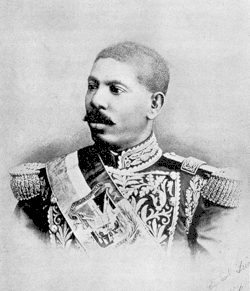
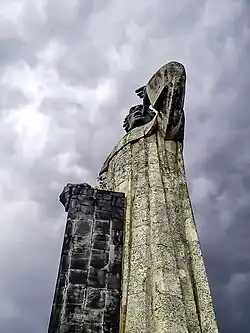


.jpg)
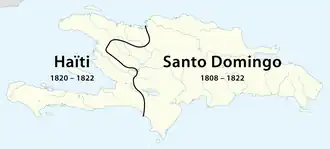


.jpg)

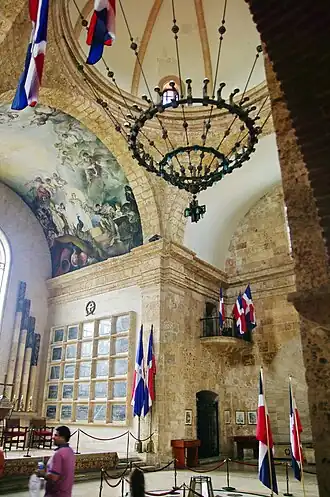



.jpg)
.jpg)



.jpg)


.jpg)