Portal:Classical music

The Classical Music Portal

Classical music generally refers to the art music of the Western world, considered to be distinct from Western folk music or popular music traditions. It is sometimes distinguished as Western classical music, as the term "classical music" can also be applied to non-Western art musics. Classical music is often characterized by formality and complexity in its musical form and harmonic organization, particularly with the use of polyphony. Since at least the ninth century, it has been primarily a written tradition, spawning a sophisticated notational system, as well as accompanying literature in analytical, critical, historiographical, musicological and philosophical practices. (Full article...)
Selected articles -
-

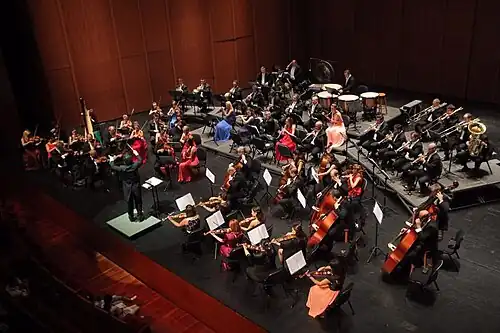
Bucharest Symphony Orchestra
An orchestra (/ˈɔːrkɪstrə/ ⓘ; OR-ki-strə) is a large instrumental ensemble typical of classical music, which combines instruments from different families. There are typically four main sections of instruments:- The string section, including the violin, viola, cello, and double bass
- The woodwind section, including the flute, oboe, clarinet, bassoon, and occasionally saxophone
- The brass section, including the French horn (commonly known as the "horn"), trumpet, trombone, cornet, and tuba, and sometimes euphonium
- The percussion section, including the timpani, snare drum, bass drum, cymbals, triangle, tambourine, tam-tam and mallet percussion instruments
-

A performance of Gustav Mahler's Eighth Symphony in the Kölner Philharmonie by the Sinfonieorchester Wuppertal conducted by Heinz Walter Florin
A symphony is an extended musical composition in Western classical music, most often for orchestra. Although the term has had many meanings from its origins in the ancient Greek era, by the late 18th century the word had taken on the meaning common today: a work usually consisting of multiple distinct sections or movements, often four, with the first movement in sonata form. Symphonies are almost always scored for an orchestra consisting of a string section (violin, viola, cello, and double bass), brass, woodwind, and percussion instruments which altogether number about 30 to 100 musicians. Symphonies are notated in a musical score, which contains all the instrument parts. Orchestral musicians play from parts which contain just the notated music for their own instrument. Some symphonies also contain vocal parts (e.g., Beethoven's Ninth Symphony, or Mahler's Second Symphony). (Full article...) -
Finlandia, Op. 26, is a tone poem by the Finnish composer Jean Sibelius. It was written in 1899 and revised in 1900. The piece was composed for the Press Celebrations of 1899, a covert protest against increasing censorship from the Russian Empire, and was the last of seven pieces performed as an accompaniment to a tableau depicting episodes from Finnish history. The premiere was on 2 July 1900 in Helsinki with the Helsinki Philharmonic Society conducted by Robert Kajanus. A typical performance takes between 7+1⁄2 and 9 minutes. (Full article...) -
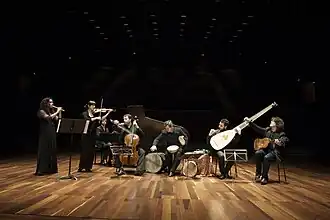
Performance on period instruments is a key aspect of HIP, such as this baroque orchestra (Photo: Josetxu Obregón and the Spanish ensemble La Ritirata, 2013).
Historically informed performance (also referred to as period performance, authentic performance, or HIP) is an approach to the performance of classical music which aims to be faithful to the approach, manner and style of the musical era in which a work was originally conceived.
It is based on two key aspects: the application of the stylistic and technical aspects of performance, known as performance practice; and the use of period instruments which may be reproductions of historical instruments that were in use at the time of the original composition, and which usually have different timbre and temperament from their modern equivalents. A further area of study, that of changing listener expectations, is increasingly under investigation. (Full article...) -
The Piano Concerto No. 2 in B♭ major, Op. 83, by Johannes Brahms is separated by a gap of 22 years from his first piano concerto. Brahms began work on the piece in 1878 and completed it in 1881 while in Pressbaum near Vienna. It took him three years to work on this concerto, which indicates that he was always self-critical. He wrote to Clara Schumann: "I want to tell you that I have written a very small piano concerto with a very small and pretty scherzo." He was ironically describing a huge piece. This concerto is dedicated to his teacher, Eduard Marxsen. The public premiere of the concerto was given in Budapest on 9 November 1881, with Brahms as soloist and the Budapest Philharmonic Orchestra, and was an immediate success. He proceeded to perform the piece in many cities across Europe.
The piece is scored for 2 flutes (1st also piccolo), 2 oboes, 2 clarinets (B♭), 2 bassoons, 4 horns (initially 2 in B♭ bass, 2 in F), 2 trumpets (B♭), timpani (B♭ and F, A and D in second movement) and strings. (The trumpets and timpani are used only in the first two movements, which is unusual.) (Full article...) -

The pipe organ is a musical instrument that produces sound by driving pressurised air (called wind) through the organ pipes selected from a keyboard. Because each pipe produces a single tone and pitch, the pipes are provided in sets called ranks, each of which has a common timbre, loudness (volume), and construction throughout the keyboard compass. In other words, a rank is a set of pipes all having the same tonal quality, but having a range of different pitches. Most organs have many ranks of pipes of differing pitch, timbre, and volume that the player can employ singly or in combination through the use of controls called stops.
A pipe organ has one or more keyboards (called manuals) played by the hands, and most have a pedalboard played by the feet; each keyboard controls its own division (group of stops). The keyboard(s), pedalboard, and stops are housed in the organ's console. The organ's continuous supply of wind allows it to sustain notes for as long as the corresponding keys are pressed, unlike the piano and harpsichord whose sound begins to dissipate immediately after a key is depressed. The smallest portable pipe organs may have only one or two dozen pipes and one manual; the largest pipe organs can have over 33,000 pipes and seven manuals. A list of some of the most notable and largest pipe organs in the world can be viewed at List of pipe organs. A ranking of the largest organs in the world—based on the criterion constructed by Michał Szostak, i.e. 'the number of ranks and additional equipment managed from a single console'—can be found in the quarterly magazine The Organ and in the online journal Vox Humana. (Full article...) -

Shinobue and other flutes
The flute is a member of a family of musical instruments in the woodwind group. Like all woodwinds, flutes are aerophones, producing sound with a vibrating column of air. Flutes produce sound when the player's air flows across an opening. In the Hornbostel–Sachs classification system, flutes are edge-blown aerophones. A musician who plays the flute is called a flautist or flutist.
Paleolithic flutes with hand-bored holes are the earliest known identifiable musical instruments. A number of flutes dating to about 53,000 to 45,000 years ago have been found in the Swabian Jura region of present-day Germany, indicating a developed musical tradition from the earliest period of modern human presence in Europe. While the oldest flutes currently known were found in Europe, Asia also has a long history with the instrument. A playable bone flute discovered in China is dated to about 9,000 years ago. The Americas also had an ancient flute culture, with instruments found in Caral, Peru, dating back 5,000 years and in Labrador dating back about 7,500 years. (Full article...) -
The Symphony No. 9 in D minor, Op. 125, is a choral symphony, the final complete symphony by Ludwig van Beethoven, composed between 1822 and 1824. It was first performed in Vienna on 7 May 1824. The symphony is regarded by many critics and musicologists as a masterpiece of Western classical music and one of the supreme achievements in the history of music. One of the best-known works in common practice music, it stands as one of the most frequently performed symphonies in the world.
The Ninth was the first example of a major composer scoring vocal parts in a symphony. The final (4th) movement of the symphony, commonly known as the Ode to Joy, features four vocal soloists and a chorus in the parallel key of D major. The text was adapted from the "An die Freude (Ode to Joy)", a poem written by Friedrich Schiller in 1785 and revised in 1803, with additional text written by Beethoven. In the 20th century, an instrumental arrangement of the chorus was adopted by the Council of Europe, and later the European Union, as the Anthem of Europe. (Full article...) -
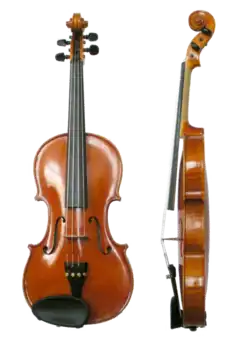
The violin, sometimes referred to as a fiddle, is a wooden chordophone, and is the smallest, and thus highest-pitched instrument (soprano) in regular use in the violin family. Smaller violin-type instruments exist, including the violino piccolo and the pochette, but these are virtually unused. Most violins have a hollow wooden body, and commonly have four strings (sometimes five), usually tuned in perfect fifths with notes G3, D4, A4, E5, and are most commonly played by drawing a bow across the strings. The violin can also be played by plucking the strings with the fingers (pizzicato) and, in specialized cases, by striking the strings with the wooden side of the bow (col legno).
Violins are important instruments in a wide variety of musical genres. They are most prominent in the Western classical tradition, both in ensembles (from chamber music to orchestras) and as solo instruments. Violins are also important in many varieties of folk music, including country music, bluegrass music, and in jazz. Electric violins with solid bodies and piezoelectric pickups are used in some forms of rock music and jazz fusion, with the pickups plugged into instrument amplifiers and speakers to produce sound. The violin has come to be incorporated in many non-Western music cultures, including Indian music and Iranian music. The name fiddle is often used regardless of the type of music played on it. (Full article...) -
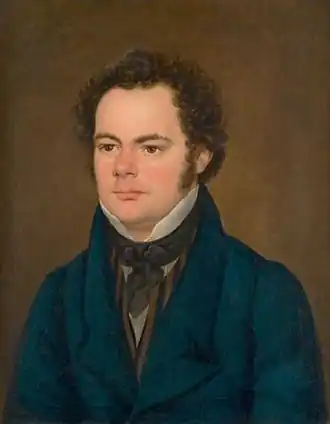
Portrait by Anton Depauly, of Schubert at the end of his life
Franz Schubert's last three piano sonatas, D 958, 959 and 960, are his last major compositions for solo piano. They were written during the last months of his life, between the spring and autumn of 1828, but were not published until about ten years after his death, in 1838–39. Like the rest of Schubert's piano sonatas, they were mostly neglected in the 19th century. By the late 20th century, however, public and critical opinion had changed, and these sonatas are now considered among the most important of the composer's mature masterpieces. They are part of the core piano repertoire, appearing regularly on concert programs and recordings.
One of the reasons for the long period of neglect of Schubert's piano sonatas seems to be their dismissal as structurally and dramatically inferior to the sonatas of Beethoven. In fact, the last sonatas contain distinct allusions and similarities to works by Beethoven, a composer Schubert venerated. Nevertheless, musicological analysis has shown that they maintain a mature, individual style. The last sonatas are now praised for that mature style, manifested in unique features such as a cyclical formal and tonal design, chamber music textures, and a rare depth of emotional expression. (Full article...) -

Dutch Grasshoppers aerobatics team, flying the Alouette helicopters they used in the world premiere of the Helicopter String Quartet
The Helikopter-Streichquartett (English: Helicopter String Quartet) is one of Karlheinz Stockhausen's best-known pieces, and one of the most complex to perform. It involves a string quartet, four helicopters with pilots, as well as audio and video equipment and technicians. It was first performed and recorded in 1995. Although performable as a self-sufficient piece, it also forms the third scene of the opera Mittwoch aus Licht ("Wednesday from Light"), from the opera cycle Licht. (Full article...) -
Jean-Baptiste Lully born Giovanni Battista Lulli (28 or 29 November [O.S. 18 or 19 November] 1632 – 22 March 1687) was an Italian-French composer, dancer and instrumentalist, who is considered a master of the French Baroque music style. Best known for his operas, he spent most of his life working in the court of Louis XIV and became a French subject in 1661. He was a close friend of the playwright Molière, with whom he collaborated on numerous comédie-ballets, including L'Amour médecin, George Dandin ou le Mari confondu, Monsieur de Pourceaugnac, Psyché and his best known work, Le Bourgeois gentilhomme. (Full article...)
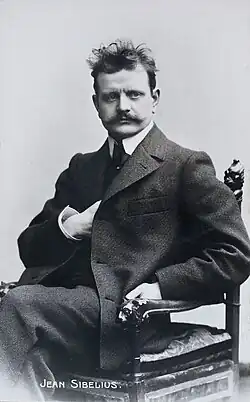


General images -
-

-
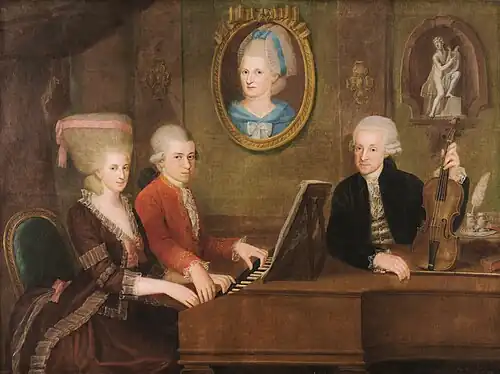 Portrait of the Mozart Family, dated 1780–81 (from Classical period (music))
 -
 Painting by Evaristo Baschenis of Baroque instruments, including a cittern, viola da gamba, violin, and two lutes (from Baroque music)
 -

-
Portrait of Beethoven, 1820 (from Classical period (music))
-
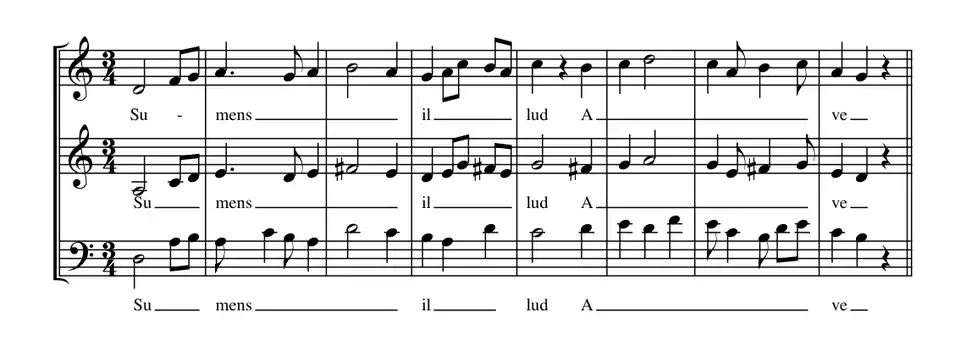 Portion of Du Fay's setting of Ave maris stella, in fauxbourdon. The top line is a paraphrase of the chant; the middle line, designated "fauxbourdon", (not written) follows the top line but exactly a perfect fourth below. The bottom line is often, but not always, a sixth below the top line; it is embellished, and reaches cadences on the octave.Play (from Renaissance music)
 -
 View of Vienna in 1758, by Bernardo Bellotto (from Classical period (music))
 -
 Gluck, detail of Portrait of Christoph Willibald Gluck by Joseph Duplessis, dated 1775 (Kunsthistorisches Museum, Vienna) (from Classical period (music))
 -
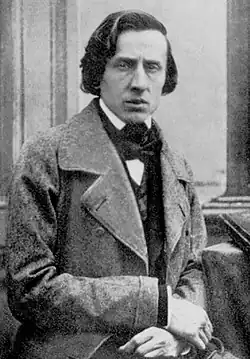 Daguerreotype of Chopin, c. 1849 (from Romantic music)
 -
 Selection of Renaissance instruments (from Renaissance music)
 -
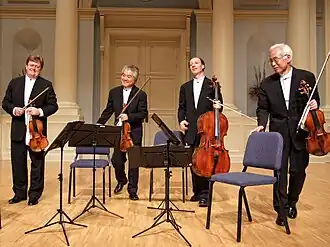 A modern string quartet. In the 2000s, string quartets from the Classical era are the core of the chamber music literature. From left to right: violin 1, violin 2, cello, viola (from Classical period (music))
 -
 Richard Wagner in Paris, 1861
 -
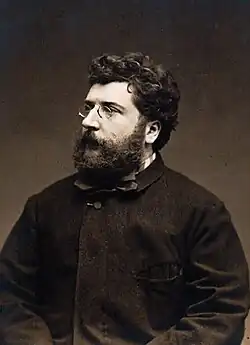 Bizet photographed by Étienne Carjat (1875) (from Romantic music)
 -
 Musicians from 'Procession in honour of Our Lady of Sablon in Brussels.' Early 17th-century Flemish alta cappella. From left to right: bass dulcian, alto shawm, treble cornett, soprano shawm, alto shawm, tenor sackbut. (from Renaissance music)
 -
 A large instrumental ensemble's performance in the lavish Teatro Argentina, as depicted by Panini (1747) (from Baroque music)
 -
 Bernhard Crusell, a Swedish-Finnish composer and clarinetist, in 1826 (from Classical period (music))
 -
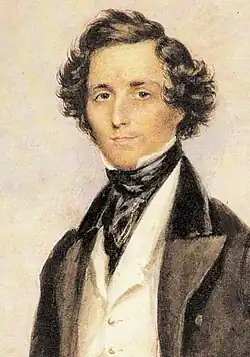
-
 Wanderer above the Sea of Fog, by Caspar David Friedrich, is an example of Romantic painting. (from Romantic music)
 -
 Josef Danhauser's 1840 painting Liszt at the Piano featuring Franz Liszt at the piano surrounded by (from left to right) Alexandre Dumas, Hector Berlioz, George Sand, Niccolò Paganini, Gioachino Rossini and Marie d'Agoult, with a bust of Ludwig van Beethoven on the piano (from Romantic music)
 -

-
 The opening bars of the Commendatore's aria in Mozart's opera Don Giovanni. The orchestra starts with a dissonant diminished seventh chord (G# dim7 with a B in the bass) moving to a dominant seventh chord (A7 with a C# in the bass) before resolving to the tonic chord (D minor) at the singer's entrance. (from Classical period (music))
 -
.jpg) Haydn portrait by Thomas Hardy, 1792 (from Classical period (music))
Haydn portrait by Thomas Hardy, 1792 (from Classical period (music)) -
 Gustav Mahler, photographed in 1907 by Moritz Nähr at the end of his period as director of the Vienna Hofoper (from Romantic music)
 -
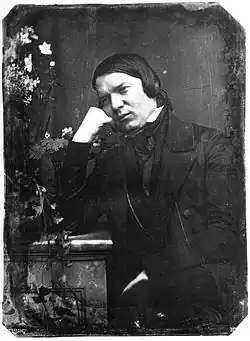
-
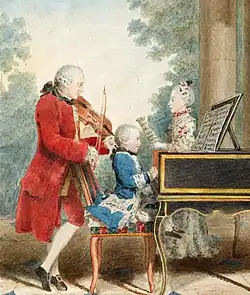 Wolfgang Amadeus Mozart, a representative composer of the Classical period, seated at a keyboard. (from Classical period (music))
 -
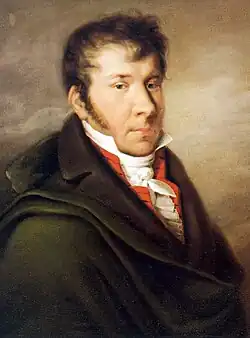 Hummel in 1814 (from Classical period (music))
 -
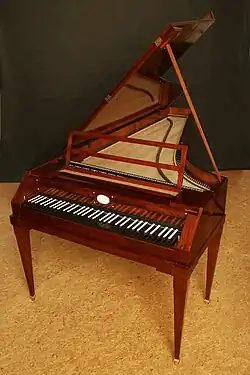 Fortepiano by Paul McNulty after Walter & Sohn, c. 1805 (from Classical period (music))
 -
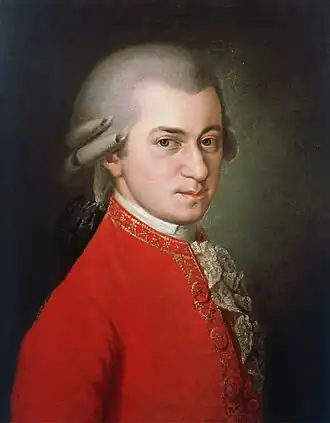 Wolfgang Amadeus Mozart, posthumous painting by Barbara Krafft in 1819 (from Classical period (music))
 -
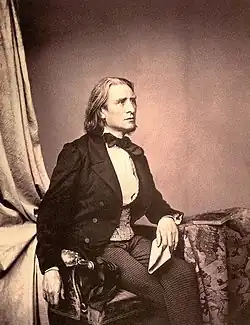 Franz Liszt in 1858, by Franz Hanfstaengl (from Romantic music)
 -
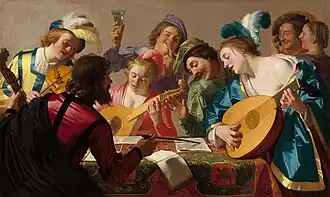 Gerard van Honthorst, The Concert (1623), National Gallery of Art, Washington D.C. (from Renaissance music)
 -
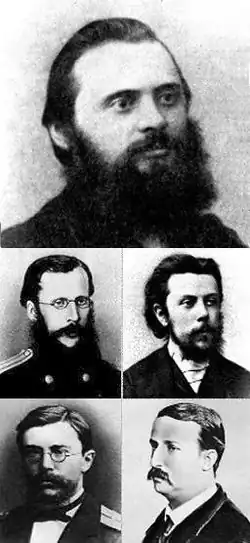 Balakirev (top), Cui (upper left), Mussorgsky (upper right), Rimsky-Korsakov (lower left), and Borodin (lower right). (from Romantic music)
 -
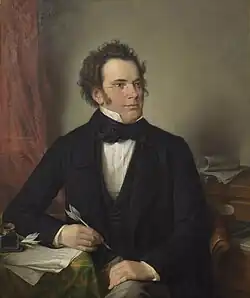 1875 oil painting of Franz Schubert by Wilhelm August Rieder, after his own 1825 watercolor portrait (from Classical period (music))
 -
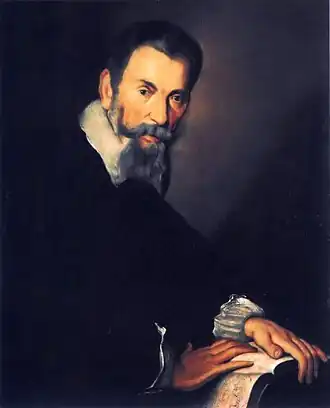 Claudio Monteverdi in 1640 (from Baroque music)
 -
Quotes -
| “ | Music is the wine which inspires one to new generative processes, and I am Bacchus who presses out this glorious wine for mankind and makes them spiritually drunken. | ” |
| — Ludwig van Beethoven | ||
Related portals
WikiProjects
|
|
|
| WikiProject Classical music | WikiProject Composers | WikiProject Contemporary music |
|---|---|---|

|
|

|
| WikiProject Opera | WikiProject Richard Wagner | WikiProject Gilbert and Sullivan |
 Selected composers -
-
Gustav Mahler, photographed in 1907 by Moritz Nähr at the end of his period as director of the Vienna Hofoper
Gustav Mahler (German: [ˈɡʊstaf ˈmaːlɐ] ⓘ; 7 July 1860 – 18 May 1911) was an Austro-Bohemian Romantic composer, and one of the leading conductors of his generation. As a composer he acted as a bridge between the 19th-century Austro-German tradition and the modernism of the early 20th century. While in his lifetime his status as a conductor was established beyond question, his own music gained wide popularity only after periods of relative neglect, which included a ban on its performance in much of Europe during the Nazi era. After 1945 his compositions were rediscovered by a new generation of listeners; Mahler then became one of the most frequently performed and recorded of all composers, a position he has sustained into the 21st century.
Born in Bohemia (then part of the Austrian Empire) to Jewish parents of humble origins, the German-speaking Mahler displayed his musical gifts at an early age. After graduating from the Vienna Conservatory in 1878, he held a succession of conducting posts of rising importance in the opera houses of Europe, culminating in his appointment in 1897 as director of the Vienna Court Opera (Hofoper). During his ten years in Vienna, Mahler—who had converted to Catholicism to secure the post—experienced regular opposition and hostility from the anti-Semitic press. Nevertheless, his innovative productions and insistence on the highest performance standards ensured his reputation as one of the greatest of opera conductors, particularly as an interpreter of the stage works of Wagner, Mozart, and Tchaikovsky. Late in his life he was briefly director of New York's Metropolitan Opera and the New York Philharmonic. (Full article...) -
Philip Arnold Heseltine (30 October 1894 – 17 December 1930), known by the pseudonym Peter Warlock, was a British composer and music critic. The Warlock name, which reflects Heseltine's interest in occult practices, was used for all his published musical works. He is best known as a composer of songs and other vocal music; he also achieved notoriety in his lifetime through his unconventional and often scandalous lifestyle.
As a schoolboy at Eton College, Heseltine met the British composer Frederick Delius, with whom he formed a close friendship. After a failed student career in Oxford and London, Heseltine turned to musical journalism, while developing interests in folk-song and Elizabethan music. His first serious compositions date from around 1915. Following a period of inactivity, a positive and lasting influence on his work arose from his meeting in 1916 with the Dutch composer Bernard van Dieren; he also gained creative impetus from a year spent in Ireland, studying Celtic culture and language. On his return to England in 1918, Heseltine began composing songs in a distinctive, original style, while building a reputation as a combative and controversial music critic. During 1920–21 he edited the music magazine The Sackbut. His most prolific period as a composer came in the 1920s, when he was based first in Wales and later at Eynsford in Kent. (Full article...) -
Tōru Takemitsu (武満 徹; pronounced [takeꜜmitsɯ̥ toːɾɯ]; 8 October 1930 – 20 February 1996) was a Japanese composer and writer on aesthetics and music theory. Largely self-taught, Takemitsu was admired for his subtle manipulation of instrumental and orchestral timbre. He is known for combining elements of oriental and occidental philosophy and for fusing sound with silence and tradition with innovation.
He composed several hundred independent works of music, scored more than ninety films and published twenty books. He was also a founding member of the Jikken Kōbō (Experimental Workshop) in Japan, a group of avant-garde artists who distanced themselves from academia and whose collaborative work is often regarded among the most influential of the 20th century. (Full article...) -
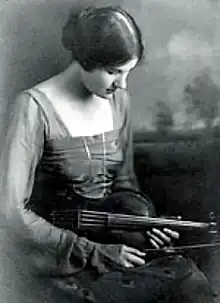
Clarke with a viola in 1919
Rebecca Helferich Clarke (27 August 1886 – 13 October 1979) was a British classical composer and violist. Internationally renowned as a viola virtuoso, she also became one of the first female professional orchestral players in London.
Rebecca Clarke had a German mother and an American father, and spent substantial periods of her life in the United States, where she permanently settled after World War II. She was born in Harrow and studied at the Royal Academy of Music and Royal College of Music in London. Stranded in the United States at the outbreak of World War II, she married composer and pianist James Friskin in 1944. Clarke died at her home in New York at the age of 93. (Full article...) -
Leo Ornstein (born Lev Ornshteyn; Russian: Лев Орнштейн; c. December 11, 1895 – February 24, 2002) was an American experimental composer and pianist of the early twentieth century. His performances of works by avant-garde composers and his own innovative and even shocking pieces made him a cause célèbre on both sides of the Atlantic. The bulk of his experimental works were written for piano.
Ornstein was the first important composer to make extensive use of the tone cluster. As a pianist, he was considered a world-class talent. By the mid-1920s, he had walked away from his fame and soon disappeared from popular memory. Though he gave his last public concert before the age of forty, he continued writing music for another half-century and beyond. Largely forgotten for decades, he was rediscovered in the mid-1970s. Ornstein completed his eighth and final piano sonata in September 1990 at the age of ninety-four, making him the oldest published composer in history at the time (a mark since passed by Elliott Carter). (Full article...) -
Yasunori Mitsuda (光田 康典, Mitsuda Yasunori; born January 21, 1972) is a Japanese composer. He is best known for his work in video games, primarily for the Chrono, Xeno, Shadow Hearts, and Inazuma Eleven franchises, among various others. Mitsuda began composing music for his own games in high school, later attending a music college in Tokyo. While still a student, he was granted an intern position at the game development studio Wolf Team.
Mitsuda joined Square upon graduation in 1992 and worked there as a sound effects designer for two years before telling Square's vice president Hironobu Sakaguchi he would quit unless he could write music for their games. Shortly after, Sakaguchi assigned him to work on the soundtrack for Chrono Trigger (1995), whose music has since been cited as among the best in video games. (Full article...) -

Modern-day Kemah, Turkey, where the ancient city Ani-Kamakh was in which Khosrovidukht was imprisoned
Khosrovidukht (Armenian: Խոսրովիդուխտ, lit. 'daughter of Khosrov'; fl. early 8th century) was an Armenian hymnographer and poet who lived during the early 8th century. After her slightly earlier contemporary Sahakdukht, she is the first known woman of Armenian literature and music, and among the earliest woman composers in the history of music.
Daughter of the ruler of Goghtn, Khosrov Goghtnatsi, her father was killed and she was imprisoned in a fortress of Ani-Kamakh (modern-day Kemah) for twenty years. Her brother was imprisoned and eventually killed; Khosrovidukht's only surviving work, the sharakan (chant) "Zarmanali e indz" (More astonishing to me) was dedicated to him. Its authenticity has occasionally been doubted, with some scholars attributing it to Sahakdukht. The work did not enter the general repertory of sharakan liturgy but was eventually approved by the Armenian Church for religious use. (Full article...) -
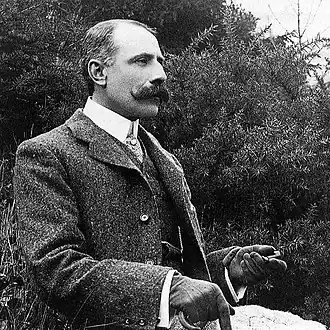
Elgar, c. 1900
Sir Edward William Elgar, 1st Baronet, OM, GCVO (/ˈɛlɡɑːr/ ⓘ; 2 June 1857 – 23 February 1934) was an English composer, many of whose works have entered the British and international classical concert repertoire. Among his best-known compositions are orchestral works including the Enigma Variations, the Pomp and Circumstance Marches, concertos for violin and cello, and two symphonies. He also composed choral works, including The Dream of Gerontius, chamber music and songs. He was appointed Master of the King's Musick in 1924.
Although Elgar is often regarded as a typically English composer, most of his musical influences were not from England but from continental Europe. He felt himself to be an outsider, not only musically, but socially. In musical circles dominated by academics, he was a self-taught composer; in Protestant Britain, his Roman Catholicism was regarded with suspicion in some quarters; and in the class-conscious society of Victorian and Edwardian Britain, he was acutely sensitive about his humble origins even after he achieved recognition. He nevertheless married the daughter of a senior British Army officer. She inspired him both musically and socially, but he struggled to achieve success until his forties, when after a series of moderately successful works his Enigma Variations (1899) became immediately popular in Britain and overseas. He followed the Variations with a choral work, The Dream of Gerontius (1900), based on a Roman Catholic text that caused some disquiet in the Anglican establishment in Britain, but it became, and has remained, a core repertory work in Britain and elsewhere. His later full-length religious choral works were well received but have not entered the regular repertory. (Full article...) -
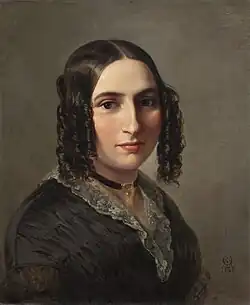
Fanny Hensel, 1842, by Moritz Daniel Oppenheim
Fanny Cäcilie Mendelssohn (14 November 1805 – 14 May 1847) was a German composer and pianist of the early Romantic era later known as Fanny Mendelssohn Bartholdy and as Fanny Hensel. Her compositions number over 450, and include a string quartet, a piano trio, a piano quartet, an orchestral overture, four cantatas, more than 125 pieces for solo piano, and over 250 lieder. Most of these were unpublished in her lifetime. Although lauded for her piano technique, she rarely gave public performances outside her family circle.
She grew up in Berlin and received a thorough musical education from teachers including her mother, as well as the composers Ludwig Berger and Carl Friedrich Zelter. Her younger brother Felix Mendelssohn, also a composer and pianist, shared the same education and the two developed a close relationship. Owing to her family's reservations and to social conventions of the time about the roles of women, six of her songs were published under her brother's name in his Opus 8 and 9 collections. In 1829, she married artist Wilhelm Hensel and, in 1830, they had their only child, Sebastian Hensel. In 1846, despite the continuing ambivalence of some of her family (but not her husband) toward her musical ambitions, Fanny Hensel published a collection of songs as her Opus 1. She died of a stroke in 1847, aged 41. (Full article...) -

Pyotr Ilyich Tchaikovsky (top left) and The Five (counter-clockwise from bottom left): Mily Balakirev, César Cui, Alexander Borodin, Modest Mussorgsky, and Nikolai Rimsky-Korsakov
In mid- to late-19th-century Russia, Pyotr Ilyich Tchaikovsky and a group of composers known as The Five had differing opinions as to whether Russian classical music should be composed following Western or native practices. Tchaikovsky wanted to write professional compositions of such quality that they would stand up to Western scrutiny and thus transcend national barriers, yet remain distinctively Russian in melody, rhythm and other compositional characteristics. The Five, made up of composers Mily Balakirev, Alexander Borodin, César Cui, Modest Mussorgsky, and Nikolai Rimsky-Korsakov, sought to produce a specifically Russian kind of art music, rather than one that imitated older European music or relied on European-style conservatory training. While Tchaikovsky himself used folk songs in some of his works, for the most part he tried to follow Western practices of composition, especially in terms of tonality and tonal progression. Also, unlike Tchaikovsky, none of The Five were academically trained in composition; in fact, their leader, Balakirev, considered academicism a threat to musical imagination. Along with critic Vladimir Stasov, who supported The Five, Balakirev attacked relentlessly both the Saint Petersburg Conservatory, from which Tchaikovsky had graduated, and its founder Anton Rubinstein, orally and in print.
As Tchaikovsky had become Rubinstein's best-known student, he was initially considered by association as a natural target for attack, especially as fodder for Cui's printed critical reviews. This attitude changed slightly when Rubinstein left the Saint Petersburg musical scene in 1867. In 1869 Tchaikovsky entered into a working relationship with Balakirev; the result was Tchaikovsky's first recognized masterpiece, the fantasy-overture Romeo and Juliet, a work which The Five wholeheartedly embraced. When Tchaikovsky wrote a positive review of Rimsky-Korsakov's Fantasy on Serbian Themes he was welcomed into the circle, despite concerns about the academic nature of his musical background. The finale of his Second Symphony, nicknamed the Little Russian, was also received enthusiastically by the group on its first performance in 1872. (Full article...) -
Jakob Ludwig Felix Mendelssohn Bartholdy (3 February 1809 – 4 November 1847), widely known as Felix Mendelssohn, was a German composer, pianist, organist and conductor of the early Romantic period. Mendelssohn's compositions include symphonies, concertos, piano music, organ music and chamber music. His best-known works include the overture and incidental music for A Midsummer Night's Dream (which includes his "Wedding March"), the Italian and Scottish Symphonies, the oratorios St. Paul and Elijah, the Hebrides Overture, the mature Violin Concerto, the String Octet, and the melody used in the Christmas carol "Hark! The Herald Angels Sing". Mendelssohn's Songs Without Words are his most famous solo piano compositions.
Mendelssohn's grandfather was the Jewish philosopher Moses Mendelssohn, but Felix was initially raised without religion until he was baptised aged seven into the Reformed Christian church. He was recognised early as a musical prodigy, but his parents were cautious and did not seek to capitalise on his talent. His sister Fanny Mendelssohn received a similar musical education and was a talented composer and pianist in her own right; some of her early songs were published under her brother's name and her Easter Sonata was for a time mistakenly attributed to him after being lost and rediscovered in the 1970s. (Full article...) -
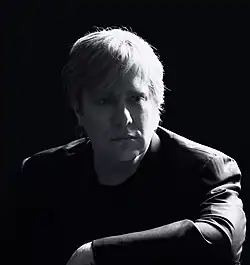
Jeremy Soule (/soʊl/ SOHL) is an American composer of soundtracks for film, television, and video games. He has composed soundtracks for over 60 games and over a dozen other works during his career, including The Elder Scrolls, Guild Wars, Total Annihilation, and the Harry Potter series.
He became an employee of Square in 1994 after several years of private composition studies. After finishing the soundtrack to Secret of Evermore in 1995, he left to join Humongous Entertainment, where he composed for several children's games as well as Total Annihilation, his first award-winning score. In 2000, he left to form his own music production company, Soule Media, later called Artistry Entertainment. In 2005, he founded DirectSong, a record label that published digital versions of his soundtracks as well as those of classical composers. DirectSong remained active until 2019. (Full article...) -
Clara Josephine Schumann (/ˈʃuːmɑːn/; German: [ˈklaːʁa ˈʃuːman]; née Wieck; 13 September 1819 – 20 May 1896) was a German pianist, composer, and piano teacher and prodigy. Regarded as one of the most distinguished pianists of the Romantic era, she exerted her influence over the course of a 61-year concert career, changing the format and repertoire of the piano recital by lessening the importance of purely virtuosic works. She also composed solo piano pieces, a piano concerto, chamber music, choral pieces, and songs.
She grew up in Leipzig, where both her father Friedrich Wieck and her mother Mariane were pianists and piano teachers. In addition, her mother was a singer. Clara was a child prodigy, and was trained by her father. She began touring at age eleven, and was successful in Paris and Vienna, among other cities. She married the composer Robert Schumann, on 12 September 1840, and the couple had eight children. Together, they encouraged Johannes Brahms and maintained a close relationship with him. She gave the public premieres of many works by her husband and by Brahms. (Full article...) -
.jpg)
Britten in 1968, by Hans Wild
Edward Benjamin Britten, Baron Britten OM CH (22 November 1913 – 4 December 1976) was an English composer, conductor, and pianist. He was a central figure of 20th-century British music, with a range of works including opera, other vocal music, orchestral and chamber pieces. His best-known works include the opera Peter Grimes (1945), the War Requiem (1962) and the orchestral showpiece The Young Person's Guide to the Orchestra (1945).
Britten was born in Lowestoft, Suffolk, the son of a dentist. He showed talent from an early age. He studied at the Royal College of Music in London and privately with the composer Frank Bridge. Britten first came to public attention with the a cappella choral work A Boy Was Born in 1934. With the premiere of Peter Grimes in 1945, he leapt to international fame. Over the next 28 years, he wrote 14 more operas, establishing himself as one of the leading 20th-century composers in the genre. In addition to large-scale operas for Sadler's Wells and Covent Garden, he wrote chamber operas for small forces, suitable for performance in venues of modest size. Among the best known of these is The Turn of the Screw (1954). Recurring themes in his operas include the struggle of an outsider against a hostile society and the corruption of innocence. (Full article...) -
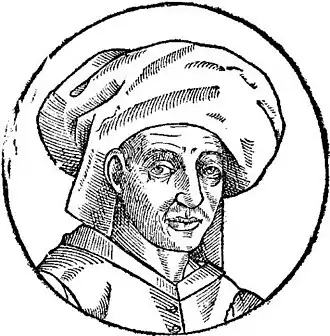
A 1611 woodcut of Josquin des Prez, possibly copied from a now-lost oil painting made during his lifetime. There have been doubts concerning whether this depiction is an accurate likeness, see § Portraits.
Josquin Lebloitte dit des Prez (c. 1450–1455 – 27 August 1521) was a singer and composer of Renaissance music, who is variously described as French or Franco-Flemish. Considered one of the greatest composers of the Renaissance, he was a central figure of the Franco-Flemish School and had a profound influence on the music of 16th-century Europe. Building on the work of predecessors like Johannes Ockeghem, he developed a complex style of polyphony that emphasized the relationship between text and music. Josquin preferred motifs to melisma, and his compositions are mainly vocal works like masses, motets, and secular chansons.
Josquin's biography has been continually revised by modern scholarship. By 1477 he was in the choir of René of Anjou. In the 1480s, Josquin traveled to Italy with the Cardinal Ascanio Sforza. Many of his works were printed and published by Ottaviano Petrucci in the early 16th century. From 1504 until the end of his life, he lived in Condé, where he produced some of his most admired works, including the masses Missa de Beata Virgine, and Missa Pange lingua. (Full article...)
.jpg)
.jpg)
.jpg)
.jpg)
Did you know (auto-generated) -

- ... that opera singer Charles Holland spent much of his career in Europe as opportunities in classical music for African Americans were limited?
- ... that in 1994, Anthony Pople created two computer programs to analyse classical music?
- ... that WFMT classical music radio host Don Tait owned such a large collection of recordings that he had to buy a house and have its floor reinforced to accommodate the weight?
Selected image
-
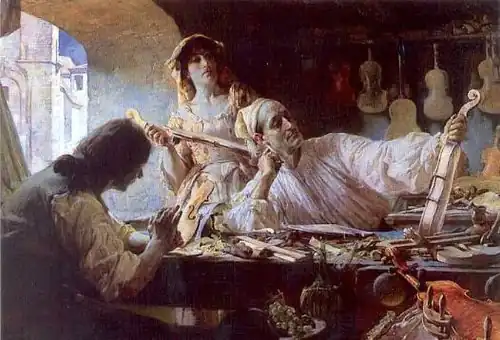 Stradivarius is one of the violins, violas, cellos and other string instruments built by members of the Italian Stradivari family, particularly Antonio Stradivari.
 -
 Sheet music for the Polonaise in A-flat major, Op. 53, a solo piano piece written by Frédéric Chopin in 1842. This work is one of Chopin's most admired compositions and has long been a favorite of the classical piano repertoire. The piece, which is very difficult, requires exceptional pianistic skills and great virtuosity to be interpreted. A typical performance of the polonaise lasts seven minutes.
 -

A picture of the first theatre drawn shortly before it burned down in 1808.
The Royal Opera House is an opera house and major performing arts venue in the London district of Covent Garden. The large building, often referred to as simply "Covent Garden", is the home of The Royal Opera, The Royal Ballet and the Orchestra of the Royal Opera House. -
 Photo: Guillaume PiolleThe anatomy of a Périnet piston valve, this one taken from a B♭ trumpet. When depressed, the valve diverts the air stream through additional tubing, thus lengthening the instrument and lowering the harmonic series on which the instrument is vibrating (i.e., it lowers the pitch). Trumpets generally use three valves, with some variations, such as a piccolo trumpet, having four. When used singly or in combination, the valves make the instrument fully chromatic, or capable of playing all twelve pitches of classical music. Trumpets may also use rotary valves instead.
 -
 The Teatro alla Scala (or La Scala, as it is known), in Milan, Italy, is one of the world's most famous opera houses. The theatre was inaugurated on 3 August 1778, under the name Nuovo Regio Ducal Teatro alla Scala with Salieri's Europa riconosciuta.
 -
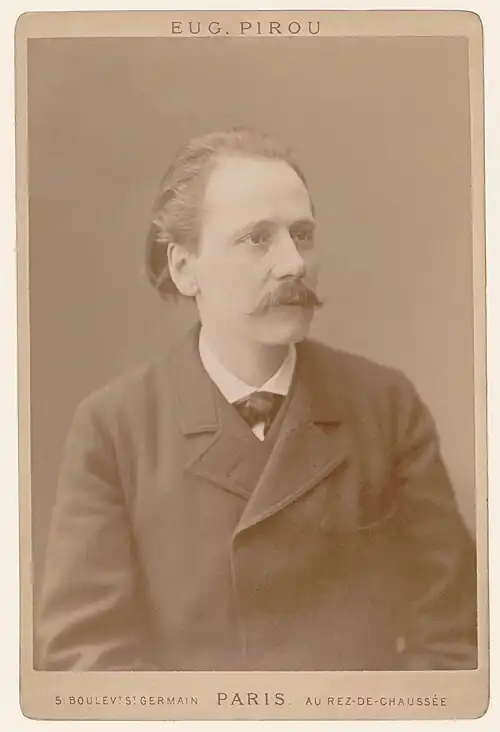 Photograph credit: Eugène Pirou; restored by Adam CuerdenJules Massenet (12 May 1842 – 13 August 1912) was a French composer of the Romantic era, best known for his operas. Between 1867 and his death, he wrote more than forty stage works in a wide variety of styles, from opéra comique to grand depictions of classical myths, romantic comedies and lyric dramas, as well as oratorios, cantatas and ballets. Massenet had a good sense of the theatre and of what would succeed with the Parisian public. Despite some miscalculations, he produced a series of successes that made him the leading opera composer in France in the late 19th and early 20th centuries. By the time of his death, he was regarded as old-fashioned; his works, however, began to be favourably reassessed during the mid-20th century, and many have since been staged and recorded. This photograph of Massenet was taken by French photographer Eugène Pirou in 1875.
 -
 Painting: Thomas GainsboroughJohann Christian Bach (5 September 1735 – 1 January 1782) was a composer of the Classical era, the eighteenth child of Johann Sebastian Bach, and the youngest of his eleven sons. Bach was taught by his father and then, after the latter's death, by his half-brother C. P. E. Bach. Bach moved to Italy in 1754, and then to London in 1762, where he became known as the "London Bach". Bach's compositions include eleven operas, as well as chamber music, orchestral music and compositions for keyboard music. In 1764 Bach met Wolfgang Amadeus Mozart, who was eight at the time, and spent five months teaching him composition. He had considerable influence on Mozart, and was later described by scholars as his "only, true teacher".
This portrait of Bach was painted in 1776 by Thomas Gainsborough, as part of a collection started by Bach's former teacher Padre Martini. It now hangs in the National Portrait Gallery, London. -
 Ballet is a formalized form of dance with its origins in the French court, further developed in France and Russia as a concert dance form.
 -
 Photo: W. J. Mayer; Restoration: Lise BroerA bust of the German composer and pianist Ludwig van Beethoven (1770–1827), made from his death mask. He was a crucial figure in the transitional period between the Classical and Romantic eras in Western classical music, and remains one of the most acclaimed and influential composers of all time. Born in Bonn, of the Electorate of Cologne and a part of the Holy Roman Empire of the German Nation in present-day Germany, he moved to Vienna in his early twenties and settled there, studying with Joseph Haydn and quickly gaining a reputation as a virtuoso pianist. His hearing began to deteriorate in the late 1790s, yet he continued to compose, conduct, and perform, even after becoming completely deaf.
 -
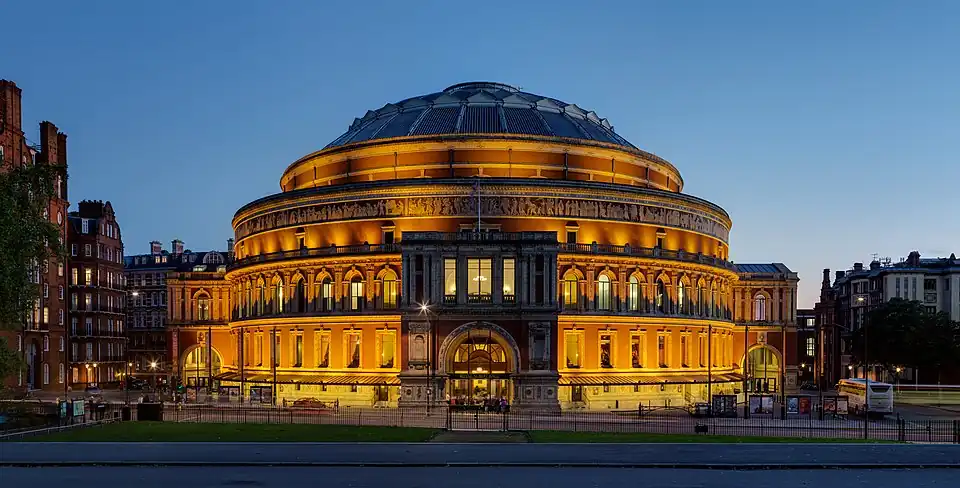 Photograph: David IliffThe Royal Albert Hall is a concert hall, seating a maximum of 5,272, on the northern edge of South Kensington, London. Constructed beginning in 1867, the hall was inaugurated on 29 March 1871. Since 1941 it has held The Proms, an eight-week summer season of daily orchestral classical music concerts and other events.
 -
.jpg) Photograph credit: William P. Gottlieb; restored by Adam CuerdenBilly Strayhorn (November 29, 1915 – May 31, 1967) was an American jazz composer, pianist, lyricist, and arranger, best remembered for his long-time collaboration with bandleader and composer Duke Ellington that lasted nearly three decades. Though classical music was Strayhorn's first love, his ambition to become a classical composer went unrealized because of the harsh reality of a black man trying to make his way in the world of classical music, which at that time was almost completely white. He was introduced to the music of pianists like Art Tatum and Teddy Wilson at age 19, and the artistic influence of these musicians guided him into the realm of jazz, where he remained for the rest of his life. This photograph of Strayhorn was taken by William P. Gottlieb in the 1940s.
Photograph credit: William P. Gottlieb; restored by Adam CuerdenBilly Strayhorn (November 29, 1915 – May 31, 1967) was an American jazz composer, pianist, lyricist, and arranger, best remembered for his long-time collaboration with bandleader and composer Duke Ellington that lasted nearly three decades. Though classical music was Strayhorn's first love, his ambition to become a classical composer went unrealized because of the harsh reality of a black man trying to make his way in the world of classical music, which at that time was almost completely white. He was introduced to the music of pianists like Art Tatum and Teddy Wilson at age 19, and the artistic influence of these musicians guided him into the realm of jazz, where he remained for the rest of his life. This photograph of Strayhorn was taken by William P. Gottlieb in the 1940s.
Topics
Things you can do
 |
Here are some tasks awaiting attention:
|
Categories

Associated Wikimedia
The following Wikimedia Foundation sister projects provide more on this subject:
-
 Commons
Free media repository -
 Wikibooks
Free textbooks and manuals -
 Wikidata
Free knowledge base -
 Wikinews
Free-content news -
 Wikiquote
Collection of quotations -
 Wikisource
Free-content library -
 Wikiversity
Free learning tools -
 Wiktionary
Dictionary and thesaurus
-
 List of all portals
 -

-

-

-

-

-

-

-

-

-
 Random portal
 -
 WikiProject Portals