This portal is manually maintained by Casablanca Rock. Please contact these user(s) when you plan to make significant changes.
This portal has a single page layout. It is possible that any subpages may no longer be needed.
Please take care when editing, especially if using automated editing software, and seek consensus before making major changes. Learn how to update the maintenance information here.
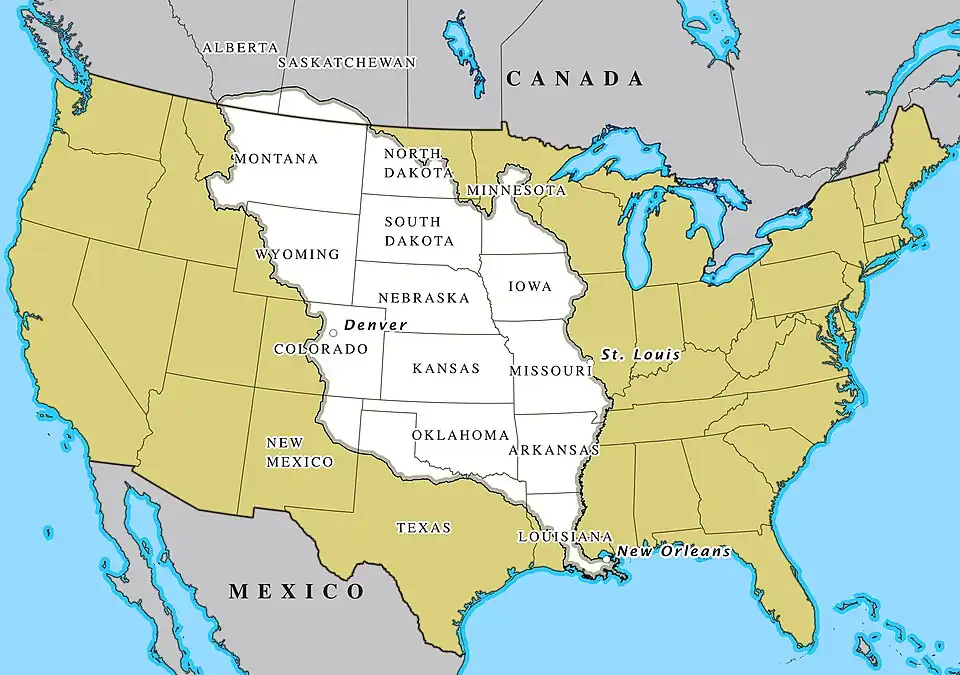
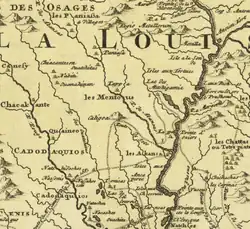
Previously part of French Louisiana and the Louisiana Purchase, the Territory of Arkansas was admitted to the Union as the 25th state on June 15, 1836. Much of the Delta had been developed for cotton plantations, and landowners there largely depended on enslaved African Americans' labor. In 1861, Arkansas seceded from the United States and joined the Confederate States of America during the American Civil War. On returning to the Union in 1868, Arkansas continued to suffer economically, due to its overreliance on the large-scale plantation economy. Cotton remained the leading commodity crop, and the cotton market declined. Because farmers and businessmen did not diversify and there was little industrial investment, the state fell behind in economic opportunity. In the late 19th century, the state instituted various Jim Crow laws to disenfranchise and segregate the African-American population. During the civil rights movement of the 1950s and 1960s, Arkansas and particularly Little Rock were major battlegrounds for efforts to integrate schools. Following World War II in the 1940s, Arkansas began to diversify its economy and see prosperity. During the 1960s, the state became the base of the Walmart corporation, the world's largest company by revenue, headquartered in Bentonville.
Once the American Civil War began in 1861 and Arkansas seceded, Hindman joined the Confederate States Army, first commanding the 2nd Arkansas Infantry Regiment, then a brigade, and then an ad-hoc division at the Battle of Shiloh in April 1862; he was wounded during the battle. Following Shiloh, Hindman was promoted to major general and sent to the Trans-Mississippi Department to command Arkansas, Missouri, the Indian Territory, and part of Louisiana. As commander of the region, his policies were sometimes legally questionable and were unpopular, although they were successful in building up the district from a basically indefensible state. Public outcry led to Hindman's removal from his regional command. He was defeated at the Battle of Prairie Grove in December. Transferred to the Army of Tennessee in 1863, he led a division at the Battle of Chickamauga in September, where he was again wounded. After recovering, he commanded a division during the early stages of the Atlanta campaign although he wished to be transferred elsewhere. (Full article...)
Gragg played as a wide receiver for Warren High School, and converted to a tight end after his freshman season at the University of Arkansas. In his sophomore and junior seasons for the Razorbacks, the team made appearances in Bowl Championship Series games and defeated the Kansas State Wildcats in the 2012 Cotton Bowl Classic. A knee injury caused Gragg to miss eight games his senior season as Arkansas finished with a losing record. Gragg participated in the NFL Scouting Combine, an evaluative competition among prospective NFL players, and topped several statistics among the tight ends in attendance; in the following draft, the Bills chose him with the 222nd overall selection. (Full article...)
Confederate cavalry commanded by John S. Marmaduke and Samuel B. Maxey attacked the foraging party. Marmaduke's men formed a roadblock east along the way back to Camden, while Maxey's men attacked from south of the road. The first two Confederate attacks were unsuccessful, but the third broke the Union line. Williams's command was routed, losing its wagon train and four cannons. African-American soldiers from the 1st Kansas Colored Infantry Regiment were massacred and mutilated during and after the battle. Poison Spring has been referred to as the worst massacre in the history of Arkansas. The defeat at Poison Spring and another defeat at the Battle of Marks' Mills a week later led Steele to retreat to Little Rock. In the April 30 Battle of Jenkins' Ferry, men from the 2nd Kansas Colored Infantry Regiment murdered Confederate soldiers in revenge of the massacre at Poison Spring. Poison Springs Battleground State Park, which is part of the Camden Expedition Sites National Historic Landmark, preserves a portion of the site of the battle. (Full article...)
Image 4
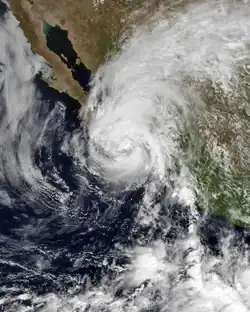
Hurricane Ismael approaching Sinaloa on September 14
Hurricane Ismael killed 116 people in Mexico during the 1995 Pacific hurricane season. It developed from a persistent area of deep convection on September 12, and steadily strengthened as it moved to the north-northwest. Ismael attained hurricane status on September 14 while located 210 miles (340 km) off the coast of Mexico. It continued to the north, and after passing a short distance east of Baja California Sur it made landfall on Topolobampo in the state of Sinaloa with winds of 80 mph (130 km/h). Ismael rapidly weakened over land, and dissipated on September 16 over northwestern Mexico. The remnants entered the United States and extended eastward into the Mid-Atlantic states.
Offshore, Ismael produced waves of up to 30 feet (9.1 m) in height. Hundreds of fishermen were unprepared for the hurricane, which was expected to move more slowly, and as a result 52 ships were wrecked, killing 57 fishermen. On land, Ismael caused 59 deaths in mainland Mexico and resulted in $26 million in damage (1995 USD$, 54.9 million 2026 USD). The hurricane destroyed thousands of houses, leaving 30,000 people homeless. Moisture from the storm extended into the United States, causing heavy rainfall and localized moderate damage in southeastern New Mexico. (Full article...)
Image 5
The 2nd Indiana Battery in action at Cane Hill, during the beginning of the battle.
The Battle of Cane Hill was fought between Union and Confederate forces during the American Civil War on November 28, 1862, in northwestern Arkansas, near the town of Cane Hill. Confederate Major GeneralThomas C. Hindman had made an abortive offensive into southwestern Missouri from Arkansas earlier in the year, but had withdrawn to Arkansas. Union troops under Brigadier GeneralJames G. Blunt had followed Hindman into northwestern Arkansas, and the Confederate general saw an opportunity to attack Blunt while his division was separated from the rest of the Union Army of the Frontier. Hindman then sent a force under Brigadier General John S. Marmaduke to Cane Hill, which was also known as Boonsboro, to collect supplies. In early November, a detachment of Blunt's command led by ColonelWilliam F. Cloud defeated a small Confederate force commanded by Colonel Emmett MacDonald in the Cane Hill area.
After MacDonald's defeat, Marmaduke remained in the Cane Hill area with his force. Blunt moved to attack Marmaduke on November 27. The Confederates expected the Union attack to come up the Cincinnati Road, but it instead followed the Ridge Road and then the Fayetteville Road. Cloud's men led the Union advance and made contact with Colonel Joseph O. Shelby's Confederate troopers on the morning of November 28. Shelby withdrew from the Cane Hill area after an artillery duel, and Marmaduke reformed his line in the Newburg area. (Full article...)
Image 6
The Van Buren raid occurred in Crawford County, Arkansas, on December 28, 1862, during the American Civil War. After defeating Confederate forces led by Major General Thomas C. Hindman at the Battle of Prairie Grove on December 7, 1862, Union forces under Brigadiers General James G. Blunt and Francis J. Herron prepared for a raid against the Confederate positions at Van Buren and Fort Smith. Disease, lack of supplies, and desertion had previously forced Hindman to begin withdrawing most of his force from the area. Setting out on December 27, the Union troops struck an outlying Confederate cavalry unit near Drippings Spring, north of Van Buren, on the morning of December 28. The Confederate cavalry fled to Van Buren, which was then overrun by Union troops.
The Union pursued and captured three steamboats on the Arkansas River, and captured some Confederate troops and many supplies in Van Buren. Across the river in Fort Smith, the Confederates destroyed supplies and also burned two steamboats trapped upriver. An artillery duel took place at Van Buren, and after nightfall a minor skirmish was fought downriver at Strain's Landing. After the raid, Hindman withdrew his men to Little Rock and the Union force returned from the raid, unable to maintain a supply line to Van Buren across the Boston Mountains. The battle of Prairie Grove and the Van Buren raid broke Confederate strength in the region. (Full article...)
Image 7
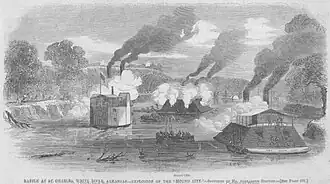
The Battle at St. Charles, White River, Arkansas—Explosion of the "Mound City" by Alexander Simplot
The Union ships advanced against the Confederate positions on June 17. The 46th Indiana Infantry Regiment was sent ashore to attack the fortifications on land, while two ironclads and two timberclads attacked the fort from the river. During the fighting, a Confederate solid shot struck the ironclad USS Mound City, puncturing one of the ship's steam drums. In what has been referred to as the deadliest shot of the war, scalding steam filled the ship, killing or wounding all but about 25 of the roughly 175 men on the vessel. The 46th Indiana overran the Confederate defenses on land and the position was taken. The supply mission was unable to make it all the way to Curtis's position, and withdrew back down the river due to low water levels. Thereafter, Curtis's army cut loose from their supply line and marched to Helena, Arkansas. A portion of the battlefield is listed on the National Register of Historic Places as the St. Charles Battle Site. (Full article...)
On September 6, 1863, near Little Rock, Arkansas, a duel was fought between John S. Marmaduke and Lucius M. Walker, two generals in the Confederate States Army. Tension had risen between the two officers during the Battle of Helena on July 4, 1863, when Marmaduke accused Walker of not supporting his force, and then retaliated by not informing Walker of a Confederate retreat. Marmaduke was later assigned to serve under Walker during a Union advance against Little Rock. Walker did not support Marmaduke during a retreat after the Battle of Brownsville, and Marmaduke questioned Walker's courage after the Battle of Bayou Meto on August 27. A series of notes passed between the two generals by friends resulted in a duel, during which Marmaduke fatally wounded Walker. Marmaduke was arrested and charged with murder but was soon released, and later the charge was dropped. He survived the war and later became Governor of Missouri. Union forces captured Little Rock later in the campaign, after the Battle of Bayou Fourche. (Full article...)
Image 9
The Bombardment and Capture of Fort Hindman, Arkansas Post, Ark. Jany. 11th 1863
McClernand arrived at Memphis, Tennessee, in late December and found that Sherman had left without him. McClernand moved downriver, joined Sherman's force, and took command in early January 1863, calling it the Army of the Mississippi. Both Sherman and McClernand had independently come to the conclusion that Arkansas Post should be attacked: Confederate forces raiding from Fort Hindman had recently captured a Union supply vessel, and Sherman may have been hoping for a victory to restore his reputation after Chickasaw Bayou. McClernand's troops and a Union Navy fleet commanded by Acting Rear AdmiralDavid Dixon Porter moved upriver towards the Arkansas River. The expedition began unloading troops downriver from the fort late on January 9. The next day, some of Porter's warships bombarded the fort, while McClernand's troops maneuvered into position. At 1:00 pm on January 11, Porter's warships began another bombardment of the fort, and McClernand's troops attacked the Confederate positions, which consisted of the fort and a line of rifle pits that extended west to a bayou. (Full article...)
Image 10
Fort Southerland Park in 2022
Fort Southerland, also known as Redoubt E and possibly Fort Diamond, is a redoubt built during the American Civil War to protect Camden, Arkansas. Confederate forces built it along with four other redoubts in early 1864 after a Union victory in the Little Rock campaign the previous year. Fort Southerland is about the size of a city block and is roughly oval. It could hold three cannons. When Union forces captured Camden in April 1864 during the Camden Expedition, they improved the defenses of the five redoubts, which were not sufficient for proper defense of the city. After the Confederates retook Camden later that month, they continued to improve the city's defenses.
Differing interpretations of Holmes' order to attack at daylight resulted in Brigadier GeneralJames F. Fagan's troops attacking Battery D unsupported, and Major General Sterling Price's attack against the Union center was made after Fagan's had largely fizzled out. To the north, Confederate cavalry commanded by Brigadier Generals John S. Marmaduke and Lucius M. Walker failed to act in concert and accomplished little. The assaults failed, and Vicksburg fell the same day. Later in the year, Union troops used Helena as a staging ground for their successful campaign to capture Little Rock, Arkansas. (Full article...)
Image 12
Angelou in 1993
Maya Angelou (/ˈændʒəloʊ/ⓘAN-jə-loh; born Marguerite Annie Johnson; April 4, 1928 – May 28, 2014) was an American memoirist, essayist, poet, and civil rights activist. She published seven autobiographies, three books of essays, several books of poetry, and is credited with a list of plays, movies, and television shows spanning over 50 years. She received dozens of awards and more than 50 honorary degrees. Angelou's series of seven autobiographies focus on her childhood and early adult experiences. The first, I Know Why the Caged Bird Sings (1969), tells of her life up to the age of 17 and brought her international recognition and acclaim.
"A Plague O' Both Your Houses!" by C.S.R. shows "Arkansas" as victim of the feud between the two sides.
The Brooks–Baxter War, also known as the Brooks–Baxter Affair, Arkansas Civil War, or the Second American Civil War was an attempt made by failed gubernatorial candidate Joseph Brooks of the "Brindletail" faction of Arkansas' Republican Party to take control of the state from Elisha Baxter, who was the Republicangovernor. The victor in the end was the Baxter administration, also known as the "Minstrels", supported by some "carpetbaggers" and Democrats over the Brindle-tails supported by "scalawags" and "freedmen".
The struggle began with the ratification of the 1868 Arkansas Constitution, rewritten to allow Arkansas to rejoin the Union after the American Civil War. The Reconstruction Acts required the rebel states to accept the 14th Amendment – establishing civil rights for freedmen – and enact new constitutions providing suffrage to freedmen while temporarily disenfranchising former Confederates. Some conservatives and Democrats refused to participate in the writing of the constitution and ceased participation in government. Republicans and Unionists wanting Arkansas to rejoin the Union formed a coalition to write and pass the new constitution, and formed a new state government. In the wake of a wave of reactionary violence by the Ku Klux Klan and a poor economy, the coalition soon fractured into two factions: the Minstrels, who were mostly carpetbaggers, and the Brindle-tails, who were mostly scalawags. This led to a failed impeachment trial of the carpetbagger Republican governor, Powell Clayton; he was then elected a U.S. Senator by the Arkansas General Assembly. (Full article...)
Parker became known as the "hanging judge" of the American frontier / Old West, because he sentenced numerous convicts to death. In serving 21 years on the federal bench, Judge Parker tried 13,490 cases. In more than 8,500 of these cases, the defendant either pleaded guilty or was convicted at trial. Parker sentenced 160 people to death; 79 were executed. The other 81 either died while incarcerated, were pardoned, or had their sentences commuted. (Full article...)
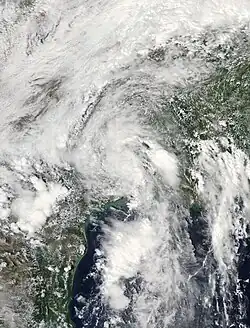
Tropical Storm Grace weakening over Texas on August 31
Tropical Storm Grace was a weak tropical storm that struck Texas in the 2003 Atlantic hurricane season. The eleventh tropical depression and the seventh tropical storm of the season, Grace was also the weakest storm of the season. On August 30 the storm developed from a long-track tropical wave in the western Gulf of Mexico. Grace remained disorganized throughout its lifetime due to an upper-level low to its west. The weak storm moved northwestward and made landfall on southeastern Texas. Grace quickly weakened over land, and dissipated on September 2 as it merged into a cold front.
In Texas, the storm dropped heavy rainfall, causing minor flash flooding. The cold front, combined with the remnants of the storm, dropped moderate to heavy rainfall from Texas through the Mid-Atlantic. The worst of the flooding occurred in Indianapolis, where record rainfall affected over 700 homes. Despite the rainfall, damage was minimal along its path. (Full article...)
Image 7
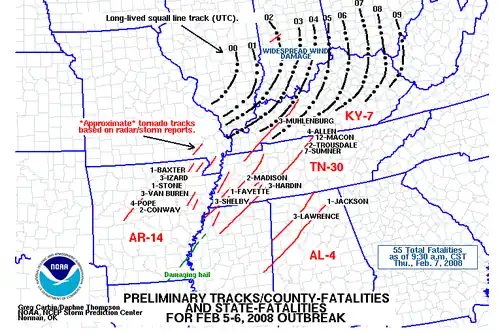
During the late afternoon and evening hours of February 5, 2008, a long-track and deadly EF4tornado moved through central and northern Arkansas, impacting several towns and communities including Atkins, Clinton and Mountain View along a 122-mile (196 km) path. A total of 13 fatalities were recorded and 163 people were injured, making the tornado the deadliest in Arkansas since 1997, where another violent and deadly tornado impacted communities in central Arkansas and killed 15. The tornado was part of a larger tornado outbreak that took place during Super Tuesday 2008, and had the longest path of the outbreak.
The tornado first touched down in Yell County, intensifying into Pope County before impacting the community of Atkins at EF3 intensity, damaging or destroying several homes and killing five people. Maintaining intensity, the tornado tore through Conway County, destroying more homes and downing trees and power poles, killing two more people. The tornado became violent in Van Buren County, demolishing several homes and businesses near Clinton, killing an additional three people. Throughout Stone, Izard, and Sharp counties; several more homes and businesses were damaged or destroyed at EF3-EF4 intensity, trees and power poles were snapped and toppled, and more fatalities occurred before the tornado dissipated near Highland. The tornado was on the ground for 127 minutes, had a maximum width of 1320 yards (1.21 km) and traveled approximately 121.84 miles (196.08 km) through several counties and communities, making the path length the longest on record in Arkansas since 1950. Damage costs totaled an estimated $119.31 million. (Full article...)
Marmaduke's men defended a forward position, while Walker's remained to the rear in some woods; the plan was for Marmaduke to draw Union troops into an ambush. However, Walker did not come to Marmaduke's aid when a Union brigade commanded by Geiger advanced. Geiger's men drove the outnumbered Confederates from their first position. Reforming, Marmaduke attempted to form another line further to the west, but retreated again after delaying the Union advance. Union troops pursued until nightfall. The campaign against Little Rock continued, and the city was taken on September 10. (Full article...)
A division of Union troops in the Army of the Frontier, commanded by James G. Blunt, was posted in northwestern Arkansas after winning the Battle of Cane Hill on November 28. The First Corps, Trans-Mississippi Army, commanded by Thomas C. Hindman moved towards Blunt's division in order to attack while it was isolated. However, Blunt was reinforced by two divisions commanded by Francis J. Herron, leading Hindman to take a defensive position on some high ground known as Prairie Grove. Herron attempted to assault Hindman's lines twice, but both attacks were beaten off with heavy casualties. Hindman responded to the repulse of each of Herron's attacks with unsuccessful counterattacks of his own. Later in the day, Blunt arrived and attacked Hindman's flank. Eventually, both sides disengaged and the fighting reached an inconclusive result. However, the unavailability of reinforcements forced Hindman's army to retreat from the field, giving the Union army a strategic victory and control of northwestern Arkansas. (Full article...)
An Arkansas resident most of his life, Pierce made his directorial debut with Boggy Creek, a faux documentary-style film inspired by the legend of the Bigfoot-like Fouke Monster. Pierce followed that with several inexpensive, regional films set in the southern United States, including The Town That Dreaded Sundown, based on the true story of the Phantom Killer murders in Texarkana. (Full article...)
Image 11
Frederick Notrebe (1780 – April 4, 1849) was an early settler and businessman in Arkansas Post, Arkansas. A Frenchman and former soldier, Notrebe immigrated to the United States around the year 1810 and soon moved to Arkansas Post. He originally was involved with the fur trade and trade with the Native Americans, but became a dominant figure in the eastern Arkansas cotton market, both growing his own cotton and purchasing cotton from others for resale. He was one of the founders of Napoleon, Arkansas, which he named after Napoleon Bonaparte. Having to conduct some of his business on the barter basis and desiring greater circulation of money in the region, Notrebe helped bring a branch of the State Bank of Arkansas to Arkansas Post, for which purposes he donated land.
Notrebe's land holdings grew to 5,500 acres (2,200 ha) and he owned 119 slaves; for a time he was the largest slaveholder in Arkansas County, Arkansas. He entertained many notable guests at his home, including Albert Pike and Washington Irving; Notrebe may have been the inspiration for a character in Irving's short story "The Creole Village". Notrebe died in 1849 of either cholera or pneumonia in New Orleans, Louisiana. (Full article...)
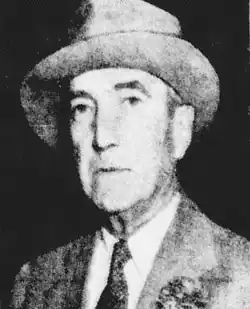
McLaughlin was born in Hot Springs in 1888, and was educated at Hot Springs High School and attended the University of Arkansas for two weeks. He entered politics in the 1910s as a member of the state house before being elected as city attorney in Hot Springs. He left politics temporarily after being drafted into the United States Army, but returned to the position of city attorney. (Full article...)
Image 13
During the evening hours of April 27, 2014, a large and destructive high-end EF4tornado moved through several communities northwest of Little Rock, Arkansas. The tornado, also known as the Mayflower–Vilonia tornado, and which was part of a larger outbreak of severe weather across the central and southern United States, devastated the towns of Paron, Mayflower, Lake Conway, Vilonia, and El Paso, killing sixteen people and injuring over one hundred more. The tornado retained peak wind speeds of 190 miles per hour (310 km/h) as it moved through the town of Vilonia, where eight fatalities were recorded. The tornado was on the ground for almost an hour, and traveled a total of 41.10 miles (66.14 km) along its path, reaching a peak width of 1,320 yards (1.21 km).
The tornado touched down near the western edge of Pulaski County, moving to the northwest before impacting Paron at EF3 intensity, killing three people and damaging several residential buildings as it moved by. The tornado continued to move to the northwest as it left the community in ruins, reaching EF4 intensity for the first time as it entered the city limits of Mayflower. The tornado produced heavy structural damage as it tore through the southern edge of the town, killing three people. The tornado later hit Vilonia, where it produced high-end EF4 damage and killed ten people. The tornado dissipated a short time later. (Full article...)
Image 14
Highway 142 (AR 142) is a north–south state highway in Chicot County, Arkansas. The route starts its southern terminus at Levee Road near Lakeport. The road then travels north, passing through the Lakeport Plantation. It ends at its northern terminus at U.S. Route 82 (US 82) and US 278 in Shives. AR 142 was designated in 1931, from US 61 to the Mississippi River, and part of the route was redesignated as part of US 82 in 1940. The route was paved in asphalt by 1962. The route is maintained by the Arkansas Department of Transportation (ArDOT). (Full article...)
Image 15
Sue Bailey Thurman (née Sue Elvie Bailey; August 26, 1903 – December 25, 1996) was an American author, lecturer, historian and civil rights activist. She briefly taught at the Hampton Institute in Virginia, before becoming involved in international work with the YWCA in 1930. During a six-month trip through Asia in the mid-1930s, Thurman became the first African-American woman to have an audience with Mahatma Gandhi.
The meeting with Gandhi inspired Thurman and her husband, theologian Howard Thurman, to promote non-violent resistance as a means of creating social change, bringing it to the attention of a young preacher, Martin Luther King Jr. While she did not actively protest during the Civil Rights Movement, she served as spiritual counselors to many on the front lines, and helped establish the first interracial, non-denominational church in the United States. (Full article...)
Hot spring pool steaming at the entrance of the park
Hot Springs National Park is a national park of the United States in central Garland County, Arkansas, adjacent to the city of Hot Springs. Hot Springs Reservation was initially created by an act of the United States Congress on April 20, 1832, to be preserved for future recreation. Established before the concept of a national park existed, it was the first time that land had been set aside by the federal government to preserve its use as an area for recreation. The hot spring water has been popularly believed for centuries to possess medicinal properties, and was a subject of legend among several Native American tribes. Following federal protection in 1832, the city developed into a successful spa town.
Incorporated January 10, 1851, the city was known in the early 20th century as the home to Major League Baseball spring training, illegal gambling, speakeasies during the Prohibition era, and gangsters such as Al Capone, horse racing at Oaklawn Park, the Army and Navy Hospital, and 42nd President Bill Clinton. The area was established as a national park on March 4, 1921. Until the redesignation of Jefferson National Expansion Memorial as Gateway Arch National Park in 2018, Hot Springs was the smallest national park by area in the United States. Since Hot Springs National Park is the oldest park maintained by the National Park Service, it was the first to receive its own US quarter in April 2010 as part of the America the Beautiful Quarters coin series. (Full article...)
This list was generated from these rules. Questions and feedback are always welcome! The search is being run daily with the most recent ~14 days of results. Note: Some articles may not be relevant to this project.
Rules | Match log | Results page (for watching) | Last updated: 2026-02-21 19:17 (UTC)
Note: The list display can now be customized by each user. See List display personalization for details.




_(cropped).jpg)
.jpg)

.jpg)
_by_C.S.R.jpg)







.jpg)




.jpg)