This portal's subpages have been checked by an editor, and are needed.
Please take care when editing, especially if using automated editing software. Learn how to update the maintenance information here.
Welcome to
The Anime and Manga Portal
Introduction
Anime (アニメ) refers to animation originating from Japan. It is characterized by distinctive characters and backgrounds (hand-drawn or computer-generated) that visually and thematically set it apart from other forms of animation. Storylines may include a variety of fictional or historical characters, events, and settings. Anime is aimed at a broad range of audiences; consequently, a given series may have aspects of a range of genres. Anime is most frequently distributed by streaming services, broadcast on television, or sold on DVDs and other media, either after their broadcast run or directly as original video animation (OVA). Console and computer games sometimes also feature segments or scenes that can be considered anime.
Manga (漫画), Japanese for "comics" or "whimsical pictures", are comics or graphic novels originating from Japan. Manga developed from a mixture of ukiyo-e and Western styles of drawing, and took its current form shortly after World War II. Manga, apart from covers, is usually published in black and white but it is common to find introductions to chapters to be in color. It is typically read from top to bottom and then right to left, similar to the layout of Japanese plain text. In 2005, manga represented a market of ¥24 billion in Japan and $180 million in the United States, and was the fastest-growing segment of books in the United States in the same year. In 2020, Japan's manga industry hit a value of ¥612.6 billion due to the fast growth of the digital manga market, while manga sales in North America reached an all-time high of almost $250 million.
Anime and manga have a shared iconography, including exaggerating the scale of physical features to which the reader presumably should pay most attention, the best known being "large eyes". Manga are often adapted into anime, usually with the collaboration of the original author. Light novel series and video games can also be adapted into anime or manga. In such cases, the work's original story is often compressed or modified to fit the new format and appeal to a wider demographic. Popular franchises sometimes include full-length feature films, both animated and live-action, as well as live-action television programs.
Selected article
Air is a Japanese visual novel developed by Key, a brand of Visual Arts. It was released on September 8, 2000, for Windows as an adult game. Key later released versions of Air without the erotic content, and the game was ported to the Dreamcast, PlayStation 2, PlayStation Portable, PlayStation Vita and Nintendo Switch. The story follows the life of Yukito Kunisaki, a traveling showman searching for the "girl in the sky". He arrives in a quiet, seaside town where he meets three girls, one of whom is the key to the end of his journey.
The gameplay in Air follows a branching plot line which offers pre-determined scenarios with courses of interaction, and focuses on the appeal of the three female main characters by the player character. The game is divided into three segments—Dream, Summer, and Air—which serve as different phases in the overall story. The title of the game reflects the prominent themes of the air, skies, and use of wings throughout gameplay. The game ranked as the best-selling PC game sold in Japan for the time of its release, and charted in the national top 50 several more times afterwards. Air has sold over 300,000 units across several platforms.
The chapters of Soul Eater is written and illustrated by Atsushi Okubo. The series follows the adventures of three students at a school called the Death Weapon Meister Academy (or DWMA for short), known as meisters, who use demon weapon companions with human and weapon forms. These meisters, Maka Albarn, Black Star, and Death the Kid, seek to turn their weapons, Soul Eater, Tsubaki, and the Thompson sisters respectively, into "death scythes" for Shinigami, the Grim Reaper and head of the DWMA, by having their weapons consume the souls of ninety-nine evil humans and one witch.
The manga initially began as three separate one-shots serialized between June 24, 2003 and November 26, 2003 in two manga magazines published by Square Enix. The first one-shot was published in the summer 2003 special edition of Gangan Powered, the second following in the autumn 2003 special edition of the same magazine, and the third serialized in Gangan Wing. The manga started regular serialization in Square Enix's Monthly Shōnen Gangan magazine on May 12, 2004. The first tankōbon was released by Square Enix under their Gangan Comicsimprint (trade name) on June 22, 2004 in Japan; as of February 22, 2010, 16 volumes have been released. (Full list...)
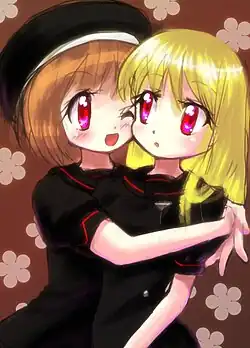
Yuri anime and manga involves lesbian relationships. The word yuri (百合) translates to "lily", and is used in Japan to describe sexual or romantic attraction between women in fiction.