"The Sixties", as they are known in both scholarship and popular culture, is a term used by historians, journalists, and other objective academics; in some cases nostalgically to describe the counterculture and revolution in social norms about clothing, music, drugs, dress, formalities and schooling. Conservatives denounce the decade as one of irresponsible excess and flamboyance, and decay of social order. The decade was also labeled the Swinging Sixties because of the fall or relaxation of social taboos especially relating to racism and sexism that occurred during this time.
The 1960s became synonymous with the new, radical, and subversive events and trends of the period. In Africa the 1960s was a period of radical political change as 32 countries gained independence from their European colonial rulers.
Some commentators have seen in this era a classical Jungian nightmare cycle, where a rigid culture, unable to contain the demands for greater individual freedom, broke free of the social constraints of the previous age through extreme deviation from the norm. Christopher Booker charts the rise, success, fall/nightmare and explosion in the London scene of the 1960s. However, this alone does not explain the mass nature of the phenomenon.
Several nations such as the U.S., France, Germany and Britain turned to the left in the early and mid 1960s. In the United States, John F. Kennedy, a Keynesian and staunch anti-communist, pushed for social reforms. His assassination in 1963 was a stunning shock. Liberal reforms were finally passed under Lyndon B. Johnson including civil rights for African Americans and healthcare for the elderly and the poor. Despite his large-scale Great Society programs, Johnson was increasingly reviled by the New Left at home and abroad. The heavy-handed American role in the Vietnam War outraged student protestors across the globe, as they found peasant rebellion typified by Ho Chi Minh and Che Guevara more appealing. Italy formed its first left-of-center government in March 1962 with a coalition of Christian Democrats, Social Democrats, and moderate Republicans. Socialists joined the ruling block in December 1963. In Britain, the Labour Party gained power in 1964. In Brazil, João Goulart became president after Jânio Quadros resigned.
Featured article -
This is a Featured article, which represents some of the best content on English Wikipedia..
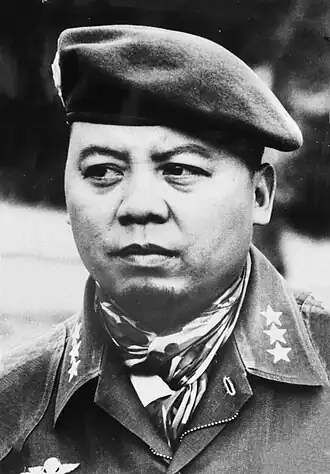
Nguyễn Khánh, the leader of the coup, in 1964
Before dawn on 19 December 1964, a coup d'état took place when the ruling military junta of South Vietnam led by General Nguyễn Khánh dissolved the High National Council (HNC) and arrested some of its members. The HNC was an unelected legislative-style civilian advisory body they had created at the request of the United States—South Vietnam's main sponsor—to give a veneer of civilian rule. The dissolution dismayed the Americans, particularly the ambassador, Maxwell D. Taylor, who engaged in an angry war of words with various generals including Khánh and threatened aid cuts. They were unable to do anything about the fait accompli that had been handed to them, because they strongly desired to win the Vietnam War and needed to support the Army of the Republic of Vietnam. Instead, Taylor's searing verbal attacks were counterproductive as they galvanized the Vietnamese officers around the embattled Khánh. At the time, Khánh's leadership was under threat from his fellow generals, as well as Taylor, who had fallen out with him and was seeking his removal.
The genesis of the removal of the HNC was a power struggle within the ruling junta. Khánh, who had been saved from an earlier coup attempt in September 1964 by the intervention of some younger generals dubbed the Young Turks, was indebted to them and needed to satisfy their wishes to stay in power. The Young Turks disliked a group of older officers who had been in high leadership positions but were now in powerless posts, and wanted to sideline them completely. As a result, they decided to hide their political motives by introducing a policy to compulsorily retire all general officers with more than 25 years of service. The chief of state Phan Khắc Sửu, an elderly figure appointed by the military to give a semblance of civilian rule, did not want to sign the decree without the agreement of the HNC, which mostly consisted of old men. The HNC recommended against the new policy, and the younger officers, led by I Corps commander General Nguyễn Chánh Thi and Air Marshal Nguyễn Cao Kỳ, disbanded the body and arrested some of its members along with other politicians. (Full article...)
On February 28, 1966, a Northrop T-38 Talon from NASA crashed at Lambert Field in St. Louis, Missouri, United States, killing two Project Gemini astronauts, Elliot See and Charles Bassett. The aircraft, piloted by See, crashed into the McDonnell Aircraft building where their Gemini 9 spacecraft was being assembled. The weather was poor with rain, snow, fog, and low clouds. A NASA panel, headed by the Chief of the Astronaut Office, Alan Shepard, investigated the crash. While the panel considered possible medical issues or aircraft maintenance problems, in addition to the weather and air traffic control factors, the end verdict was that the crash was caused by pilot error.
In the aftermath of the crash, the backup crew of Thomas Stafford and Eugene Cernan were moved up to the primary position for the Gemini 9 mission, scheduled for early June. Jim Lovell and Buzz Aldrin, who had formerly been the backup crew for Gemini 10, became the mission's backup crew and through the normal rotation were assigned as prime crew for Gemini 12. Without the Gemini experience, it is unlikely that Aldrin would have been assigned to the Apollo 11 mission, during which he became the second person to walk on the Moon. (Full article...)
This is a Featured article, which represents some of the best content on English Wikipedia..
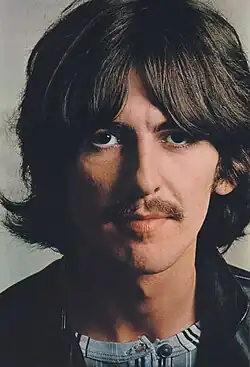
Harrison in 1968
George Harrison (25 February 1943 – 29 November 2001) was an English musician who achieved international fame as the lead guitarist of the Beatles. Known as "the quiet Beatle", Harrison played a significant role in shaping the band's musical direction and later established a successful solo career, particularly through his interest in non-Western musical influences.
This is a Good article, an article that meets a core set of high editorial standards.
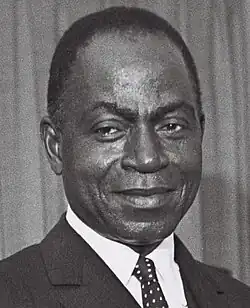
Houphouët-Boigny in 1962
Félix Houphouët-Boigny (French:[feliksufwɛ(t)bwaɲi]; 18 October 1905 – 7 December 1993), affectionately called Papa Houphouët or Le Vieux ("The Old One"), was an Ivorian politician and physician who served as the first president of Ivory Coast from 1960 until his death in 1993. A tribal chief, he worked as a medical aide, union leader, and planter before being elected to the French Parliament in 1945. He served in several ministerial positions within the Government of France before leading Ivory Coast following independence in 1960. Throughout his life, he played a significant role in politics and the decolonisation of Africa.
Under Houphouët-Boigny's politically moderate leadership, Ivory Coast prospered economically. This success, uncommon in poverty-ridden West Africa, became known as the "Ivorian miracle"; it was due to a combination of sound planning, the maintenance of strong ties with the West (particularly France) and development of the country's significant coffee and cocoa industries. However, reliance on the agricultural sector caused difficulties in 1980, after a sharp drop in the prices of coffee and cocoa. (Full article...)
The 1960 Summer Olympics (Italian: Giochi Olimpici estivi del 1960), officially known as the Games of the XVII Olympiad (Italian: Giochi della XVII Olimpiade) and commonly known as Rome 1960 (Italian: Roma 1960), were an international multi-sport event held from 25 August to 11 September 1960 in Rome, Italy. Rome had previously been awarded the administration of the 1908 Summer Olympics. However, following the eruption of Mount Vesuviusin 1906, the city had no choice but to decline and pass the honour to London. The Soviet Union won the most gold and overall medals at the 1960 Games.
The 1st Paralympic Games were held in Rome in conjunction with the 1960 Summer Olympics, marking the first time such events coincided. (Full article...)
You are invited to participate in WikiProject History, a group of editors dedicated to developing and improving articles about History. If interested, add your name to our list of members
Consider becoming a member of WikiProject The Beatles, a WikiProject that aims to expand and improve coverage of The Beatles on Wikipedia. Please feel free to join.
Associated Wikimedia
The following Wikimedia Foundation sister projects provide more on this subject:





.jpg)




 Commons
 Wikibooks
 Wikidata
 Wikinews
 Wikiquote
 Wikisource
 Wikiversity
 Wiktionary
 List of all portals





 Random portal
 WikiProject Portals