Nikolai Kormašov
Nikolai Kormašov | |
|---|---|
Николай Иванович Кормашов | |
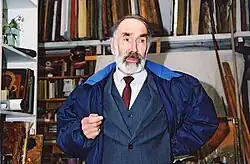 Kormašov in his studio (2001) | |
| Born | 28 August 1929 |
| Died | 22 August 2012 Tallinn, Estonia |
| Citizenship | Estonian |
| Education | Ivanovo Art School; State Art Institute of the Estonian SSR, now the Estonian Academy of Arts |
| Known for | Painting; restoration and collecting of Old Russian icons |
| Movement | Severe style |
| Awards | Kristjan Raud Art Award; Honoured Artist of the Estonian SSR; People’s Artist of the Estonian SSR; Order of the White Star, 4th Class; Tallinn Decoration |
Nikolai Kormašov (28 August 1929 – 22 August 2012) was a Russian-Estonian painter and art restorer. He became one of the best-known figures of Estonia’s post-Stalin “Sixties Generation” and is commonly associated with the Soviet-era Severe style.[1][2] He was also noted for collecting and restoring Old Russian icons. A museum exhibition of icons from his private collection in 1971 has been described as the first museum presentation of icons from a private collection in the Soviet Union.[3][4]
Life and education
Kormašov was born in Turgenevo in Russia’s Vladimir Oblast and trained at the Ivanovo Art School. He later moved to Tallinn to study at the State Art Institute of the Estonian SSR, now the Estonian Academy of Arts.[1][5] After graduating, he remained in Tallinn as a freelance artist and was described in Estonian cultural coverage as bridging Russian realist traditions with more experimental form-searching in Estonian painting.[5]
Painting and reception
Kormašov’s 1960s work is frequently discussed through the lens of the Severe Style, often characterised as a form of Soviet-era modernism connected with thematic painting and contemporary-subject compositions.[1][2] His major works from the period are regularly cited in Estonian art writing as key Severe Style images, including paintings such as Fishermen (1963) and Reinforced Concrete (1965).[5]
From the mid-1960s onward, Old Russian icon art increasingly informed his formal language and the tonal aura of his paintings, a shift emphasised in museum interpretation of his 1960s oeuvre.[1] Later coverage notes that his 1980s paintings often turned toward more intimate and poetic treatments of Setomaa village life, landscapes and still-lifes, including the series Mi olõmi seto’h painted in 1986–1994.[5]
Restoration work and icon collecting
From the 1960s, Kormašov built a private collection of icons through expeditions in northern Russia and visits to Old Believer villages, restoring much of the material himself.[3][4] The Mikkel Museum has described his collection as containing more than 150 icons spanning the 15th to 20th centuries, including both high-quality iconostasis icons and more provincial examples.[3] A consultant to the 2018 exhibition, Natalia Komaško of the Andrei Rublev Museum in Moscow, is quoted by the Art Museum of Estonia as calling Kormašov’s collection one of the most substantial private collections in scholarly terms.[3]
Museum sources state that a 1971 exhibition of icons from his collection at the Art Museum of Estonia was an unprecedented step in the Soviet context and was followed by exhibitions in Moscow in 1974 and elsewhere. His curated icon display was also shown at the Mikkel Museum from 1997, and later related icon initiatives were staged at the Kadriorg Art Museum in 2011.[3][4][6]
Exhibitions
In 2013–2014, Kumu Art Museum presented The Sacred Modernity. Nikolai Kormashov’s Paintings from the 1960s, framing his early decade as a key explorative period and publishing an accompanying trilingual book. The exhibition and book were reported in Estonian national culture coverage.[1][7]
The Estonian art-biographical lexicon EKABL lists extensive participation in exhibitions, including personal exhibitions in Estonia and abroad, including venues in Russia, Lithuania and Germany.[8]
According to national reporting, Kormašov’s final lifetime solo exhibitions included an 80th-birthday retrospective at the Tallinn Art Hall Gallery and the exhibition Alguses oli etüüd (In the beginning was a sketch) at Haus Gallery, both in 2009.[5]
Awards and honours
Kormašov received the title of Honoured Artist of the Estonian SSR in 1975 and People’s Artist of the Estonian SSR in 1980.[5] He received the Order of the White Star, 4th Class, in 1999.[5][1] In 2001, he received the Tallinn Decoration for preserving cultural values in Tallinn.[9] ERR also reports that he received the Kristjan Raud art annual prize in 1974 for paintings including Minu Eestimaa and Pojad I–II.[5]
Works in collections
National reporting notes that Kormašov’s paintings from the 1960s to the 1990s are held in major public collections, including the Art Museum of Estonia, the Tartu Art Museum, and institutions such as the Tretyakov Gallery in Moscow, the State Russian Museum in Saint Petersburg, Museum Ludwig in Cologne, and the National Gallery of Armenia in Yerevan, among others.[5]
Further reading
- Vana-vene kunst N. Kormašovi kogus (catalogue of Old Russian art from Kormašov’s collection).[10]
References
- ^ a b c d e f "The Sacred Modernity. Nikolai Kormashov's Paintings from the 1960s". Kumu Art Museum. Retrieved 9 February 2026.
- ^ a b Talvoja, Kädi (2018). "The official art of the Khrushchev Thaw: The Severe Style movement and its reception in Estonia". Journal of Baltic Studies. doi:10.1080/01629778.2018.1459756.
- ^ a b c d e "Päästetud pühadus. Ikoonid Nikolai Kormašovi kogust (Saved Sanctity: Icons from the Collection of Nikolai Kormašov)". Mikkel Museum. Retrieved 9 February 2026.
- ^ a b c "Saved Sanctity: Icons from the Collection of Nikolai Kormashov". Art Museum Riga Bourse. Retrieved 9 February 2026.
- ^ a b c d e f g h i "Suri maalikunstnik Nikolai Kormašov (Painter Nikolai Kormašov has died)". ERR. 23 August 2012. Retrieved 9 February 2026.
- ^ "Päästetud pühadus (Saved Sanctity)". Digar (Keskus). 12 April 2018. Retrieved 9 February 2026.
- ^ "Nikolai Kormašov Kumus". ERR. 10 November 2013. Retrieved 9 February 2026.
- ^ "Nikolai Kormašov". Eesti Kunsti ja Arhitektuuri Biograafiline Leksikon (EKABL). Retrieved 9 February 2026.
- ^ "Nikolai Kormašov". City of Tallinn (in Russian). Retrieved 10 February 2026.
- ^ "Vana-vene kunst N. Kormašovi kogus : kataloog". Digar. Retrieved 9 February 2026.
External links
 Media related to Nikolai Kormašov at Wikimedia Commons
- The Sacred Modernity (Kumu Art Museum)
- Saved Sanctity (Mikkel Museum)
- Nikolai Kormašov at EKABL