Motoori Ōhira
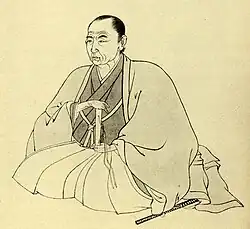
Motoori Ōhira (本居 大平; March 17, 1756 - October 23, 1833) was a kokugaku scholar and a successor to Motoori Norinaga.[1] He wrote under the pen name Fuji no Kakitsu (藤 垣内).
Life
Ōhira was born in Matsusaka, Ise Province (now Matsusaka, Mie Prefecture) as the eldest son of Inagake Munetaka (稲懸棟隆), a chōnin and pupil of Motoori Norinaga. Ōhira became a pupil of Norinaga's in when he was 13. From early morning to afternoon, he dedicated himself to the family business, and from afternoon to night, he dedicated himself to his studies.[2]
He was adopted by Norinaga in 1799 when he was 43 and became the head of the family estate when Norinaga's biological son, Motoori Haruniwa, lost his sight. He served the Kishū Tokugawa family in various positions, such as lecturer, where he laid the foundations for kokugaku and classical studies establishments.[3]
He had an adopted son, Motoori Uchitō.
Career
Motoori Norinaga was serving Wakayama Domain. However, Ōhira inherited a patrimony at Motoori house after the Norinaga's death, because Norinaga's first son, Motoori Haruniwa (本居 春庭) was blinded. In 1802, Wakayama Domain gave an order to Ōhira to work. After Ōhira was moved to Wakayama in 1809, Norinaga's school branched off Haruniwa's school in Matsuzaka and Ōhira's one in Wakayama.
Ōhira's character was gentle, his seigneur was deeply trusted in him. Ōhira taught seigneur about classical Japanese literature and edited "Ise Zoku Fudoki (伊勢続風土記)" that was chorography. He endeavored to succeed to Norinaga's Study and to lead the school. He had at least 1,000 pupils.
Works
Ōhira mostly faithfully followed Norinaga's thoughts.
- Kogaku no Kaname : Japanese name (古学要)
- Tamahoko Hyakushukai : Japanese name (玉鉾百首解)
- Kagurauta Shinshaku : Japanese name (神楽歌新釈)
- Yasoura no Tama : Japanese name (八十浦之玉)
- Inabashū : Japanese name (稲葉集) It is an anthology of Waka Poems
References
- ^ Peter Francis Kornicki (2001). The Book in Japan: A Cultural History from the Beginnings to the Nineteenth Century. University of Hawaii Press. p. 217. ISBN 0-8248-2337-0. Retrieved 2009-10-11.
- ^ Jōfuku, Isamu (March 1988). 本居宣長 [Motoori Norinaga] (in Japanese). Tōkyō: Yoshikawa kōbunkan. ISBN 978-4-642-05110-1.
- ^ Tanaka, Kōji (2014). 本居宣長:文学と思想の巨人 [Motoori Norinaga: A Titan of Literature and Philosophy] (in Japanese). Tokyo: Chuokoron-Shinsha. ISBN 978-4-12-102276-9.