Mellah of Casablanca

The mellah of Casablanca, traditionally inhabited by the Jews of Casablanca, was located south of the medina.[1][2]
History
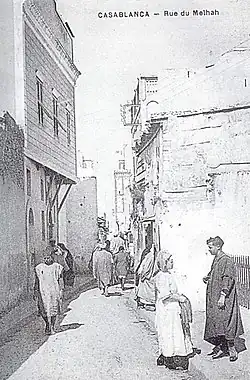
According to tradition, the first of the modern Jewish community in Casablanca came from Ben Ahmed near Settat to the south in the Chaouia plain, then under the control of the Mzab tribe.[2] After the reopening of the port of Casablanca for trade in 1831,[2] with commercial development through European economic penetration, industrial imports from Europe drove traditional Jewish crafts out of the market, costing many Jews in the interior their traditional livelihoods.[3][4] Moroccan Jews started migrating from the interior to coastal cities such as Essaouira, Mazagan, Asfi, and later Casablanca for economic opportunity, participating in trade with Europeans and the development of those cities.[5] Casablanca also attracted Jewish merchants from other major cities.[6]
In the 1907 bombardment of Casablanca, the beginning of the French invasion of Morocco from the West, mellah was pillaged after the landing and invasion of French troops and subsequent invasion of tribesmen from the Chaouia.[7]: 116,133 According to testimony from the director of the school of the Alliance Israélite Universelle:
From the first cannon round, the soldiers of the Makhzen advanced towards the mellah, followed by the general populace, and the looting began. The 5,000–6,000 tribesmen who had been waiting outside the gates entered the city and swept throughout the mellah as well as the medina, stealing, pillaging, raping, killing, and burning...[a][7]: 133
As Jews from around Morocco moved to Casablanca during the French protectorate (1912–1956), they congregated in the mellah.[8] Poor Jews lived in the mellah throughout the protectorate, though Jews were not required to live there and some moved into nearby neighborhoods as they could afford to do so.[8]


As Casablanca developed and expanded, the mellah was repeatedly threatened by colonial architects' plans to expand the Place de France (now United Nations Square). According to Jean-Louis Cohen, "the square's history can be said to emphasize the ambiguous and ever-changing attitude of the Protectorate with respect to the Jewish community."[10]
A group of concerned residents of the mellah told Hubert Lyautey in a collective letter:
This project consists of gutting the neighborhood, which has been home to our kin for almost a century, in the aim of widening the main street of the new town, the so-called Place de France... Never in the entire history of French North Africa has a project of this type been conceived, let alone put into effect... In Casablanca, though, the order has been issued to pull down our houses, synagogues, and mausoleums, which for decades past have formed the resting place for the remains of our venerated saints... The administration's handsome designs for our poor little mellah may well be far worthier than our tumbledown houses, shop booths and modest temples, but in our eyes, these booths and temples represent an entire century of toil and labor.[10]: 121
Notes
- ^ Original French text:
les soldats du Makhzen, dès le premier coup de canon, se précipitent sur le mellah, suivis de la populace, et commencent le pillage. Les 5 à 6 000 hommes des tribus, qui attendaient aux portes, pénètrent en ville, se répandent tant au mellah qu'à la médina, volent, pillent, violent, tuent, incendient...[7]: 133
References
- ^ Mirtil, Marcel (15 December 1918). "Le mellah de Casablanca". Revue France-Maroc : revue mensuelle illustrée : organe du Comité des foires du Maroc / directeur Alfred de Tarde.
- ^ a b c Levy, Andre; Schroeter, Daniel (1 Oct 2010), "Casablanca", Encyclopedia of Jews in the Islamic World, doi:10.1163/1878-9781_ejiw_COM_0005090, retrieved 2026-02-08
- ^ Jean-Louis Miège, L'ouverture, vol. 2 of Le Maroc et l'Europe, Paris: Presses Universitaires de France, 1961, 569
- ^ Mohammed Kenbib, Juifs et musulmans au Maroc, 1859–1948, Rabat: Université Mohammed V, 1994, 431-33
- ^ Gottreich, Emily R. Jewish space in the Morroccan city : a history of the mellah of Marrakech, 1550-1930. p. 54. OCLC 77066581.
- ^ Levy, Andre; Schroeter, Daniel (1 Oct 2010), "Casablanca", Encyclopedia of Jews in the Islamic World, doi:10.1163/1878-9781_ejiw_COM_0005090, retrieved 2026-02-08
- ^ a b c Adam, André (1968). Histoire de Casablanca, des origines à 1914. Éditions Ophrys.
- ^ a b Levy, Andre; Schroeter, Daniel (1 Oct 2010), "Casablanca", Encyclopedia of Jews in the Islamic World, doi:10.1163/1878-9781_ejiw_COM_0005090, retrieved 2026-02-08
- ^ Comité des foires du Maroc Auteur du texte (15 August 1917). "France-Maroc : revue mensuelle illustrée : organe du Comité des foires du Maroc / directeur Alfred de Tarde". Gallica (in French). Archived from the original on 3 October 2021. Retrieved 17 October 2019.
- ^ a b c Cohen, Jean-Louis (2002). Casablanca : colonial myths and architectural ventures. Monacelli Press. ISBN 1-58093-087-5. OCLC 49225856.
