List of shipwrecks in 1930
The list of shipwrecks in 1930 includes ships sunk, foundered, grounded, or otherwise lost during 1930.
|
1930
| |||
|---|---|---|---|
| Jan | Feb | Mar | Apr |
| May | Jun | Jul | Aug |
| Sep | Oct | Nov | Dec |
| Unknown date | |||
| References | |||
January
1 January
| Ship | State | Description |
|---|---|---|
| Mapocho |  Chile Chile
|
The cargo liner ran aground south of Samanco and was abandoned.[1] She was refloated on 3 January.[2] |
| Sönderberg |  Denmark Denmark
|
The cargo ship ran aground on Harris, Outer Hebrides, United Kingdom. All 27 crew survived.[3] |
4 January
| Ship | State | Description |
|---|---|---|
| Busho Maru | .svg.png) Japan Japan
|
The cargo ship ran aground in thick fog. The vessel pulled herself off on 7 January.[4] |
| Edgar Quinet |  Marine Nationale Marine Nationale
|
The Edgar Quinet-class cruiser ran aground off Oran, Algeria. All crew were rescued. She broke up on 8 January and was a total loss. |
5 January
| Ship | State | Description |
|---|---|---|
| Hofplein |  Netherlands Netherlands
|
The cargo ship ran aground on the Norwegian coast near the Svinøy Lighthouse and broke in two with the loss of five of her 32 crew.[2][5] |
6 January
| Ship | State | Description |
|---|---|---|
| Albert Morillon |  France France
|
The cargo ship ran aground off Diégo-Suarez, Madagascar and was wrecked.[6] |
| Ethel |  United Kingdom United Kingdom
|
The salvage vessel sank in the Bristol Channel off Breaksea Point, Glamorgan. The crew were rescued.[7] |
| Miraman | .svg.png) Argentina Argentina
|
The cargo ship caught fire at Quequen and was a total loss.[8] |
7 January
| Ship | State | Description |
|---|---|---|
| Limpopo | .svg.png) Portugal Portugal
|
The coaster ran aground in Luderitz Bay on her maiden voyage and was a total loss.[9] |
| Olga | Denmark
|
The schooner was wrecked in the North Sea during a gale. She was towed into Ålesund being kept afloat by her cargo.[7] |
9 January
| Ship | State | Description |
|---|---|---|
| Porthmeor | United Kingdom
|
The coaster sprang a leak in the Irish Sea and was beached at Ardglass, County Down.[10] She was refloated on 27 January.[11] |
10 January
| Ship | State | Description |
|---|---|---|
| Edward Luckenbach | .svg.png) United States United States
|
The cargo ship ran aground at Block Island, Rhode Island.[12] She was refloated on 5 March.[13] |
12 January
| Ship | State | Description |
|---|---|---|
| Daiten Maru | Japan
|
The cargo ship ran aground on Rushiri Island, off Hokkaidō.[14] Salvage efforts were abandoned on 17 January and she was declared a total loss.[15] |
| Katie | United Kingdom
|
The schooner broke free from her moorings in Torbay and drifted into the English Channel. Four crew were rescued by the Padstow Lifeboat.[14] |
| Reine des Cieux | France
|
The ketch broke free from her moorings in Torbay. Three crew were rescued by the Padstow Lifeboat.[14] She came ashore at Bridport, Dorset and broke up.[16] |
| HMS St Genny |  Royal Navy Royal Navy
|
The tug foundered in the English Channel 32 nautical miles (59 km) north west of Ouessant, Finistère, France with the loss of 28 of her 33 crew.[17] Survivors were rescued by HMS St. Cyrus ( Royal Navy).[18]
|
| The Forester | United Kingdom
|
The coaster broke free from her moorings in Portland Harbour, Dorset. She was driven against a breakwater and sank. All eight people on board survived.[14][19] |
13 January
| Ship | State | Description |
|---|---|---|
| Skauts |  Latvia Latvia
|
The cargo ship was driven ashore on Texel, Netherlands.[14] She was refloated on 21 January.[20] |
| Thyra |  Sweden Sweden
|
The cargo ship's propeller shaft fractured. She was driven ashore on the Norwegian coast and was a total loss.[14] |
| Valentino Coda | .svg.png) Italy Italy
|
The cargo ship was abandoned in the North Sea (53°28′N 4°22′E / 53.467°N 4.367°E). She came ashore on Vlieland, Netherlands.[19] Valentino Coda was refloated on 19 January.[21] |
14 January
| Ship | State | Description |
|---|---|---|
| Bradfyne | United Kingdom
|
The cargo ship was beached at Houston, Texas, United States in order to avoid a collision with South American towing the barge Tampico (both United States).[16] She was refloated on 24 January.[22]
|
| Gulfqueen | United States
|
The cargo ship was driven ashore at Philadelphia, Pennsylvania.[16] She was refloated on 17 January.[15] |
16 January
| Ship | State | Description |
|---|---|---|
| Ko Chow | United Kingdom
|
The cargo ship struck rocks off Wuchow, China and was beached.[23] |
| Marietta Nomikou |  Greece Greece
|
The cargo ship was holed in the Corinth Canal and was beached.[23] She was refloated on 20 January.[24] |
| Romanie | .svg.png) Belgium Belgium
|
The cargo ship was wrecked in Pridmouth Bay, English Channel. The crew were rescued.[23] |
17 January
| Ship | State | Description |
|---|---|---|
| Arctic | United States
|
The 64.42-foot (19.64 m), 62-gross register ton tug was officially abandoned after being disassembled and beached on the Lake Michigan coast of Wisconsin north of the harbor at Manitowoc. Her wreck separated into two sections 800 feet (240 m) apart that lie in 10 to 15 feet (3.0 to 4.6 m) of water 1.5 miles (2.4 km) northeast of the Manitowoc Harbor lighthouse and became partially covered by sand. It is within the boundaries of the Wisconsin Shipwreck Coast National Marine Sanctuary.[25][26] |
| Telegraaf 6 | Netherlands
|
The cargo ship collided with Main (.svg.png) Germany) in the Scheldt at Liefkenshoek, Antwerp, Belgium and was beached.[15] She was refloated the next day.[21] Germany) in the Scheldt at Liefkenshoek, Antwerp, Belgium and was beached.[15] She was refloated the next day.[21]
|
21 January
| Ship | State | Description |
|---|---|---|
| Ibero |  Spain Spain
|
The cargo ship departed Cardiff, Glamorgan, United Kingdom for Barcelona. She passed Penarth Head that day. No further trace, presumed foundered with the loss of all hands.[27] |
23 January
| Ship | State | Description |
|---|---|---|
| Monte Cervantes | Germany
|
  Argentina).[28] Argentina).[28]
|
26 January
| Ship | State | Description |
|---|---|---|
| Daksa | .svg.png) Yugoslavia Yugoslavia
|
The cargo ship issued an SOS in the Atlantic Ocean (42°30′N 9°35′W / 42.500°N 9.583°W). No further trace, presumed foundered with the loss of all hands.[29] |
| W. H. Libby | United States
|
The cargo ship ran aground at Port Eads, Louisiana.[11] She was refloated on 31 January.[30] |
27 January
| Ship | State | Description |
|---|---|---|
| Grace Hankinson | United Kingdom
|
The coaster was towing Ruby L II ( United Kingdom). Both vessels were wrecked in the Petit Passage, Nova Scotia, Canada.[11]
|
| Knebworth | United Kingdom
|
The cargo ship was wrecked near Biarritz, Basses-Pyrénées, France.[31] |
28 January
| Ship | State | Description |
|---|---|---|
| Edgar F. Coney | United States
|
The tug sank in the Gulf of Mexico in rough seas and high winds 70 miles (110 km) south east of Port Arthur, Texas. Lost with all 14 hands.[32][33] |
29 January
| Ship | State | Description |
|---|---|---|
| Braaland |  Norway Norway
|
The cargo ship ran aground on the Bombay Reef, Paracel Islands and the crew abandoned ship.[34][35] She was declared a total loss on 4 February.[36] |
30 January
| Ship | State | Description |
|---|---|---|
| Koshun Maru | Japan
|
During a voyage from Puget Sound in Washington to East Asia with a cargo of lumber, the steamer ran aground and broke in two in Unimak Pass near Scotch Cap Light on the coast of Unimak Island in the Aleutian Islands.[37][38] |
31 January
| Ship | State | Description |
|---|---|---|
| Tyrienne S | United Kingdom
|
The schooner was destroyed by fire at Harbour Le Cou, Newfoundland.[30] |
February
1 February
| Ship | State | Description |
|---|---|---|
| Gatwick | United Kingdom
|
The cargo ship was driven ashore at Methil, Fife. The crew were taken off by breeches buoy.[30] She was refloated on 13 February.[39] |
2 February
| Ship | State | Description |
|---|---|---|
| Brioni | Italy
|
The cargo ship foundered in the Adriatic Sea off Vis, Yugoslavia with the loss of two crew.[40] |
| Hans Maersk | Denmark
|
The cargo ship collided with Emsland ( Germany) in the Kaiser Wilhelm Canal and was beached.[30]
|
3 February
| Ship | State | Description |
|---|---|---|
| Diva | Italy
|
The barque came ashore at Saint-Raphaël, Var, France. The crew were rescued.[40] |
| Scheldesop | Belgium
|
Ran aground on the Goodwin Sands, English Channel. Refloated but leaking, cargo discharged at Ramsgate the ship sailed to Antwerp where she was declared a constructive total loss. Later repaired and returned to service.[41] |
4 February
| Ship | State | Description |
|---|---|---|
| Albert Second | United Kingdom
|
The schooner was driven ashore on Isla Contoy, Quintana Roo, Mexico and was wrecked.[42] |
| Zalophus | United States
|
The yacht struck a submerged object off Lido Key near Sarasota, Florida and sank.[43] |
5 February
| Ship | State | Description |
|---|---|---|
| Hav | Norway
|
The cargo ship broke free from her tow in the Atlantic Ocean off the coast of Portugal. She came ashore at Cape Roca and was wrecked.[44] |
7 February
| Ship | State | Description |
|---|---|---|
| Tatsuta Maru | Japan
|
The almost-completed ocean liner was severely damaged by fire at Nagasaki.[45] |
8 February
| Ship | State | Description |
|---|---|---|
| Hartfield | United Kingdom
|
The cargo ship struck a rock and was holed in the Dardanelles. She was beached at Çanakkale, Turkey but was refloated the next day.[46] |
| Oranje | Netherlands
|
The auxiliary schooner sprang a leak and sank in the Thames Estuary off Southend Pier with the loss of two of her three crew.[47] She was raised on 20 February.[48] |
9 February
| Ship | State | Description |
|---|---|---|
| Elcano | Spain
|
The cargo ship sank at her moorings at Valencia, Spain during a gale.[49] |
| Sveti Duje | Yugoslavia
|
The cargo ship was driven ashore in Mazarrón Bay.[49] She was refloated on 16 February.[50] |
10 February
| Ship | State | Description |
|---|---|---|
| Dorothy Baird | .svg.png) Dominion of Newfoundland Dominion of Newfoundland
|
The schooner sprang a leak in the Atlantic Ocean (39°42′N 53°07′W / 39.700°N 53.117°W) and was abandoned. She was set on fire as salvage was impossible and she was a danger to navigation. The crew were rescued by British Valour ( United Kingdom).[51][52]
|
11 February
| Ship | State | Description |
|---|---|---|
| München | Germany
|
The ocean liner caught fire and sank at New York, United States. She was subsequently salvaged, repaired and returned to service as General von Steuben. |
| Vineyard | United Kingdom
|
The auxiliary sailing vessel was sunk at Irvine, Ayrshire when a railway wagon overran coal drops and fell through the ship.[51] |
15 February
| Ship | State | Description |
|---|---|---|
| Admiral Benson | United States
|
The cargo ship ran aground at the mouth of the Columbia River.[53] She was abandoned as a total loss.[54] |
16 February
| Ship | State | Description |
|---|---|---|
| Beauport | United Kingdom
|
The cargo ship was wrecked off Guernsey, Channel Islands, in the Little Russel. Towed to a beach next to St Peter Port harbour, she sank, could not be refloated and was blown up with explosives.[55] |
| Carroll | United States
|
The ocean-going barge, towed by Montrose ( United States), sank in a severe storm south west of Five Fathom Bank light station. Lost with all four hands.[56][57]
|
| Henry A. McLellan | United Kingdom
|
The four-masted schooner broke free from here moorings at Meteghan, Nova Scotia, Canada. She was driven into the auxiliary schooners Avon Queen and Edwin G. Farrar (both United Kingdom). All three vessels were beached. Henry A. McLellan was a total loss.[58]
|
17 February
| Ship | State | Description |
|---|---|---|
| Bullmouth | United Kingdom
|
The tanker collided with Fiumana ( Italy) at Istanbul, Turkey and was beached. She was later refloated.[59]
|
| El Paraguayo | United Kingdom
|
The cargo ship ran aground at Santos, São Paulo, Brazil.[50] She was refloated on 23 February.[60] |
| Mahone | United Kingdom
|
The schooner was driven ashore at St. John's, Newfoundland.[59] She was refloated on 22 February.[60] |
18 February
| Ship | State | Description |
|---|---|---|
| Iron Monarch |  Australia Australia
|
The cargo ship ran aground on Curlew Island, Australia, near the head of Spencer's Gulf. She was refloated, repaired, and returned to service.[61] |
| Lorraine | United States
|
While no one was on board, the 9-gross register ton, 36-foot (11.0 m) motor vessel sank in Saginaw Bay (56°55′N 134°16′W / 56.917°N 134.267°W) on the north coast of Kuiu Island in the Alexander Archipelago in Southeast Alaska.[62] |
19 February
| Ship | State | Description |
|---|---|---|
| John Blumer | Norway
|
The cargo ship caught fire at Rufisque, French West Africa and was beached.[54] She was a total loss.[63] |
21 February
| Ship | State | Description |
|---|---|---|
| Alabama Maru | Japan
|
The cargo ship ran aground near Cape Inubō.[64] She broke in two on 7 March and was a total loss.[65] |
| Kohshun Maru | Japan
|
The cargo ship ran aground at the Scotch Cap Lighthouse, Unimak Island, Alaska, United States.[66] She was a total loss.[64] |
| Sembilan | Netherlands
|
The cargo ship collided with Halle ( Germany) at Port Said, Egypt and was beached in the Suez Roads.[66] She was refloated on 23 February.[64]
|
23 February
| Ship | State | Description |
|---|---|---|
| Batitu | Argentina
|
The tug collided with Vauban ( United Kingdom) in the Point India Channel and sank. The crew were rescued by Vauban.[64]
|
25 February
| Ship | State | Description |
|---|---|---|
| Fofo | Greece
|
The cargo ship suffered an onboard explosion in the Mediterranean Sea and sank 40 nautical miles (74 km) north east of Oran, Algeria (36°10′N 0°02′W / 36.167°N 0.033°W). All 22 crew were rescued by HMS Nelson ( Royal Navy).[67][68]
|
27 February
| Ship | State | Description |
|---|---|---|
| HMCS Thiepval | Royal Canadian Navy
|
The Battle-class naval trawler struck an uncharted rock in Barkley Sound off the Broken Islands Group, British Columbia and was beached. She sank the next day. Her crew were rescued by HMCS Armentières ( Royal Canadian Navy).
|
28 February
| Ship | State | Description |
|---|---|---|
| Paling Maru | Japan
|
The cargo ship struck a rock on Namoa Island and was beached.[69] |
| Perilia | United Kingdom
|
The fishing drifter went aground in fog on rocks at Milleur Point, Loch Ryan, Wigtownshire, Scotland and sank; the crew took to the ship's boat.[70] |
March
2 March
| Ship | State | Description |
|---|---|---|
| Kohlenimport | Germany
|
The cargo ship collided with Gudur ( Sweden) in the North Sea off Terschelling, Netherlands and sank. The crew were rescued by Gudur.[71]
|
| Seantic | United States
|
The steamer was docked at the Alabo wharehouse dock, New Orleans in the Mississippi River when bales of cotton on the dock caught fire and spread to the ship so quickly the gangplank and lifeboat were unusable. Four crew, 3 women, and a child died.[72] |
3 March
| Ship | State | Description |
|---|---|---|
| Cornwall | United Kingdom
|
The cargo ship ran aground on the south shore of Curaçao, Netherlands Antilles.[73] She was refloated on 17 March.[74] |
| Kindred Star | United Kingdom
|
The 91.9-foot (28.0 m), 115-ton steam trawler was wrecked off South Bishops Rock, Pembrokeshire. The crew were rescued from her boat by Cheshire Coast ( United Kingdom).[75][76]
|
| Ulf | Denmark
|
The cargo ship collided with Iceland ( United Kingdom) in the North Sea off Norderney, Germany and sank. Her crew were rescued by Iceland.[71]
|
4 March
| Ship | State | Description |
|---|---|---|
| Fukuju Maru | Japan
|
The cargo ship was driven ashore at Shiriyasaki and was wrecked with the loss of all hands.[77] |
5 March
| Ship | State | Description |
|---|---|---|
| Capable | United Kingdom
|
The coaster was driven ashore at Atherfield Point, Isle of Wight. All six crew were rescued.[13] She was refloated on 13 March.[78] |
| Mars | Latvia
|
The cargo ship ran aground at Ystad, Skåne County, Sweden.[13] She was refloated on 13 March and found to be severely damaged.[78] |
7 March
| Ship | State | Description |
|---|---|---|
| Manfred | Sweden
|
The coaster ran aground at Steabjerg.[65] She was refloated on 18 March and found to be extensively damaged.[79] |
| Tyne Maru | Japan
|
The cargo ship ran aground in the Kurushima Strait.[65] She was refloated on 26 March.[80] |
| Urajio Maru | Japan
|
The cargo ship ran aground in the Ryukyu Islands.[65] She was refloated on 11 March.[81] |
8 March
| Ship | State | Description |
|---|---|---|
| Lavinia M. Snow | United States
|
The four-masted schooner was driven ashore at Cape Hatteras, North Carolina and was wrecked.[82] |
10 March
| Ship | State | Description |
|---|---|---|
| General Plumer | United Kingdom
|
The schooner departed Barbados for Port aux Basques, Newfoundland. No further trace, presumed foundered in the Atlantic Ocean with the loss of all hands.[83] |
| Shimzu Maru | Japan
|
The cargo ship collided with Eurypylus ( United Kingdom) in the Astraea Channel and was beached.[84]
|
11 March
| Ship | State | Description |
|---|---|---|
| Munaires | United States
|
The cargo ship was severely damaged at New Orleans, Louisiana when a dockside fire spread to the ship.[85] Having sunk, she was refloated on 16 March.[74] |
12 March
| Ship | State | Description |
|---|---|---|
| Geneva Kathleen | United States
|
The schooner was driven ashore in the Cayman Islands and was wrecked.[85] |
14 March
| Ship | State | Description |
|---|---|---|
| Matemba | Belgium
|
The cargo ship was extensively damaged by fire at Antwerp.[86] |
15 March
| Ship | State | Description |
|---|---|---|
| Ament | United Kingdom
|
The cargo ship ran aground in the North Sea off the Longsands Lightship ( United Kingdom) and broke up. Her crew were rescued by Train Ferry No.2 ( United Kingdom).[86] United Kingdom) and broke up. Her crew were rescued by Train Ferry No.2 ( United Kingdom).[86]
|
17 March
| Ship | State | Description |
|---|---|---|
| Blijdendijk | Netherlands
|
The cargo ship caught fire at Suez, Egypt and was abandoned by her crew.[74] |
18 March
| Ship | State | Description |
|---|---|---|
| Sprat | United States
|
Under tow on a voyage from Juneau to Wrangell in the waters of Southeast Alaska with no people or cargo aboard, the 27-gross register ton, 52.8-foot (16.1 m) scow sank without loss of life 7 nautical miles (13 km; 8.1 mi) south of Point Hugh (57°34′10″N 133°48′30″W / 57.56944°N 133.80833°W) in the Territory of Alaska.[87] |
20 March
| Ship | State | Description |
|---|---|---|
| Nils | Norway
|
The cargo ship ran aground on Sable Island, Nova Scotia, Canada.[88] She was declared a total loss on 26 March.[80] |
21 March
| Ship | State | Description |
|---|---|---|
| Titoki | United Kingdom
|
The cargo ship ran aground at Motucka, South Island, New Zealand.[89] She was refloated on 28 March.[90] |
26 March
| Ship | State | Description |
|---|---|---|
| Panama | United States
|
The 51-gross register ton 68.7-foot (20.9 m) fishing vessel was wrecked on a reef off Marmot Island in the Kodiak Archipelago in a snowstorm with heavy seas and broke up in the surf. Her nine-man crew made it to the island in dories and spent 36 hours there, then reached Ouzinkie on Spruce Island in the dories.[91] |
27 March
| Ship | State | Description |
|---|---|---|
| Secundus | Germany
|
The galiot sank off Falsterbo, Sweden. The crew were rescued.[92] |
| Wheatplain | United Kingdom
|
The coaster ran aground on Tory Island, County Donegal, Ireland and was wrecked. Her crew were rescued.[92] She broke in three during a gale on 29 March.[93] |
28 March
| Ship | State | Description |
|---|---|---|
| Kirsten B | Norway
|
The cargo ship ran aground off Farsund, Norway.[90] She later broke in two, with the stern section sinking.[94] |
29 March
| Ship | State | Description |
|---|---|---|
| Ben Doran | United Kingdom
|
The vessel went aground on the Ve Skerries, Shetland, deemed to have done so through because of poor visibility. Despite rescue efforts made by Arora and Smiling Morn, the full crew of at least seven were lost with the severity of the weather.[95] |
| Kosai Maru | Japan
|
The cargo ship ran aground at Kungtungtau, China and was abandoned in a sinking condition.[93] |
| HMS L1 | Royal Navy
|
The L-class submarine parted her tow and came ashore at Cape Cornwall, Cornwall.[93] |
| Rambler | United Kingdom
|
The auxiliary schooner was driven ashore in Glasserton Bay and was wrecked. Her crew survived.[93] |
| Rhine Maru | Japan
|
The cargo ship was driven ashore at Point Sur, California, United States. Her crew were rescued.[93] She was declared a total loss on 16 April.[96] |
30 March
| Ship | State | Description |
|---|---|---|
| Königstein | Germany
|
The cargo ship ran aground at Varberg, Halland County, Sweden.[97] She was refloated on 7 April.[98] |
April
2 April
| Ship | State | Description |
|---|---|---|
| Miguel de Cervantes | .svg.png) Spanish Navy Spanish Navy
|
The Almirante Cervera-class cruiser broke free from her moorings at Ferrol, Galicia. She collided with the quayside and sank. She was refloated the next day.[99] Later repaired and returned to service. |
| Shespoikrabolov |  Soviet Union Soviet Union
|
The cargo ship ran aground off Chōsi, Chiba, Japan. Salvage efforts were abandoned on 5 April.[100] |
3 April
| Ship | State | Description |
|---|---|---|
| Persiano | Italy
|
The cargo ship ran aground at Bokalikale, Turkey.[101] She was refloated on 6 April.[100] |
4 April
| Ship | State | Description |
|---|---|---|
| Ballena | Chile
|
The cargo ship was wrecked at Cape Chimpel.[100][102] |
5 April
| Ship | State | Description |
|---|---|---|
| Paradigm | Sweden
|
The cargo ship ran aground in the Lessoe Channel. The crew were rescued by Kattegat ( Denmark).[100]
|
6 April
| Ship | State | Description |
|---|---|---|
| Cogandale | United Kingdom
|
The cargo ship sank at Eastern Gut, India. The crew were rescued.[100] |
8 April
| Ship | State | Description |
|---|---|---|
| Colbert | France
|
The cargo ship ran aground at Alexandria, Egypt.[103] She was refloated on 15 April.[104] |
| General | United States
|
The tug sank at Detour Township, Michigan and was declared a total loss.[105] |
10 April
| Ship | State | Description |
|---|---|---|
| Lila E. D. Young | United Kingdom
|
The schooner sprang a leak in the Atlantic Ocean off the coast of Portugal (40°00′N 9°40′W / 40.000°N 9.667°W). She was abandoned and set on fire. The crew were rescued by Freixall (flag unknown).[106] |
| St. Sunniva | United Kingdom
|
The ferry ran aground on Mousa, Shetland Islands and was wrecked. All on board were rescued. |
11 April
| Ship | State | Description |
|---|---|---|
| Benjamin C. Smith | United Kingdom
|
The schooner was abandoned in the Atlantic Ocean off the coast of Nova Scotia, Canada. The crew were rescued.[107] |
| City of Pekin | United Kingdom
|
The cargo ship struck a submerged rock and sank off Brookes Island, Port Hamilton, Korea. The crew were rescued.[106] |
| Mazeppa | United Kingdom
|
The Thames barge collided with Steingrim ( Norway) in the North Sea off the Kentish Knock Lightship ( United Kingdom). All five crew were rescued by the Walton-on-the-Naze Lifeboat.[107]
|
15 April
| Ship | State | Description |
|---|---|---|
| K. C. Gorden | United Kingdom
|
The schooner caught fire off St. John's, Newfoundland and was a total loss. The crew were rescued.[108] |
| Tiziano | Italy
|
The cargo ship came ashore at Mazzara, Sicily.[104] She was refloated on 18 April.[109] |
17 April
| Ship | State | Description |
|---|---|---|
| Diamond C | United States
|
The 14-gross register ton motor vessel caught fire and exploded while refueling at Wrangell, Territory of Alaska. Her two-man crew survived.[110] |
20 April
| Ship | State | Description |
|---|---|---|
| Kamiyoshi Maru | Japan
|
The cargo ship ran aground and sank off Swatow, China.[111] |
| Michalis Pontos | Greece
|
The cargo ship ran aground off Penarth Head, Glamorgan, United Kingdom.[109] She was refloated on 24 April.[112] |
| Nisshin Maru No.2 | Japan
|
The cargo ship ran aground on Okujiri Island and was a total loss. The crew were rescued.[113] |
22 April
| Ship | State | Description |
|---|---|---|
| Vera E. Himmelman | United Kingdom
|
The schooner sprang a leak in the Atlantic Ocean off North Sydney, Nova Scotia, Canada and was abandoned.[113] |
23 April
| Ship | State | Description |
|---|---|---|
| Famalicao Terceiro | Portugal
|
The schooner was discovered abandoned in the Atlantic Ocean (approximately 41°N 9°W / 41°N 9°W).[112] |
| Federico Garolla | Italy
|
The cargo ship suffered an explosion of her boilers and sank in the Ionian Sea between Zakynthos and Kephalonia with the loss of twenty of her 23 crew.[114] |
24 April
| Ship | State | Description |
|---|---|---|
| Thames | United States
|
The 142-foot (43 m), 540-gross register ton steamer, a cargo ship, was beached off Sound Beach on Captain's Island, Long Island Sound off Norwalk, Connecticut, and burned to the waterline. Her crew abandoned ship in two lifeboats, which quickly were swamped in heavy seas. Sources differ on the size of her crew and the number of survivors: She either had a crew of 26 of which 16 died, or a crew of 16 of which six died.[115][116] |
25 April
| Ship | State | Description |
|---|---|---|
| Margit | Sweden
|
The auxiliary three-masted schooner ran aground near Lysekil, Västra Götaland County and sank.[117] She was raised on 7 May.[118] |
26 April
| Ship | State | Description |
|---|---|---|
| Kirkwood | United Kingdom
|
The collier was rammed and sunk in the North Sea off the Elbe No.1 Lightship ( Germany) by President Harding ( United States) with the loss of a crew member. The survivors were rescued by President Harding.[119][120]
|
28 April
| Ship | State | Description |
|---|---|---|
| Rosa | United Kingdom
|
The Admiralty fuelling craft ran aground at Flamborough Head, Yorkshire and was wrecked. All sixteen crew were rescued by the Flamborough Lifeboat.[121] |
29 April
| Ship | State | Description |
|---|---|---|
| Gairsoppa | United Kingdom
|
The cargo ship ran aground at Fulton Point, India. She was refloated later that day. |
30 April
| Ship | State | Description |
|---|---|---|
| Luzon Maru | Japan
|
The cargo ship ran aground at Inuboye-saki.[122] She broke in two, sank, and was declared a total loss.[123] |
| Westerner | United States
|
The cargo ship ran aground at Ak-bash-liman, Turkey.[111] She was refloated on 9 May.[124] |
Unknown date
| Ship | State | Description |
|---|---|---|
| Omaney | United States
|
The halibut schooner was wrecked on Sitkinak Island in the Kodiak Archipelago[125] |
May
2 May
| Ship | State | Description |
|---|---|---|
| Jessie | Italy
|
The cargo ship foundered in the Mediterranean Sea off Misrata, Libya.[126] |
| Raven | United Kingdom
|
The cargo ship collided with Cleopatra ( Greece) in the North Sea (53°52′N 6°50′E / 53.867°N 6.833°E) and sank. The crew were rescued by Cleopatra.[127]
|
7 May
| Ship | State | Description |
|---|---|---|
| Katiesau | .svg.png) Honduras Honduras
|
The auxiliary schooner collided with Copan ( Honduras) in the Caribbean Sea 5 nautical miles (9.3 km) east of Puerto Cortés and sank.[128]
|
8 May
| Ship | State | Description |
|---|---|---|
| Richfield | United States
|
The tanker was driven ashore at Drake's Bay, California. The crew were rescued.[124] |
9 May
| Ship | State | Description |
|---|---|---|
| Teddy H | United States
|
The 153-gross register ton, 74.3-foot (22.6 m) sternwheel paddle steamer, in operation as a cargo ship, was crushed by ice on the Tanana River 0.5-mile (0.80 km) above Nenana in the Territory of Alaska when an ice jam upriver from her broke free during the spring thaw, came downstream, and broke her apart. Her crew of 13 survived.[129] |
11 May
| Ship | State | Description |
|---|---|---|
| Twins | United States
|
During a voyage in the Territory of Alaska from Cordova to Cape Hinchinbrook, the 11-gross register ton 35.9-foot (10.9 m) fishing vessel dragged her anchors, drifted onto Montague Island at the entrance to Prince William Sound, and was wrecked with no one aboard after her three occupants left her in a skiff which capsized as they tried to reach shore, killing one of them. With the skiff overturned, the two survivors were unable to return to Twins to save her from drifting ashore.[129] |
12 May
| Ship | State | Description |
|---|---|---|
| Prima | United Kingdom
|
The dredger capsized in the English Channel off the Owers Lightship ( United Kingdom).[130]
|
| Zia |  Turkey Turkey
|
The cargo ship caught fire in the Mediterranean Sea (approximately 37°N 26°E / 37°N 26°E) and was abandoned by her crew.[130][131] |
13 May
| Ship | State | Description |
|---|---|---|
| Remenham | United Kingdom
|
The cargo ship struck a submerged object in the Baltic Sea (54°30′N 11°40′E / 54.500°N 11.667°E) and was holed. She was beached on the south coast of Falster, Denmark.[132] She was refloated the next day.[133] |
15 May
| Ship | State | Description |
|---|---|---|
| Azua | United States
|
The schooner collided with City of Atlanta ( United States) in the Atlantic Ocean 47 nautical miles (87 km) south south east of the Barnegat Lighthouse, New Jersey.[134]
|
| Motau | United Kingdom
|
The auxiliary schooner foundered in the Pacific Ocean off Suva, fiji.[134] |
| Principe de Asturias | Spain
|
The cargo ship foundered in the Atlantic Ocean off Fernando Pó, French West Africa during a cyclone. The crew survived.[134] |
17 May
| Ship | State | Description |
|---|---|---|
| Icarahy | .svg.png) Brazil Brazil
|
The cargo ship collided with the breakwater at Rio Grande do Norte and sank with the loss of seven crew.[135] |
| Isobel Moore | United Kingdom
|
The schooner ran aground in Danzig Cove, Newfoundland and was a total loss. The crew survived.[135] |
18 May
| Ship | State | Description |
|---|---|---|
| Josina | Spain
|
The cargo ship ran aground on Île d'Aix, Charente-Maritime, France, at the mouth of the Charente.[131] She was refloated on 23 May.[136] |
| Yonan Maru | Japan
|
The cargo ship was severely damaged by fire at Singapore.[137] |
19 May
| Ship | State | Description |
|---|---|---|
| Maria S. Kastanou | Greece
|
The cargo ship ran aground at Carrumeiro Vejo, Spain.[137] She was declared a total loss on 22 May.[138] |
20 May
| Ship | State | Description |
|---|---|---|
| John G Watson | United Kingdom
|
The fishing trawler, under tow of tug Lynx from Aberdeen to Grimsby for repairs following a stranding, began leaking five miles north-east of the Longstone lighthouse, off the Northumberland coast and the six riding crew were taken off. Soon after, the trawler suddenly capsized and sank.[139] |
21 May
| Ship | State | Description |
|---|---|---|
| Asia | France
|
The passenger ship caught fire at Jeddah, Nejd and Hejaz and was abandoned with the loss of about 100 lives.[138] She was declared a total loss.[140] |
| Portgwarra | United Kingdom
|
The cargo ship came ashore at Castle Island, Bermuda. She was refloated on 26 May.[140] |
22 May
| Ship | State | Description |
|---|---|---|
| Eleftheria | Greece
|
The cargo ship foundered in the Aegean Sea off Skiathos.[136] |
| Maria Adelia | Portugal
|
The cargo ship was destroyed by fire at Melilla, Spain.[136] |
23 May
| Ship | State | Description |
|---|---|---|
| Archiduc Rodolphe | Belgium
|
The cargo ship ran aground on Lissa Island, Yugoslavia and was wrecked.[41] |
| Normand | France
|
The cargo ship sank at Buncrana, County Donegal, Ireland.[141] |
25 May
| Ship | State | Description |
|---|---|---|
| City of Honolulu | .svg.png) United States United States
|
The ocean liner caught fire, burned out and sank in Honolulu Harbour, Territory of Hawaii. She was raised on 9 June, patched up and sailed to Los Angeles, California, where she was declared a constructive total loss. City of Honolulu was scrapped at Osaka, Japan in December 1933. |
| St. Croix | United Kingdom
|
The tug ran aground 6 nautical miles (11 km) north of Walvis Bay, South Africa and was wrecked. The crew were rescued.[141] |
28 May
| Ship | State | Description |
|---|---|---|
| Kruisschans | Belgium
|
The cargo ship struck a submerged object and sank in the English Channel, 20 nautical miles (37 km) west of Beachy Head, Sussex, United Kingdom. The crew were rescued by the trawler D.L.C. ( United Kingdom).[142]
|
| Rimula | United Kingdom
|
The cargo ship ran aground on the south shore of Curaçao, Netherlands Antilles. Her crew were rescued.[143] She was refloated on 16 June.[144] |
30 May
| Ship | State | Description |
|---|---|---|
| Taihoku Maru | Japan
|
The cargo ship ran aground and sank in the Chanjiku Channel, Korea.[145] |
June
1 June
| Ship | State | Description |
|---|---|---|
| Dreadnaught | United States
|
The 8-gross register ton motor vessel sank in Southeast Alaska at a location described by her captain as the "other side Kletachekoff Island, near Leo's Anchorage, Chichagoff Island," probably a reference to Klokachef Island (57°24′41″N 135°53′23″W / 57.4114°N 135.8897°W) opposite Leo Anchorage (57°25′20″N 135°51′47″W / 57.4222°N 135.8631°W) on Chichagof Island in the Alexander Archipelago. The two people aboard survived.[110] |
| Inger | Sweden
|
The cargo ship collided with Literno ( Italy) in the English Channel 7 nautical miles (13 km) south west of Beachy Head, Sussex, United Kingdom and sank with the loss of fifteen of her eighteen crew. Survivors were rescued by Literno and the Eastbourne Lifeboat.[146][147]
|
6 June
| Ship | State | Description |
|---|---|---|
| Arpha | United Kingdom
|
The yacht ran aground in Moon Sound. She was refloated on 10 June. |
| Chang Wo | United Kingdom
|
The cargo ship ran aground in Tungting Lake, China.[148] She was refloated on 10 June.[149] |
8 June
| Ship | State | Description |
|---|---|---|
| Buenos Aires Maru | Japan
|
The cargo ship collided with Kalinin (.svg.png) Soviet Union) at Montevideo, Uruguay and was beached.[150] Soviet Union) at Montevideo, Uruguay and was beached.[150]
|
| Masula | United Kingdom
|
The cargo ship arrived at Gibraltar with her cargo on fire. She was beached the next day.[150] The fire was extinguished on 11 June,[151] and she was refloated on 23 June.[152] |
10 June
| Ship | State | Description |
|---|---|---|
| Pinthis | United States
|
Carrying a cargo of gasoline, the 1,111-gross register ton coastal tanker collided in thick fog with the passenger ship Fairfax ( United States) in the Atlantic Ocean off Fourth Cliff at Scituate, Massachusetts. She caught fire, exploded and subsequently capsized and sank in up to 100 feet (30 m) of water 6 nautical miles (11 km; 6.9 mi) east of Fourth Cliff at 42°09′18″N 070°33′48″W / 42.15500°N 70.56333°W with the loss of her entire crew (either 19 or 20 people). Seventeen crew and 14 passengers on board Fairfax also were killed.[153][154][155][156][157]
|
11 June
| Ship | State | Description |
|---|---|---|
| Dorothy M. Smart | United Kingdom
|
The schooner foundered in the Atlantic Ocean off Cape Breton, Nova Scotia.[151] |
13 June
| Ship | State | Description |
|---|---|---|
| Miss England II | United Kingdom
|
The speedboat struck a floating tree branch in Windermere during a world speed record attempt. She capsized and sank, killing Sir Henry Segrave and injuring the other two crew. |
| Muroran Maru | Japan
|
The cargo ship came ashore on the Kamchatka Peninsula, Soviet Union and was abandoned by her crew.[144] |
16 June
| Ship | State | Description |
|---|---|---|
| Thirlby | United Kingdom
|
The cargo ship ran aground on a reef 7 nautical miles (13 km) west of Puerto Padre, Cuba.[144] She was refloated on 23 June.[152] |
17 June
| Ship | State | Description |
|---|---|---|
| Dimitrios M. Diacakis | Greece
|
The cargo ship ran aground at Akbashliman, Turkey.[158] She was refloated on 24 June.[159] |
| N.A.F. | United Kingdom
|
The schooner was wrecked in Bay St. George, Newfoundland. Her crew were rescued.[160] |
| Sea Belle II | .svg.png) Straits Settlements Straits Settlements
|
The governor's yacht run aground on a reef or rock ledge off the Perhentian Islands, Kelantan. Refloated on 21 June, repaired, and returned to service.[161] |
| Sulby | United Kingdom
|
The 287-ton steam trawler had a carbide drum fall into the engine crankcase and explode. She was beached at Fleetwood. Refloated, repaired, and returned to service.[162] |
18 June
| Ship | State | Description |
|---|---|---|
| Aberdonian | United Kingdom
|
The passenger ship ran aground at Staithes, Yorkshire. Her 55 passengers were taken off by a tug.[158] She was refloated on 22 June.[163] |
19 June
| Ship | State | Description |
|---|---|---|
| Baltic | United Kingdom
|
The four-masted schooner struck rocks in Penrhos Bay and capsized. All five people on board survived.[164] |
20 June
| Ship | State | Description |
|---|---|---|
| Towy | United Kingdom
|
The coaster grounded on rocks when leaving Portstewart, Northern Ireland for Irvine, Scotland in ballast. She was refloated on 26 June by tug Milewater and towed towards Portrush, but foundered one mile from Portrush harbour.[165][166] |
21 June
| Ship | State | Description |
|---|---|---|
| Keishin Maru | Japan
|
The cargo ship ran aground at Keelung, China.[163] She was refloated on 25 June.[167] |
| Towy | United Kingdom
|
The coaster ran aground at Portstewart, County Londonderry.[163] She was refloated on 26 June and taken under tow with the intention of reaching Portrush but she capsized and sank. All crew were rescued.[168] |
23 June
| Ship | State | Description |
|---|---|---|
| Casablanca | Germany
|
The cargo ship was in collision with Henry Stanley ( United Kingdom) in the English Channel (49°36′N 3°00′W / 49.600°N 3.000°W) and sank. All 27 people on board were rescued by Henry Stanley.[163]
|
24 June
| Ship | State | Description |
|---|---|---|
| Daian Maru | Japan
|
The cargo ship ran aground at Cape Patience, Sakhalin, Soviet Union. Salvage efforts were abandoned on 28 June and she was declared a total loss.[169][170] |
25 June
| Ship | State | Description |
|---|---|---|
| Mary G. Maynard | United States
|
The schooner was abandoned in the Atlantic Ocean. Her crew were rescued by Evina ( Norway). She was later reported derelict at 38°33′N 59°25′W / 38.550°N 59.417°W by Maindy Grange ( United Kingdom).[168]
|
26 June
| Ship | State | Description |
|---|---|---|
| John B. King | .svg.png) Canada Canada
|
The scow exploded and sank in the St. Lawrence Seaway near Brockville, Ontario, Canada, when lightning struck her, detonating dynamite she had on board. Thirty of her crew were killed; the 12 survivors were rescued by the United States Coast Guard Cutter CGQ-II. |
| Niigata Maru | Japan
|
The cargo ship ran aground in the Oki Islands.[171] She was refloated on 4 July.[172] |
30 June
| Ship | State | Description |
|---|---|---|
| Frida | Germany
|
The cargo ship ran aground on Saaremaa, Estonia. Her crew were rescued.[173] |
Unknown date
| Ship | State | Description |
|---|---|---|
| Equity | United Kingdom
|
The cargo ship ran aground at Alderney in the Channel Islands. Although partially swamped, she was salvaged. |
July
1 July
| Ship | State | Description |
|---|---|---|
| Koyo Maru | Japan
|
The cargo ship came ashore on Sakhalin, Soviet Union.[174] She was refloated on 6 July.[175] |
| Kurdistan | United Kingdom
|
The cargo ship came ashore in the Molyneux Sound.[176] She was refloated on 6 July.[175] |
| Moritz | United States
|
As a means of disposal, the retired 3,500-gross register ton cargo ship was partially burned and then scuttled in approximately 200 feet (61 m) of water 5 nautical miles (9.3 km) east of Halfway Rock off Marblehead, Massachusetts, at 42°30′15″N 70°39′18″W / 42.504261°N 070.65504°W.[177] |
2 July
| Ship | State | Description |
|---|---|---|
| Mona |  Isle of Man Isle of Man
|
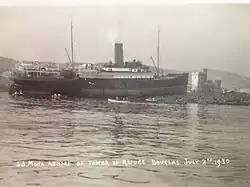 |
4 July
| Ship | State | Description |
|---|---|---|
| Knight of the Realm | United Kingdom
|
The cargo ship ran aground in the Paraná River 10 nautical miles (19 km) upstream of Rosario, Santa Fe, Argentina.[178] She was refloated on 11 July.[179] |
6 July
| Ship | State | Description |
|---|---|---|
| Karagjorgje | Yugoslavia
|
The passenger ship collided with Francesco Morosini ( Italy) off Pašman with the loss of four lives. She was beached and all passengers were taken off by Francesco Morosini.[175][180]
|
7 July
| Ship | State | Description |
|---|---|---|
| Dampto | Norway
|
The cargo ship collided with Hoten Maru ( Japan) off the Shandong Promontory, China and sank. Her crew was rescued.[181]
|
8 July
| Ship | State | Description |
|---|---|---|
| Greypoint | .svg.png) Nicaragua Nicaragua
|
The cargo ship caught fire at Twelve Mile Island, Alabama, United States.[182] She was a constructive total loss.[167] |
| Iwai Maru | Japan
|
The cargo ship ran aground off Notorosaki.[183] She was refloated on 12 July.[167] |
| Mac Hinery | United Kingdom
|
The cargo ship foundered in the Atlantic Ocean off Cape Breton Island, Nova Scotia, Canada.[182] |
10 July
| Ship | State | Description |
|---|---|---|
| Dolores | Spain
|
The auxiliary schooner foundered in the Mediterranean Sea off Portsay. Her crew survived.[184] |
| Yorkton | United Kingdom
|
The cargo ship collided with Mantadoc ( United Kingdom) in Whitefish Bay and sank.[179] She was refloated on 9 August.[185]
|
11 July
| Ship | State | Description |
|---|---|---|
| Clara Blanche | United States
|
The 15-gross register ton purse seiner was destroyed by fire in port at Tyee, Territory of Alaska. Her crew of four survived.[186] |
| Evangeline | United States
|
The cargo ship suffered an onboard explosion at Rockaway Point, New York. She was beached in the Rockaway Inlet and was destroyed by the subsequent fire.[184] |
| Lauretta Frances | United Kingdom
|
The schooner sprang a leak and foundered in the Atlantic Ocean 15 nautical miles (28 km) off Cape Anguille, Newfoundland. The crew survived.[179] |
12 July
| Ship | State | Description |
|---|---|---|
| Ascot | United Kingdom
|
The cargo ship ran aground in the Paraná River at Borghi, Argentina.[179] She was refloated on 15 July.[167] |
| Turuna | Portugal
|
The three-masted schooner was abandoned in the Atlantic Ocean (44°30′N 60°55′W / 44.500°N 60.917°W). She was set on fire by her crew, who were rescued by Coiborno (flag unknown).[179] |
14 July
| Ship | State | Description |
|---|---|---|
| Fawn | United Kingdom
|
The coaster struck a rock off Portnahaven, Islay and was beached.[187] She was refloated on 18 July.[188] |
| Kohatsu Maru | Japan
|
The cargo ship collided with Aeneas ( United Kingdom) in the East China Sea off Cape Shantung, China and sank.[187]
|
| Pengreep | United Kingdom
|
The cargo ship ran aground in the Paraná River 25 nautical miles (46 km) downstream of Rosario, Argentina.[187] She was refloated on 18 July.[189] |
18 July
| Ship | State | Description |
|---|---|---|
| El Hurd | United States
|
The 39-gross register ton, 60.3-foot (18.4 m) motor schooner was stranded in Chichagof Bay (55°39′N 160°14′W / 55.650°N 160.233°W) on the south coast of the Alaska Peninsula in the Territory of Alaska. Her crew of five survived. She was refloated a few days later, but her damage was discovered to be so severe that she was declared a total loss.[190] |
19 July
| Ship | State | Description |
|---|---|---|
| Aikoku Maru | Japan
|
The cargo ship sank at Nagasaki during a typhoon.[189] |
| Kalypso Vergotti | Greece
|
The cargo ship ran aground on the English Bank off Uruguay.[189] She was refloated on 1 August.[191] |
| Ryohi Maru | Japan
|
The cargo ship sank at Nagasaki during a typhoon.[189] |
| Targis | Germany
|
The cargo liner caught fire in the Atlantic Ocean and foundered (33°45′N 50°45′W / 33.750°N 50.750°W). All on board were rescued by Rangitata ( United Kingdom).[189][192]
|
21 July
| Ship | State | Description |
|---|---|---|
| Adele Traber | Germany
|
The cargo ship ran aground near the Pevna Lighthouse, Oulu, Finland.[193] She was refloated on 24 July.[194] |
| North Pacific | United Kingdom
|
The cargo ship ran aground in the Paraná River at Arroyo Seco, Santa Fe, Argentina.[193] She was refloated on 25 July.[194] |
22 July
| Ship | State | Description |
|---|---|---|
| Anna Barron | United States
|
The 82-gross register ton steam cannery tender was stranded on rocks while trying to moor to a dolphin off Ansley Point (58°12′30″N 135°07′10″W / 58.20833°N 135.11944°W) in Icy Strait in the Alexander Archipelago in Southeast Alaska. Her crew of seven survived, but she was deemed a total loss.[195] |
| Saint Hilda | United States
|
The dredger struck a submerged object and foundered at Tampico, Tamaulipas, Mexico, with the loss of two crew.[196] |
23 July
| Ship | State | Description |
|---|---|---|
| Dustu | France
|
The schooner struck a rock in the Bay of Biscay 5 nautical miles (9.3 km) off Lochtudy, Finistère and foundered.[197] |
| Raymond | Belgium
|
The coaster ran aground at Warkworth, Northumberland, United Kingdom.[197] She was refloated on 29 July.[198] |
28 July
| Ship | State | Description |
|---|---|---|
| Kronprins Gustav Adolf | Sweden
|
The cargo ship caught fire in the Atlantic Ocean 82 nautical miles (152 km) off Vitória, Brazil. She was consequently abandoned 14 nautical miles (26 km) south east of the Rio Doce Lighthouse.[199] The crew were rescued by Alphacea ( Netherlands) and Vandyck ( United Kingdom). She drifted ashore 60 nautical miles (110 km) north of Vitória and was a total loss.[198][200]
|
29 July
| Ship | State | Description |
|---|---|---|
| George J. Whalen | United States
|
The dredger foundered in Lake Erie six miles (9.7 km) off of Dunkirk, New York, 23 miles (37 km) east of Presque Isle. 15 crew were killed.[200][201][202] |
| Twin B | United States
|
The 9-gross register ton, 40-foot (12 m) fishing vessel was destroyed by fire while departing Port Althorp, Territory of Alaska. Her three-man crew survived.[129] |
30 July
| Ship | State | Description |
|---|---|---|
| Biyo Maru | Japan
|
The cargo ship ran aground off the Shiriyazaki Lighthouse, Honshu.[203] She was refloated on 24 August.[204] |
| Heijun Maru | Japan
|
The cargo ship ran aground off the Shiriyazaki Lighthouse.[203] She was refloated on 19 August.[205] |
31 July
| Ship | State | Description |
|---|---|---|
| Nerbudda | United Kingdom
|
The cargo ship collided with Legazpi ( Spain) in the Atlantic Ocean (36°22′N 3°24′W / 36.367°N 3.400°W) and was holed.[206] She was taken in tow by Nankin ( United Kingdom) and beached at Castle Ferro, Spain.[191][207] Nerbudda was refloated on 4 August and towed to Gibraltar.[208]
|
Unknown date
| Ship | State | Description |
|---|---|---|
| Cretefarm |  Spain Spain
|
The 180-foot (55 m) concrete barge was sunk at Candás harbour in Asturias, Spain, sometime in July.[209] |
August
1 August
| Ship | State | Description |
|---|---|---|
| Eastborough | United Kingdom
|
The cargo ship ran aground in the Paraná River, Argentina.[210] She was refloated on 7 August.[211] |
| Feltore | United States
|
The cargo ship ran aground at Cruz Grande, Mexico and was abandoned.[191][210] |
2 August
| Ship | State | Description |
|---|---|---|
| Thyland | Germany
|
The cargo ship collided with Hedwigshütte ( Germany) in the Kaiser Wilhelm Canal and was beached.[210]
|
3 August
| Ship | State | Description |
|---|---|---|
| Akashi | .svg.png) Imperial Japanese Navy Imperial Japanese Navy
|
The decommissioned coast defense ship was sunk as a target by Imperial Japanese Navy dive bombers in the Pacific Ocean south of Izu Ōshima. |
7 August
| Ship | State | Description |
|---|---|---|
| August Thyssen | Germany
|
The cargo ship came ashore at Alligator Pond, Jamaica.[211] She was refloated on 10 August.[185] |
| Svea |  Estonia Estonia
|
The sailing ship collided with Jupiter ( Estonia) at Stockholm, Sweden and sank with the loss of a crew member.[212]
|
| Tregenna | United Kingdom
|
The cargo ship ran aground at San Pedro de Macorís, Dominican Republic.[212] She was refloated on 15 August.[213] |
8 August
| Ship | State | Description |
|---|---|---|
| Avgy | Greece
|
The cargo ship caught fire in the Atlantic Ocean and put into Leixões, Portugal and was beached.[214][215] She was refloated on 29 August.[216] |
| Hochelaga | United Kingdom
|
The cargo ship was beached on one of the Magdalen Islands, Quebec, Canada having previously run aground in the Bird Islands, Northwest Territories.[214] Following storm damage on August 18, she was a total loss.[217] |
9 August
| Ship | State | Description |
|---|---|---|
| Sir Stafford Northcote | United Kingdom
|
The cargo ship collided with City of London ( United Kingdom) in the River Thames and sank.[218]
|
10 August
| Ship | State | Description |
|---|---|---|
| Caribou | United Kingdom
|
The passenger ship ran aground on Muse Island, Newfoundland. All passengers and crew took to the lifeboats.[215] She was a total loss.[185] |
12 August
| Ship | State | Description |
|---|---|---|
| Baltic |  Danzig Danzig
|
The tanker ran aground at Punta Indio, Argentina.[219] She was refloated on 16 August.[220] |
| Dalila | France
|
The cargo ship ran aground in the Charente at Tonnay-Charente, Charente-Maritime.[219] |
| Halley's Comet | United Kingdom
|
The schooner foundered off Bell Island, Newfoundland.[221] |
| Taitsu Maru | Japan
|
The cargo ship ran aground at Urusan, Korea.[213] She was still aground on 22 October.[222] |
13 August
| Ship | State | Description |
|---|---|---|
| Go Get | United States
|
The 29-gross register ton motor vessel was destroyed by fire while docked at the Kukak Bay Cannery on the south coast of the Alaska Peninsula in the Territory of Alaska. Her crew of four survived.[223] |
| Ryuho Maru No.1 | Japan
|
The cargo ship ran aground at Lopatka, Soviet Union.[221] She was refloated on 29 August.[216] |
15 August
| Ship | State | Description |
|---|---|---|
| Verna | .svg.png) United States United States
|
The 9-gross register ton 32.3-foot (9.8 m) fishing vessel was destroyed by fire in the Territory of Alaska at a place identified in contemporary accounts as "Point Rosalie," possibly a reference to Point Saint Rosalia (55°34′15″N 133°24′45″W / 55.57083°N 133.41250°W).[224] |
17 August
| Ship | State | Description |
|---|---|---|
| Angele | France
|
The sailing ship departed Cardiff, Glamorgan, United Kingdom for Pont-l'Abbé, Finistère. No further trace, presumed foundered with the loss of all hands.[225] |
| Tahiti | United Kingdom
|
.jpg) United States).[220][226][227] United States).[220][226][227]
|
18 August
| Ship | State | Description |
|---|---|---|
| Brilliant | United States
|
The coastal tanker suffered an onboard explosion and fire at Jacksonville, Florida and was a constructive total loss. Five crew were killed.[205][228] |
21 August
| Ship | State | Description |
|---|---|---|
| Ba | Norway
|
The cargo ship struck rocks at Guardiana, Portugal and sank. Her crew were rescued.[229] |
| Izaro | Spain
|
The cargo ship struck a rock and sank in the Mediterranean Sea off Cape Palos, Murcia.[230] |
| Saxon | United Kingdom
|
The 120.4-foot (36.7 m), 239.34-ton steam trawler was wrecked in a gale on Hough Skerries. She broke up between 22–25 August in heavy swells, a total loss. The crew rowed 5 miles (8.0 km) to shore in her boat to Tiree beach.[231] |
| Tami Maru | Japan
|
The cargo ship ran aground on the Shiretoko Peninsula.[230] She was refloated on 31 August.[232] |
22 August
| Ship | State | Description |
|---|---|---|
| Mitchell | United States
|
The 14-gross register ton motor vessel was stranded in fog on a reef off Fannie Island (58°02′45″N 133°47′10″W / 58.04583°N 133.78611°W) in Southeast Alaska, then destroyed by a fire that broke out during an attempt to refloat her. The only person on board survived.[233] |
23 August
| Ship | State | Description |
|---|---|---|
| Guine | Portugal
|
The cargo ship was wrecked at Bissau, Portuguese Guinea.[234] |
26 August
| Ship | State | Description |
|---|---|---|
| Daring | United Kingdom
|
The tug caught fire and sank in the Pacific Ocean off Vancouver Island, Canada with the loss of six crew.[235] |
27 August
| Ship | State | Description |
|---|---|---|
| Argentum | United Kingdom
|
The cargo ship ran aground at Nairn.[235] She was refloated on 23 September.[236] |
| Spica | Norway
|
The cargo ship ran aground on the Cerebus Shoal in the Strait of Canso.[237] She was declared a total loss on 10 September.[238] |
28 August
| Ship | State | Description |
|---|---|---|
| Neches | United States
|
The cargo ship collided with a scow off the Coney Island Lighthouse, New York Harbor and sank, as did the scow.[237] |
| Starck | Sweden
|
The cargo ship ran aground at Ulkogrunni, Finland and was beached.[237] She was refloated on 4 September.[239] |
31 August
| Ship | State | Description |
|---|---|---|
| Claretta | United Kingdom
|
The coaster collided with Borderland ( United Kingdom) in the Atlantic Ocean 11 nautical miles (20 km) of the Longships Lighthouse and sank. Her crew were rescued by Borderland.[240]
|
| Maroussio | Greece
|
The cargo ship ran aground at Injeh Burno, Turkey.[241] |
| Shoreham | United Kingdom
|
The coaster was in collision with Annik ( France) in the Atlantic Ocean 5 nautical miles (9.3 km) off Trevose Head, Cornwall and sank. Her crew were rescued by Annik.[240]
|
September
1 September
| Ship | State | Description |
|---|---|---|
| Fort Union | United States
|
Suffering from a rotten hull, the 2,654-ton, 267-foot (81.4 m) barge was beached deliberately for salvage purposes at Ship's Cove (56°15′20″N 134°39′45″W / 56.25556°N 134.66250°W) at Port Conclusion (56°16′01″N 134°39′44″W / 56.2669°N 134.6623°W) in Southeast Alaska. She subsequently was scrapped in situ.[242] |
| Orient | United States
|
The fishing vessel was sunk in a collision with Admiral Nulton ( United States) one-half mile (0.80 km) north north west of Sisters Island light, British Columbia. Ten killed.[243]
|
| Sunset | United States
|
During a voyage in the Kodiak Archipelago from Perenosa Bay (58°25′51″N 152°25′02″W / 58.4307°N 152.4173°W) on Afognak Island to Uyak Bay (57°48′00″N 154°04′00″W / 57.8000°N 154.0667°W) on Kodiak Island with a crew of three and a cargo of 15 tons of silver salmon, the 35-gross register ton, 56.3-foot (17.2 m) fishing vessel was wrecked without loss of life in Litnik Bay (58°01′30″N 152°44′00″W / 58.02500°N 152.73333°W) on the coast of Afognak Island.[87] |
2 September
| Ship | State | Description |
|---|---|---|
| St. Christophe | United Kingdom
|
The cargo ship was wrecked at Los Roques, Venezuela. The crew were rescued.[244] She was a total loss.[245] |
3 September
| Ship | State | Description |
|---|---|---|
| Assimacos | Greece
|
The cargo ship ran aground at Cape Silleiro, Spain.[246] She was declared a total loss on 16 September.[247] |
| Liny | Germany
|
The schooner was in collision with the steamer Hero ( United Kingdom) in the Weser in northwestern Germany and was beached.[239]
|
| Mimi | Germany
|
The schooner was in collision with the steamer Hero ( United Kingdom) in the Weser in northwestern Germany and was beached.[239]
|
| USC&GS Oceanographer |  United States Coast and Geodetic Survey United States Coast and Geodetic Survey
|
The ocean survey ship ran aground on the Lobster Rocks, Islesboro, Maine.[246] She was refloated, repaired, and returned to service. |
7 September
| Ship | State | Description |
|---|---|---|
| Chase | United States
|
Carrying a cargo of three tons of canned clams and coal and a crew of one, the 11-gross register ton, 38.8-foot (11.8 m) motor vessel departed Kodiak on Kodiak Island bound for Seward, Territory of Alaska, and was never heard from again. She disappeared without trace.[186] |
8 September
| Ship | State | Description |
|---|---|---|
| Bol | United States
|
The 25-gross register ton motor vessel was wrecked on Strawberry Bar (60°24′N 146°03′W / 60.400°N 146.050°W) on the south-central coast of the Territory of Alaska. Her crew of two abandoned ship in a skiff and survived.[248] |
| Innisinver | United Kingdom
|
The cargo ship struck submerged wreckage in the English Channel 5.5 nautical miles (10.2 km) south of Portland Bill, Dorset and sank. All crew survived.[249] |
| Maria M. | Greece
|
The cargo ship was severely damaged by fire at Drapetsona when benzine leaked from the tanker Donax ( United Kingdom) and caught fire. Seven other sailing vessels were destroyed by fire, and many others were damaged.[249]
|
| Mary Patricia | United Kingdom
|
The cargo ship was abandoned in the Atlantic Ocean off Cape Breton Island, Nova Scotia, Canada.[250] |
9 September
| Ship | State | Description |
|---|---|---|
| Tupy | Brazil
|
The cargo ship was wrecked 30 nautical miles (56 km) south of Vitória.[249] |
10 September
| Ship | State | Description |
|---|---|---|
| Malmesbury | United Kingdom
|
The cargo ship ran aground on the Jacob Reef, off the coast of South Africa and was abandoned. The crew were rescued.[238] She broke in tow on 16 September and was a total loss.[251] |
11 September
| Ship | State | Description |
|---|---|---|
| Edera | Italy
|
The cargo ship ran aground in the North Sea on Bollen Hinder Bank of the coast of the Netherlands.[252] She was refloated on 16 October.[253] |
13 September
| Ship | State | Description |
|---|---|---|
| Lorne, Pacific Gatherer |
United Kingdom
|
 The tug and barge collided with the Second Narrows Bridge, Vancouver, British Columbia, Canada and jammed under it. The rising tide eventually caused the collapse of the bridge,[254] which took four years to repair. |
| Nine | United Kingdom
|
The cargo ship ran aground on the Sealark Reef, Guadalcanal, Solomon Islands and was a total loss. The crew were rescued.[225] |
15 September
| Ship | State | Description |
|---|---|---|
| Owl | United States
|
The 14-gross register ton fishing vessel drifted onto a reef in Wide Bay (57°22′N 156°11′W / 57.367°N 156.183°W) on the south-central coast of the Territory of Alaska and was wrecked after a malfunctioning clutch caused her gasoline engine to break down. Her crew of three survived.[125] |
18 September
| Ship | State | Description |
|---|---|---|
| Alma | Germany
|
The schooner came ashore at Luleå, Sweden and was wrecked. Her crew were rescued.[255] |
| Goteborg | Sweden
|
The coaster ran aground north of Lysekil, Västra Götaland County and sank. All passengers and crew were rescued.[255] |
19 September
| Ship | State | Description |
|---|---|---|
| Kwalju Maru | Japan
|
The cargo ship ran aground in the Yangtze downstream of Antung, China. She broke in two and was a total loss.[225] |
| Llandilo | United Kingdom
|
The cargo ship ran aground on the Rabbit Islands, Turkey.[225] She was refloated on 29 September but again ran aground.[256] She was refloated again on 1 October.[257] |
| Tigris | Belgium
|
The cargo ship passed Dungeness, Kent, United Kingdom, bound for Alexandria, Egypt. No further trace, presumed foundered with the loss of all hands.[258] |
| Tréport | United Kingdom
|
The cargo ship ran aground on the Girdler Sands, in the North Sea off the Essex coast. The crew were rescued by Queen of Thanet ( United Kingdom) and the Margate Lifeboat. She was a total loss.[225]
|
20 September
| Ship | State | Description |
|---|---|---|
| Madeleine Tristan | France
|
The three-masted schooner was driven ashore at Chesil Beach, Dorset, United Kingdom and was wrecked. All seven crew were rescued.[259] |
| Theodoros Bulgaris | Greece
|
The cargo ship lost her steering gear in a storm in the Atlantic Ocean (46°48′N 6°43′W / 46.800°N 6.717°W). She was abandoned at 47°15′N 6°20′W / 47.250°N 6.333°W, the crew were rescued by Advocate ( United Kingdom).[259] Theodoris Bulgaris was towed into Brest, Finistère, France on 23 September by Livadia ( Germany).[236]
|
21 September
| Ship | State | Description |
|---|---|---|
| Foxhon | Netherlands
|
The coaster foundered in the Thames Estuary with the loss of three of the five people on board. Survivors were rescued by the trawler Notre Dame des Ardents ( France).[260]
|
22 September
| Ship | State | Description |
|---|---|---|
| Ida | Belgium
|
The coaster ran aground at Prawle Point, Devon, United Kingdom in dense fog. All twelve crew were rescued.[261] She broke in two on 9 October,[262] and had broken up by November.[263] |
23 September
| Ship | State | Description |
|---|---|---|
| City of Osaka | United Kingdom
|
The cargo ship ran aground 6 nautical miles (11 km) south of Buchanness, Aberdeenshire. The crew were rescued by HMS Walker ( Royal Navy) or breeches buoy.[236]
|
| Deerhound | Belgium
|
The cargo ship ran aground in the River Humber, United Kingdom. She was refloated and was then hit by Lakewood ( United Kingdom) and sank.[41][236]
|
| Eagle | United States
|
While laid up on the gridiron in Odiak Slough (60°32′30″N 145°46′00″W / 60.54167°N 145.76667°W) – where she had lain since July 1930 – near Cordova, Territory of Alaska, with no one aboard, the single-masted motor vessel was destroyed by a storm.[190] |
| Matsqui | United Kingdom
|
The cargo ship caught fire off Vancouver, British Columbia, Canada and was beached.[264] |
24 September
| Ship | State | Description |
|---|---|---|
| Chance | United States
|
During a voyage in the Territory of Alaska from Juneau to Sitka, the 16-gross register ton motor vessel was destroyed by fire off Marmion Island (58°11′55″N 134°15′25″W / 58.1986°N 134.2569°W) in Southeast Alaska. The only person aboard abandoned ship in a small boat and reported Chance′s burned-out hull aground above the high-water mark between Marmion Island and Douglas Island.[186] |
| Kasugayama Maru | Japan
|
The cargo ship ran aground on Sakhalin in the Soviet Union and was wrecked.[265] |
| Taniwha | United Kingdom
|
The cargo ship sank at Puriri, New Zealand.[264] |
25 September
| Ship | State | Description |
|---|---|---|
| Katingo | Greece
|
The cargo ship ran aground at Nagara Point, Turkey.[266] She was refloated on 28 September.[265] |
26 September
| Ship | State | Description |
|---|---|---|
| Agnesina | Italy
|
The brigantine was abandoned in the Mediterranean Sea (36°22′N 19°56′E / 36.367°N 19.933°E). All nine people on board were rescued by Lalandia ( Denmark).[265][267]
|
| Doris | United Kingdom
|
The schooner came ashore at the mouth of the River Tees, County Durham. Her crew were rescued.[268] She broke her back the next day and was a total loss.[265] |
| Margarita | United Kingdom
|
The cargo ship collided with Nueva Señora del Carmen ( Spain) in the Strait of Gibraltar and was beached in Gibraltar Bay.[269] She was refloated the next day.[256]
|
| North Shore | United States
|
The gas steamer sank in Lake Michigan between Benton Harbor, Michigan and Milwaukee, Wisconsin, in a gale. Wreckage found floating 30 miles (48 km) north of Racine, Wisconsin. Lost with her captain, his wife and all five hands.[270][271] |
28 September
| Ship | State | Description |
|---|---|---|
| Vibert T Shave | United Kingdom
|
The schooner collided with Haugarland ( Norway) in the Atlantic Ocean 3 nautical miles (5.6 km) off Ferryland, Newfoundland with the loss of five of the six people on board.[265][272]
|
29 September
| Ship | State | Description |
|---|---|---|
| Princess Lena | United States
|
The 10-gross register ton, 29.8-foot (9.1 m) motor vessel broke loose from her mooring to a barge during a gale and was wrecked on Mansfield Peninsula (58°14′46″N 134°49′14″W / 58.2461°N 134.8206°W) on the coast of Southeast Alaska 1 nautical mile (1.9 km; 1.2 mi) south of Horse Island (58°15′06″N 134°43′33″W / 58.2517°N 134.7258°W) abreast of Douglas Island. The only person aboard survived.[91] |
Unknown date
| Ship | State | Description |
|---|---|---|
| South Coast | United States
|
The steamer sank in the Pacific Ocean between Coos Bay, Oregon and Crescent City, California possibly between Brookings and Gold Beach after leaving port on 14 or 16 September. Wreckage found later indicated she broke up on rocks. Lost with all 19 hands.[273][274] |
October
2 October
| Ship | State | Description |
|---|---|---|
| Elmo II | United States
|
With her captain ashore and only one crewman aboard, the 8-gross register ton motor vessel drifted ashore and broke up at Comet, Territory of Alaska, after her anchor line broke during a gale. The crewman escaped unharmed.[190] |
3 October
| Ship | State | Description |
|---|---|---|
| Fort McPherson | United Kingdom
|
The cargo ship came ashore in the Richardson Islands, Northwest Territories, Canada, and was wrecked.[275] |
5 October
| Ship | State | Description |
|---|---|---|
| Lottie May | United Kingdom
|
The schooner was destroyed by fire in the Bay d'Espoir, Newfoundland. The crew survived.[276] |
6 October
| Ship | State | Description |
|---|---|---|
| Bamfield | United Kingdom
|
The cargo ship collided with the steamer Princess Joan ( United Kingdom) in the Pacific Ocean off Discovery Island, British Columbia, Canada, and sank.[276]
|
9 October
| Ship | State | Description |
|---|---|---|
| Agnes | Norway
|
The cargo ship broke free from her moorings in a storm at Haugesund, Norway, and sank.[262] |
| Allende | United Kingdom
|
The cargo ship ran aground at Mokha, Aden Protectorate.[262] She was refloated on 13 October.[258] |
11 October
| Ship | State | Description |
|---|---|---|
| Lutetian | United Kingdom
|
The tanker ran aground on Margarita Island, Venezuela.[277] She was refloated on 16 October.[278] |
| Mersey Rose | United Kingdom
|
The cargo ship collided with the steamer Gleneden ( United Kingdom) in the English Channel off St. Catherine's Point, Isle of Wight (50°01′N 2°04′W / 50.017°N 2.067°W), England, and sank. Gleneden rescued her crew.[277]
|
13 October
| Ship | State | Description |
|---|---|---|
| Corapeake | United States
|
The schooner collided with a number of scows at Norfolk, Virginia, and sank.[258] |
| Tiffon | Estonia
|
The schooner came ashore at Säkkijärvi, Finland, and was wrecked. Her crew were rescued.[258] |
14 October
| Ship | State | Description |
|---|---|---|
| Faustina | United Kingdom
|
The schooner sprang a leak in the Atlantic Ocean and was abandoned at 41°42′N 24°51′W / 41.700°N 24.850°W. The steamer Wearwood ( United Kingdom) rescued her crew.[279]
|
15 October
| Ship | State | Description |
|---|---|---|
| Defiance | United States
|
During a voyage in the Territory of Alaska from Nome to Kotzebue, the 7-gross register ton, 37-foot (11.3 m) motor lighterage vessel sank in bad weather in Kotzebue Sound near Cape Blossom. The steamer Arthur J. Baldwin ( United States) rescued her crew of four.[110]
|
| Demokratia | Greece
|
The cargo ship ran aground off the Leander's Tower, Istanbul, Turkey.[279] She was refloated on 22 October.[280] |
16 October
| Ship | State | Description |
|---|---|---|
| Antonin del Collado | Italy
|
The passenger ship collided with the steamer Hallmoor ( United Kingdom) in the Atlantic Ocean 10 nautical miles (19 km) off Mariel, Cuba, and sank. Hallmoor rescued all on board.[278]
|
17 October
| Ship | State | Description |
|---|---|---|
| Elkhound | United Kingdom
|
The tanker was destroyed by fire at Thameshaven, Essex, england.[281] |
19 October
| Ship | State | Description |
|---|---|---|
| Millie | United Kingdom
|
The Thames barge foundered in the Thames Estuary in England. The steamer Baltrader ( United Kingdom) rescued her crew of two.[282]
|
21 October
| Ship | State | Description |
|---|---|---|
| Fito | Spain
|
The cargo ship collided with another vessel 12 nautical miles (22 km) east of Sálvora, Galicia, Spain, and sank.[283] |
22 October
| Ship | State | Description |
|---|---|---|
| Zannis Xenios | Greece
|
The cargo ship ran aground on Seskli island in the Aegean Sea and sank. Her crew survived.[284] |
24 October
| Ship | State | Description |
|---|---|---|
| Kong Ragnar | Norway
|
The cargo ship came ashore at Randøy, Norway, and sank with the loss of six crew.[283] |
| Ortona | United Kingdom
|
The cargo ship ran aground in the River Tees at Middlesbrough, Yorkshire, England.[283] She was refloated on 8 November.[285] |
25 October
| Ship | State | Description |
|---|---|---|
| Sonnia | United Kingdom
|
The cargo ship foundered 7 nautical miles (13 km) northeast of The Skerries, Isle of Anglesey. The crew took to the lifeboats and landed at Moelfre, Anglesey, England. Her captain was rescued by the fishing trawler Jeanne ( Belgium).[286]
|
| HDMS Triton |  Royal Danish Navy Royal Danish Navy
|
The Æger-class submarine was severely damaged by an onboard explosion. Subsequently repaired and returned to service.[287] |
28 October
| Ship | State | Description |
|---|---|---|
| Andalusia | Italy
|
The cargo ship ran aground at Tønsnesskjæret, Troms, Norway.[288] She was refloated on 2 November.[289] |
31 October
| Ship | State | Description |
|---|---|---|
| Rahra | United Kingdom
|
The three-masted auxiliary schooner ran aground on Danger Island in the Cook Islands and was wrecked.[290] |
November
1 November
| Ship | State | Description |
|---|---|---|
| Ascot | United Kingdom
|
The cargo ship ran aground at Quequon, Argentina.[291] She was refloated on 9 November.[292] |
| Choshun Maru | Japan
|
The passenger ship ran aground on Green Island, Hong Kong. The passengers and crew were taken off.[289] |
2 November
| Ship | State | Description |
|---|---|---|
| Commandant Marchand | France
|
The schooner capsized in the Bristol Channel off Cardiff, Glamorgan, United Kingdom.[289] |
| Ethel | United Kingdom
|
The cargo ship ran aground at Bideford, Devon.[291] She was refloated on 5 November.[293] |
| Helmsdale | United Kingdom
|
The cargo ship ran aground on Als, Denmark.[291] She was refloated on 6 November.[294] |
| Julia | United Kingdom
|
The schooner ran aground at The Needles, Isle of Wight. She was refloated on 10 November.[292] |
| Ma Gondole | France
|
The cargo ship foundered in the English Channel off Portland Bill, Dorset, United Kingdom. Three crew were rescued by Josephine Charlotte ( Belgium).[289]
|
| Menelaos | Greece
|
The cargo ship (1,588 GRT, 1898) was abandoned in the English Channel about 6 nautical miles (11 km) south south west of Selsey Bill, Sussex, United Kingdom. Her crew were rescued by Canute and Naperian (both United Kingdom).[289]
|
5 November
| Ship | State | Description |
|---|---|---|
| Seven Seas Trader | United Kingdom
|
The cargo ship was driven ashore at Trapani, Sicily, Italy.[293] She was refloated on 11 November.[295] |
6 November
| Ship | State | Description |
|---|---|---|
| Hakusan Maru | Japan
|
The cargo ship collided with Benmacdhui ( United Kingdom) at Kobe and was beached.[296] She was refloated on 8 November.[285]
|
| Hermione | United Kingdom
|
The tanker ran aground at Kara Point, Greece.[296] She was refloated on 10 November.[295] |
| Seiyo Maru | Japan
|
The cargo ship lost her rudder in the Pacific Ocean (50°30′N 176°48′E / 50.500°N 176.800°E) and was abandoned in a sinking condition. Her crew were rescued by Shiraha Maru ( Japan).[296]
|
7 November
| Ship | State | Description |
|---|---|---|
| Santa Rita | Italy
|
The cargo ship ran aground at the mouth of the Adour river, Bayonne, Basses-Pyrénées, France and broke her back. She was a total loss.[285] |
| Tamiahua | United States
|
The tanker ran aground off the Pigeon Point Lighthouse, California. She was refloated on 26 November.[297] |
8 November
| Ship | State | Description |
|---|---|---|
| Brooklyn | United States
|
The coaster was disabled when her engine room filled with water crossing the bar at Eureka, California. She drifted ashore three miles (4.8 km) up the coast and broke up in heavy surf. 17 crewmen and 1 stowaway were killed, there was 1 survivor.[298] |
| Dunham Wheeler | United States
|
The schooner foundered in the Atlantic Ocean off Cape Canaveral, Florida. Ten crew were rescued by Aztec ( Honduras).[295]
|
| Kenton | United Kingdom
|
The cargo ship ran aground at Akban Liman, Turkey.[285] She was refloated on 16 November.[299] |
| Northern Light | United States
|
The barge, a former freighter, foundered in a storm off Key Largo in the Florida Keys after losing her tow. Five crew were killed and one was rescued by the tugboat Ontario.[300] |
| Olive Moore | United Kingdom
|
The schooner foundered in the Atlantic Ocean (35°35′N 15°50′W / 35.583°N 15.833°W). Six crew were rescued by Montello ( Italy).[285][295]
|
9 November
| Ship | State | Description |
|---|---|---|
| Laura | United States
|
The 8-gross register ton fishing vessel drifted ashore and broke up near Grindall Point (55°27′10″N 132°09′15″W / 55.45278°N 132.15417°W) outside of Kasaan Bay (55°29′50″N 132°19′10″W / 55.4972222°N 132.3194444°W) in Southeast Alaska after her anchor chain broke in a gale. The only person aboard survived.[62] |
| Stralsund | Germany
|
The coaster passed Dover, Kent, United Kingdom bound for Gothenburg, Sweden. No further trace. Presumed foundered in the North Sea off Sylt, Schleswig-Holstein, where a lifeboat washed up on 15 November.[301] |
| Tanja | Sweden
|
The coaster departed the Free City of Danzig for Trollhättan. No further trace, presumed foundered with the loss of all hands.[302] |
10 November
| Ship | State | Description |
|---|---|---|
| Ilford | United Kingdom
|
The cargo ship ran aground at São Vicente, Cape Verde Islands, Portugal.[295] She was refloated on 14 November.[303] |
| Linkmoor | United Kingdom
|
The cargo ship ran aground at Skarfskerry Head, Caithness. All crew were rescued.[292] She was declared a total loss on 19 November.[304] |
| Teifi | United Kingdom
|
The cargo ship struck a submerged object in the Bristol Channel off Cardiff, Glamorgan and sank. Her crew survived. She may have struck the wreck of the French schooner Commandant Marchand.[292] |
11 November
| Ship | State | Description |
|---|---|---|
| Moyalla | United Kingdom
|
The coaster ran aground at Ballina, County Mayo, Ireland.[295] She was refloated on 10 December.[305] |
12 November
| Ship | State | Description |
|---|---|---|
| Else | Denmark
|
The coaster ran aground in the Kattegat off Hjelm and sank.[290] |
| Glenarch | United Kingdom
|
The cargo ship ran aground in the Penfeld at Brest, Finistère, France.[306] She was refloated on 16 November.[299] |
| Joyce Llewellyn | United Kingdom
|
The cargo ship came ashore on the west coast of Ven, Sweden.[306] She was refloated on 16 November.[307] |
| Sahara | Spain
|
The schooner collided with the trawler Santa Eulala ( Spain) in the Atlantic Ocean off Las Palmas, Canary Islands and sank. Her crew were rescued by Santa Eulala.[306]
|
13 November
| Ship | State | Description |
|---|---|---|
| Yero Callas | Greece
|
The ship was driven ashore at Cape Upright, Chile. She was on a voyage from Montevideo, Uruguay to Valparaiso, Chile. Yero Callas was refloated on 6 December.[308][309] |
14 November
| Ship | State | Description |
|---|---|---|
| Doreena | United Kingdom
|
The Thames barge collided with Camberwell ( United Kingdom) in the River Thames and sank with the loss of a crew member.[310]
|
| Laimons | Latvia
|
The cargo ship ran aground on the Curonian Spit. Her crew were rescued.[307] |
| Margherita Madre | Italy
|
The schooner was abandoned in the Tyrrhenian Sea 2 nautical miles (3.7 km) off Punta Imperatore, Ischia.[303] |
| Yero Carras | Greece
|
The cargo ship came ashore at Cape Upright, Chile. She was declared a total loss on 18 November,[303][311] but was refloated on 6 December and beached at Baker Cove.[312][313] |
15 November
| Ship | State | Description |
|---|---|---|
| Anglesea Rose | United Kingdom
|
The cargo ship ran aground at Yarmouth, Isle of Wight.[307] She was refloated on 18 November.[314] |
| Laura | Chile
|
The full-rigged ship was wrecked in Cucao Lake, Chiloé Island with the loss of all but eight crew.[307] |
16 November
| Ship | State | Description |
|---|---|---|
| Brière | France
|
The cargo ship ran aground north east of Brest, Finistère.[307] She broke in two on 20 November and was a total loss.[301] |
| Hursley | United Kingdom
|
The coaster ran aground on the Goodwin Sands, Kent and sank. Six crew were rescued by the Ramsgate Lifeboat. |
| Ronald M. Douglas | United Kingdom
|
The schooner was abandoned in the Atlantic Ocean (33°22′N 49°12′W / 33.367°N 49.200°W). She was set on fire by her crew, who were rescued by Murex ( United Kingdom).[299]
|
17 November
| Ship | State | Description |
|---|---|---|
| Trevellas | United Kingdom
|
The auxiliary three masted schooner departed Port Talbot, Glamorgan for New Ross, County Wexford, Ireland. No further trace, presumed foundered with the loss of all hands.[315] |
18 November
| Ship | State | Description |
|---|---|---|
| Rosie | United States
|
While beached for repairs on Goose Island (60°43′N 146°43′W / 60.717°N 146.717°W) in Prince William Sound on the south-central coast of the Territory of Alaska, the 9-gross register ton, 33.4-foot (10.2 m) fishing vessel went adrift during a gale and broke up on the shore of the island. The only person aboard survived.[316] |
19 November
| Ship | State | Description |
|---|---|---|
| Continental Freighter | United Kingdom
|
The cargo ship collided with Hebble ( United Kingdom) in the Scheldt at Antwerp, Belgium and sank.[314] She was refloated on 4 December.[317]
|
| Highland Hope | United Kingdom
|
The ocean liner ran aground on Farilhões Island, Berlengas, Portugal and was a total loss. All on board were rescued by a Portuguese Navy vessel and Portuguese fishing boats.[301][302][318] |
| J. H. Barrow | United Kingdom
|
The schooner was driven ashore in the River Severn at Oldbury-on-Severn, Gloucestershire.[314] She was refloated on 22 November.[319] |
| Ovidia | Sweden
|
The cargo ship sprang a leak in the Atlantic Ocean 400 nautical miles (740 km) south east of Cape Race, Newfoundland (42°00′N 50°55′W / 42.000°N 50.917°W) and was abandoned. Twenty-eight people and the ship's cat were rescued by Mauretania ( United Kingdom).[304][318][320]
|
20 November
| Ship | State | Description |
|---|---|---|
| Dronning Sophie |  Ireland Ireland
|
The coal hulk sank at Queenstown, County Cork.[301] |
| Ida Adams | United Kingdom
|
The 125-foot (38 m), 275-ton steam trawler was wrecked in fog on Frenchman's Rocks, or Fisherman's Rocks, northwest of Portnahaven, Rinns of Islay and then slipped off into deeper water. The crew rowed 4 miles (6.4 km) to shore in her boat.[321][322] |
| Kenkon Maru No.8 | Japan
|
The cargo ship ran aground off Dalozaki and broke in two. She was a total loss.[301][323] |
| Verena | Netherlands
|
The auxiliary schooner came ashore at Cape Arkona, Mecklenburg-Vorpommern, Germany and was wrecked. Her crew were rescued.[301] |
21 November
| Ship | State | Description |
|---|---|---|
| Ruperra | United Kingdom
|
The cargo ship ran aground in Angle Bay, Pembrokeshire.[302] She was refloated on 5 December.[324] |
| Sunko Maru | Japan
|
The coaster caught fire and sank off in the Pacific Ocean off Tosa Province.[319] |
| Teresa | United States
|
The 8-gross register ton, 30-foot (9.1 m) fishing vessel sank near Khaz Head (57°31′45″N 136°01′00″W / 57.52917°N 136.01667°W) in Southeast Alaska during a storm. The vessel Estebeth ( United States) rescued all four people who had been aboard Teresa.[129]
|
23 November
| Ship | State | Description |
|---|---|---|
| Luise Leonhardt | Germany
|
The cargo ship was driven on the Grosser Vogel sandbank, in the North Sea off the mouth of the Elbe and sank with the loss of all 31 crew.[325] |
24 November
| Ship | State | Description |
|---|---|---|
| Krysanthi Patera | Greece
|
The cargo ship caught fire in the Atlantic Ocean 75 nautical miles (139 km) off Cristóbal, Colón, Panama and was abandoned. All crew were rescued by Trevean ( United Kingdom) before she sank.[325]
|
| HMAS Torrens | Royal Australian Navy
|
The River-class torpedo-boat destroyer was sunk in the Tasman Sea off Australia's Sydney Heads by a gelignite charge after use as a gunnery target during the day. |
25 November
| Ship | State | Description |
|---|---|---|
| Anna Helen | United States
|
During a voyage via the Inland Passage from Seattle, Washington, to the Territory of Alaska, the 80-gross register ton motor yacht was destroyed by fire in Discovery Passage 8 nautical miles (15 km; 9.2 mi) west of Seymour Narrows on the coast of British Columbia in Canada. He crew of four survived, but she was deemed a total loss.[195] |
| Citta di Trani | United Kingdom
|
The auxiliary schooner was wrecked in the Abaco Islands.[326] |
29 November
| Ship | State | Description |
|---|---|---|
| Lütt | Germany
|
The auxiliary three-masted schooner capsized in the Baltic Sea off Rugenwalde, Western Pomerania.[327] She was towed into Swinemüne on 9 December.[328] |
30 November
| Ship | State | Description |
|---|---|---|
| Perez | Spain
|
The schooner was driven ashore at Valencia and was wrecked. Her crew were rescued.[327] |
Unknown date
| Ship | State | Description |
|---|---|---|
| Seiyo Maru | Japan
|
The 405-foot (123 m) 6,550-ton cargo ship was abandoned on 4 November after losing her rudder and listing in a typhoon south of the Aleutian Islands in the Pacific Ocean on 2 November. Her crew were rescued by Shiraha Maru ( Japan).[329][330]
|
December
1 December
| Ship | State | Description |
|---|---|---|
| Georges Philippar | France
|
The ocean liner caught fire at Saint-Nazaire, Loire-Inférieure whilst being fitted out. She was completed in January 1932 and was lost on her maiden voyage. |
2 December
| Ship | State | Description |
|---|---|---|
| Asmund | Norway
|
The cargo ship ran aground at Holyhead, Anglesey, United Kingdom.[331] She sank on 7 December.[332] |
| Southland | United States
|
The retired 1,521-gross register ton cargo liner was burned and scuttled as a means of disposal in 160 feet (49 m) of water off Scituate, Massachusetts.[333][334] |
3 December
| Ship | State | Description |
|---|---|---|
| Hedwig | Netherlands
|
The cargo ship ran aground on a coral reef off Pratas Island (approximately 20°N 116°E / 20°N 116°E) and was wrecked.[335][336] |
| Linton | United Kingdom
|
The coaster was wrecked at Cape Forchu, Yarmouth, Nova Scotia, Canada with the loss of all eight crew.[335] |
4 December
| Ship | State | Description |
|---|---|---|
| Alda | Spain
|
The cargo ship ran aground at Navia, Asturias.[317] She was refloated on 9 December.[337] |
5 December
| Ship | State | Description |
|---|---|---|
| Dazzle | United Kingdom
|
The auxiliary schooner was abandoned 8 nautical miles (15 km) off Ramea, Newfoundland. Her crew were rescued.[275] |
| Yselhaven | Netherlands
|
The cargo ship collided with Oakland ( United Kingdom) in the Weser at Nordenham, Germany and was beached.[338] She was refloated on 9 December.[337]
|
7 December
| Ship | State | Description |
|---|---|---|
| Irene B | United States
|
During a gale, large waves struck the 7-gross register ton motor vessel while she was hauled out on the beach 0.5 miles (0.8 km) south of Wrangell, Territory of Alaska, and broke her up.[339] |
8 December
| Ship | State | Description |
|---|---|---|
| Artiglio | Italy
|
The salvage vessel was sunk in the Bay of Biscay between Belle Île and Houat, Morbihan, France by the explosion of munitions on board Florence H ( United States), which she was salvaging, with the loss of fourteen of her nineteen crew. Survivors were rescued by Rostro ( Italy).[340][341]
|
| Belle (or Bell E) | United States
|
The 8-gross register ton motor vessel sank abreast of Spire Island (55°16′10″N 131°30′00″W / 55.26944°N 131.50000°W) in Southeast Alaska after the flywheel flew off her gasoline engine and punched a hole in her hull below the waterline. The only person aboard abandoned ship in a skiff and survived.[248] |
10 December
| Ship | State | Description |
|---|---|---|
| Don Carlos | Argentina
|
The coaster sank in the Uruguay River, Buenos Aires with the loss of one of her eleven crew.[305][342] |
| Empress of Scotland | United Kingdom
|
The ocean liner was gutted by fire at a shipbreakers' yard in Blyth, Northumberland. She broke in two and sank. Scrapping was completed in 1933. |
| Hilda | United Kingdom
|
The barquentine collided with the trawler Kudos ( United Kingdom) in the North Sea 15 nautical miles (28 km) off Hartlepool, County Durham and sank. All six crew were rescued by Kudos.[343]
|
| Vialle Montagne III | Sweden
|
The cargo ship collided with Kresnamn ( Germany) at Gothenburg and sank.[305]
|
11 December
| Ship | State | Description |
|---|---|---|
| Amy G. McKean | United Kingdom
|
The schooner sprang a leak in the Atlantic Ocean (50°25′N 20°08′W / 50.417°N 20.133°W). She was set on fire and abandoned by her crew, who were rescued by Strasan ( Sweden).[342]
|
| Saltwick | United Kingdom
|
The cargo ship ran aground in the Paraná River, Argentina.[342] She was refloated on 14 December.[344] |
| Schlesien | Germany
|
The ocean liner ran aground in the Kii Channel.[342] She was refloated on 15 December.[344] |
12 December
| Ship | State | Description |
|---|---|---|
| Oberon |  Finland Finland
|
The passenger steamer collided with the passenger steamer Arcturus ( Finland) in fog in the Kattegat and sank in three minutes with the loss of 41 passengers and crew.[345][346]
|
13 December
| Ship | State | Description |
|---|---|---|
| Nordo | Finland
|
The auxiliary sailing ship ran aground on Svanegrunden, Kattegat. Her crew were rescued.[344] |
15 December
| Ship | State | Description |
|---|---|---|
| Chapel Point | United Kingdom
|
The auxiliary schooner was abandoned in the Pacific Ocean off Punta Colonet, Baja California Mexico, and was a total loss.[344] |
| Chester L | United States
|
The 11-gross register ton motor vessel caught fire and, after a hole was cut in her bow to douse the flames, was towed to the beach 6 nautical miles (11 km; 6.9 mi) southeast of Boss Island (56°30′N 134°12′W / 56.500°N 134.200°W) in Southeast Alaska, where she sank. The only person aboard survived.[186] |
| Warren M. Colp | United Kingdom
|
The schooner came ashore at Burnt Point, Newfoundland and was wrecked with the loss of four of her six crew.[347] |
16 December
| Ship | State | Description |
|---|---|---|
| Gipsy Queen | United Kingdom
|
The schooner was abandoned in the Atlantic Ocean off the coast of Newfoundland. Her crew survived.[348] |
| Thraki | Greece
|
The cargo ship ran aground at Kavala, Greece.[347] She was refloated on 21 December.[349] |
17 December
| Ship | State | Description |
|---|---|---|
| Alice | United States
|
While the 11-gross register ton motor vessel was anchored in the Karta River (55°34′N 132°34′W / 55.567°N 132.567°W) in Southeast Alaska, she caught fire when her gasoline engine backfired. The fire went out of control, and she burned to the waterline and sank in 48 to 54 feet (14.6 to 16.5 m) of water. There was no loss of life.[195] |
18 December
| Ship | State | Description |
|---|---|---|
| Ceramic | United Kingdom
|
The ocean liner collided with the cargo ship Laguna ( United Kingdom) in the River Thames near Gravesend, England. Both ships suffered sight damage.[350]
|
| Christos Sigalas | Greece
|
The cargo ship sprang a leak in the Atlantic Ocean (approximately 33°N 69°W / 33°N 69°W) and was abandoned in a sinking condition. Her crew were rescued by Monfiore ( Italy).[351]
|
| Cremon | Germany
|
The cargo ship was beached at Üto.[351] |
19 December
| Ship | State | Description |
|---|---|---|
| Oberon | Finland
|
The ferry collided with Arcturus ( Finland) in the Kattegat off Læsø, Denmark and sank with the loss of 42 of the 82 people on board. Survivors were rescued by Arcturus.[352]
|
20 December
| Ship | State | Description |
|---|---|---|
| Glen Derry | United Kingdom
|
The cargo ship caught fire in the North Sea off Happisburgh, Norfolk and was abandoned. Her crew were rescued by Heworth ( United Kingdom). Glen Derry later sank.[353]
|
21 December
| Ship | State | Description |
|---|---|---|
| Oinoussios | Greece
|
The cargo ship ran aground at Nicolaeff, Ukraine.[354] She was refloated on 29 December.[355] |
| Rio Azul | United Kingdom
|
The cargo ship collided with Hopatcong ( United States) at Istanbul, Turkey and was beached.[353]
|
22 December
| Ship | State | Description |
|---|---|---|
| Lucy | United Kingdom
|
The cargo ship ran aground at Kettleness, Yorkshire and was abandoned. The crew were rescued by the Whitby Lifeboat.[356][357] |
| Malve | Finland
|
The cargo ship ran aground at Knollen Drogden.[349] |
| Sonja | Norway
|
The cargo ship ran aground at Ronglevær, Norway.[349] She was refloated on 29 December.[354] |
| Suffolk Coast | United Kingdom
|
The coaster ran aground at King's Lynn, Norfolk.[349] She was refloated on 5 January 1931.[358] |
24 December
| Ship | State | Description |
|---|---|---|
| Uad Ras | Spanish Navy
|
The Uad Ras-class naval trawler was wrecked on this date. |
27 December
| Ship | State | Description |
|---|---|---|
| Queenmoor | United Kingdom
|
The cargo ship caught fire in the Indian Ocean and was abandoned by her crew. She was towed into Aden by Preserver ( United Kingdom).[357]
|
29 December
| Ship | State | Description |
|---|---|---|
| Branch Railway | United Kingdom
|
The schooner was driven ashore at Cock's Cove, St. Mary's Bay, Newfoundland and was wrecked.[359] |
31 December
| Ship | State | Description |
|---|---|---|
| Stela | .svg.png) Egypt Egypt
|
The cargo ship sprang a leak in the Aegean Sea off Levitha, Greece (36°46′N 28°46′E / 36.767°N 28.767°E) and was abandoned.[355][360] She sank 8 nautical miles (15 km) east of Astypalaia.[361] |
| Theodoris Bulgaris | Greece
|
The cargo ship sprang a leak in the Atlantic Ocean and was abandoned (45°31′N 6°00′W / 45.517°N 6.000°W). Her crew survived.[355] |
Unknown date
| Ship | State | Description |
|---|---|---|
| Aklavik | Canada
|
The 60-foot (18.3 m) sailing vessel sank in Bernard Harbour on the coast of the Northwest Territories in Canada due to damage she suffered while in winter lay-up there. She was refloated, repaired, and returned to service.[362] |
| Baymaud | United Kingdom
|
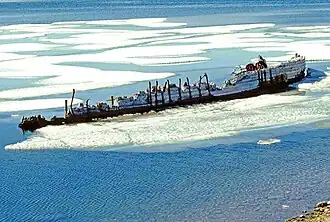 The auxiliary three-masted schooner sank in Cambridge Bay, Northwest Territories, Canada. |
| City of Taunton | United States
|
The 292-foot (89 m) cargo ship, a sidewheel paddle steamer, was beached and abandoned at Somerset, Massachusetts, on the west bank of the Taunton River at 41°42′39″N 071°10′33″W / 41.71083°N 71.17583°W, just south of the future site of the Charles M. Braga Jr. Memorial Bridge, sometime during the 1930s. The wreck settled on the river bottom in very shallow water.[363] |
| F. C. Pendleton | United States
|
The 145-foot (44 m), 408-gross register ton three-masted schooner burned and sank without loss of life in up to 45 feet (14 m) of water at 44°19′38″N 068°54′27″W / 44.32722°N 68.90750°W while at anchor in Seal Harbor at Islesboro, Maine, sometime during the 1930s.[364] |
| Gardner G. Deering | United States
|
The 251-foot (77 m), 1,982-gross register ton five-masted schooner was abandoned and later burned in Smith Cove off West Brooksville, Maine, sometime during the 1930s. Her wreck settled in 10 to 30 feet (3.0 to 9.1 m) of water approximately 500 feet (150 m) off the north shore of the cove at 44°22′55″N 068°46′30″W / 44.38194°N 68.77500°W.[365] |
| Half Moon | United States
|
The yacht sank in the Atlantic Ocean off Key Biscayne, Florida. |
| HMS Peterel | Royal Navy
|
The river gunboat ran aground in the Yangtze. She was refloated and returned to service. |
| Unknown | United States
|
 |
References
- ^ "Another wreck off the Pacific coast". The Times. No. 45402. London. 4 January 1930. col. C, p. 19.
- ^ a b "Casualty reports". The Times. No. 45403. London. 6 January 1930. col. F, p. 22.
- ^ "Steamers ashore". The Times. No. 45401. London. 3 January 1930. col. E, p. 10.
- ^ "Japanese transports". www.combinedfleet.com. Retrieved 6 October 2022.
- ^ "Dutch steamer wrecked". The Times. No. 45403. London. 6 January 1930. col. C, p. 11.
- ^ "Casualty reports". The Times. No. 45409. London. 13 January 1930. col. D, p. 22.
- ^ a b "Casualty reports". The Times. No. 45405. London. 8 January 1930. col. C, p. 22.
- ^ "Casualty reports". The Times. No. 45404. London. 7 January 1930. col. G, p. 22.
- ^ "New steamer lost". The Times. No. 45405. London. 8 January 1930. col. C, p. 22.
- ^ "Casualty reports". The Times. No. 45407. London. 10 January 1930. col. G, p. 21.
- ^ a b c "Casualty reports". The Times. No. 45422. London. 28 January 1930. col. G, p. 22.
- ^ "United States steamer stranded". The Times. No. 45408. London. 11 January 1930. col. C, p. 19.
- ^ a b c "Casualty reports". The Times. No. 45454. London. 6 March 1930. col. C, p. 25.
- ^ a b c d e f "The gale at sea". The Times. No. 45410. London. 14 January 1930. col. D, p. 16.
- ^ a b c "Casualty reports". The Times. No. 45414. London. 18 January 1930. col. C, p. 19.
- ^ a b c "Casualty reports". The Times. No. 45411. London. 15 January 1930. col. C, p. 24.
- ^ "The great gale". The Times. No. 45410. London. 14 January 1930. col. D, p. 14.
- ^ "The lost tug". The Times. No. 45411. London. 15 January 1930. col. E, p. 14.
- ^ a b "Casualty reports". The Times. No. 45410. London. 14 January 1930. col. F, p. 23.
- ^ "Casualty reports". The Times. No. 45417. London. 22 January 1930. col. E, p. 25.
- ^ a b "Casualty reports". The Times. No. 45415. London. 20 January 1930. col. F, p. 22.
- ^ "Casualty reports". The Times. No. 45421. London. 27 January 1930. col. B, p. 20.
- ^ a b c "Casualty reports". The Times. No. 45413. London. 17 January 1930. col. F, p. 24.
- ^ "Casualty reports". The Times. No. 45416. London. 21 January 1930. col. E, p. 20.
- ^ "Final Voyage". Wisconsin Shipwrecks. Retrieved January 1, 2018.
- ^ "Today". Wisconsin Shipwrecks. Retrieved January 2, 2019.
- ^ "Marine insurance". The Times. No. 45437. London. 14 February 1930. col. E, p. 22.
- ^ "Monte Cervantes (+1930)". Wrecksite. Retrieved 7 May 2023.
- ^ "The Daksa uninsurable". The Times. No. 45431. London. 7 February 1930. col. F, p. 20.
- ^ a b c d "Casualty reports". The Times. No. 45427. London. 3 February 1930. col. E, p. 20.
- ^ "WWI Standard Built Ships A-K". Mariners. Retrieved 8 May 2011.
- ^ "Annual report of the Supervising Inspector-general Steamboat-inspection Service, Year ending June 30, 1930". Government Printing Office, Washington. Retrieved 8 January 2020 – via Haithi Trust.
- ^ "Edgar F. Coney (+1930)". Wrecksite. Retrieved 8 January 2020.
- ^ "Casualty reports". The Times. No. 45424. London. 30 January 1930. col. C, p. 24.
- ^ "Casualty reports". The Times. No. 45428. London. 4 February 1930. col. E, p. 22.
- ^ "The Braaland uninsurable". The Times. No. 45429. London. 5 February 1930. col. C, p. 24.
- ^ alaskashipwreck.com Alaska Shipwrecks (K)
- ^ Alaska State Library Historical Collections: Pedersen, Theodore (Ted), Collector/Photographer; Ted Pedersen Photograph Collection, 1910-1988 PCA 377 (Unpaginated)
- ^ "Casualty reports". The Times. No. 45437. London. 14 February 1930. col. E, p. 22.
- ^ a b "Casualty reports". The Times. No. 45429. London. 5 February 1930. col. C, p. 24.
- ^ a b c "Belgian Merchant A-G" (PDF). Belgische Koopvaardij. Retrieved 1 October 2010.
- ^ "Casualty reports". The Times. No. 45430. London. 6 February 1930. col. A, p. 24.
- ^ Barnette, Michael (2008). Florida's Shipwrecks. Images of America. Charleston, South Carolina: Arcadia Publishing. p. 115. ISBN 978-0-7385-5413-6.
- ^ "Norwegian steamer lost". The Times. No. 45430. London. 6 February 1930. col. A, p. 24.
- ^ "Casualty reports". The Times. No. 45432. London. 8 February 1930. col. C, p. 21.
- ^ "Casualty reports". The Times. No. 45433. London. 10 February 1930. col. C, p. 22.
- ^ "Lives lost at sea". The Times. No. 45433. London. 10 February 1930. col. F, p. 12.
- ^ "Casualty reports". The Times. No. 45443. London. 21 February 1930. col. E, p. 20.
- ^ a b "Casualty reports". The Times. No. 45434. London. 11 February 1930. col. F, p. 24.
- ^ a b "Casualty reports". The Times. No. 45440. London. 18 February 1930. col. G, p. 26.
- ^ a b "Casualty reports". The Times. No. 45435. London. 12 February 1930. col. D, p. 23.
- ^ "No. 33697". The London Gazette. 10 March 1931. p. 1644.
- ^ "Casualty reports". The Times. No. 45439. London. 17 February 1930. col. C, p. 24.
- ^ a b "Marine insurance". The Times. No. 45442. London. 20 February 1930. col. F, p. 23.
- ^ "WWI Standard Built Ships L - W". Mariners. Retrieved 8 May 2011.
- ^ "Annual report of the Supervising Inspector-general Steamboat-inspection Service, Year ending June 30, 1930". Penn State University. Retrieved 8 January 2020.
- ^ "Carroll (+1930)". Wrecksite. Retrieved 8 January 2020.
- ^ "Casualty reports". The Times. No. 45442. London. 20 February 1930. col. E, p. 23.
- ^ a b "Casualty reports". The Times. No. 45441. London. 19 February 1930. col. C, p. 23.
- ^ a b "Casualty reports". The Times. No. 45446. London. 25 February 1930. col. E, p. 20.
- ^ "Aground - Iron Monarch - In Spencers Gulf". The West Australian, Friday 24 September 1937, p.19. Retrieved 9 August 2011.
- ^ a b alaskashipwreck.com Alaska Shipwrecks (L)
- ^ "Casualty reports". The Times. No. 45444. London. 22 February 1930. col. G, p. 22.
- ^ a b c d "Casualty reports". The Times. No. 45445. London. 24 February 1930. col. E, p. 21.
- ^ a b c d "Casualty reports". The Times. No. 45456. London. 8 March 1930. col. C, p. 23.
- ^ a b "Japanese steamer ashore". The Times. No. 45444. London. 22 February 1930. col. G, p. 22.
- ^ "Casualty reports". The Times. No. 45447. London. 26 February 1930. col. F, p. 25.
- ^ "British steamer on fire". The Times. No. 45448. London. 27 February 1930. col. C, p. 13.
- ^ "Casualty reports". The Times. No. 45450. London. 1 March 1930. col. C, p. 23.
- ^ "Drifter crew's escape". Evening Despatch. No. 12076. Birmingham. 1 March 1930. p. 1. Retrieved 7 February 2023 – via British Newspaper Archive.
- ^ a b "Casualty reports". The Times. No. 45452. London. 4 March 1930. col. C, p. 26.
- ^ "Annual report of the Supervising Inspector-general Steamboat-inspection Service, Year ending June 30, 1930". Penn State University. Retrieved 8 January 2020.
- ^ "Federal liner stranded". The Times. No. 45453. London. 5 March 1930. col. G, p. 27.
- ^ a b c "Casualty reports". The Times. No. 45464. London. 18 March 1930. col. E, p. 26.
- ^ "Kindred Star (+1930)". Wrecksite. 4 September 2025.
- ^ "Lost vessels". fleetwood-trawlers. 4 September 2025.
- ^ "Casualty reports". The Times. No. 45453. London. 5 March 1930. col. C, p. 27.
- ^ a b "Casualty reports". The Times. No. 45461. London. 14 March 1930. col. C, p. 24.
- ^ "Casualty reports". The Times. No. 45464. London. 19 March 1930. col. F, p. 25.
- ^ a b "The Nils uninsurable". The Times. No. 45472. London. 27 March 1930. col. C, p. 25.
- ^ "Urajio Maru refloated". The Times. No. 45459. London. 12 March 1930. col. E, p. 20.
- ^ "Casualty reports". The Times. No. 45457. London. 10 March 1930. col. G, p. 23.
- ^ "Casualty reports". The Times. No. 45524. London. 28 May 1930. col. E, p. 28.
- ^ "Casualty reports". The Times. No. 45458. London. 11 March 1930. col. D, p. 21.
- ^ a b "Casualty reports". The Times. No. 45460. London. 13 March 1930. col. E, p. 20.
- ^ a b "British steamer aground". The Times. No. 45463. London. 17 March 1930. col. G, p. 12.
- ^ a b alaskashipwreck.com Alaska Shipwrecks (S)
- ^ "Norwegian steamer ashore". The Times. No. 45467. London. 21 March 1930. col. F, p. 21.
- ^ "Casualty reports". The Times. No. 45468. London. 22 March 1930. col. G, p. 17.
- ^ a b "Casualty reports". The Times. No. 45474. London. 29 March 1930. col. G, p. 22.
- ^ a b alaskashipwreck.com Alaska Shipwrecks (P)
- ^ a b "Casualty reports". The Times. No. 45473. London. 28 March 1930. col. F, p. 25.
- ^ a b c d e "Casualty reports". The Times. No. 45475. London. 31 March 1930. col. G, p. 23.
- ^ "D/S Kirsten B". Warsailors. Retrieved 6 July 2012.
- ^ "Two Wrecks in the Shetlands" (PDF). The Lifeboat. 28: 66–69. June 1930 – via Lifeboat Magazine Archive.
- ^ "The Rhine Maru uninsurable". The Times. No. 45490. London. 17 April 1930. col. G, p. 7.
- ^ "Casualty reports". The Times. No. 45476. London. 1 April 1930. col. G, p. 27.
- ^ "Casualty reports". The Times. No. 45482. London. 8 April 1930. col. E, p. 27.
- ^ "Spanish cruiser sunk in port". The Times. No. 45479. London. 4 April 1930. col. B, p. 13.
- ^ a b c d e "Casualty reports". The Times. No. 45481. London. 7 April 1930. col. C, p. 23.
- ^ "Casualty reports". The Times. No. 45479. London. 4 April 1930. col. F, p. 21.
- ^ "Casualty reports". The Times. No. 45480. London. 5 April 1930. col. F, p. 23.
- ^ "French steamer ashore". The Times. No. 45483. London. 9 April 1930. col. C, p. 27.
- ^ a b "Casualty reports". The Times. No. 45489. London. 16 April 1930. col. D, p. 25.
- ^ "Casualty reports". The Times. No. 45484. London. 10 April 1930. col. C, p. 21.
- ^ a b "British steamer lost". The Times. No. 45486. London. 12 April 1930. col. E, p. 20.
- ^ a b "Casualty reports". The Times. No. 45486. London. 12 April 1930. col. D, p. 9.
- ^ "Casualty reports". The Times. No. 45490. London. 17 April 1930. col. G, p. 7.
- ^ a b "Casualty reports". The Times. No. 45492. London. 21 April 1930. col. F, p. 16.
- ^ a b c alaskashipwreck.com Alaska Shipwrecks (D)
- ^ a b "Casualty reports". The Times. No. 45501. London. 1 May 1930. col. F, p. 28.
- ^ a b "Casualty reports". The Times. No. 45496. London. 25 April 1930. col. D, p. 21.
- ^ a b "Casualty reports". The Times. No. 45494. London. 23 April 1930. col. C, p. 21.
- ^ "Explosion in Italian steamer". The Times. No. 45495. London. 24 April 1930. col. C, p. 11.
- ^ "Annual report of the Supervising Inspector-general Steamboat-inspection Service, Year ending June 30, 1930". Government Printing Office, Washington. Retrieved 8 January 2020 – via Haithi Trust.
- ^ "Thames". Hunting New England Shipwrecks. Retrieved 26 January 2021.
- ^ "Casualty reports". The Times. No. 45497. London. 26 April 1930. col. E, p. 19.
- ^ "Casualty reports". The Times. No. 45507. London. 8 May 1930. col. C, p. 28.
- ^ "British steamer sunk". The Times. No. 45498. London. 28 April 1930. col. F, p. 13.
- ^ "Casualty reports". The Times. No. 45497. London. 28 April 1930. col. F, p. 23.
- ^ "Casualty reports". The Times. No. 45499. London. 29 April 1930. col. C, p. 26.
- ^ "Japanese steamers ashore". The Times. No. 45501. London. 1 May 1930. col. C, p. 28.
- ^ "Luzon Maru uninsurable". The Times. No. 45502. London. 2 May 1930. col. C, p. 25.
- ^ a b "Casualty reports". The Times. No. 45509. London. 10 May 1930. col. C, p. 22.
- ^ a b alaskashipwreck.com Alaska Shipwrecks (O)
- ^ "Casualty reports". The Times. No. 45503. London. 3 May 1930. col. C, p. 22.
- ^ "Casualty reports". The Times. No. 45504. London. 5 May 1930. col. G, p. 24.
- ^ "Casualty reports". The Times. No. 45508. London. 9 May 1930. col. G, p. 21.
- ^ a b c d alaskashipwreck.com Alaska Shipwrecks (T)
- ^ a b "Casualty reports". The Times. No. 45511. London. 13 May 1930. col. E, p. 22.
- ^ a b "Casualty reports". The Times. No. 45517. London. 20 May 1930. col. E, p. 22.
- ^ "Casualty reports". The Times. No. 45512. London. 14 May 1930. col. F, p. 27.
- ^ "Casualty reports". The Times. No. 45513. London. 15 May 1930. col. F, p. 28.
- ^ a b c "Casualty reports". The Times. No. 45514. London. 16 May 1930. col. C, p. 29.
- ^ a b "Casualty reports". The Times. No. 45516. London. 19 May 1930. col. D, p. 24.
- ^ a b c "Casualty reports". The Times. No. 45521. London. 24 May 1930. col. F, p. 21.
- ^ a b "Greek steamer ashore". The Times. No. 45517. London. 20 May 1930. col. E, p. 22.
- ^ a b "The Maria S. Kastanou uninsurable". The Times. No. 45520. London. 23 May 1930. col. F, p. 8.
- ^ "Trawler Founders". Shields Daily News. No. 22209. North Shields. 22 May 1930. p. 3. Retrieved 15 January 2025 – via British Newspaper Archive.
- ^ a b "The Asia uninsurable". The Times. No. 45523. London. 27 May 1930. col. C, p. 28.
- ^ a b "Casualty reports". The Times. No. 45522. London. 26 May 1930. col. C, p. 25.
- ^ "Casualty reports". The Times. No. 45525. London. 29 May 1930. col. G, p. 8.
- ^ "Casualty reports". The Times. No. 45526. London. 30 May 1930. col. G, p. 21.
- ^ a b c "Casualty reports". The Times. No. 45541. London. 17 June 1930. col. D, p. 25.
- ^ "Casualty reports". The Times. No. 45527. London. 31 May 1930. col. F, p. 20.
- ^ "Collision in the Channel". The Times. No. 45528. London. 2 June 1930. col. G, p. 14.
- ^ "Casualty reports". The Times. No. 45528. London. 2 June 1930. col. C, p. 25.
- ^ "Casualty reports". The Times. No. 45533. London. 7 June 1930. col. F, p. 22.
- ^ "Casualty reports". The Times. No. 45536. London. 11 June 1930. col. F, p. 23.
- ^ a b "Casualty reports". The Times. No. 45535. London. 10 June 1930. col. D, p. 20.
- ^ a b "Casualty reports". The Times. No. 45537. London. 12 June 1930. col. C, p. 25.
- ^ a b "Casualty reports". The Times. No. 45547. London. 24 June 1930. col. E, p. 19.
- ^ "U.S. ships in collision". The Times. No. 45537. London. 12 June 1930. col. D, p. 14.
- ^ "Annual report of the Supervising Inspector-general Steamboat-inspection Service, Year ending June 30, 1931". Penn State University. Retrieved 7 January 2020.
- ^ "Pinthis (+1930)". Wrecksite. Retrieved 7 January 2020.
- ^ "Annual report of the Supervising Inspector-general Steamboat-inspection Service, Year ending June 30, 1930". Government Printing Office, Washington. Retrieved 8 January 2020 – via Haithi Trust.
- ^ "Pinthis". Hunting New England Shipwrecks. Retrieved 20 February 2021.
- ^ a b "Casualty reports". The Times. No. 45543. London. 19 June 1930. col. E, p. 19.
- ^ "Casualty reports". The Times. No. 45548. London. 25 June 1930. col. C, p. 28.
- ^ "Casualty reports". The Times. No. 45542. London. 18 June 1930. col. C, p. 26.
- ^ "ACCIDENT TO THE SEA BELLE II". Straits Times via eresources.nlb.gov.sg. 26 December 2025.
- ^ "S. T. Velia FD49". fleetwood-trawlers. 4 September 2025.
- ^ a b c d "Casualty reports". The Times. No. 45546. London. 23 June 1930. col. G, p. 23.
- ^ "Casualty reports". The Times. No. 45544. London. 20 June 1930. col. D, p. 27.
- ^ Haws, Duncan (1982). Royal Mail Line & Nelson Line. Crowborough, Sussex: TCL Publ. p. 79. ISBN 0-946378-00-2.
- ^ "Marine Casualties". Journal of Commerce. No. 32326. Liverpool. 27 June 1930. p. 2. Retrieved 6 December 2025 – via British Newspaper Archive.
- ^ a b c d "Casualty reports". The Times. No. 45566. London. 16 July 1930. col. E, p. 24.
- ^ a b "Casualty reports". The Times. No. 45550. London. 27 June 1930. col. E, p. 21.
- ^ "Japanese steamer ashore". The Times. No. 45548. London. 25 June 1930. col. E, p. 28.
- ^ "Casualty reports". The Times. No. 45552. London. 30 June 1930. col. G, p. 23.
- ^ "Casualty reports". The Times. No. 45551. London. 28 June 1930. col. D, p. 21.
- ^ "The Niigata Maru refloated". The Times. No. 45557. London. 5 July 1930. col. F, p. 23.
- ^ "Casualty reports". The Times. No. 45553. London. 1 July 1930. col. G, p. 27.
- ^ "Casualty reports". The Times. No. 45556. London. 4 July 1930. col. E, p. 27.
- ^ a b c "Casualty reports". The Times. No. 45558. London. 7 July 1930. col. F, p. 23.
- ^ "Casualty reports". The Times. No. 45554. London. 2 July 1930. col. C, p. 25.
- ^ "Moritz". Hunting New England Shipwrecks. Retrieved 16 February 2021.
- ^ "Casualty reports". The Times. No. 45557. London. 5 July 1930. col. F, p. 23.
- ^ a b c d e "Casualty reports". The Times. No. 45564. London. 14 July 1930. col. C, p. 19.
- ^ "Francesco Morosini (5606895)". Miramar Ship Index. Retrieved 7 July 2012.
- ^ "Casualty reports". The Times. No. 45559. London. 8 July 1930. col. C, p. 24.
- ^ a b "Casualty reports". The Times. No. 45560. London. 9 July 1930. col. C, p. 26.
- ^ "Casualty reports". The Times. No. 45562. London. 11 July 1930. col. C, p. 26.
- ^ a b "Casualty reports". The Times. No. 45563. London. 12 July 1930. col. C, p. 20.
- ^ a b c "Casualty reports". The Times. No. 45589. London. 12 August 1930. col. G, p. 15.
- ^ a b c d alaskashipwreck.com Alaska Shipwrecks (C)
- ^ a b c "Casualty reports". The Times. No. 45565. London. 15 July 1930. col. F, p. 19.
- ^ "Casualty reports". The Times. No. 45569. London. 19 July 1930. col. G, p. 19.
- ^ a b c d e "Casualty reports". The Times. No. 45570. London. 21 July 1930. col. C, p. 19.
- ^ a b c alaskashipwreck.com Alaska Shipwrecks (E)
- ^ a b c "News of the Nerbudda". The Times. No. 45581. London. 2 August 1930. col. F, p. 12.
- ^ "German steamer lost". The Times. No. 45570. London. 21 July 1930. col. C, p. 19.
- ^ a b "Casualty reports". The Times. No. 45571. London. 22 July 1930. col. G, p. 21.
- ^ a b "Casualty reports". The Times. No. 45575. London. 26 July 1930. col. D, p. 21.
- ^ a b c alaskashipwreck.com Alaska Shipwrecks (A)
- ^ "Casualty reports". The Times. No. 45573. London. 24 July 1930. col. G, p. 23.
- ^ a b "Casualty reports". The Times. No. 45574. London. 25 July 1930. col. G, p. 19.
- ^ a b "Casualty reports". The Times. No. 45578. London. 30 July 1930. col. G, p. 17.
- ^ "Casualty reports". The Times. No. 45577. London. 29 July 1930. col. G, p. 24.
- ^ a b "Casualty reports". The Times. No. 45579. London. 31 July 1930. col. C, p. 24.
- ^ "Annual report of the Supervising Inspector-general Steamboat-inspection Service, Year ending June 30, 1931". Government Printing Office, Washington. Retrieved 7 January 2020 – via Haithi Trust.
- ^ "George J. Whalen (+1930)". Wrecksite. Retrieved 7 January 2020.
- ^ a b "Two Japanese steamers ashore". The Times. No. 45579. London. 31 July 1930. col. D, p. 24.
- ^ "Biyo Maru refloated". The Times. No. 45600. London. 25 August 1930. col. D, p. 17.
- ^ a b "Casualty reports". The Times. No. 45597. London. 21 August 1930. col. G, p. 6.
- ^ "British steamer in collision". The Times. No. 45580. London. 1 August 1930. col. F, p. 24.
- ^ "Casualty reports". The Times. No. 45580. London. 1 August 1930. col. F, p. 24.
- ^ "Casualty reports". The Times. No. 45583. London. 5 August 1930. col. E, p. 15.
- ^ "World War I Ferro Concrete Barges and tugs". thecretefleet.com. Retrieved 16 June 2025.
- ^ a b c "Casualty reports". The Times. No. 45582. London. 4 August 1930. col. G, p. 17.
- ^ a b "Casualty reports". The Times. No. 45587. London. 9 August 1930. col. F, p. 19.
- ^ a b "Casualty reports". The Times. No. 45586. London. 8 August 1930. col. C, p. 18.
- ^ a b "Casualty reports". The Times. No. 45593. London. 16 August 1930. col. F, p. 19.
- ^ a b "British steamers ashore". The Times. No. 45587. London. 9 August 1930. col. F, p. 19.
- ^ a b "Casualty reports". The Times. No. 45588. London. 11 August 1930. col. G, p. 19.
- ^ a b "Casualty reports". The Times. No. 45605. London. 30 August 1930. col. G, p. 16.
- ^ "Casualty reports". The Times. No. 45595. London. 19 August 1930. col. C, p. 19.
- ^ "News in Brief". The Times. No. 45588. London. 11 August 1930. col. G, p. 7.
- ^ a b "Casualty reports". The Times. No. 45590. London. 13 August 1930. col. E, p. 18.
- ^ a b "Casualty reports". The Times. No. 45594. London. 18 August 1930. col. F, p. 17.
- ^ a b "Casualty reports". The Times. No. 45591. London. 14 August 1930. col. G, p. 15.
- ^ "Reinsurance rates". The Times. No. 45650. London. 22 October 1930. col. E, p. 26.
- ^ alaskashipwreck.com Alaska Shipwrecks (G)
- ^ alaskashipwreck.com Alaska Shipwrecks (V)
- ^ a b c d e "Casualty reports". The Times. No. 45623. London. 20 September 1930. col. E, p. 15.
- ^ "The Tahiti". The Times. No. 45595. London. 19 August 1930. col. D, p. 10.
- ^ plimsoll.org Report on a Shipping Casualty to the Steamship "Tahiti," 15 September 1930
- ^ "Casualty reports". The Times. No. 45596. London. 20 August 1930. col. E, p. 12.
- ^ "Telegrams in Brief". The Times. No. 45599. London. 23 August 1930. col. G, p. 9.
- ^ a b "Casualty reports". The Times. No. 45598. London. 22 August 1930. col. E, p. 18.
- ^ "S. T. Saxon FD159". fleetwood-trawlers. 4 September 2025.
- ^ "Tami Maru refloated". The Times. No. 45606. London. 1 September 1930. col. F, p. 17.
- ^ alaskashipwreck.com Alaska Shipwrecks (M)
- ^ "Casualty reports". The Times. No. 45601. London. 26 August 1930. col. E, p. 14.
- ^ a b "Casualty reports". The Times. No. 45603. London. 28 August 1930. col. G, p. 6.
- ^ a b c d "Casualty reports". The Times. No. 45626. London. 24 September 1930. col. C, p. 17.
- ^ a b c "Casualty reports". The Times. No. 45604. London. 29 August 1930. col. C, p. 20.
- ^ a b "British steamer ashore". The Times. No. 45615. London. 11 September 1930. col. F, p. 18.
- ^ a b c "Casualty reports". The Times. No. 45610. London. 5 September 1930. col. G, p. 20.
- ^ a b "Casualty reports". The Times. No. 45606. London. 1 September 1930. col. E-F, p. 17.
- ^ "Casualty reports". The Times. No. 45607. London. 2 September 1930. col. B-C, p. 17.
- ^ alaskashipwreck.com Alaska Shipwrecks (F)
- ^ "Annual report of the Supervising Inspector-general Steamboat-inspection Service, Year ending June 30, 1931". Government Printing Office, Washington. Retrieved 7 January 2020 – via Haithi Trust.
- ^ "Casualty reports". The Times. No. 45609. London. 4 September 1930. col. F, p. 15.
- ^ "Casualty reports". The Times. No. 45618. London. 15 September 1930. col. G, p. 19.
- ^ a b "Greek steamer ashore". The Times. No. 45609. London. 4 September 1930. col. F, p. 15.
- ^ "Italian steamer ashore". The Times. No. 45620. London. 17 September 1930. col. D, p. 18.
- ^ a b alaskashipwreck.com Alaska Shipwrecks (B)
- ^ a b c "Casualty reports". The Times. No. 45614. London. 10 September 1930. col. F, p. 21.
- ^ "Casualty reports". The Times. No. 45613. London. 9 September 1930. col. G, p. 20.
- ^ "Casualty reports". The Times. No. 45621. London. 18 September 1930. col. D, p. 21.
- ^ "Casualty reports". The Times. No. 45616. London. 12 September 1930. col. E, p. 20.
- ^ "The Edera floated". The Times. No. 45646. London. 17 October 1930. col. F, p. 23.
- ^ Heaton, K E (8 July 2004). "Shipwrecks in British Columbia's Waters". Archived from the original on 23 March 2012. Retrieved 21 April 2011.
- ^ a b "Casualty reports". The Times. No. 45622. London. 19 September 1930. col. E, p. 4.
- ^ a b "Casualty reports". The Times. No. 45631. London. 30 September 1930. col. B, p. 17.
- ^ "The Llandilo refloated". The Times. No. 45633. London. 2 October 1930. col. E, p. 21.
- ^ a b c d "Casualty reports". The Times. No. 45643. London. 14 October 1930. col. F, p. 19.
- ^ a b "Casualty reports". The Times. No. 45624. London. 22 September 1930. col. D, p. 20.
- ^ "Steamers in distress off French coast". The Times. No. 45624. London. 22 September 1930. col. F, p. 12.
- ^ "Belgian seamen rescued". The Times. No. 45626. London. 24 September 1930. col. E, p. 12.
- ^ a b c "Casualty reports". The Times. No. 45640. London. 10 October 1930. col. B, p. 21.
- ^ "Belgian Merchant H-O" (PDF). Belgische Koopvaardij. Retrieved 31 October 2010.
- ^ a b "Casualty reports". The Times. No. 45627. London. 15 September 1930. col. D, p. 21.
- ^ a b c d e "Casualty reports". The Times. No. 45630. London. 29 September 1930. col. C, p. 22.
- ^ "Casualty reports". The Times. No. 45628. London. 26 September 1930. col. F, p. 21.
- ^ "Lalandia (5606660)". Miramar Ship Index. Retrieved 11 July 2012.
- ^ "Casualty reports". The Times. No. 45629. 27 September 1930. p. 18.
- ^ "News of the City of Osaka". The Times. No. 45629. London. 27 September 1930. col. G, p. 18.
- ^ "Annual report of the Supervising Inspector-general Steamboat-inspection Service, Year ending June 30, 1931". Government Printing Office, Washington. Retrieved 7 January 2020 – via Haithi Trust.
- ^ "North Shore (1930)". wisconsinshipwrecks.org. Retrieved 23 February 2021.
- ^ "Telegrams in Brief". The Times. No. 45631. London. 30 September 1930. col. G, p. 11.
- ^ "Annual report of the Supervising Inspector-general Steamboat-inspection Service, Year ending June 30, 1931". Government Printing Office, Washington. Retrieved 7 January 2020 – via Haithi Trust.
- ^ "South Coast (+1930)". Wrecksite. Retrieved 7 January 2020.
- ^ a b "Casualty reports". The Times. No. 45690. London. 8 December 1930. col. G, p. 18.
- ^ a b "Casualty reports". The Times. No. 45638. London. 8 October 1930. col. E-F, p. 20.
- ^ a b "Casualty reports". The Times. No. 45642. London. 13 October 1930. col. G, p. 19.
- ^ a b "Casualty reports". The Times. No. 45646. London. 17 October 1930. col. F, p. 23.
- ^ a b "Casualty reports". The Times. No. 45645. London. 16 October 1930. col. E, p. 23.
- ^ "Casualty reports". The Times. No. 45651. London. 23 October 1930. col. C, p. 23.
- ^ "Casualty reports". The Times. No. 45647. London. 18 October 1930. col. F, p. 17.
- ^ "Casualty reports". The Times. No. 45648. London. 20 October 1930. col. G, p. 24.
- ^ a b c "Casualty reports". The Times. No. 45653. London. 25 October 1930. col. C, p. 21.
- ^ "Casualty reports". The Times. No. 45652. London. 24 October 1930. col. C, p. 23.
- ^ a b c d e "Casualty reports". The Times. No. 45666. London. 10 November 1930. col. G, p. 18.
- ^ "Casualty reports". The Times. No. 45654. London. 27 October 1930. col. A, p. 21.
- ^ "Sea Accidents and Losses". Danish Naval History. Retrieved 24 December 2019.
- ^ "Casualty reports". The Times. No. 45656. London. 8 October 1930. col. G, p. 23.
- ^ a b c d e "British steamer beached". The Times. No. 45661. London. 4 November 1930. col. B, p. 25.
- ^ a b "Casualty reports". The Times. No. 45670. London. 14 November 1930. col. G, p. 23.
- ^ a b c "Casualty reports". The Times. No. 45660. London. 3 November 1930. col. G, p. 20.
- ^ a b c d "Casualty reports". The Times. No. 45667. London. 11 November 1930. col. G, p. 24.
- ^ a b "Casualty reports". The Times. No. 45663. London. 6 November 1930. col. C, p. 24.
- ^ "Collision between British and Japanese steamers". The Times. No. 45664. London. 7 November 1930. col. F, p. 22.
- ^ a b c d e f "Casualty reports". The Times. No. 45668. London. 12 November 1930. col. G, p. 25.
- ^ a b c "Casualty reports". The Times. No. 45664. London. 7 November 1930. col. F, p. 22.
- ^ "The Tamiahua floated". The Times. No. 45681. London. 27 November 1930. col. E, p. 21.
- ^ "Annual report of the Supervising Inspector-general Steamboat-inspection Service, Year ending June 30, 1931". Government Printing Office, Washington. Retrieved 7 January 2020 – via Haithi Trust.
- ^ a b c "Casualty reports". The Times. No. 45673. London. 18 November 1930. col. G, p. 24.
- ^ Barnette, Michael (2008). Florida's Shipwrecks. Images of America. Charleston, South Carolina: Arcadia Publishing. p. 110. ISBN 978-0-7385-5413-6.
- ^ a b c d e f "Casualty reports". The Times. No. 45676. London. 21 November 1930. col. F, p. 13.
- ^ a b c "British steamer ashore". The Times. No. 45676. London. 21 November 1930. col. F, p. 25.
- ^ a b c "Casualty reports". The Times. No. 45671. London. 15 November 1930. col. D, p. 21.
- ^ a b "Swedish steamer in distress". The Times. No. 45675. London. 20 November 1930. col. E, p. 20.
- ^ a b c "Casualty reports". The Times. No. 45693. London. 11 December 1930. col. G, p. 22.
- ^ a b c "Casualty reports". The Times. No. 45669. London. 13 November 1930. col. C, p. 24.
- ^ a b c d e "Casualty reports". The Times. No. 45672. London. 17 November 1930. col. E, p. 22.
- ^ "Spectator". Clydesite. Archived from the original on 7 April 2017. Retrieved 1 July 2016.
- ^ "Lloyd's Register, Navires a Vapeur et a Moteurs" (PDF). Lloyd's Register. Lloyd's of London. 1930. Retrieved 1 July 2016.
- ^ "News in Brief". The Times. No. 45672. London. 17 November 1930. col. G, p. 9.
- ^ "The Yero Carras uninsurable". The Times. No. 45674. London. 19 November 1930. col. G, p. 20.
- ^ "The disaster to the Artiglio". The Times. No. 45691. London. 9 December 1930. col. B, p. 24.
- ^ "Greek steamer beached". The Times. No. 45692. London. 10 December 1930. col. F, p. 26.
- ^ a b c "Casualty reports". The Times. No. 45675. London. 20 November 1930. col. E, p. 16.
- ^ "Missing vessel". The Times. No. 45709. London. 1 January 1931. col. G, p. 20.
- ^ alaskashipwreck.com Alaska Shipwrecks (R)
- ^ a b "Casualty reports". The Times. No. 45688. London. 5 December 1930. col. E, p. 26.
- ^ a b "Swedish steamer abandoned". The Times. No. 45675. London. 20 November 1930. col. E, p. 16.
- ^ a b "Casualty reports". The Times. No. 45678. London. 24 November 1930. col. C, p. 23.
- ^ "Rescued Swedish crew". The Times. No. 45676. London. 21 November 1930. col. F, p. 13.
- ^ "Ida Adams (+1930)". Wrecksite. 2 September 2025.
- ^ "S. T. Ida Adams FD327". fleetwood-trawlers. 2 September 2025.
- ^ "Casualty reports". The Times. No. 45684. London. 1 December 1930. col. G, p. 24.
- ^ "The Ruperra floated". The Times. No. 45689. London. 6 December 1930. col. E, p. 20.
- ^ a b "German Steamer wrecked". The Times. No. 45679. London. 25 November 1930. col. F, p. 14.
- ^ "Casualty reports". The Times. No. 45681. London. 27 November 1930. col. G, p. 21.
- ^ a b "Casualty reports". The Times. No. 45685. London. 2 December 1930. col. C, p. 25.
- ^ "Casualty reports". The Times. No. 45692. London. 10 December 1930. col. C, p. 27.
- ^ "CREW RESCUED". Straits Times via eresources.nlb.gov.sg. 8 January 2026.
- ^ "Seiyo Maru (+1930)". Wrecksite. 8 January 2026.
- ^ "Casualty reports". The Times. No. 45686. London. 3 December 1930. col. B, p. 21.
- ^ "The Asmund reported sunk". The Times. No. 45690. London. 9 December 1930. col. G, p. 18.
- ^ "Southland". Hunting New England Shipwrecks. Retrieved 25 February 2021.
- ^ "Boston Dumping Ground Exploration Project". Quest Marine Services. Retrieved 25 February 2021.
- ^ a b "Casualty reports". The Times. No. 45687. London. 4 December 1930. col. F, p. 27.
- ^ "A Schooner on a Coral Reef". 11 December 1930. Archived from the original on 4 November 2020.
- ^ a b "Casualty reports". The Times. No. 45692. London. 10 December 1930. col. F, p. 26.
- ^ "Casualty reports". The Times. No. 45689. London. 6 December 1930. col. G, p. 20.
- ^ alaskashipwreck.com Alaska Shipwrecks (I)
- ^ "Salvage ship disaster". The Times. No. 45691. London. 9 December 1930. col. A, p. 14.
- ^ "Casualty reports". The Times. No. 45691. London. 9 December 1930. col. E, p. 24.
- ^ a b c d "Casualty reports". The Times. No. 45694. London. 12 December 1930. col. F, p. 20.
- ^ "Two vessels sunk". The Times. No. 45693. London. 11 December 1930. col. B, p. 13.
- ^ a b c d "Casualty reports". The Times. No. 45697. London. 16 December 1930. col. G, p. 23.
- ^ Lloyd's Register of Shipping (PDF). London: Lloyd's Register. 1931. Retrieved 11 October 2020.
- ^ Wilson, RM (1956). The Big Ships. London: Cassell & Co. pp. 220, 221.
- ^ a b "Casualty reports". The Times. No. 45698. London. 17 December 1930. col. C, p. 22.
- ^ "Casualty reports". The Times. No. 45699. London. 18 December 1930. col. E, p. 26.
- ^ a b c d "Casualty reports". The Times. No. 45703. London. 23 December 1930. col. G, p. 19.
- ^ Helgason, Guðmundur (1995–2014). "Ceramic". German U-boats of WWII - uboat.net. Retrieved 5 August 2014.
- ^ a b "Casualty reports". The Times. No. 45700. London. 19 December 1930. col. G, p. 19.
- ^ "The Oberon disaster". The Times. No. 45702. London. 22 December 1930. col. D, p. 12.
- ^ a b "Casualty reports". The Times. No. 45702. London. 22 December 1930. col. F, p. 21.
- ^ a b "Casualty reports". The Times. No. 45707. London. 30 December 1930. col. C, p. 19.
- ^ a b c "Casualty reports". The Times. No. 45709. London. 1 January 1931. col. F-G, p. 20.
- ^ "Casualty reports". The Times. No. 45705. London. 27 December 1930. col. G, p. 17.
- ^ a b "Fire in British steamer". The Times. No. 45706. London. 29 December 1930. col. F, p. 9.
- ^ "Casualty reports". The Times. No. 45713. London. 6 January 1931. col. G, p. 21.
- ^ "Casualty reports". The Times. No. 45708. London. 31 December 1930. col. C, p. 21.
- ^ "Casualty reports". The Times. No. 45710. London. 2 January 1931. col. G, p. 18.
- ^ "Casualty reports". The Times. No. 45711. London. 3 January 1931. col. C, p. 19.
- ^
"Scotty Gall". Kitikmeot Heritage. Archived from the original on 2004-07-21. Retrieved 2017-04-29.
Scotty ended up in Fort Smith in May of 1923 helping to put an engine in the HBC schooner Aklavik.
- ^ "City of Taunton". Hunting New England Shipwrecks. Retrieved 1 February 2021.
- ^ "F. C. Pendleton". Hunting New England Shipwrecks. Retrieved 3 February 2021.
- ^ "Gardner G. Deering". Hunting New England Shipwrecks. Retrieved 6 February 2021.
- ^ "Dump scow". National Oceanic and Atmospheric Administration. Retrieved November 15, 2019.