List of Winnie-the-Pooh books

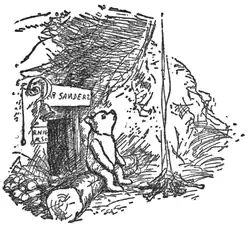
This list includes books that feature the character Winnie-the-Pooh created by A. A. Milne, as well as a substantial literary criticism of the character.
By A.A. Milne
- When We Were Very Young (1924); the poem "Teddy Bear" within, that originally appeared in Punch in February 1924, is considered to be the first appearance of Winnie-the-Pooh
- Winnie-the-Pooh (1926)
- Now We Are Six (1927) contains eleven poems that feature Winnie-the-Pooh illustrations
- The House at Pooh Corner (1928)
Fanfics
- Return to the Hundred Acre Wood, the first authorized sequel
- Winnie-the-Pooh: The Best Bear in All the World, the second authorized sequel
- 2022: The Call of Poohthulhu, an anthology of Lovecraftian horror short stories set in the Winnie-the-Pooh universe[1]
A number of fanfics was written by Jane Riordan.[2]
- 2016: Winnie-the-Pooh Meets the Queen, also published as Winnie-the-Pooh and the Royal Birthday
- 2020: Winnie The Pooh Goes To London, an abridged version of Winnie-the-Pooh and the Royal Birthday
- 2021: Once There Was a Bear, a prequel by Jane Riordan [3]
Allegory, allusions, and criticism
Translations
As of 2021, the Pooh stories have been translated into 72 languages.[3]
- Belarusian: the first translation as Віня-Пых, "Vinya-Pykh", by Vital Voranau was published in 2007, in Poznań, Poland.[4]
- Esperanto: Winnie-La-Pu by Ivy Kellerman Reed and Ralph A. Lewin (1972)
- Hebrew: The first translation was done by Vera Israelit and Eliyahu David Shapir in 1943. At these times, the colloquial Hebrew was in its infancy, and the language of this translation is not well comprehensible for the young Israelis of the 21st century, especially in rendering the British cultural allusions and wordplay. Therefore, Avirama Golan undertook a new translation, published in 2004.[5]
- Latin: by Alexander Lenard, Winnie ille Pu (1958)
- Lithuanian: Pūkuotuko pasaulis: Mikė Pūkuotukas. Trobelė Pūkuotynėje (by Virgilijus Čepaitis, 1958, 1962).
- Polish: There were several translations.[6]
- 1938: by Irena Tuwim: Kubuś Puchatek and Chatka Puchatka ; considered to be the classical translations[6]
- Miś Puh-Niedźwiedzki (1943), by Maria Grażyna Ławrukianiec
- Fredzia Phi-Phi (1986), by Monika Adamczyk (Monika Adamczyk-Garbowska); the change of the gender of the bear (Kubuś is a definitely masculine name, from Jacob, whereas Fredzia is perceived as feminine) caused a major outcry in Poland.[7]
- Zakątek Fredzi Phi-Phi (1990), (transl. of The House..) by Monika Adamczyk-Garbowska
- O Kubusiu Puchatku (1993), by Agnieszka Traut
- Kubuś Puchatek (1994), by Bohdan Drozdowski
- Russian: "retold by"[a] Boris Zakhoder, Винни-Пух и все остальные (literally "Winnie-the-Pooh and Everybody Else") (1960), later renamed to Винни-Пух и все-все-все (literally "Winnie-the-Pooh and All-All-All")[9]
See also
Notes
References
- ^ Cunningham, Lisa; Rawlik, Pete; Morgan, Christine (2022-05-07). The Call of Poohthulhu. Amazon Digital Services LLC – Kdp. ISBN 979-8-4470-9291-7.
- ^ Jane Riordan books
- ^ a b Winnie-the-Pooh prequel celebrates Sussex locations
- ^ Віня-Пых
- ^ Yehuda Atlas, הרפתקאות דב קטן, שאין לו שכל בכלל, 19 April 2004
- ^ a b Agata Chwirot, "Winnie-the-Pooh jako obcy polskiej literatury", doi:10.18276/rk.2019.10-08
- ^ Awantura o płeć Kubusia. Dlaczego Puchatek został Fredzią Phi-Phi?
- ^ Жизнь, которую пересказал Заходер, 9 September 2018
- ^ 3 июля 1960 года была подписана к печати книга про Винни-Пуха в переводе Заходера, 13 July 2015
