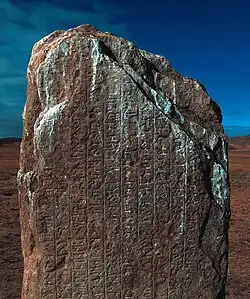
Kul-chur inscription or Küli Čor inscription was an inscription erected in honor of a military leader called Kul Chur of the Xueyantuo. It was erected between 723 and 725.[1]
… with the armour of a warrior on a quick horse he bit with the spear three soldiers (enemy)… at the battle he rode a quick bay horse…
…then swimming across the Pearl river, reaching Iron Gates he fought with Tezhik and subdued them. He had seven battles with Nine Oguzes.
… in five battles with Kitans and Tatabıs Kuli-Chur was the wisest speaker, the greatest commander.
… when Kuli-Chur was seven years old he killed a fox, at nine he killed a wild boar. When Karluks were conquered, in battles at the Tez
…when they fought with Karluks he rode a white horse Edul again, rushed to attack and won the enemy…
… he fought with a spear. Bit the Karluks. A new army advanced in the direction of Karluks. Karluks put forwards their strongest army…
…with a beat Karluk broke the back of a bay horse. Karluks…Elteris came. The son Esir Erkin Yegen Chor came.
…fought and bit their army. Conquered their country. Took children and wives to prison. Esbar Bilge Kuli-Chur
…felt obliged for aid and rushed to attack alone and found his death.
…kagan, younger brother El Chur came. Four noble people held Esbara Bilge Kuli-Chur's funeral ceremony. Funeral complex was built.
…ruled…
…tegin came. (Tardush) son… Chora Yegen Chur came…
…so many people came to the ceremony. I, Ebizter, wrote.
… to know unknown things in this mortal world, I wrote all this.
… bent…
Identity
Since the first line of the Küli Çor inscription is incomplete, the "apa tarqan čıqan tonyukuk atıγ bermiš" section follows the part that starts with the "üčün" preposition. It is translated as "apa tarqan gave the name čıqan tonyukuk". Thus, it is possible that the name of Küli Çor before he received his hero name (er at) was Tonyukuk. On the second line of the western face of the inscription, the missing beginning of the line could be read as "quda jegtürmiš Išbara Čїqan Küli Čur bolmïš" which translated into "(when … happened) (since) he was created (better), he took that title of Išvara Čıqan Küli Čor".[3]
Gerard Clauson states that the first three lines of the inscription provides information on the identity of Küli Çor. He argued that the personal name of Küli Çor was Tonyukuk, (unrelated to the 646–726 Tonyukuk),[4] since his known title was Boyla Baγa Tarqan and especially based on the name Qapaghan Qaghan to be mentioned in the third line, it was not possible for Küli Çor to have died after 716. It was not possible to obtain the title of "Köl", witnessed as Kül Tigin in Turks, and "otčigin" by Mongolians, which was given to the smallest male child of the house. It is not written with ñ but using the signs that correspond to n and y.[5]
References
^A. B. Ercilasun (1985) Kutadgu bilig grameri—Fiil, Gazi Universitesi; p. 59