Kokuho (film)
| Kokuho | |
|---|---|
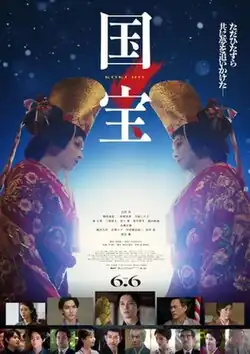 Theatrical release poster | |
| Japanese | 国宝 |
| Directed by | Lee Sang-il |
| Written by | Satoko Okudera |
| Based on | Kokuho by Shuichi Yoshida |
| Produced by |
|
| Starring | |
| Cinematography | Sofian El Fani |
| Edited by | Tsuyoshi Imai |
| Music by | Marihiko Hara |
Production companies |
|
| Distributed by | Toho |
Release dates |
|
Running time | 175 minutes |
| Country | Japan |
| Language | Japanese |
| Budget | ¥1.2 billion (US$8 million) |
| Box office | $131 million[1] |
Kokuho (国宝, Kokuhō; lit. 'National Treasure') is a 2025 Japanese historical drama film directed by Lee Sang-il and written by Satoko Okudera, based on the 2018 novel of the same name by Shuichi Yoshida. It stars Ryo Yoshizawa, Ryusei Yokohama, Mitsuki Takahata, Shinobu Terajima, Min Tanaka, and Ken Watanabe.[2][3]
The film had its world premiere in the Directors' Fortnight section of the 78th Cannes Film Festival on 18 May 2025,[4] and was theatrically released in Japan on 6 June, by Toho. It received positive reviews from critics, particularly for the acting, directing, cinematography and makeup and hairstyling. It has grossed $128 million in Japan, becoming the all-time highest-grossing Japanese live-action film.[5][6] It was selected as the Japanese entry for Best International Feature Film, making the December shortlist,[7] and was nominated for Best Makeup and Hairstyling at the 98th Academy Awards.[8]
Plot
Renowned kabuki actor Hanai Hanjiro II visits yakuza group Tachibana for a New Year gathering. During the gathering, Kikuo Tachibana, the son of the Tachibana group’s leader, performs an excerpt of the kabuki performance Barrier Gate with yakuza youth Tokuji. Kikuo’s onnagata performance impresses Hanjiro, who requests to speak to him after the performance. However, a rival yakuza group attacks, killing Kikuo’s father Gongōro as Hanjiro and Kikuo watch.
Following the death of his family, Kikuo gets a back tattoo of an eagle owl, which symbolises gratitude as they always return favours. Despite the protests of his girlfriend Harue, he plans revenge on the rival yakuza with Tokuji. They attempt to take revenge and kill the yakuza members but fail.
A year later, Kikuo is taken on as an apprentice by Hanjiro at the age of 15, despite the reluctance of Hanjiro’s wife Sachiko, who is both wary of Kikuo’s yakuza background and outsider status, as bloodline is highly valued in the world of Kabuki. Kikuo is given the stage name Toichiro and begins training alongside Shunsuke (whose stage name is Hanya), Hanjiro’s son and heir to the Tanba-ya house of Kabuki. Raised together, the two form a brotherly bond and rivalry as they go through rigorous trainings. Hanjiro takes them to see a performance of Heron Maiden by Mangiku, an onnagata kabuki actor who is a Kokuho (Living National Treasure). The performance deeply inspires both Kikuo and Shunsuke, but Mangiku warns Kikuo that although his face is beautiful, it may also lead to his downfall. Kikuo and Shunsuke also visit a teahouse, where geisha Fujikoma expresses her admiration for Kikuo and her desire to become his romantic partner.
While both Shunsuke and Kikuo are talented, Kikuo is truly passionate about honing the craft, while Shunsuke is more laid-back and even shows up hungover before performing. Sachiko and Hanjiro decide to pair the two up as an onnagata duo, and they make their debut as the “Tohan” duo with a performance of Wisteria Maiden. This attracts the attention and praise of Umeki from the Mitomo corporation which is heavily involved in the kabuki business. He offers the Tohan duo the opportunity to perform Ninin Dojoji at the Osaka Shochikuza Theatre. Mitomo employee Takeno is dismissive, stating that things are bound to end badly for Kikuo because of kabuki’s hereditary nature, which causes Kikuo to attack him in a rage.
The Tohan duo debut successfully and become immensely popular. Kikuo asks Harue to marry him, but Harue is hesitant because of the upwards trajectory of Kikuo’s career. As the duo continue to grow in popularity, Hanjiro suddenly gets into a traffic accident. While he survives, he is injured and unable to perform as the lead onnagata role of Ohatsu in his upcoming performance of The Love Suicides at Sonezaki. Hanjiro picks Kikuo instead of Shunsuke to replace him, resulting in great displeasure from Sachiko. Kikuo performs extremely well, upsetting Shunsuke who leaves and hides in the theatre foyer. Seeing this, Harue leaves as well to comfort him. Telling Harue that he wants to be a real actor, they two leave the theatre together as the performance ends.
Eight years later, Shunsuke still has not returned. Hanjiro, now almost blind from diabetes, expresses his wish for Kikuo to inherit the title of Hanai Hanjiro III so that he can inherit the title of Hanai Byakko IV. Despite the disapproval of Sachiko, Kikuo accepts. Kikuo visits Fujikoma, with whom he now has an illegitimate daughter named Ayano.
Hanjiro vomits blood at the ceremony, causing it to be cut short. As Hanjiro struggles, he repeatedly calls for Shunsuke, causing Kikuo to be filled with immense grief, mumbling apologies as Mangiku watches.
Shunsuke, having had a son with Harue and performing kabuki during his leave, returns and meets with Kikuo, who is now Hanai Hanjiro III. Following Hanjiro Hanai II’s death, Kikuo has not been able to land any leading or even speaking roles, even though he is technically the successor of the Tanba-ya house and has taken the responsibility of paying all of his master’s debts, while Shunsuke immediately gets starring roles alongside Mangiku.
Public opinion turns against Kikuo as his yakuza background, tattoo, and illegitimate daughter are made public. Furthermore, there is much resentment against him for “stealing” the Hanai Hanjiro name. Unable to find roles, Kikuo enters a relationship with Akiko, daughter of a prominent kabuki investor. When her father finds out, he beats Kikuo and threatens to disown Akiko. In love with Kikuo, Akiko decides to leave her family.
Kikuo becomes resentful towards Shunsuke, rejecting his offer to partner up once again as the “Han-han” onnagata duo. Shunsuke questions Kikuo’s taking advantage of Akiko, resulting in a physical altercation. Following their fight, Kikuo leaves the kabuki scene.
Four years later, Kikuo is unable to rejoin the kabuki scene and makes a living with Akiko by performing kabuki at banquets and small establishments. During one performance at a banquet, one man becomes enamoured with Kikuo’s onnagata and approaches him backstage with the encouragement of his friends after the performance. Upon finding out that Kikuo is a man, the man and his friends beat Kikuo. Kikuo becomes disillusioned and drinks heavily on a rooftop, dancing drunkenly. When Akiko talks to him, he does not look at her, and she leaves him.
Mangiku, now 93 and retired, asks for Kikuo to see him, offering Kikuo a way back into the kabuki world. After performing for Mangiku, Kikuo teams up again with Shunsuke as the “Han-han” duo to great success. Kikuo also coaches Shunsuke’s son in kabuki, although he is more interested in basketball.
During a performance of Ninin Dojoji, Shunsuke is unable to climb up a ladder, and Kikuo has to complete the performance alone. Shunsuke has gangrene in his foot due to his diabetes and has to amputate his left foot, meaning it will now be extremely difficult for him to continue acting in kabuki roles.
Shunsuke’s diabetes spreads to his right foot. Shunsuke expresses his desire to perform as Ohatsu in The Love Suicides at Sonezaki before he has to amputate his right foot; Kikuo agrees and offers to perform as the male lead Tokubei. During the performance, Shunsuke trips several times. Despite the intense physical pain, they continue the performance to great success, although Shunsuke is close to death by the end of the performance.
16 years later in 2014, Shunsuke is posthumously granted the title of Hanai Byakko V. Kikuo is named a kokuho and is set to perform Heron Maiden in his honour. At an interview, Kikuo is asked what he is further seeking, to which he replies that he is looking for a certain type of scenery, the same answer he gave after his performance of Ninin Dojoji years ago. The interview photographer, revealed to be Ayano, tells him that although she has never seen him as a father figure due to his abandonment, she still cannot help being drawn in by his performances.
Kikuo performs Heron Maiden. After the performance, he stares up alone at the lights and envisions the falling of snow. He tears up in awe, admiring the beauty of the scenery.
Cast
- Ryo Yoshizawa as Kikuo Tachibana / Hanai Toichiro / Hanai Hanjiro III
- Sōya Kurokawa as young Kikuo
- Ryusei Yokohama as Shunsuke Ōgaki / Hanai Han'ya
- Keitatsu Koshiyama as young Shunsuke
- Mitsuki Takahata as Harue Fukuda
- Shinobu Terajima as Sachiko Ōgaki, Shunsuke's mother
- Nana Mori as Akiko
- Ai Mikami as Fujikoma, a geisha
- Kumi Takiuchi as Ayano, Kikuo and Fujikoma's daughter
- Masatoshi Nagase as Gongorō Tachibana, Kikuo's father
- Emma Miyazawa as Matsu Tachibana, Kikuo's foster mother
- Takahiro Miura as Takeno
- Kyusaku Shimada as Umeki
- Tateto Serizawa as Genkichi
- Nakamura Ganjirō IV as Akiko's father
- Min Tanaka as Onogawa Mangiku, a Living National Treasure
- Ken Watanabe as Hanai Hanjiro II, Shunsuke's father
Production
The original novel exceeded 800 pages, and the initial cut ran for four and a half hours. Director Lee reflected that the process of cutting it down to three hours was extremely difficult.[9]
Ryo Yoshizawa, the lead actor, trained for a year and a half under Kabuki actor Nakamura Ganjirō IV alongside Ryusei Yokohama. Yoshizawa regarded this film as the culmination of his career so far.[10] After seeing the completed movie, Ken Watanabe gave his strong approval, saying, 'I believe this will become Ryo's signature work.[11]
In making this work, the main cast members Ryo Yoshizawa and Ryusei Yokohama devoted a year and a half to rehearsals, including kabuki dance and movements, and spent three months filming. In an interview after filming, Yoshizawa said, "Practicing for a year and a half, I realized more and more that I couldn't keep up the pace the more I did. Compared to everyone who has been performing on stage since childhood, of course, a year and a half isn't enough to master it all, but I think what was necessary for this film was the spirit of clinging to kabuki despite understanding that. That perseverance was what I felt was needed." Yokohama commented, "I didn't know much about the world of kabuki myself. If I had known more, I might have been overwhelmed with unnecessary information, so maybe my desire to learn more came from not knowing. While respecting the customs and traditions, I also lived as a kabuki actor, and I think I was able to throw myself into it wholeheartedly.".[12]
When asked about a scene that left a strong impression while playing in this work, Yoshizawa replied, "It might not be the same as 'touching the heart,' but there is a scene where I dance wildly on a rooftop of a building. Out of about three takes, what I was doing was all over the place and mostly improvised. The one used was the last take, and the director told me to look at Nanao Mori's face. When I looked at her suddenly, she asked, 'Where are you looking?' That line naturally came out of me, thinking, 'Where am I looking?' It was a moment where, through my own filter, I wondered, 'Where is Kikuo looking?' and I couldn't quite tell. I remember everything about the filming of that scene vividly, including that honest line.".[12]
Regarding a scene or line that left an impression, Yokohama responded, "The line Shunsuke says, 'I want to become a true actor,' really struck me... Shunsuke and I are complete opposites, but that one desire was something I could resonate with and empathize with."[12]
Release
The film had its world premiere in the Directors' Fortnight section of the 2025 Cannes Film Festival on May 18, 2025,[4] and was theatrically released in Japan by Toho on June 6.[5][6]
Kokuho will also be presented in the Gala Presentation at the 30th Busan International Film Festival in September 2025.[13]
Reception
On review aggregator website Rotten Tomatoes, the film currently holds a 93% rating based on 27 critics' reviews.[14]
Box office
This film was released in Japan on June 6 and debuted in third place with a box office revenue of ¥346 million in its first three days, following Lilo & Stitch and Mission: Impossible – The Final Reckoning.[6] It received high praise from audiences and moved up one spot in its second week, with cumulative box office revenue surpassing ¥1.1 billion.[15] The film finally hit number one in its third week and held that spot for four consecutive weeks until Demon Slayer: Kimetsu no Yaiba – The Movie: Infinity Castle was released.
Toho announced on August 18 that Kokuho has become the fourth Japanese live-action film to surpass ¥10 billion at the box office. It's the first film to achieve this milestone in 22 years, since Bayside Shakedown 2.[16] Its strong performance at the box office continued, with the film breaking ¥15 billion mark on September 24. Not only that, but the original novel recorded ten consecutive weeks at the top of the sales charts.[17] Furthermore, reports indicate that the number of people interested in Kabuki itself increased, with ticket sales rising by 20% compared to the previous year.[18]
On November 25, it was announced that the box office revenue for this movie reached ¥17.37 billion, surpassing Bayside Shakedown 2 to become the highest-grossing live-action Japanese film of all time.[19]
Accolades
Kokuho is the first Japanese-produced film to receive a nomination for Best Makeup and Hairstyling at the 98th Academy Awards.[20]
| Award | Category | Recipient(s) | Result | Ref. |
|---|---|---|---|---|
| 2025 Vancouver International Film Festival | Audience Award, Galas & Special Presentations | Kokuho | Won | [21] |
| 50th Hochi Film Awards | Best Film | Kokuho | Won | [22] |
| Best Director | Lee Sang-il | Won | ||
| Best Actor | Ryo Yoshizawa | Won | ||
| BS10 Premium Award | Kokuho | Won | ||
| 47th Yokohama Film Festival | Best Film | Kokuho | Won | [23] |
| Best Director | Lee Sang-il | Won | ||
| Best Screenplay | Satoko Okudera | Won | ||
| Best Actor | Ryo Yoshizawa | Won | ||
| Best Supporting Actor | Min Tanaka | Won | ||
| Examiner Special Award | Nakamura Ganjirō IV | Won | ||
| Special Grand Prize | Yohei Taneda | Won | ||
| 38th Nikkan Sports Film Awards | Best Film | Kokuho | Won | [24] |
| Best Director | Lee Sang-il | Won | ||
| Best Actor | Ryo Yoshizawa | Won | ||
| Best Supporting Actor | Min Tanaka | Won | ||
| Best Supporting Actress | Kumi Takiuchi | Won | ||
| Yūjirō Ishihara Newcomer Award | Sōya Kurokawa | Won | ||
| 80th Mainichi Film Awards | Best Film | Kokuho | Nominated | [25] [26] |
| Best Director | Lee Sang-il | Won | ||
| Best Lead Performance | Ryo Yoshizawa | Won | ||
| Best Supporting Performance | Ryusei Yokohama | Nominated | ||
| Best Supporting Performance | Min Tanaka | Nominated | ||
| Best Newcomer | Sōya Kurokawa | Nominated | ||
| Best Screenplay | Satoko Okudera | Won | ||
| Best Cinematography | Sofian El Fani | Won | ||
| Best Art Direction | Yohei Taneda and Nao Shimoyama | Won | ||
| Best Music | Marihiko Hara | Won | ||
| Best Sound Recording | Mitsugu Shiratori | Won | ||
| 68th Blue Ribbon Awards | Best Film | Kokuho | Won | [27] [28] |
| Best Director | Lee Sang-il | Nominated | ||
| Best Actor | Ryo Yoshizawa | Nominated | ||
| Best Supporting Actor | Ryusei Yokohama | Nominated | ||
| Best Supporting Actor | Ken Watanabe | Nominated | ||
| Best Supporting Actor | Min Tanaka | Nominated | ||
| Best Supporting Actress | Shinobu Terajima | Nominated | ||
| Best Supporting Actress | Nana Mori | Nominated | ||
| 99th Kinema Junpo Awards | Best Director | Lee Sang-il | Won | [29] |
| Best Screenplay | Satoko Okudera | Won | ||
| Best Actor | Ryo Yoshizawa | Won | ||
| 49th Japan Academy Film Prize | Best Film | Kokuho | Pending | [30] |
| Best Director | Lee Sang-il | Pending | ||
| Best Actor | Ryo Yoshizawa | Pending | ||
| Best Supporting Actor | Ryusei Yokohama | Pending | ||
| Best Supporting Actor | Ken Watanabe | Pending | ||
| Best Supporting Actor | Min Tanaka | Pending | ||
| Best Supporting Actress | Mitsuki Takahata | Pending | ||
| Best Supporting Actress | Shinobu Terajima | Pending | ||
| Best Supporting Actress | Nana Mori | Pending | ||
| Best Screenplay | Satoko Okudera | Pending | ||
| Best Music | Marihiko Hara | Pending | ||
| Best Cinematography | Sofian El Fani | Pending | ||
| Best Lighting Direction | Yuki Nakamura | Pending | ||
| Best Art Direction | Yohei Taneda and Nao Shimoyama | Pending | ||
| Best Sound Recording | Mitsugu Shiratori | Pending | ||
| Best Film Editing | Tsuyoshi Imai | Pending | ||
| Newcomer of the Year | Ai Mikami | Won | ||
| 98th Academy Awards | Best Makeup and Hairstyling | Kyoko Toyokawa, Naomi Hibino and Tadashi Nishimatsu | Pending | [31] |
See also
- List of highest-grossing films in Japan
- List of submissions to the 98th Academy Awards for Best International Feature Film
- List of Japanese submissions for the Academy Award for Best International Feature Film
References
- ^ "Kokuho". Box Office Mojo. IMDb. Retrieved 8 February 2026.
- ^ "国宝". eiga.com (in Japanese). Archived from the original on 31 May 2024. Retrieved 14 June 2025.
- ^ "'Kokuho' finds riveting drama on and off the kabuki stage". The Japan Times. 8 June 2025. Archived from the original on 14 June 2025. Retrieved 14 June 2025.
- ^ a b "Cannes Directors' Fortnight Unveils 2025 Lineup". Deadline. 15 April 2025. Retrieved 3 January 2026.
- ^ a b Schley, Matt (6 June 2025). "'Kokuho' illuminates the high price of becoming a national treasure". The Japan Times. Archived from the original on 10 June 2025. Retrieved 4 August 2025.
- ^ a b c "『リロ&スティッチ』が初登場1位! この他新作は3位に『国宝』、7位に『見える子ちゃん』がランクイン(2025年6月6日-6月8日)". Kogyo Tsushinsha (in Japanese). 9 June 2025. Archived from the original on 9 June 2025. Retrieved 9 June 2025.
- ^ Davis, Clayton (16 December 2025). "Oscars Shortlists Announced in 12 Categories: 'Sinners' and 'Wicked: For Good' Lead, 'Sirât' Gets Strong Showing". Variety. Retrieved 16 December 2025.
- ^ Ramachandran, Naman (28 August 2025). "Japan Picks Lee Sang-il's Hit Kabuki Drama 'Kokuho' as Oscar Submission". Variety. Archived from the original on 28 August 2025. Retrieved 28 August 2025.
- ^ "映画『国宝』の175分が示した時間の価値 ── 李相日(映画監督)×グランドセイコー". GQ Japan (in Japanese). 28 November 2025. Retrieved 16 January 2026.
- ^ "吉沢亮「僕と流星は1つの役に1年半の準備かけた」横浜流星とともに魂込めた主演作「国宝」". Nikkan Sports (in Japanese). 7 June 2025. Archived from the original on 6 June 2025. Retrieved 16 June 2025.
- ^ "渡辺謙、主演・吉沢亮を絶賛「代表作になるね」 覚悟と執念を評価". Oricon (in Japanese). 23 April 2025. Archived from the original on 22 July 2025. Retrieved 16 June 2025.
- ^ a b c Fumitaka Otsuka (2 June 2025). "Ryo Yoshizawa and Riku Yokohama embodying their roles fully, the true meaning of dedicating oneself to art ["National Treasure" interview]". Eiga.com. Eiga Dot Com Co., Ltd. Archived from the original on 16 June 2025. Retrieved 16 June 2025.
- ^ Naman Ramachandran (26 August 2025). "Shu Qi's 'Girl' and 'Resurrection' Among Competition Titles as Busan Film Festival Unveils Lineup for 30th Edition". Variety. Retrieved 26 August 2025.
- ^ "Kokuho | Rotten Tomatoes". www.rottentomatoes.com. Retrieved 6 February 2026.
- ^ "『リロ&スティッチ』が2週連続で1位! 新作は3位に『フロントライン』、5位に『ドールハウス』がランクイン(2025年6月13日-6月15日)". Kogyo Tsushinsha (in Japanese). 16 June 2025. Archived from the original on 16 June 2025. Retrieved 16 June 2025.
- ^ "『国宝』興収100億円突破! 邦画実写22年ぶりの快挙、吉沢亮&横浜流星らが感謝". Cinematoday (in Japanese). 18 August 2025. Archived from the original on 23 August 2025. Retrieved 18 August 2025.
- ^ "映画『国宝』原作本、10週連続文庫1位・2位独占 同一シリーズの文庫ではオリコン史上初記録更新【オリコンランキング】". Oricon (in Japanese). 10 October 2025. Retrieved 11 October 2025.
- ^ "[週刊エンタメ]<トレンド>映画「国宝」効果 歌舞伎に関心急上昇「国立劇場棚ざらしは痛い…」". Yomiuri Shimbun (in Japanese). 5 September 2025. Retrieved 11 October 2025.
- ^ "映画『国宝』興行収入173.7億円を突破 『踊る大捜査線 THE MOVIE 2』を超え邦画実写歴代1位 22年ぶり"金字塔"". Oricon (in Japanese). 25 November 2025. Retrieved 25 November 2025.
- ^ "Kokuho Gets Oscar Nomination in Makeup, Hairstyling". nippon.com. 23 January 2026. Retrieved 1 February 2026.
- ^ "『国宝』バンクーバー国際映画祭で「観客賞」受賞! 米アカデミー賞前哨戦で快挙". Cinema Cafe (in Japanese). 18 October 2025. Retrieved 20 October 2025.
- ^ "第50回報知映画賞が決定 作品賞は「国宝」「鬼滅の刃」、主演男優賞は吉沢亮、主演女優賞は北川景子". Sanspo (in Japanese). 2 December 2025. Retrieved 2 December 2025.
- ^ "2025年日本映画個人賞". Yokohama Film Festival (in Japanese). Retrieved 7 December 2025.
- ^ "【映画大賞】「国宝」が史上最多の6冠 主演男優賞は吉沢亮、主演女優賞は広瀬すず". Nikkan Sports (in Japanese). 28 December 2025. Retrieved 28 December 2025.
- ^ "毎日映画コンクール「国宝」が最多10部門ノミネート! 主演俳優賞候補に吉沢亮、来年1・16各賞発表". Sponichi (in Japanese). 19 December 2025. Retrieved 19 December 2025.
- ^ "第80回毎日映画コンクール「敵」が日本映画大賞、「国宝」は最多7冠 主演賞に吉沢亮". Natalie (in Japanese). Retrieved 16 January 2026.
- ^ "ブルーリボン賞ノミネートが決定 映画「国宝」が最多5部門8ノミネート「宝島」「ナイトフラワー」が続く". Sports Hochi (in Japanese). 5 January 2026. Retrieved 5 January 2026.
- ^ "【ブルーリボン賞】歴史的ヒット「国宝」に作品賞 李相日監督「"目覚め"のような発見があったのでは」". Tokyo Sports (in Japanese). 28 January 2026. Retrieved 28 January 2026.
- ^ "キネ旬1位は「旅と日々」「ワン・バトル・アフター・アナザー」、シム・ウンギョン&吉沢亮が主演賞". Natalie (in Japanese). 29 January 2026. Retrieved 29 January 2026.
- ^ "「第49回日本アカデミー賞」優秀賞&新人俳優賞発表 吉沢亮・松村北斗・長澤まさみほか【受賞者・作品一覧】". Model Press (in Japanese). 19 January 2026. Retrieved 19 January 2026.
- ^ "The 98th Academy Awards". oscars.org. Retrieved 22 January 2026.