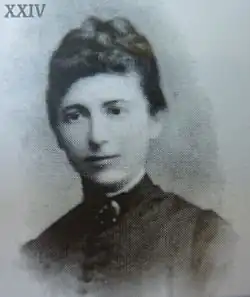
Karla Absolonová-Bufková
Karla Absolonová-Bufková | |
|---|---|
 | |
| Born | Karolina Anna Maximiliana Wankelová 7 February 1855 |
| Died | 29 November 1941 (aged 86) Prague, Protectorate of Bohemia and Moravia |
| Occupations | Writer, ethnographer and folklorist |
| Known for | collecting Moravian customs, folktales, legends and music |
| Notable work | Z Ječmínkovy říše: moravské povídky a pověsti (1897) |
| Spouse(s) | Vilibald Absolon (m. 1872, d. 1882) Eduard Bufka (m. 1887) |
| Children | 3, Karel Absolon, Olga Stránská-Absolonová and Vladimír Jindřich Bufka |
| Parents |
|
| Relatives | Lucie Bakešová (sister) Madlena Wanklová (sister) Vlasta Havelková (sister) Jaroslav Bakes (nephew) |
Karla Anna Maximiliana Absolonová-Bufková (née Wankelová; 7 February 1855 – 29 November 1941) was a Czech writer, ethnographer and folklorist. She wrote children's books and plays, and collected Moravian customs, folktales, legends and music.
Early life and family
Absolonová-Bufková was born on 7 February 1855 in Blansko, Moravia, Austrian Empire (now in the Czech Republic).[1][2][3]
Absolonová-Bufková was the second of four daughters born to Jindřich Wankel, a palaeontologist and archaeologist known as the "father of Moravian archaeology",[4] and his wife Eliška Wanklová (née Šímová), an ethnographer and national revivalist.[1][5] Her sisters were Lucie Bakešová, ethnographer and social worker; Madlena Wanklová, and Vlasta Havelková, collector of folk embroidery and the custodian of the Náprstek Museum in Prague.[1][2][5]
When Absolonová-Bufková was a child, her father was a friend of the painter Josef Mánes. Mánes would stay with in the family home and painted a portrait of her dressed in national costume when she was aged 12.[4]
Absolonová-Bufková married her first husband, Vilibald Absolon, a medical doctor, on 4 November 1872. They had two children together and family lived in Boskovice in South Moravia. She was widowed in 1882.[2]
Five years after her husband's death, Absolonová-Bufková remarried to her second husband, Eduard Bufka, a clerk and banker, in 1887.[2][4] They had a son together.[6]
Absolonová-Bufková's children with her first husband were Karel Absolon, a palaeontologist and naturalist[7] and Olga Stránská-Absolonová, a writer and suffragist.[8][9] Her son with her second husband was Vladimír Jindřich Bufka, a chemist and pictorialism photographer, who died aged 26.[6][7]
Career and later life
Absolonová-Bufková attended municipal school in Blansko, then studied at Vyšší dívčí škola v Praze [cs], the higher girls' school in Prague.[2]
Alongside writing children's books and plays, Absolonová-Bufková was an ethnographer and folklorist.[10][11] She collected Moravian customs, folktales, legends and music and was particularly interested in the ornamentation of folk objects.[12] She initially published articles about her work in women's magazines.[1][13] She then published her collected Moravian legends in the book Z Ječmínkovy říše: moravské povídky a pověsti (1897),[1] and recorded the legend of Býčí skála Cave.[14] With her sisters, Absolonová-Bufková prepared ethnographic exhibitions in Olomouc (1885) and Prague (1895).[1]
Absolonová-Bufková was a member of the Museum Association in Olomouc and the women's singing group the Academic Society Žerotín. She was also active in the women's movement with her sisters.[1]
Absolonová-Bufková died on 29 November 1941 in Prague, Protectorate of Bohemia and Moravia, aged 86.[1][2]
Select publications
- Z Ječmínkovy říše: moravské povídky a pověsti (1897)[15]
- Po stopách slovanských na Rujáně (1900)
- Moravské pověsti a pohádky zejména z Krasu moravského (1920)[1][15]
- Tulák: drama ve čtyřech jednáních (1925)
References
- ^ a b c d e f g h i Husová, Marcella. "BUFKOVÁ-WANKLOVÁ Karla 1855–1941". Biografický slovník českých zemí (in Czech). Retrieved 13 February 2026.
- ^ a b c d e f "Karla Bufková". Encyklopedie dějin Brna (in Czech). Retrieved 13 February 2026.
- ^ Šášinková, Marcela (2005). Žena umělkyně na přelomu 19. a 20. století (in Czech). Středočeské muzeum v Roztokách u Prahy. p. 365. ISBN 978-80-239-5958-1.
- ^ a b c "Blanenský chodec: Děvčátko, jež stálo modelem Mánesovi". Blanenský deník (in Czech). 6 October 2012. Retrieved 14 February 2026.
- ^ a b Kulaviaoková, Dagmar (2008) Příběh ženské emancipace v rodině JIndřicha Wankela (in Czech). p. 58.
- ^ a b Dufek, Antonín (2010). Vladimír Jindřich Bufka. Torst. ISBN 978-80-7215-401-2.
- ^ a b Moštěk, Martin (21 November 2020). "Matka vědce Absolona, který se věnoval průzkumu Krasu, sbírala pověsti a písně". Blanenský deník (in Czech). Retrieved 13 February 2026.
- ^ "STRÁNSKÁ Olga 1872–1927". Biografický slovník českých zemí (in Czech). Retrieved 13 February 2026.
- ^ Horák, Pavel; Hájková, Dagmar; Rous, Lukáš (24 March 2025). T. G. M. v kostce (in Czech). Masarykův ústav a Archiv AV ČR. p. 26. ISBN 978-80-88611-29-5.
- ^ Uhrová, Eva (2008). České ženy známé a neznámé (in Czech). E. Uhrová. pp. 124–137. ISBN 978-80-254-3002-6.
- ^ "Bufková-Wanklová, Karla 1855-1941". ObalkyKnih.cz (in Czech). Retrieved 13 February 2026.
- ^ Folia ethnographica (in Czech). Vol. 33. Moravské muzeum. 1999. p. 38. ISBN 978-80-7028-472-8.
- ^ Nový velký ilustrovaný slovník naučný (in Czech). Vol. 18. Nakl. Nebeský a Beznoska. 1933. p. 8.
- ^ Stejskalová, Helena (13 January 2023). "Záhadná Býčí skála: Pohřbili zde místo velmože ženu?". epochaplus.cz (in Czech). Retrieved 13 February 2026.
- ^ a b Forst, Vladimír (1985). "Karla Bufková-Wankelová". Lexikon české literatury osobnosti, díla, instituce [Lexicon of Czech Literature personalities, works, institutions] (in Czech). Vol. 1 (A-G). Praha: Academia. p. 326. Retrieved 13 February 2026 – via Digitální knihovna AV ČR.
External links
- Photograph of Karla Absolonová-Bufková c. 1871 at the Moravská galerie's online collection