Ian Fraser (Royal Navy pilot)
Ian Fraser | |
|---|---|
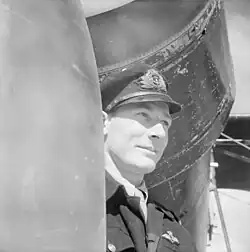 Fraser in Malta during the Second World War | |
| Birth name | Ian Duncan Fraser |
| Born | 11 September 1921 |
| Died | 7 March 2015 (aged 93) |
| Allegiance | United Kingdom |
| Branch | Royal Navy |
| Rank | Lieutenant |
| Conflicts | World War II |
| Other work | Colonial Official |
Ian Duncan Fraser OBE DSC (11 September 1921 – 7 March 2015) was a Royal Navy officer who served with distinction in the Mediterranean theatre, particularly in the fighting around Malta. Fraser was awarded the Distinguished Service Cross (DSC) for bravery while attacking enemy shipping, including disabling the Italian light cruiser Luigi di Savoia Duca degli Abruzzi with a torpedo. He was also involved in the dangerous work of dropping mines in enemy harbours.
After the war, Fraser was a Colonial Service official, notably in Singapore as it moved towards independence.
Early Life
Ian Fraser was born in Solihull in the West Midlands on 11 September 1921. His father was a Priest, and originally from Scotland. He was schooled at Marlborough College, then Christ Church, Oxford where he was an undergraduate reading history when World War II broke out. Fraser volunteered for the Royal Navy, but was able to complete his finals before having to report for duty.[1]
Service in World War II
Training
Fraser became a Naval Airman 2nd Class at HMS St Vincent in Gosport, which after the outbreak of war had become an officer training establishment for the Fleet Air Arm (FAA). During 1940 he learned to fly at RAF Elmdon (which after the war became Birmingham Airport), then was trained as a torpedo bomber pilot and taught how to take-off and land on an aircraft carrier. Fraser was subsequently commissioned as an officer in the Royal Navy Volunteer Reserve.[2]
However, rather than serving on an aircraft carrier, Fraser was then loaned to the Royal Air Force (RAF) where he would fly the land-based Bristol Beaufighter fighter-bomber with RAF 252 Squadron.[3]
Active Service in the Mediterranean
In May 1941, Fraser arrived in Malta where he saw action, helping to shoot down an Axis transport aircraft, before being sent to the Western Desert Campaign, where he was shot down and spent three days wounded and sheltering beneath the wreckage of his aircraft before being rescued. Fraser was treated in a hospital in Suez, where he was initially viewed as close to death, and nearly had an arm amputated. Fraser was then sent to South Africa to recover, then returned to Britain and learned to fly again.[4]

Back with the FAA, Fraser was again sent to Malta in 1942 as a pilot in 830 Naval Air Squadron (NAS). In the North Africa campaign, Malta was a critical base from which British aircraft, ships and submarines launched damaging attacks on Axis convoys shipping supplies and re-enforcements from Italy to the Libya, from where Irwin Rommel's Panzer Army Africa would soon invade Egypt. 1942 was a critical year in the campaign, which saw the major battles of Gazala, First El Alamein, Alam el Halfa and Second El Alamein. The pressure on Rommel's supply lines from British forces on Malta played an important role in wearing down the effectiveness of Rommel's forces.
On 22 November 1942 while flying a Fairey Albacore torpedo bomber, he carried out a night attack on three Italian navy cruisers off the coast of Calabria. He released his torpedoes at a range of 500 yards, which struck the light cruiser Luigi di Savoia Duca degli Abruzzi. Flying at an altitude of just 30ft, Fraser later said he was more concerned about hitting the mast of one of the ships than by the fire from the enemy anti-aircraft guns. The Italian warship was badly damaged, with a 40ft hole in its hull, and saw no further action prior to Italy quitting the Axis in September 1943. Fraser, who was operating at the edge of his aircraft's range, so had to return to base immediately after completing his attack, only discovered how successful he had been thanks to subsequent Allied intelligence reports.[5][6]
Fraser was subsequently awarded the DSC. The decoration was reported in the London Gazette on 29 June 1943, which said the award was “for bravery in successful air-attacks on enemy shipping in the Mediterranean”. [7]
Fraser's squadron were then tasked with dropping mines in enemy harbours, flying just 10 feet above the water on moonless nights, which Fraser described as "more nerve-racking and dangerous than attacking ships". In March 1943, Fraser had completed his tour missions, so had the option to return to Britain and become a training instructor, but he volunteered to serve another combat tour.[8]
Prisoner of War
On 30 March 1943, Fraser's aircraft was hit by flak over Palermo, Sicily, rupturing the fuel tank, and he had to ditch in the sea. Fraser, and his follow crew member, Midshipman Michael Barbour, found themselves adrift in a dinghy for days before they were rescued by a German patrol boat. Barbour, who was just 19 years old, died shortly after they were rescued.[9][10]
Fraser spent the rest of the conflict as a prisoner of war. He was the held in Stalag Luft III, the camp where the real life Great Escape prisoner breakout occurred in March 1944. During this escape attempt, Fraser served as a lookout.[11]
Fraser finished the war as a Lieutenant. His brother, Gordon, also served in the FAA, but was lost over the North Sea in poor weather conditions in September 1942.[12]
Post-war Career
After the war, Fraser joined the British Colonial Service and served in Malaya, Aden, the Bahamas and Singapore. He became Acting Permanent Secretary in Singapore in 1960, during the period the colony was transitioning to self-rule, for which he was made an Officer of the Order of the British Empire (OBE) in the 1961 New Year Honours list.[13]
References
- ^ Daily Telegraph, 16 April 2015.
- ^ Daily Telegraph, 16 April 2015.
- ^ The Times, 19 June 2015.
- ^ Daily Telegraph, 16 April 2015.
- ^ The Times, 19 June 2015.
- ^ Daily Telegraph, 16 April 2015.
- ^ London Gazette, 29 June 1943.
- ^ Daily Telegraph, 16 April 2015.
- ^ The Times, 19 June 2015.
- ^ Daily Telegraph, 16 April 2015.
- ^ The Times, 19 June 2015.
- ^ Daily Telegraph, 16 April 2015.
- ^ Daily Telegraph, 16 April 2015.
Sources
- "Ian Fraser, naval pilot - obituary." Daily Telegraph, 16 April 2015. https://www.telegraph.co.uk/news/obituaries/11542578/Ian-Fraser-naval-pilot-obituary.html
- London Gazette, Supplement, 29 June 1943. https://www.thegazette.co.uk/London/issue/36072/supplement/2946/data.pdf
- Poolman, Kenneth (1980). Night Strike From Malta: 830 Squadron RN and Rommel's Convoys. London: Jane's Publishing Company. ISBN 0710600038.
- "Ian Fraser. Pilot who torpedoed an Italian Cruiser in 1942." The Times, 19 June 2015. https://www.thetimes.com/travel/destinations/europe-travel/italy/ian-fraser-c69f7k6wqt8