Helen Corson Hovenden
Helen Corson Hovenden | |
|---|---|
 | |
| Born | Helen Corson September 15, 1847[1] Plymouth Meeting, Pennsylvania |
| Died | October 6, 1935 (aged 88) Plymouth Meeting, Pennsylvania |
| Education | Philadelphia School of Design for Women, Académie Julian, Paris |
| Known for | Painting, illustration |
| Spouse | Thomas Hovenden |
| Children | 2 |
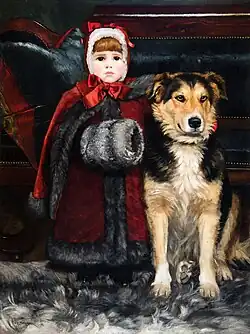
Helen Corson Hovenden (1847–1935) was a Philadelphia-area painter who specialized in portraits, sometimes of children with pets, and watercolors of birds and flowers.
She was the wife of Irish-born genre painter Thomas Hovenden. Their son, Thomas Hovenden Jr., became a civil engineer; their daughter, Martha Maulsby Hovenden, became a sculptor.
The Woodmere Art Museum in Chestnut Hill, Philadelphia possesses a number of Helen Corson Hovenden's works, along with works by her husband and daughter.
Family, education and marriage
Helen Corson was born in Plymouth Meeting, Whitemarsh Township, Pennsylvania, the daughter of Quakers George and Martha Maulsby Corson. She attended the Plymouth Friends School, and the Philadelphia School of Design for Women. She traveled to Paris in 1875 to study painting at the Académie Julian, and exhibited at the Paris Salons of 1876, 1879 and 1880.[2]
In 1880, she met Irish painter Thomas Hovenden at the summer artist colony at Pont-Aven, France.[1] They returned to the United States later that year, and were married at the Plymouth Friends Meetinghouse on June 9, 1881.[1]


The newlyweds settled into her late parents' house, across Germantown Pike from the meetinghouse.[3] Her mother's father, Samuel Maulsby, had built the house in 1795,[4] and he and her father's father, Joseph Corson, were lifelong friends and ardent abolitionists. Both had been founding members of the Plymouth Meeting Anti-Slavery Society in 1831.[5] For decades the Maulsby/Corson House was an important stop on the Underground Railroad.[a]
In 1856, her father, George Corson, built Abolition Hall behind the house's barn, as a lecture hall and meeting place for abolitionists.[1] Twenty-five years later, Thomas Hovenden turned Abolition Hall into his studio, and found inspiration in the righteous anti-slavery arguments that had been made there.[b]
Selected works
| External videos | |
|---|---|
 “Looking at Paintings with Bill Valerio: Thomas Hovenden & Helen Corson Hovenden”, John Thornton “Looking at Paintings with Bill Valerio: Thomas Hovenden & Helen Corson Hovenden”, John Thornton |
Helen Corson Hovenden exhibited sporadically at the annual exhibitions of the Pennsylvania Academy of the Fine Arts. The eight works she showed between 1885 and 1905 were all portraits, some of which may have included pets.[8]
She exhibited domestic scenes of children at the National Academy of Design in 1885 and 1886.

- Breton Courtyard (1878, oil on canvas), private collection, Plymouth Meeting, PA[9]
- Uncle Ned and His Pupil (1881, oil on canvas), Wells Fargo Bank N.A. Headquarters, Sioux Falls, South Dakota.[10] An elderly Black man teaching a boy (grandson?) to play the banjo.
- I Take My Pen in Hand (1883, watercolor), Dawson Gallery, Annapolis, MD[11]
- Short Days and Long Lessons (1885), unsigned etching after Helen Corson Hovenden's unlocated painting, Woodmere Art Museum, Chestnut Hill, Philadelphia
- The Little Housekeeper (c.1885), unlocated. Exhibited at the National Academy of Design, October 1885
- Playing School (c.1886), unlocated. Exhibited at the National Academy of Design, October 1886
- Martha Hovenden and Her Dog Rob (c.1887, oil on canvas), Woodmere Art Museum, Chestnut Hill, Philadelphia
- The Concert (c.1890, oil on canvas), Woodmere Art Museum, Chestnut Hill, Philadelphia.[12] Six-year-old Martha Hovenden playing a harmonica to a dog.
- In the Gallery (1901, oil on canvas), Chrysler Museum of Art, Norfolk, VA. A teenage boy (Thomas Jr.?) looking at paintings.
- Portrait of Dr. William Corson (year, oil on canvas), Historical Society of Montgomery County, Norristown, PA. Dr. Corson was Helen C. Hovenden's uncle (her father's brother).
- Portrait of Dr. Louis W. Read (year, oil on canvas), Historical Society of Montgomery County, Norristown, PA. Dr. Read was Helen C. Hovenden's uncle (husband of her father's sister Sarah).[13]
Widowhood
.jpg)

"Thomas Hovenden lost his life on an unguarded grade crossing of the Pennsylvania Railroad near his home, August 14, 1895, in an attempt to save the life of a little girl [ten-year-old Bessie Pifer] who was crossing in front of an approaching engine. Both were killed."[14]
Rev. William Henry Furness gave the eulogy at Thomas Hovenden's funeral, and his pall bearers were painter Thomas Eakins, sculptor Samuel Murray, and four male Corson relatives.[15]
Helen Corson Hovenden channeled her grief into advocacy, leading a successful public letter-writing campaign by Quaker women to pressure the Pennsylvania Railroad into elevating the tracks of its Trenton Cutoff, separating high-speed PRR trains from the grade level tracks of streetcars.[1]
She donated her husband's last completed painting, Jerusalem the Golden (1892-94), to the Metropolitan Museum of Art, in his memory.[16] It features a sickly young woman, a worried husband, and a pianist in the background playing the Protestant hymn "Jerusalem the Golden." The hymn "was meant to provide solace and comfort to the faithful in the face of death by offering salvation and promising peace in the afterlife."[c]
Helen Corson Hovenden moved to Washington, D.C., where both her children attended the Sidwell Friends School.[18] Following daughter Martha's graduation, the family moved back to Plymouth Meeting.
The reminiscence of a friend: “But I did have many lovely weekends visiting my Quaker friends—the famous Hovenden family at Plymouth Meeting. Mrs. Hovenden had been Miss Helen Corson, and as an artist had studied abroad and in Paris. In art circles she met Mr. Thomas Hovenden, of warm Irish background, and they married. He painted the famous work, Breaking Home Ties— ... Tragically, Mr. Hovenden was killed saving a small child from a Pennsylvania Railroad train bearing down on her at Spring Mill.”[19]
Fifteen years after his death, Helen Corson Hovenden wrote a biographical sketch of her late husband for the Historical Society of Montgomery County, Pennsylvania.[14] Rev. Ernst P. Pfatteicher gave a detailed account of Thomas Hovenden's funeral in the same volume, and wrote about the immense popularity of his paintings. Harrison S. Morris, Director of the Pennsylvania Academy of the Fine Arts, 1882-1905, wrote about his friendship with Thomas Hovenden, and their years of working together.[20]
Children
Thomas Hovenden Jr. (1882–1915) graduated from Sidwell Friends School with the class of 1899.[18] He earned bachelor (1903) and masters (1904) degrees in civil engineering from the University of Pennsylvania.[18] He worked as an instructor at the university for a year, and was certified as a civil engineer in 1905. He joined the Philadelphia firm of W. W. Lindsay & Co., Inc., engineering consultants and contractors,[18] and rose to general superintendent of the company.[18] Over the next decade, he designed and built blast furnaces, manufacturing plants and highway bridges in the United States and Cuba.[18] Thomas Hovenden Jr. died unexpectedly at age 33, on September 19, 1915.[18]
Martha Maulsby Hovenden (1884–1941) studied under sculptor Charles Grafly at the Pennsylvania Academy of the Fine Arts in Philadelphia,[21] where her late father had taught. Subsequently, she studied under sculptor Hermon Atkins MacNeil at the Art Students League of New York.[21] She had a moderately successful career, and lived with her mother in Plymouth Meeting until Helen Corson Hovenden's death in 1935. She continued to occupy the Maulsy/Corson/Hovenden House until her own death, on February 27, 1941.[21] Martha Maulsby Hovenden modeled and carved two large limestone bas-relief panels for the Washington Memorial Chapel in Valley Forge, Pennsylvania.[21]
Notes
- ^ The greater burden of the work [of sheltering runaways] was borne by George and his wife, Martha Maulsby Corson. Their residence in the old Maulsby home, right in front of the Friends' Plymouth Meeting-House, was so prominent a place, known by everybody for miles around, made it easy for slaves to find the place, when sent by those from a distance to "George Corson's at Plymouth Meeting." He it was who forwarded fugitives to Mahlon Linton, at Newtown, or to William H. Johnson, at Buckingham, or to Richard Moore, at Quakertown, Bucks county, time after time, during the whole period of the great struggle from 1830 to 1850.[6]
- ^ "When Thomas Hovenden, the historic painter, was commissioned to paint a picture of John Brown, he came to the house of George Corson, and the hall at this station of the 'Underground Railroad' became most appropriately the studio in which Mr. Hovenden painted his great picture, John Brown Being Led to Execution."[7]
- ^ Jerusalem the Golden
1) Jerusalem the golden, With milk and honey blest,
Beneath thy contemplation Sink heart and voice oppressed:
I know not, O I know not, What joys await us there,
What radiance of glory, What bliss beyond compare!
4) O sweet and blessed country, The home of God’s elect!
O sweet and blessed country That eager hearts expect!
Jesus, in mercy bring us To that dear land of rest,
Who art, with God the Father And Spirit, ever blest![17]
References
- ^ a b c d e "Hovenden, Helen Corson". woodmereartmuseum.org. Retrieved 2018-03-17.
- ^ EHRMANN, Thierry. "The biography of Helen Corson HOVENDEN: information and auctions for the artworks by the artist Helen Corson HOVENDEN – Artprice.com". www.artprice.com. Retrieved 2018-03-17.
- ^ Thomas Hovenden (1840–1895): American painter of hearth and homeland: 10 September - 3 December 1995. Hovenden, Thomas, 1840-1895., Terhune, Anne Gregory., Yount, Sylvia., Woods, Naurice Frank., Woodmere Art Museum. Philadelphia: Woodmere Art Museum. 1995. ISBN 1888008008. OCLC 33262503.
{{cite book}}: CS1 maint: others (link) - ^ Nancy Corson (April 1969). National Register of Historic Places Registration: Pennsylvania SP Hovenden House, Barn and Abolition Hall. National Archives and Records Administration. Retrieved December 29, 2025. (Downloading may be slow.)
- ^ Hiram Corson, M.D. "George Corson," The Corson Family: A History of the Descendants of Benjamin Corson, Son of Cornelius Corssen of Staten Island, New York. (Philadelphia: H.L. Everett, 1906), pp. 112-17.
- ^ Hiram Corson, M.D. "The Plymouth Group," The Abolitionists of Montgomery County, (Norristown, PA: Historical Society of Montgomery County, 1900), pp. 41–43.[1]
- ^ Clifton S. Hunsicker, Montgomery County, Pennsylvania: A History, Volume 2. New York and Chicago: (Lewis Historical Publishing Company, Inc.), p. 124.
- ^ Peter Hastings Falk, ed. The Annual Exhibition Record of the Pennsylvania Academy of the Fine Arts, Volume 2, 1876-1913 (Madison, CT: Sound View Press, 1989), p. 259
- ^ Breton Courtyard from SIRIS.
- ^ Uncle Ned and His Pupil from SIRIS.
- ^ I Take My Pen in Hand from SIRIS.
- ^ The Concert, from Woodmere Art Museum.
- ^ "Louis Wernwag Read, M. D.", Clifton S. Hunsicker, History of Montgomery County, Volume 3, New York and Chicago: (Lewis Historical Publishing Company, Inc., 1923), pp. 626-27.
- ^ a b Helen Corson Hovenden, "Thomas Hovenden," Historical Sketches: A collection of papers prepared for the Historical Society of Montgomery County, Volume 4, (Norristown, PA: Historical Society of Montgomery County, 1910), p. 5.
- ^ Ernest Pfattiecher, "Thomas Hovenden," The Book News Monthly, vol. 5, no. 25 (January 1907), p. 305.
- ^ Jerusalem the Golden, from The Metropolitan Museum of Art.
- ^ "Thomas Hovenden," in Natalie Spassky et al., American Paintings in the Metropolitan Museum of Art, Volume 2, (New York: The Metropolitan Museum of Art, 1985), p. 540.
- ^ a b c d e f g W. W. Lindsay & Co., "Thomas Hovenden, Jr., Associate Member, American Society of Civil Engineers", Papers and Discussions to be presented to the Annual Meeting, January 19, 1916, pp. 2793-94.
- ^ Sean M. Heuvel, ed., Life After J. E. B. Stuart: The memoirs of his granddaughter, Marrow Stuart Smith (Lanham, MD: University Press of America, Inc., 2011), pp. 93-94.
- ^ Rev. Ernst P. Pfatteicher and Harrison S. Morris, "Thomas Hovenden," Historical Sketches: A collection of papers prepared for the Historical Society of Montgomery County, Volume 4, (Norristown, PA: Historical Society of Montgomery County, 1910), pp. 6-17.
- ^ a b c d Martha M. Hovenden, Sculptor, obituary The New York Times, February 28, 1941.
